
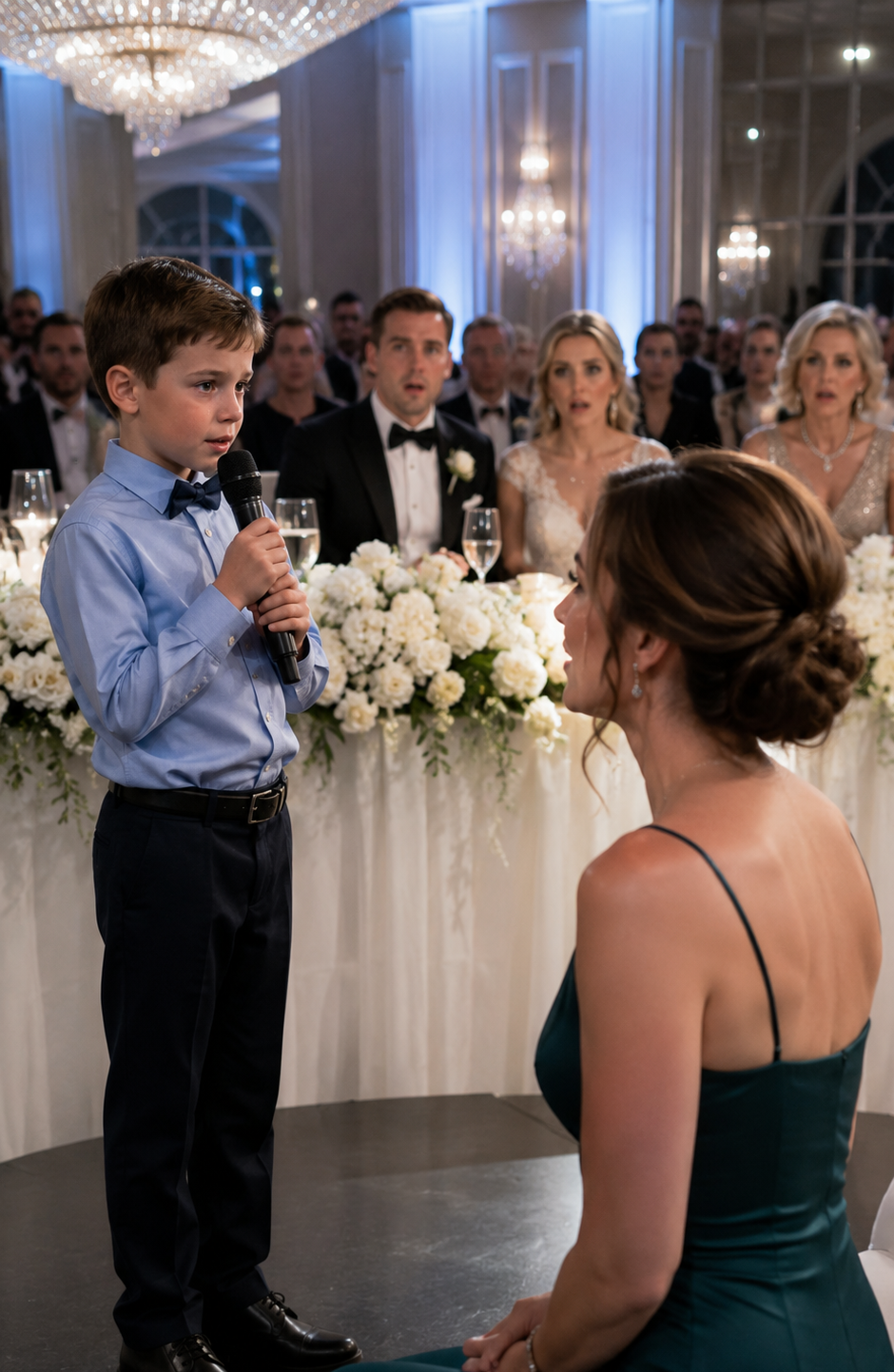
I sat frozen while the entire wedding reception laughed at me.
My brother’s bride had just called me “a sad single mother,” and before I could even breathe, my own mother smiled from the head table and said I was “a clearance item with a torn tag.” Then my nine-year-old son pushed back his chair, walked toward the stage, and reached for the microphone.
For one second, I forgot how to move.
The ballroom was still glittering around me like nothing cruel had happened.
Crystal chandeliers sparkled above the white roses.
Champagne glasses caught the candlelight.
The band near the far wall kept their instruments lowered, waiting to see whether this was part of the entertainment or the beginning of a family disaster.
I was sitting at table twelve, exactly where Tiffany Monroe had placed me.
Not near the family table.
Not near my brother Caleb.
Not even close enough to pretend I belonged.
When the usher first led Ethan and me there, I had smiled like it did not hurt.
I told myself it was fine.
I told myself weddings were stressful.
I told myself Caleb had probably forgotten to check the seating chart.
But then I noticed the card in front of my chair.
GRACE PARKER + CHILD
Not Grace and Ethan.
Not Aunt Grace.
Not family.
Just me, reduced to a problem with an attachment.
Ethan had looked at the card quietly.
His small fingers touched the black ink, and he whispered, “Mom, why didn’t they write my name?”
I had swallowed the ache in my throat and said, “Maybe they ran out of space, sweetheart.”
But I knew.
I knew before the speeches even started.
Tiffany had always looked at me like I was a warning label.
The older sister-in-law who came without a husband.
The woman who carried her own groceries, paid her own bills, and showed up to family holidays with a little boy who asked too many honest questions.
She never said she hated me.
She was too polished for that.
She smiled.
She complimented my dress.
She touched my arm with manicured fingers and said things like, “Grace, you are so brave to come alone.”
As if being single was a public illness.
As if motherhood without a ring made me something people should pity from a distance.
Caleb used to defend me.
That was the part that hurt the most.
When we were children, he once punched a boy at school for calling me unwanted.
He stood in front of me with a bleeding lip and said, “Nobody talks to my sister like that.”
But that night, at his wedding reception, he sat beside Tiffany at the head table with a champagne glass in his hand and let the entire room laugh.
The first speech had been sweet enough.
Tiffany’s father toasted wealth, legacy, and “joining two respectable families.” Caleb smiled stiffly.
My mother dabbed her eyes with a napkin like this was the proudest day of her life.
Then Tiffany took the microphone.
The room applauded.
She looked beautiful, I will give her that.
White lace gown.
Diamond earrings.
Perfect blonde hair pinned into a bridal updo.
She looked like the kind of woman a family would rearrange itself around.
She laughed softly into the microphone.
“I just want to thank everyone who came tonight,” she said.
“Especially those who came even though love has not exactly been kind to them.”
A few guests chuckled.
I felt Ethan shift beside me.
I kept my eyes on my plate.
Tiffany’s gaze found me anyway.
“And of course, we have my new sister-in-law, Grace Parker,” she said, her smile widening.
“A sad single mother who still believes showing up alone counts as confidence.”
The room exploded.
It was not just a few uncomfortable laughs.
It was loud.
Open.
Hungry.
The kind of laughter that tells you people were waiting for permission.
My stomach dropped so sharply I thought I might be sick.
I looked at Caleb.
Just one look.
I did not need a speech.
I did not need him to cause a scene.
I only needed his face to change.
It did not.
He stared into his champagne glass with that tight, polished smile men use when they want cruelty to pass as humor.
I whispered his name without sound.
Caleb.
Please.
But he did not look at me.
Then my mother leaned toward her own microphone at the head table.
She had not been asked to speak.
She did anyway.
“Well,” she said, lifting her voice just enough to slice through the laughter, “Grace has always been like a clearance item with a torn tag.
Still on the shelf, but nobody wants the trouble.”
My fork slipped from my hand and struck the plate.
The sound was small, but to me it felt like something breaking inside my chest.
For a moment, I was no longer thirty-two years old in a wedding ballroom.
I was eight again, standing in the kitchen while my mother told Caleb he was the easy child and told me I was dramatic.
I was sixteen again, getting accepted into a college she said I could not afford.
I was twenty-three, pregnant and abandoned, hearing her say, “You always did make poor choices.”
But this time, Ethan heard it.
That was the difference.
That was the wound no one else in the room seemed to understand.
I could survive my mother humiliating me.
I had been surviving her my entire life.
But my son?
My sweet boy in his best blue shirt?
He had spent twenty minutes combing his own hair before we left the house because he wanted Uncle Caleb to think he looked grown-up.
He had asked if weddings always had dancing.
He had asked if maybe Caleb would dance with him after dinner because, in his words, “I miss having men in the family who smile at me.”
And now he was sitting beside me, completely still.
Too still.
I reached under the table and touched his knee.
“Sweetheart,” I whispered, “look at me.”
He did not.
His eyes were fixed on the stage.
Tiffany was laughing with the guests, one hand pressed delicately against her chest, as if she had just delivered the funniest line of the night.
My mother looked pleased with herself.
Caleb finally glanced in my direction, but only for half a second.
There was no apology in his face.
Only warning.
Do not make this difficult.
That look almost made me stand.
But then Tiffany lifted the microphone again.
“Oh, don’t look so serious, Grace,” she said.
“It’s just a joke.”
My lips parted, but nothing came out.
My mother added, “If she could take a joke, maybe she wouldn’t be single.”
More laughter.
A man at the next table coughed into his napkin, trying to hide a smile.
A bridesmaid leaned toward another bridesmaid and whispered something behind her hand.
Someone’s phone was lifted halfway, like they were deciding whether my humiliation was worth recording.
I looked down at my hands.
They were shaking.
I pressed them into my lap and told myself not to cry.
Crying would become part of their joke.
Crying would give them a second speech, a second punchline, a second reason to say I was too sensitive.
Then I heard Ethan’s chair scrape against the floor.
It was not loud.
But somehow the sound cut through the entire ballroom.
I turned so quickly my breath caught.
“Ethan,” I whispered.
He stood beside me, his small shoulders stiff, his face pale in the chandelier light.
“Ethan, sit down,” I said softly.
“Please.”
He did not look at me.
For the first time in his life, my son ignored my voice.
He stepped away from the table.
A woman nearby stopped laughing.
Then another.
Then another.
The silence did not fall all at once.
It moved through the room slowly, table by table, as people noticed the little boy walking alone toward the stage.
His shoes tapped against the marble floor.
Tap.
Tap.
Tap.
Every step made my heart beat harder.
I wanted to run after him.
I wanted to pull him back into my arms and protect him from all those glittering strangers, from Tiffany’s perfect smile, from my mother’s poison, from Caleb’s cowardice.
But something in Ethan’s face stopped me.
It was not rage.
It was worse.
It was understanding.
He had understood something that night no child should ever have to understand: that adults can dress cruelty in diamonds and call it a joke.
Tiffany lowered the microphone as he approached.
Her smile faltered.
“Honey,” she said, still trying to sound sweet, “what are you doing?”
Ethan climbed the two small steps onto the stage.
The ballroom went completely quiet.
Even the band stopped shifting in their chairs.
Caleb finally sat up straight.
My mother’s smile disappeared.
For one terrible second, nobody moved.
Ethan held out his hand toward Tiffany.
“I need that,” he said.
There were a few nervous chuckles from the back of the room, but they died quickly.
Tiffany looked at Caleb, as if asking permission to refuse a child in front of two hundred guesTS.
Caleb did nothing.
He only stared.
So Tiffany handed my son the microphone.
And that was when the room changed.
Not visibly.
Not yet.
But I felt it.
The air tightened.
The candles flickered.
The same guests who had laughed at me seconds earlier now leaned forward, suddenly uncomfortable with the idea that the joke might answer back.
Ethan turned toward the reception.
He looked so small under the chandeliers.
His blue shirt sleeves were a little too long.
His hair had fallen slightly out of place.
Both of his hands wrapped around the microphone because one hand was not enough to keep it steady.
But when he spoke, his voice did not shake.
“My mom is not a clearance item.”
No one breathed.
My hand flew to my mouth.
Tiffany’s face went blank.
Caleb’s champagne glass froze halfway between the table and his lips.
Ethan looked across the room, not at Tiffany, not at my mother, not at the guests, but at me.
His eyes were shiny now, but he did not cry.
He just stood there, a nine-year-old boy in front of a room full of adults, holding the kind of courage they had all misplaced.
Then he said the sentence that broke me.
“She is the only person here who never made me feel unwanted.”
A sound escaped me before I could stop it.
Not a sob.
Not a word.
Just pain.
The kind that has lived quietly inside you for years and suddenly hears its own name.
My mother’s face tightened.
Tiffany swallowed.
Caleb looked down at the table like the marble floor had become more interesting than his own nephew.
But Ethan was not finished.
That was when I noticed something in his other hand.
A folded piece of paper.
Small.
Cream-colored.
The same thick paper as the wedding place cards.
My heart began to pound.
Because I recognized the edge of it.
It was not from our table.
It was from the head table.
Ethan unfolded it slowly in front of everyone, and my brother’s face turned white.
On the paper, written in Tiffany’s neat bridal handwriting, were three lines I could see even from where I sat.
Mention Grace.
Make it funny.
Caleb says she won’t fight back.
Ethan lifted the microphone closer to his mouth.
Then he looked straight at my brother and said, “Uncle Caleb… why did you tell them my mom wouldn’t fight back?”
PART 2
The silence after Ethan’s question was so complete that I could hear the faint hum of the chandeliers.
Caleb’s face lost all color.
Tiffany stared at the paper as though Ethan had placed something dangerous in her hands.
My mother pushed back her chair, but I was already moving.
I crossed the ballroom, climbed the stage, and placed one hand on my son’s shoulder.
Only then did I feel how badly he was trembling.
“Ethan,” I whispered, “you did enough.”
He looked at me with wet, determined eyes.
“I didn’t want them to keep laughing.”
“I know.”
I took the microphone, crouched in front of him, and straightened the collar of his blue shirt.
He should have been thinking about cake and dancing.
He should not have been protecting his mother from a room full of adulTS.
“Where did you find the note?” I asked.
“Under Uncle Caleb’s chair.
I went up before dinner because I wanted to ask if he would dance with me.
It fell when Aunt Tiffany moved her purse.”
A murmur spread through the ballroom.
Tiffany reached for the paper.
“Give me that.
This is ridiculous.”
I moved Ethan behind me.
“No.”
It was only one word, but it startled the room.
Maybe because my family had rarely heard me say it.
My mother stepped onto the stage.
“Grace, hand me the microphone.
You are turning a joke into a spectacle.”
I looked at her.
“No, Mom.
You turned my life into a joke.
Ethan asked why.”
Her lips tightened.
“This is Caleb’s wedding.”
“I know exactly whose wedding it is.”
Caleb finally stood.
“Grace, can we talk privately?”
Privately was where apologies disappeared.
Privately was where my mother said I had misunderstood and Caleb promised to make things right before doing nothing.
“You told her I wouldn’t fight back,” I said.
“Did you know about the speech?”
His eyes flicked toward Tiffany.
That was answer enough, but I waited.
“She asked if you would be upset,” he admitted.
“I said you probably wouldn’t say anything.”
The pain in my chest became cold and clear.
Tiffany lifted her chin.
“Because everyone knows you act like a victim.
It was supposed to loosen up the room.
People make jokes at weddings.”
“About the bride and groom,” an older woman called from the back.
Tiffany’s father, Robert Monroe, rose.
“My daughter does not need to defend harmless humor at her own reception.”
Ethan stepped out from behind me.
“Then why did she write it down like a plan?”
Robert frowned.
“Young man, return to your seat.”
“No,” I said.
“You will not order my son around after your family used his mother as entertainment.”
Caleb rubbed both hands over his face.
“Grace, I made a mistake.”
“A mistake is forgetting my invitation.
This was a decision.
You knew she planned to hurt me, and you helped her decide I was safe to hurt.”
“I was trying to keep everyone happy.”
“You kept everyone happy by choosing the one person you thought would stay quiet.”
My mother grabbed my arm.
“You are being dramatic.”
Ethan flinched.
I removed her hand from me, finger by finger.
“Do not touch me.”
Her eyes widened.
“After everything I have done for you?”
The old reflex rose inside me: explain, apologize, make her comfortable.
For once, I let it pass.
“What have you done for me, Mom?”
She had no answer.
 Teen Tries To Leave After Parents Threaten To Kick Her Out, Then Gets Blamed For “Causing Drama”
So I gave the room one.
“When Dad died, I handled the bills because you said numbers made you anxious.
I paid the overdue property taxes.
I replaced your furnace.
When Caleb needed his final tuition payment, I covered it.
When the bank refused his business loan, I guaranteed it.”
Caleb’s head snapped up.
“Grace,” he said quietly.
“No.
They should know.”
I looked at the guesTS.
“I did all of that while raising Ethan alone, working full-time, and taking bookkeeping jobs at night.
I never mentioned it because I believed love did not keep score.
Apparently my silence convinced my family I had no value.”
My mother’s face reddened.
“Money does not buy respect.”
“No.
But accepting someone’s help while teaching a ballroom to despise her says something about yours.”
Tiffany folded her arms.
“So this is what you wanted? To hijack my wedding and brag?”
“I came because my brother was getting married.
You were the one who decided the evening needed a public execution.”
I raised the note.
“Mention Grace.
Make it funny.
Caleb says she won’t fight back.”
A bridesmaid near the stage began to cry.
“Marissa, don’t,” Tiffany warned.
Marissa shook her head.
“I told you not to do it.
She wrote it in the bridal suite.
She practiced the clearance line with Mrs. Parker before the ceremony.
They were laughing about where Grace was seated.”
My mother went still.
I turned toward her.
“You practiced it?”
She looked away.
That hurt more than the joke.
A cruel impulse could be blamed on champagne or stupidity.
Practiced cruelty had been polished and timed.
Ethan squeezed my hand.
“Mom, can we go home?”
Those words decided everything.
I handed the microphone to the bandleader, then stopped at the edge of the stage.
“My son should never have needed to defend me tonight,” I said.
“Every adult who laughed taught him that humiliation is acceptable when the room is beautiful enough and the joke is delivered with a smile.
I hope you remember what he taught you in return.”
For a moment, no one moved.
Then Tiffany’s great-aunt stood and began to clap.
It was slow, deliberate, and uncomfortable.
One by one, others joined her.
Some looked ashamed.
Some looked furious.
Soon the applause filled the ballroom, but it did not feel like victory.
It felt like a verdict.
“This is my wedding!” Tiffany shouted.
Ethan looked at her.
“Was it ruined when you laughed at my mom, or when I made you stop?”
Tiffany had no answer.
I led him down from the stage, collected my purse, and walked toward the doors.
At table twelve, I picked up the place card.
GRACE PARKER + CHILD.
I folded it once and placed it beside the wedding gift I would never give them.
Outside, Ethan made it halfway down the hotel steps before he began to cry.
I held him beneath the entrance lights while cars passed and the silent ballroom glittered behind us.
“I’m sorry,” he sobbed.
“You said not to make trouble.”
“You did not make trouble.
You told the truth.”
“Are they going to hate me?”
I cupped his face.
“People who punish you for telling the truth are afraid of it.
That does not mean you did anything wrong.”
The doors opened.
Caleb came outside alone, his bow tie loose and his face older than it had been an hour earlier.
“I need to apologize,” he said.
“Not tonight.”
“Please.”
“Your nephew just asked why you did not help me.
I do not have an answer that will make you look like the man he thought you were.”
Caleb looked at Ethan.
“I was a coward.
I was afraid Tiffany would be angry and Mom would say I was choosing sides.”
“You did choose a side,” I said.
“You hoped I would be polite enough not to name it.”
Tiffany stormed outside, lifting the front of her gown.
“Caleb, get back inside.
Our first dance is in five minutes.”
He did not move.
She pointed at me.
“You have done enough.”
I reached into my purse and removed the cream envelope I had carried all evening.
Inside was a letter forgiving the remaining thirty-two thousand dollars Caleb owed me from the loan I had guaranteed.
I had planned to tell him marriage should begin without old debts between siblings.
I tore the envelope in half.
Caleb closed his eyes.
“I am not calling the loan tomorrow,” I said.
“But I am done confusing love with rescuing people who hand me the bill for my own humiliation.
The repayment schedule resumes next month.”
Tiffany stared at him.
“You owe her thirty-two thousand dollars?”
Her expression told me there were many things about my brother’s life she had never bothered to learn.
I turned away.
“Grace,” Caleb called.
I looked back once.
“You do not get forgiveness because the room turned against you.
You earn it by becoming different after everyone goes home.”
Then Ethan and I left my brother standing beneath the hotel lights in his wedding suit.
PART 3
The video reached me before we arrived home.
A guest had recorded Ethan walking toward the stage.
By midnight, a short clip had been posted online with a caption praising the little boy who defended his single mother.
I watched it once.
Seeing him beneath those chandeliers made me sick.
Strangers praised his courage, but I was furious that he had needed courage at all.
I contacted the woman who posted it and asked her to remove Ethan’s face and name.
She apologized and deleted the original, though copies had already spread.
My phone filled with messages.
Some guests apologized.
Marissa sent me a photograph of the note and confirmed that Tiffany and my mother had rehearsed the jokes.
Then the family group chat came alive.
My mother wrote:
You humiliated your brother on the most important night of his life.
Tiffany added:
You trained your child to create a scene for attention.
A cousin said everyone had been drinking.
An aunt suggested I apologize for tearing up the gift.
Nobody asked whether Ethan had slept.
I typed one response.
I will not discuss this in a group where cruelty is called humor and accountability is called drama.
Do not contact Ethan or share his image.
I will decide when further contact is appropriate.
Then I left the chat.
At breakfast, Ethan pushed cereal around his bowl.
“Are we still family?” he asked.
“Yes,” I said.
“But family does not mean people can hurt you and keep coming back without changing.”
“Will we see Grandma?”
“Not for a while.”
“Uncle Caleb?”
“I don’t know yet.”
It hurt him, but it was honest.
The following Monday, I canceled the automatic payments that covered part of my mother’s mortgage and property taxes.
I gave her thirty days to adjust.
I also emailed Caleb the original loan agreement and a repayment schedule.
My mother called within minutes.
“So this is revenge.”
“No.
This is the end of an arrangement that taught you I had to pay for the right to be tolerated.”
“You cannot abandon your mother.”
“I am choosing boundaries.”
She cried, then told me I had always been difficult.
She said Caleb needed more help because he had greater potential, while I had always been capable.
That sentence explained my childhood.
Caleb had been loved because he needed protecting.
I had been used because I survived without it.
“I was a child,” I said.
“Being capable did not mean I needed less love.”
For one second, she was silent.
Then she said, “You always twist everything.”
I ended the call.
Caleb came to my apartment three days later.
I agreed to see him only while Ethan was at school.
He looked exhausted and held the torn halves of my envelope.
“Tiffany canceled the honeymoon,” he said.
“She says I betrayed her by not forcing you to apologize.”
“That is between you and Tiffany.”
He sat at my kitchen table and stared at the torn paper.
“I didn’t know you planned to forgive the loan.”
“That was the gift.”
“I don’t deserve it.”
“No.”
He flinched, but I did not soften the truth.
“Did you know Mom and Tiffany practiced the jokes?”
“Not the exact lines.
I knew you would be mentioned.”
“Why?”
“Tiffany thinks you judge her.
She says the way you live makes her feel as if you are proving you don’t need anyone.”
“Did I ever say that?”
“No.”
“Then she punished me for a conversation she invented, and you helped.”
He nodded.
“What about Mom?”
“She wanted Tiffany’s family to think we were respectable.”
“So the unmarried daughter and her nameless child were offered as proof that the rest of you knew the difference.”
“I am sorry.”
“I believe you feel sorry.
That is not the same as being different.”
“Tell me what to do.”
For years, that question would have pulled me into action.
I would have written the apology, designed the plan, and managed the consequences.
This time, I shook my head
“You are thirty years old.
Figure out what integrity requires when nobody is guiding you.”
He left without asking me to forgive him.
Two weeks later, every wedding guest received an email from Caleb.
He blamed no one but himself.
He admitted that he knew I would be mocked, allowed it because he feared conflict, and stayed silent while a child did what he should have done.
He asked everyone to stop sharing Ethan’s image.
He sent me a copy but did not ask whether it was enough.
It was not enough.
But it was a beginning.
He also made the first loan payment without being reminded.
Tiffany posted a statement online claiming she had been bullied at her own wedding.
She called the note harmless brainstorming and Ethan’s speech an ambush.
Marissa publicly confirmed that the jokes had been rehearsed, and several guests supported her.
Tiffany deleted the statement by the next morning.
My mother sent cards addressed to Ethan.
I returned them unopened because each said, Grandma misses you, and none said, Grandma hurt you.
Six weeks later, Caleb asked permission to write Ethan a letter.
It began:
I failed your mother, and I failed you.
You should never have had to be the bravest man in the room.
He did not ask for forgiveness.
He named what he had done and promised that if Ethan ever allowed him back into his life, he would never stay silent again.
Ethan read it twice.
“Can I see him?”
We met Caleb at a park.
He brought no gifts, which told me he had begun to understand.
After kicking a soccer ball for several minutes, Ethan asked, “Why were you scared of Aunt Tiffany?”
Caleb swallowed.
“Because I wanted her to love me more than I wanted to act like someone worthy of love.”
“Mom says being scared explains things, but it doesn’t excuse them.”
“She is right.”
“Are you still married?”
“For now.
We are living apart.”
“Because of us?”
“No.
Because the wedding showed me what I had been pretending not to see.”
Ethan rolled the ball beneath his shoe.
“Next time,” he said, “be brave before someone smaller has to do it for you.”
Caleb nodded with tears in his eyes.
That afternoon did not repair everything.
Real repair is slower than a dramatic apology.
Caleb attended counseling, continued making payments, stopped carrying messages from our mother, and kept telling the truth even when Tiffany demanded that he defend her version of the wedding.
Their marriage ended before their first anniversary.
I did not celebrate.
Tiffany’s unhappiness did not heal mine.
The only consequence that mattered was that Caleb finally understood that peace purchased with another person’s dignity is not peace.
Eight months after the wedding, my mother appeared outside my apartment.
“I have lost my son, my daughter, and my grandson,” she said.
“You did not lose us.
You chose contempt and expected access to survive it.”
“I said one stupid thing.”
“You practiced it.”
Her face changed.
For the first time, she knew I knew everything.
“I wanted Tiffany’s family to like me,” she whispered.
“And you offered me as the price.”
Tears filled her eyes.
“What do you want me to say?”
“The truth.”
She stood in the hallway for a long time.
Then she said, “Your independence made me feel unnecessary.
I praised Caleb for needing me and punished you for surviving me.
At the wedding, I was afraid people would look down on our family, so I gave them you to look down on instead.”
It was the first real apology she had ever given me.
It did not erase the ballroom or restore Ethan’s innocence.
But I heard it.
“I forgive you for my own peace,” I said.
“That does not mean you are ready to be in Ethan’s life.”
She nodded.
“What happens now?”
“Now you respect the boundary without making me comfort you for it.
Your actions will tell me whether the apology was real.”
She left without coming inside.
A year after the wedding, I turned thirty-three.
Ethan organized a birthday dinner in our apartment with two friends, three mismatched balloons, and a chocolate cake that leaned to the left.
Caleb came early to set the table.
He was not the brother I remembered from childhood, but he was becoming someone I could know as an adult.
My mother was not there.
Maybe someday she would be.
Maybe not.
I had stopped measuring healing by whether the family photograph looked complete.
After dinner, Ethan handed me a cream-colored card.
For one second, the paper took me back to table twelve and the words GRACE PARKER + CHILD.
Then I opened it.
On the front, in his careful handwriting, he had written:
MY MOM: NOT CLEARANCE.
NOT DAMAGED.
PRICELESS.
Inside, he had added:
You always made me feel wanted too.
I cried before I reached the second line.
Ethan wrapped his arms around me.
Caleb looked away, wiping his eyes.
Around us were ordinary plates, cheap candles, and the kind of love that did not require anyone to become smaller so someone else could feel important.
For most of my life, I thought fighting back meant shouting louder than the people who hurt me.
I was wrong.
Sometimes fighting back is taking the microphone.
Sometimes it is tearing up the gift.
Sometimes it is ending the payment, closing the door, or refusing to call cruelty a joke.
And sometimes it is a nine-year-old boy standing beneath a chandelier, reminding an entire room that the woman they treated as unwanted was the only person who had never made him feel that way.