
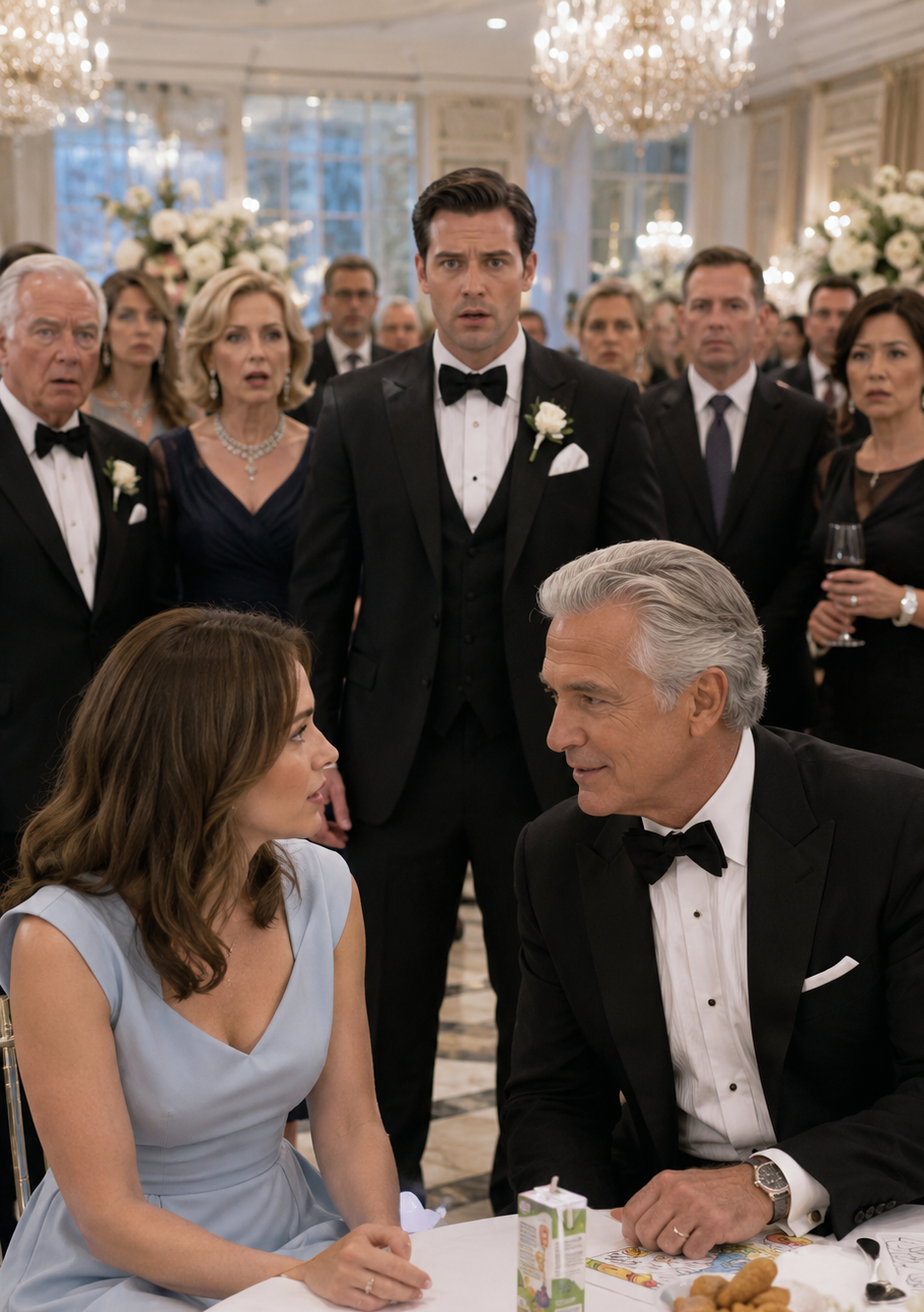
My brother seated me beside preschoolers to humiliate me at his elegant wedding, convinced I had no place among the executives and billionaires he wanted to impress.
Minutes later, the most powerful man in the ballroom walked past every VIP, sat beside me, and exposed the secret career my family had mocked for years.
Only minutes before the ceremony at a luxurious Vermont estate, Nicholas pulled me aside near the ballroom entrance.
He wasn’t smiling as he adjusted his custom tuxedo in an enormous gold-framed mirror.
“Don’t stand here, Jenna,” he said.
“This is where the guests who actually matter will be arriving.”
The words cut deeper than I expected.
In my arms was the Italian espresso machine I had bought as his wedding gift, even though it had cost nearly two months of rent.
Around us, crystal chandeliers glittered above white roses while executives, investors, and entrepreneurs drifted through the room wearing polished smiles and watches worth more than my car.
Nicholas had always worshiped that world.
Even as a child, he treated every conversation like an audition for status.
“What are you doing here?” he asked.
“I came to your wedding,” I replied, hoping he was joking.
“No.
I mean here, by the entrance.
You’ll ruin the photographs.”
I looked down at the pale blue dress he had personally chosen for me.
Even my hairstyle and lipstick matched the colors he requested.
“I’m your sister.”
“That’s why I found you another seat.”
He unfolded the seating chart and pointed toward the farthest corner of the ballroom.
Table Nineteen.
Beside the kitchen.
The children’s table.
“Nicholas, that’s where the kids are sitting.”
“Great-Aunt Beatrice is there too,” he said dismissively.
“You’ll be fine.”
“With preschoolers?”
His face turned cold.
“You don’t belong in this atmosphere, Jenna.
People here build businesses and valuable relationships.
Your little blog doesn’t fit into this world.”
My throat tightened.
“I work hard.”
He laughed.
“That blog isn’t a real career.
Just sit at Table Nineteen, smile, and don’t embarrass me.”
Then he leaned closer.
“And don’t even think about speaking to Emmett Stewart.
He’s far beyond your league.”
Nicholas walked away before I could answer, greeting executives as if he already belonged among them.
What he didn’t know was almost funny.
Emmett Stewart wasn’t simply the billionaire CEO he had spent years trying to impress.
He was one of my largest clienTS.
The keynote speech that had gone viral at a global technology conference the previous week—the speech credited with restoring investor confidence and sending his company’s stock soaring—had been written by me at two in the morning while wearing old sweatpants and eating instant noodles.
Strict confidentiality agreements protected every project I accepted.
No one knew.
Especially not my family.
To them, I was still the quiet sister who “wrote little things online.”
So I walked to Table Nineteen.
Plastic cups covered the table.
Crayons were scattered beside cold chicken nuggets, a toddler was crying, and three boys were loudly debating whether a dinosaur could outrun a semi-truck.
Great-Aunt Beatrice was already asleep.
A little boy with a crooked bow tie looked up at me.
“I like your dress.”
“Thank you.”
“I like monsters and trucks.”
“So do I.”
Before long, I was opening juice boxes, wiping ketchup from tiny fingers, and drawing fire-breathing dragons.
Somehow, our forgotten corner became the happiest table in the ballroom.
The nanny beside me smiled.
“Looks like they exiled you too.”
 She Loves Her Boyfriend, But His Plan For His Sister Made Her Walk Away Before The Wedding
“I guess I didn’t make the important guest list.”
“At least nobody over here is pretending to be someone they aren’t.”
Across the room, Nicholas laughed with investors while our parents proudly introduced him to anyone they considered influential.
None of them had ever asked what I actually did.
Then the music softened.
Every conversation stopped as Emmett Stewart entered the ballroom.
Executives immediately stepped forward, eager to greet him, but he ignored them.
His eyes searched the room until they found me.
A wide smile crossed his face.
Without hesitation, he walked past the VIP tables, past my stunned parents, and directly past Nicholas.
Then he pulled out the empty chair beside me.
“Jenna,” he said loudly enough for the entire ballroom to hear, “I’ve been searching everywhere for the brilliant writer who saved my company last week.”
The room went silent.
Nicholas stared at me as though the sister he had spent years belittling had suddenly become a stranger.
Then Emmett turned toward him and asked one question that made every smile disappear.
“Why was the most valuable person in this room seated at the children’s table?”
PART 2
Nicholas opened his mouth, but no answer came.
Across the ballroom, my parents stood frozen beneath the chandeliers as every executive nearby turned to look at them.
Emmett calmly sat beside me and accepted a crayon from the little boy with the crooked bow tie.
“I believe this is the dragon table,” he said.
The children immediately approved of him.
Nicholas forced a laugh and stepped closer.
“There’s been a misunderstanding.”
“No,” I said quietly.
“There hasn’t.”
His face tightened.
Emmett leaned back in his chair.
“Jenna wrote the speech that saved our merger.”
“She also created the investor letter that prevented three major firms from withdrawing.”
A murmur spread across the room.
My father stared at me.
“You never told us.”
“You never asked.”
The truth landed harder than any accusation.
Nicholas lowered his voice.
“You could have said something before today.”
“And you could have treated me with respect before knowing I was useful.”
His bride, Caroline, appeared beside him, her expression filled with confusion.
“You told me Jenna was unemployed.”
“I said her work wasn’t serious.”
Emmett’s smile vanished.
“Her work generated more value for my company last quarter than most senior executives produce in a year.”
Nicholas looked around and realized the people he wanted to impress were no longer admiring him.
They were judging him.
Then Emmett placed a slim black folder on the table.
“I came here for more than the wedding.”
He opened it and slid a contract toward me.
Inside was an offer to become Chief Narrative Officer for Stewart Global, complete with a salary large enough to change my life.
My mother gasped when she saw the number.
Nicholas reached for the folder.
Emmett closed it before he could touch it.
“This offer belongs to the woman you seated beside the preschoolers.”
I looked at the children around me, then at the brother who had spent years making me feel small.
“I’ll review it after dessert.”
The little boy beside me raised his juice box.
“To dragons.”
I smiled and lifted mine.
“To being underestimated.”
Then Caroline quietly pulled me aside and revealed the real reason Nicholas had insisted I stay away from Emmett.
My brother had stolen one of my confidential speeches and submitted it under his own name.
PART 3
Caroline’s words hung in the air between us like smoke that wouldn’t clear.
“Stolen? What speech?”
“The one about resilience in leadership,” she said, glancing nervously toward her new husband.
“The one that got him invited to speak at the Chamber of Commerce dinner last spring.
He told everyone he wrote it in a hotel room the night before.
I found the original file on his laptop by accident — the metadata said it was created months earlier, under a different name.
Yours.”
I felt something settle inside me, cold and clear.
It wasn’t surprise.
It was confirmation of a suspicion I’d never let myself fully examine.
“He’s done this before,” I said quietly.
“I just never had proof.”
Emmett, who had been listening without pretending not to, closed the folder in front of him and looked at Nicholas with the particular stillness of a man recalculating everything he thought he knew.
“The resilience speech,” Emmett said.
“I remember it.
Marcus Feld quoted a line from it at our board retreat.
Something about how the strongest structures aren’t the ones that never bend.”
“I wrote that in this same dress’s closet,” I said.
“At the little desk my parents gave me when I moved out, because they didn’t want it cluttering their guest room.”
Nicholas’s jaw worked, but nothing came out.
For the first time in his life, he had no room full of people to perform for.
The room was watching, but it wasn’t admiring him anymore — and a man who has built his entire identity on being watched has no idea what to do when the watching turns to something else.
“I can explain,” he finally said.
“You don’t need to explain to me,” I said.
“You need to explain to the Chamber of Commerce.
And possibly to a lawyer.”
My mother made a small, wounded sound.
My father said nothing at all, which was, in its own way, the loudest thing he’d ever said to me.
Emmett stood, buttoning his jacket with the unhurried calm of a man who had already decided how the evening would end.
“Jenna,” he said, “I’d still like an answer on that contract.
But I understand if tonight isn’t the night.”
“Tonight is exactly the night,” I said.
“I’ll sign it before we leave.”
He smiled — the real one, not the one he used for cameras — and extended a hand to help me up from the child-sized chair I’d been folded into for the better part of an hour.
The little boy in the crooked bow tie tugged my sleeve.
“Are you leaving the dragon table?”
“Only the table,” I said.
“Not the dragons.”
He seemed to accept this as sufficient.
Epilogue
I didn’t stay for the cake.
I signed the contract in the estate’s library, at a mahogany desk older than my brother’s entire understanding of who I was, while my parents hovered in the doorway trying to find words that wouldn’t come easily to people who’d spent thirty years not asking.
Caroline filed for an annulment four months later, once the plagiarism allegations became too public to manage quietly.
The Chamber of Commerce rescinded Nicholas’s speaking invitation and, more damaging to a man like him, so did everyone else who had once fought for his attention.
Status, it turns out, is a loan, not an inheritance — and his creditors called it in fast.
I became Chief Narrative Officer for Stewart Global three weeks later.
My first act was insisting my name go on my own work, in writing, in every contract, from then on.
My parents call more often now.
I let them.
Not because the money changed anything about who I am, but because it finally made them curious enough to ask — and I decided that was worth answering, even a little late.
As for Table Nineteen — I still think about it sometimes.
Not with bitterness.
With something closer to gratitude.
Nobody at that table ever once asked if I belonged there.
They just handed me a crayon and made room.