
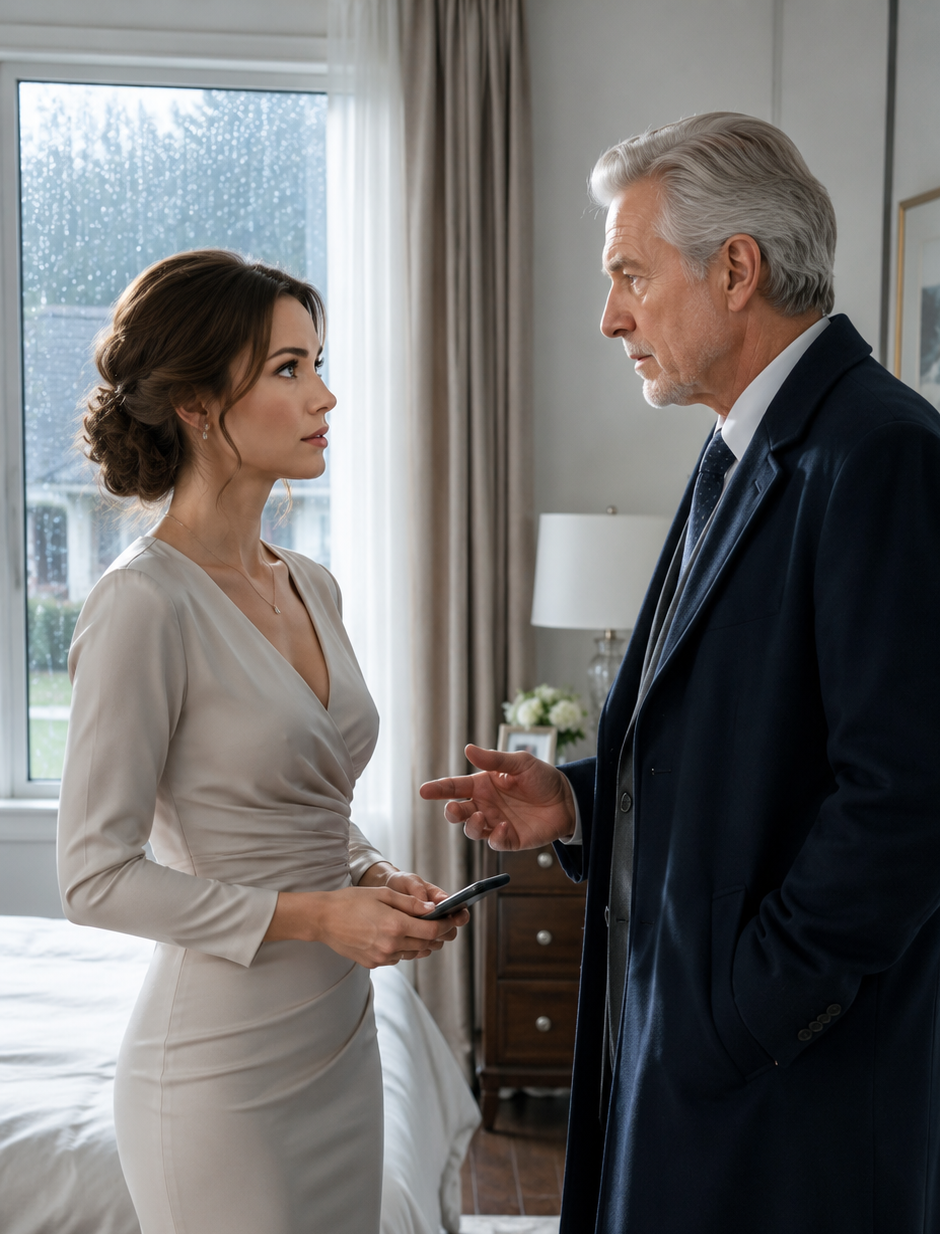
The Concealer Never Touched My Skin — He Never Expected Who’d Be Sitting There
The makeup bag landed beside my swollen face before the blood on my split lip had even finished drying.
“Mom’s coming for lunch,” Randy said through clenched teeth.
“Hide the bruises and smile.”
He stood over me in our bedroom, already dressed for work with polished cuff links and an expression so composed it almost made the previous night seem imaginary.
But the throbbing in my ribs was real.
The dark fingerprint-shaped bruise beneath my jaw was real too.
All because I had refused.
His mother, Eden, had decided we should sell my townhouse and move into her enormous colonial home “to save money.”
The truth was much simpler.
She wanted my paycheck covering her mortgage.
My hands cleaning her house.
And my silence protecting her precious son.
“I’m not living under your mother’s roof,” I had told Randy.
The first thing he did was slap me.
When I still refused, he shoved me into the dresser.
After I hit the floor, he kicked me.
Now he pointed toward the makeup bag.
“Use the green concealer.
It covers purple.”
At that moment, something inside me changed.
It didn’t break.
It simply turned cold.
Randy looked at my silence and assumed he had won.
He always made that mistake.
Leaning closer, the smell of fresh coffee still on his breath, he said, “At noon, you’ll serve lunch.
You’ll tell Mom you slipped in the bathroom.
Then we’ll talk about putting this place on the market.”
“This place belongs to me,” I said quietly.
His smile disappeared.
“Not much longer.”
At exactly 7:42 that morning, the front door slammed shut behind him.
One minute later…
I reached beneath the mattress and pulled out the second phone Randy had never known existed.
I had bought it three months earlier, after the first time he shoved me.
I worked as a senior forensic accountant for a federal contractor.
My job trained me to preserve evidence, trace financial fraud, and uncover transactions people believed nobody would ever find.
Fear had slowed me down.
Training never left.
I photographed every single bruise beside that day’s newspaper.
I downloaded the bedroom audio from our cloud-connected security system that Randy believed he had disabled weeks earlier.
Then I opened the encrypted folder named TAX RECEIPTS.
Inside were recordings of his threaTS.
Audio of Eden pressuring me to transfer ownership of the townhouse.
Bank records showing Randy had secretly borrowed money using my identity.
Messages between the two of them discussing ways to convince everyone I was “mentally unstable” if I refused to cooperate.
For months, I had quietly copied every forged document Randy brought home, every suspicious financial transfer, and every late-night conversation between him and his mother.
I just hadn’t known when I would finally be strong enough to use any of it.
That morning…
staying frightened became far more terrifying than leaving.
I dialed a number I hadn’t called in five years.
The call was answered before the third ring.
“Joanna?”
My throat tightened.
“Dad…
I need you.”
There was a brief silence.
Then came the one voice Randy feared more than any courtroom.
My father arrived at 9:18 a.m.
with a skilled family lawyer and a private security officer.
Retired Judge Anthony Wright had spent thirty years putting dangerous men behind bars.
He had not attended my wedding because Randy had convinced me my father was controlling.
I had believed Randy because abuse always starts by making you distrust the people who love you.
My father stopped walking when he saw the dark bruises on my face.
He did not scream, which made his quiet anger even more terrifying.
“Did he do this to you?”
Dad asked.
“Yes,” I whispered.
“Has he hurt you before?”
Dad asked softly.
I nodded my head as tears finally spilled over my cheeks.
My father closed his eyes for a moment before looking at me with pure determination.
“I am so sorry I let my pride keep us apart, but I am here now,” he said.
The attorney, Fiona Cole, photographed the rooms and carefully reviewed the digital files I prepared.
She confirmed that Randy’s secret loans were acts of identity theft and his forged signatures on the deed draft were felonies.
Furthermore, Eden’s text messages clearly proved they were working together.
The most damaging evidence came from a camera in the dining room.
Three nights ago, Randy and Eden had sat at the dining table drinking wine.
Fiona had already played the clip twice by the time my father sat down beside me on the couch that was no longer mine to sit on for much longer.
On the screen, Eden swirled her glass and said the words that would end up quoted in a filing two weeks later: “Once the house is in your name, we tell her she’s been imagining things.
Women like her always believe it eventually.
They want to believe it.”
Randy had laughed.
Not the tired laugh he gave me when I asked why he came home late.
A real one.
“She already thinks she’s crazy,” he’d said.
“I just have to keep reminding her.”
I had watched that footage standing in my own kitchen, in the clothes I’d slept in, with a bruise blooming under my jaw like a stormcloud, and I had felt something I hadn’t expected to feel.
Not rage.
Relief.
Because for two years I had wondered if I was inventing the coldness in his voice, exaggerating the way his hand would tighten on my arm, imagining that the accidents were never really accidenTS.
Here it was.
Not in my memory, where he could argue with it.
On a hard drive, where he couldn’t.
“How long do we have before he comes back?”
my father asked Fiona.
She checked her watch.
“Two hours, maybe less if traffic’s light.”
“Then we don’t waste them,” Dad said, and for the first time since I was nineteen, I heard the voice he used to use on the bench — flat, unhurried, absolutely certain.
The security officer, a broad-shouldered man named Priest who used to work protective detail, walked the perimeter of the house while Fiona spread three folders across the coffee table like a hand of cards.
Restraining order petition.
Emergency custody-of-assets motion, since the townhouse deed was solely in my name but Randy had used forged signatures to open two lines of credit against it.
And a third folder, thinner than the others, that she didn’t open yet.
“That one’s for the district attorney,” she said, when I asked.
“Identity theft against a spouse is still identity theft.
Assault with the injuries you’ve documented is a felony in this state, not a misdemeanor, given the pattern and the choking evidence in the audio.
We’re not just getting you out today, Joanna.
We’re building a case that ends with him in a cell, not just a courtroom.”
I thought I would cry again.
Instead I found myself asking a very practical question, the kind my job had trained into me.
“What about the money he already moved?
The two loans?”
“Frozen as of an hour ago,” Fiona said.
“I filed an emergency motion this morning based on the documentation you sent me last night.
A judge signed it by eight-thirty.
Your father made a call.”
I looked at my father.
He didn’t look up from the folder he was reading, but the corner of his mouth moved, just slightly.
It was the same look he used to give me across the dinner table when I brought home a report card he was proud of and too stubborn to praise out loud.
“You had a judge’s signature by eight-thirty,” I repeated.
“I had a friend’s signature by eight-thirty,” my father corrected.
“Judges don’t do favors.
Friends who happen to be judges review emergency petitions quickly when a woman’s life might depend on it.”
By ten o’clock, three things had happened that Randy did not yet know about.
The credit lines opened in my name were frozen pending a fraud investigation.
A restraining order was drafted and would be filed the moment the courthouse opened its afternoon docket.
And my suitcase — packed in eleven minutes by Priest’s wife, who had driven over without being asked because Fiona had called her — was already in the trunk of my father’s car, two streets away.
The only thing still in the bedroom was the untouched makeup bag, sitting exactly where Randy had thrown it that morning, the zipper still closed, the green concealer still capped.
I asked Fiona if we should hide it, get rid of any trace that I’d been told to cover my own face.
“No,” she said.
“Leave it exactly where it is.
Photograph it in place first.
Then leave it there.”
“Why?”
“Because when he walks in and sees it untouched, he’s going to know something’s wrong before he sees anything else.
And I want to watch his face when that happens.”
I didn’t understand yet what she meant.
I would, within two hours.
At 11:50, my father asked me to sit down.
Not because he wanted to comfort me.
Because he wanted to prepare me.
“When they walk through that door, Randy is going to try to control the room the way he always has,” he said.
“He is going to be charming for his mother, and cruel to you the second she isn’t looking, or cruel to you in a way disguised as concern while she’s looking.
He has done this before.
He will do it again in the next ten minutes unless something stops him.”
“What’s going to stop him?”
“You are,” my father said.
“Not with your fisTS.
With the truth, laid out so completely that he cannot lie his way around it in front of witnesses who matter.”
I thought of two years of small surrenders.
Agreeing dinner was cold because I’d microwaved it wrong, not because he’d come home ninety minutes late smelling like someone else’s perfume.
Agreeing I’d overreacted when he grabbed my wrist hard enough to bruise, because he apologized within the hour and apologies had once meant something to me.
Agreeing, eventually, that maybe I did imagine things, because it was easier to doubt myself than to accept that the man I married had planned, calmly and repeatedly, to hurt me.
“I don’t know if I can sit across from him and not fall apart,” I admitted.
My father took my hand.
His was warm, and steady, and had not touched mine in five years because I had let Randy convince me that love came with conditions attached, and one of those conditions was cutting off anyone who might see through him.
“You already did the hardest part,” he said.
“You called me.
Everything after this is just finishing what you started.”
At 11:57, we heard the car in the driveway.
Eden’s laugh arrived before she did — bright, performative, the laugh of a woman who had already decided how the afternoon would go and had never once considered that it might go differently.
The front door opened.
“Joanna, sweetheart, we brought—” Eden’s voice cut off mid-sentence.
Randy walked in one step behind her, keys still in hand, smiling the smile he wore for people who weren’t me.
And then both of them stopped.
PART 3
The living room did not look the way either of them expected.
My suitcase — which should have been zipped and waiting by the closet, ready for a move to Eden’s house neither of us had actually agreed to except in the fiction Randy had built for his mother — was gone.
In its place sat my father, in the leather armchair Randy usually claimed as his own, one leg crossed over the other, a manila folder resting closed on his knee like a man waiting for a hearing to start.
Fiona stood near the window, phone already recording.
Priest stood by the front door, arms folded, not blocking it exactly.
Just present.
Just enough.
And I sat on the couch.
Uncovered.
No concealer.
No green paste smoothed over the fingerprint bruise beneath my jaw.
My face exactly as Randy had left it that morning, in full daylight, for his mother to see.
“What,” Randy said slowly, “is going on here.”
It wasn’t a question.
It was the sound of a man recalculating in real time.
“Randy.”
Eden’s laugh had gone thin and confused.
“Who are these people?
Why does Joanna look—”
She saw my face properly then.
The bruise.
The split lip that hadn’t healed enough to hide, even without the makeup he’d told me to apply.
For one second — one single second I will remember for the rest of my life — Eden’s face showed something that might have been horror.
Then it closed, like a door.
“She’s clumsy,” Randy said quickly, the old script sliding out of him automatically.
“She fell in the bathroom this morning.
I told her to be more careful.
Mom, why don’t we—”
“That’s not what the recording says,” my father said.
He didn’t raise his voice.
He didn’t need to.
Thirty years on the bench teaches a man that volume is for people who don’t trust their evidence.
He opened the folder on his knee and turned it so it faced Randy and Eden.
On top sat a still photograph — timestamped, high resolution, taken from a camera Randy believed he had disabled — of himself standing over me in the bedroom that morning, hand raised.
Eden’s mouth opened.
Nothing came out.
“Where did you get that,” Randy said.
His voice had dropped the charm entirely now.
What was underneath it was colder, and far more familiar to me than the version he performed for other people.
“Your wife,” Fiona said, stepping forward, “has spent the last several months documenting a pattern of physical abuse, financial fraud, and coercive control.
That includes two lines of credit opened in her name without her knowledge or consent, using signatures that a forensic document examiner will testify were forged.
It includes an audio recording, three nights old, of you and your mother discussing a plan to convince Joanna’s friends and family that she is, in your words, ‘imagining things.'”
“You’ve been recording us?”
Eden’s voice cracked into something shrill.
“In our own home—”
“It’s her home,” my father said.
“The deed has one name on it.
It has always had one name on it.
That’s precisely why you needed her to sign it over voluntarily, isn’t it?
Because taking it any other way would have required exactly this.”
He gestured, once, at the folder.
Randy’s jaw worked.
I watched him run through his options the way I imagined he ran through spreadsheets at work — quickly, coldly, looking for the angle that cost him the least.
“Joanna.”
He turned to me, and for a moment his voice softened into the register he used to use early in our marriage, before I understood that softness from him was a tool, not a feeling.
“Baby, this is a misunderstanding.
You know I love you.
Whatever happened last night, I was stressed, I said I was sorry—”
“You didn’t say you were sorry,” I said.
“You handed me a makeup bag.”
The room went very quiet.
“You told me to hide it,” I continued, and my voice did not shake, which surprised me more than it surprised anyone else in the room.
“You told me to smile.
You didn’t ask if I was okay.
You asked if the concealer would cover purple.”
“Joanna—”

“I’m not finished.”
I don’t know where the steadiness came from.
Maybe it had been there the whole time, buried under two years of small surrenders, waiting for a day when I had enough evidence stacked up beside me that I no longer needed him to admit anything in order to know it was true.
“I’ve spent two years believing that if I just did everything right — if I never disagreed, never made you late, never embarrassed you in front of your mother — you’d stop.
I used to think the bruises were my fault for provoking you.
I don’t think that anymore.
I know exactly whose fault they are.”
Eden made a small, strangled sound.
“This is a family matter.
You don’t bring lawyers and — and judges — into a family matter—”
“You made it a legal matter,” my father said, “the moment you helped your son forge my daughter’s signature on a loan document.
That’s not a disagreement over Sunday dinner, Mrs.
Whitfield.
That’s a felony.”
“I never signed anything,” Eden said, too quickly.
“No,” Fiona agreed.
“You just told him how, and celebrated with wine once it was done.
We have that on camera too.”
Randy’s hands had curled into fists at his sides.
I recognized the posture — the same one that preceded the shove into the dresser, the same coiled stillness right before he decided violence was easier than losing an argument.
Priest shifted, almost imperceptibly, from the doorway.
Just enough to remind everyone in the room that this time, someone was watching who would not look away.
“You think a folder of pictures changes anything?”
Randy said, and his voice had lost the last of its performance now, gone flat and mean in the way I’d only ever heard behind closed doors.
“You think you can just — what, walk out?
You have no idea what I can do to you.
To your career.
I know people, Joanna.”
“I know people too,” my father said quietly.
“I spent thirty years learning exactly which people matter and which ones just think they do.
You’re the second kind.”
For the first time since he’d walked through the door, Randy looked less like a man in control of a room and more like a man realizing, slowly and with mounting panic, that the room had never actually been his.
“This is insane,” Eden said, grabbing at her son’s arm.
“Randy, we should go, we should call someone—”
“Call whoever you like,” Fiona said.
“The restraining order was filed twenty minutes ago.
It’s already active.
Randy, you are required to leave this residence immediately and are not permitted within five hundred feet of Joanna, her workplace, or this property.
If you remain past this conversation, the officer waiting outside” — she nodded toward the window, where a patrol car had, in fact, pulled quietly into the driveway sometime in the last ten minutes without any of us noticing — “will remove you.”
Randy’s eyes went to the window.
To the car.
Back to me.
And there it was — the moment I had been afraid of and preparing for in equal measure.
The choice that the whole morning had been building toward, though I hadn’t known it until it arrived.
He could leave with whatever dignity was still available to him.
Or he could do what he’d always done when he felt control slipping — reach out, grab, force the room back into the shape he wanted.
I watched him decide.
I watched him step toward me.
And I did not flinch, and I did not look away, and I did not wait for someone else to move first.
“Don’t,” I said.
Just that.
One word, flat and even, the way you’d speak to something that had already lost its power over you, even if it didn’t know it yet.
He stopped.
Not because of the word.
Because of Priest, already between us, already immovable, already exactly what he was there for.
“You’re done,” my father said, and stood, and for a moment the retired judge was fully present in the room, the version of him that had sentenced men like Randy for a living.
“Get in the car with your mother.
An officer will escort you off the property.
My attorney will be in contact regarding the criminal complaint.
And Randy — if you contact my daughter, by phone, by message, through a mutual friend, through anyone, the next conversation we have will not be in a living room.”
PART 4
He left.
Not gracefully.
He left the way cornered men always leave — with a parting shot aimed at whatever would hurt most.
“You’ll regret this,” he said from the doorway, looking at me and not at the officer now walking up the porch steps.
“Nobody’s going to want you after they hear what you did to this family.”
“What I did,” I repeated.
For a moment I almost laughed, except it wasn’t funny, it was just true in a way that finally, finally landed on the right person.
“I didn’t do anything to this family, Randy.
I documented what you did to me.”
He didn’t have an answer for that.
Men like him rarely do, once the audience they’ve spent years curating finally sees the version of them that only shows up behind closed doors.
But he wasn’t finished, and what he said next was the one thing he said that whole afternoon that I couldn’t fully dismiss, no matter how much I wanted to.
“You think this makes you strong,” he said, quieter now, almost tired.
“Building a whole case against me instead of just talking to me.
Two years, Joanna.
Two years you spent gathering evidence instead of telling me, to my face, what you needed me to change.
You never gave me a chance to be better.
You just waited until you had enough to bury me.”
For a moment, the room held its breath.
Because there was a version of that sentence that was true.
I had gone quiet instead of loud.
I had documented instead of demanded.
I had spent months building a case file instead of standing in the kitchen and saying, plainly, I am afraid of you, and I need that to stop.
I let the silence sit for exactly as long as it needed to.
“You’re right that I stopped talking to you,” I finally said.
“I want you to understand why.
The first time I told you to your face what I needed — for you to stop grabbing me when you were angry — you put your hand around my throat hard enough that I saw spots, and then you apologized so sincerely I believed you meant it.
The second time I told you, you locked me out of the house in December until I agreed I’d been dramatic.
I didn’t stop talking to you because I was building a case, Randy.
I built a case because talking to you never once made anything safer.
It only ever taught me exactly how unsafe it was to try.”
It was the only time all afternoon he looked, for half a second, like a man who might actually understand what he’d done.
Not sorry — I never saw sorry, not really, not the kind that changes anything.
Just understanding, thin and passing, gone again before it could take root into something useful.
Then Eden’s hand closed on his sleeve, and whatever had cracked open in him sealed itself back over, and he was just a cornered man again, reaching for the last weapon he had.
Eden didn’t look at me on her way out.
I don’t think she could.
Whatever she’d told herself for two years — that I was difficult, that I was ungrateful, that her son’s temper was somehow a burden he carried rather than a weapon he used — none of it could survive daylight and a camera she hadn’t known was recording.
The patrol car doors closed.
The engine started.
And then the driveway was empty, and the house was quiet in a way it hadn’t been in longer than I could remember.
I sat back down on the couch.
My hands were shaking now, now that there was no one left to perform steadiness for.
My father sat beside me and didn’t say anything for a while.
He just stayed.
“I should have called you two years ago,” I said eventually.
“You called me the moment you were ready,” he said.
“That’s not the same as too late.
It’s just the truth of how hard it is to leave.”
Fiona was already on the phone with the district attorney’s office, her voice low and businesslike in the kitchen.
Priest walked the perimeter one more time, out of habit more than necessity now.
“What happens now?”
I asked.
“Now,” my father said, “you finish healing.
The legal process will take months — the criminal case, the fraud investigation, probably a divorce filing once the dust settles enough to think about that.
None of that happens today.
Today you just get to exist in a house that’s actually yours, without anyone standing over you telling you how to look.”
I thought about the makeup bag, still sitting on the bedroom dresser exactly where it had landed that morning.
“I want to throw it away,” I said.
“The bag.”
“Then throw it away,” my father said.
“You don’t owe it a place in this house anymore.”
PART 5
The months that followed were not the clean, satisfying montage I might once have imagined revenge would feel like.
Fiona had warned me about that, in her calm, unhurried way, the first week: Justice is slow, and it rarely feels like the movies.
It mostly feels like paperwork and waiting rooms.
She was right.
The criminal investigation moved forward in fits and starTS.
The district attorney’s office took the case seriously — the audio, the photographs, the financial records I’d spent months quietly compiling made it, in the words of the assistant DA who called me personally, “about as documented a domestic violence and fraud case as I’ve seen in a decade.”
But documented did not mean immediate.
There were depositions.
There was a forensic accountant — not me, someone independent, because I was the victim and the witness, not the analyst, this time — who spent six weeks tracing the two fraudulent credit lines back through Eden’s laptop, back through a shared password neither of them had bothered to change, back to a paper trail neither of them had thought anyone would ever look at closely enough to find.
Randy’s attorney tried, predictably, to argue that the bedroom audio had been obtained illegally, that a spouse recording a spouse without consent violated wiretap statutes.
Fiona had anticipated that argument before he made it; our state allowed one-party consent recording, and I was a party to every conversation captured.
The motion to suppress failed in April.
I went back to work three weeks after that first morning, not because I felt ready but because staying still for too long left too much room for my mind to replay things I was trying to stop replaying.
My employer already knew, in the vague way employers sometimes learn things — a colleague had seen the bruise before it faded, had asked no questions, had simply covered two of my accounts for a week without being asked to.
I found out later she’d noticed things for months and hadn’t known how to say anything.
I didn’t blame her.
I hadn’t known how to say anything either, for a long time.
Her name was Priya, and she waited until my third week back to say anything at all.
We were in the break room, both of us pretending to care about a pot of coffee that had gone bitter an hour earlier, when she finally spoke without looking at me directly, the way people do when they’re afraid a direct look might make you bolt.
“I used to hear you on the phone with him sometimes,” she said.
“Through the wall, when you thought no one was in the hallway.
I never said anything because I didn’t know if saying something would make it worse for you at home.”
“It might have,” I admitted.
“He kept a very careful count of who knew things.”
“I should have said something anyway.”
“You covered my accounts for a week without being asked,” I said.
“That was you saying something.
Just in the language that was actually safe to use.”
She nodded, and neither of us cried, and that was somehow the right amount of acknowledgment for both of us — enough to be honest, not so much that it turned into something we’d have to manage alongside everything else already demanding to be managed that spring.
The rest of the office learned in pieces, the way offices do, mostly through the fact that a subpoena eventually arrived requesting several of my old work calendars as part of the fraud timeline, and someone in HR had to explain, carefully and without details, why.
I braced for pity.
What I got instead, mostly, was people quietly leaving coffee on my desk on the mornings after court dates, without comment, without requiring me to explain myself.
It wasn’t dramatic.
It was, I came to understand, exactly the kind of support that lets a person keep functioning: small, steady, undemanding.
The five details I’d carried since the beginning of all this — small things I hadn’t consciously tracked but that kept resurfacing — started to matter in ways I hadn’t expected.
The second phone, once a hiding place for fear, became, in the divorce proceedings, Exhibit C.
The green concealer, thrown out that first afternoon, became a small, private joke between my father and me — a shorthand for the day everything changed, said quietly across a dinner table when either of us needed to remember how far we’d come.
The dining room camera Randy believed he’d disabled kept recording, technically, for another eleven days before I finally had it removed — not because I needed more evidence, but because I didn’t want a single camera in that house pointed at anything ever again.
My father’s voice on the phone — Joanna?
— the exact sound of it, the surprise and the readiness underneath the surprise, became the sound I associated with safety for the rest of my life.
He started calling every Sunday after that.
He still does.
And Eden’s laugh, the bright performative sound that had walked through the door ahead of her that final afternoon, I never heard again.
She took a plea in the fraud case — reduced charges, restitution, no jail time, mostly because her attorney successfully argued she’d been coerced by her son more than she’d coerced me, which I did not entirely believe but did not have the energy to fight either.
Fiona told me plea deals were rarely about fairness.
They were about what a case could survive in front of a jury, and what a client could survive waiting for.
Randy did not get the same deal.
The assault charges, layered onto the identity theft and the financial fraud, took eight months to work through pretrial motions before his attorney finally recommended he take a deal rather than risk trial — eighteen months, a felony conviction, a permanent restraining order, and a debt of restitution that would follow him for a decade.
It was not the number my father had wanted.
It was not, if I’m honest, the number I had wanted either, on the nights when the anger was louder than the exhaustion.
But it was real.
It was on the record.
It was not something either of them could later convince a room full of people never happened.
PART 6
I sold the townhouse in the fall, not because I needed to but because I wanted to choose a home that had never had his hands in it.
I bought a smaller place across town with a kitchen too small for dinner parties and a porch too narrow for much of anything, and I have never once regretted the trade.
My father helped me move the last of the boxes on a Saturday in October.
Somewhere around the third trip up the stairs, he set down a box marked KITCHEN and looked at me for a long moment before he spoke.
“You know,” he said, “I used to think the hardest thing I’d ever done was sentence men like him.
Turns out the hardest thing was staying away from you for five years because I let my pride convince me it was your choice to make alone.”
“It was my choice,” I said.
“I just made the wrong one for a while.”
“You made the only one you could, with the information you had,” he said.
“That’s not the same as wrong.”
I still think about that sometimes — the difference between wrong and the only choice available to someone who hasn’t yet found the evidence, the courage, or the way out.
I don’t think I was foolish for staying as long as I did.
I think I was a woman collecting proof, quietly, methodically, the only way I knew how, until the proof was strong enough to stand on its own in a room full of people who might otherwise have believed him instead of me.
I still work as a forensic accountant.
I still trace numbers that don’t add up, patterns people think are hidden well enough that no one will notice.
It turns out the skill that saved my career is the same one that saved my life, and there’s a strange, quiet satisfaction in that — in knowing that the parts of myself Randy dismissed as boring, as too much like your father, were the exact parts that got me out.
I don’t have a neat ending to offer.
The case is closed, but the nightmares aren’t entirely gone.
I flinch, sometimes, when someone reaches for something too quickly near my face, even now, even in rooms full of people who love me.
Healing didn’t arrive the way the makeup bag had promised concealer would — a quick cover, an even finish, nothing showing underneath.
It arrived slowly, unevenly, some days better than others, most days just enough.
But I have a porch too narrow for much of anything, and on it, most Sunday evenings, I sit with a phone in my hand waiting for a call that always comes on time now.
“Joanna?”
“I’m here, Dad.”
Every time, that’s still the whole conversation that matters.
Everything after it is just details.
The bruises faded months ago.
What replaced them isn’t invisible the way concealer promises.
It’s a scar, thin and pale along my jaw where a doctor once worried about the bone underneath.
I don’t cover it anymore.
Some mornings I catch it in the mirror and remember, briefly, a man’s voice telling me the green shade covers purple best.
I don’t reach for concealer.
I just go on with my day.
Once, near the end of that first year, I ran into Eden at a grocery store two towns over, the kind of accidental collision neither of us had planned for and both of us had probably, on some level, been dreading.
She was standing in the cereal aisle, older somehow than the version of her I’d built up in my memory, her cart half full and her expression, for once, not performing anything for anyone.
We looked at each other for a long moment.
“He still won’t admit any of it changed him,” she said finally, without preamble, as though we’d been in the middle of a conversation instead of years of silence.
“Even now.
He thinks it was bad luck.
Wrong woman, wrong year.”
“What do you think?”
I asked, and I meant it, though I wasn’t sure I wanted the answer.
She was quiet long enough that I almost walked away.
“I think I spent so many years telling myself I was protecting my son that I never once asked what I was protecting him from,” she said.
“The answer was consequences.
I protected him from consequences for thirty years, and somewhere in there I stopped being able to tell the difference between protecting him and making him worse.”
It wasn’t an apology.
I don’t think she had one in her, not really, not the kind that requires admitting you built the thing you’re apologizing for.
But it was more honesty than I’d ever gotten from either of them while I was still inside that house, and I found, standing in a cereal aisle with a woman who had once wanted my paycheck more than my safety, that I didn’t need it to be more than what it was.
“I hope you figure out the difference,” I told her.
“For whoever comes after me.”
I don’t know if she ever did.
I never saw her again after that.
Some doors close on their own, without either person needing to slam them.
What I know instead is this: the woman who stood in that grocery store aisle, calm enough to speak and steady enough to walk away afterward without her hands shaking, was not the same woman who once mixed green concealer into her skin at seven in the morning because a man told her to smile through a bruise he’d made.
That woman took two years to disappear and about eleven minutes, in the end, to finally walk out the door.
I don’t reach for concealer anymore.
I just go on with my day, unhidden, in the only face I’ve ever actually had.