
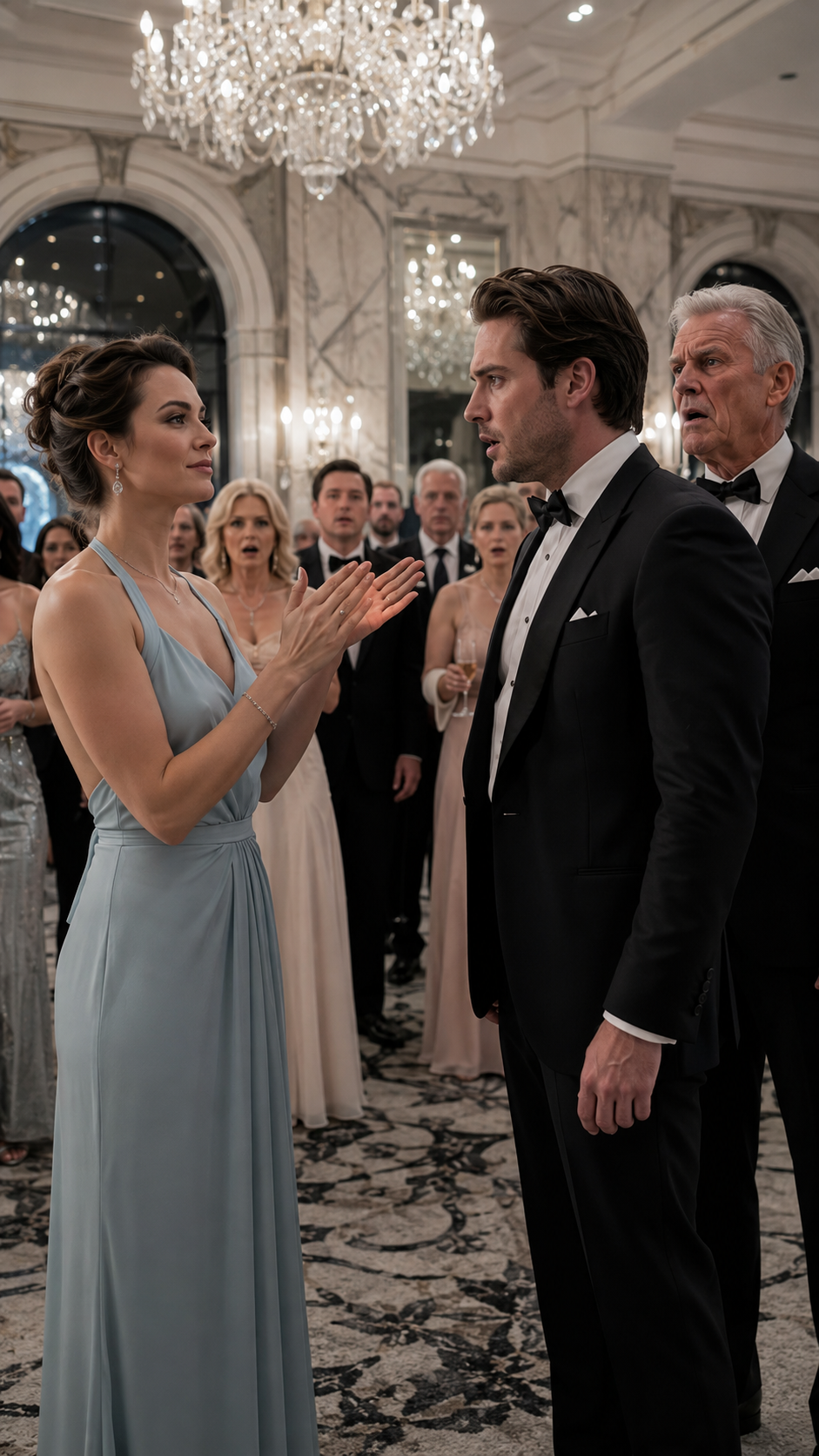
The Woman Beside My Husband
The first thing I noticed was his hand.
It rested at the small of another woman’s back with the careless familiarity of a gesture repeated many times before, and although the ballroom around them shimmered beneath thousands of crystal lights, although a string quartet played near the marble staircase and waiters moved gracefully through the crowd with silver trays, I could see nothing except those five fingers spread possessively against ivory silk.
My husband, Andrew Bellamy, looked magnificent that evening.
He always did when there was an audience.
At thirty-seven, he had inherited the handsome, polished features of an old white American family whose name had appeared on Midwestern factories, freight terminals, and charitable foundations for nearly a century.
In his black tuxedo, standing beneath the chandeliers of the Grand Marquette Hotel in Chicago, he looked exactly like the future chairman everyone expected him to become.
Beside him stood Elise Carrington, his college sweetheart.
She had returned to Illinois six weeks earlier after years in California, where she had built a successful career advising wealthy collectors on private art purchases.
She was thirty-five, elegant and pale, with soft blond hair and the kind of delicate smile that made people lean closer when she spoke.
Her silver-white gown was simple enough to appear tasteful and expensive enough to make that simplicity a statement.
Around her neck was a diamond pendant I recognized immediately.
Andrew had bought it three weeks earlier.
For her.
I stood near a column at the far edge of the ballroom, holding a glass of sparkling water I had not touched.
My name is Julia Merritt Bellamy, and at that moment, at least according to the state of Illinois, I was still Andrew’s wife.
For one month, we had barely spoken.
Now he had brought another woman to a gala our family was supposed to host together.
People tried not to stare at me, which naturally meant they stared even more.
I heard fragments of conversation behind carefully raised glasses.
“Isn’t that Elise Carrington?”
“I thought Andrew was married.”
“Julia is right over there.”
The worst part was not Andrew.
It was his mother.
Diane Bellamy stood beside Elise with unmistakable approval, touching her arm, introducing her to donors, behaving with a warmth she had never once shown me in four years of marriage.
To Diane, Elise was everything I was not—socially effortless, flattering, decorative without appearing foolish, and willing to let a Bellamy man occupy the center of every room.
I watched them from a distance, and something inside me became very still.
Then the ballroom doors opened.
Walter Bellamy, Andrew’s father and the seventy-one-year-old chairman of Bellamy Industrial Group, entered so quickly that two guests stepped aside to avoid him.
His usual executive calm was gone.
His gray hair was disordered, his bow tie slightly crooked, and his face carried the look of a man who had just learned that the floor beneath his entire life was no longer secure.
He crossed the ballroom without greeting anyone.
Andrew finally saw him.
“Dad?”
Walter stopped in front of his son and struck him once across the cheek.
The music faltered.
A hundred conversations disappeared at once.
Andrew stared at his father, one hand rising slowly to his face.
“What is wrong with you?”
Walter’s voice came out low at first, which somehow made it more powerful.
“What is wrong with me?”
He took one step closer.
“Your wife just called back two hundred and forty million dollars in private capital, Andrew.
Two banks have suspended our revolving credit access while they review the exposure.
Three lenders are demanding updated collateral statements before Monday morning.”
Andrew’s face emptied of color.
Walter pointed toward him with a trembling hand.
“And you are standing here smiling?”
For the first time that evening, my husband looked for me.
His eyes moved across the ballroom, past donors, politicians, executives, and old family friends, until he found me beside the column.
I placed my glass on a nearby table.
Then I began to clap.
Slowly.
Quietly.
One deliberate clap after another.
And to understand why, you have to understand what happened one month earlier.
PART 2: The Receipt He Forgot
Before marrying Andrew, I had spent fifteen years building a life that had nothing to do with the Bellamy name.
I was a civil engineer by training, and at twenty-nine I founded a company that designed modular water-treatment systems for rural communities and industrial sites.
The business grew faster than anyone expected.
By thirty-four, after selling a majority stake to a national infrastructure group, I had enough money to spend the rest of my life doing very little.
Instead, I made the mistake of believing that marriage meant building something together.
Bellamy Industrial Group was struggling when Andrew and I married.
Its public reputation remained impressive, but behind the polished annual reports were aging plants, expensive expansion projects, and a dangerous shortage of flexible cash.
Using proceeds from my company sale and assets held through my family trust, I provided more than two hundred million dollars through a combination of preferred equity, secured notes, and emergency credit facilities.
I did not simply hand them money.
I helped redesign supply contracts, introduced them to municipal infrastructure buyers, and negotiated a manufacturing partnership that brought three Bellamy plants back to full capacity.
Walter understood what I had done.
Andrew preferred to forget.
The first clear sign of Elise came through a receipt.
One evening, an invoice for a diamond pendant appeared in an email account used for household bookkeeping.
The purchase was just under sixty thousand dollars.
At first I assumed it was an anniversary gift, though our anniversary was months away.
Then I saw the delivery address.
A luxury hotel near Chicago’s Gold Coast.
I hired an investigator three days later.
The photographs arrived the following week.
Andrew meeting Elise outside O’Hare.
Andrew opening his car door for her.
Andrew having dinner with her in a private room at an Italian restaurant in River North.
Andrew walking beside her after midnight, leaning close as she laughed.
There was no single photograph that explained everything, yet together they told me more than I wanted to know.
That evening, I waited in our Lake Forest home until Andrew returned.
He entered the bedroom shortly after eleven, loosened his tie, and frowned when he saw me sitting awake.
“You’re still up?”
“Elise Carrington is back.”
His hand stopped at his collar.
Only for a second.
“Yeah.
She moved back recently.”
“You picked her up at the airport.”
He looked at me more carefully.
“How do you know that?”
“You bought her a diamond pendant.”
His expression hardened.
“Julia, don’t start.”
There are moments in a marriage when a sentence tells you more than a confession ever could.
Do not start.
As though the problem were not what he had done, but my inconvenient decision to notice it.
I stood and faced him.
“I’m asking you a simple question.
Why are you buying expensive jewelry for a woman you used to be involved with?”
Andrew exhaled with exaggerated patience.
“Because she has had a difficult year.
Because she came back here with almost no support system.
Because I have known her since college.
Pick one.”
“And the dinners?”
“Friends have dinner.”
“The hotel bills charged through a Bellamy corporate card?”
That finally reached him.
His eyes sharpened.
“You went through my expenses?”
I almost laughed.
“The receipt was forwarded to our household account.”
He turned away, poured himself a drink, and for several seconds said nothing.
Then he made the decision that ended our marriage, although he did not understand that yet.
He blamed me.
“Maybe I enjoy being around someone who doesn’t treat every conversation like a board meeting.”
I stared at him.
He continued.
“Elise actually listens.
She knows how to be warm.
She knows how to walk into a room without making everyone feel like they’re being evaluated.”
“Is that why you want her at the foundation gala?”
He looked back too quickly.
There it was.
I had guessed correctly.
The annual Bellamy Heritage Foundation gala was three weeks away, and Andrew and I were expected to appear together as the younger public face of the family.
“My mother thinks Elise could help with some donor introductions,” he said.
“Your mother.”
“Don’t make this childish.”
“Are you taking her?”
Andrew’s jaw tightened.
“She is better suited to certain social situations than you are.”
For four years, I had helped keep his family’s company standing.
I had spent holidays listening to Diane criticize my clothes, my work hours, my independence, and eventually the fact that Andrew and I had not given her grandchildren.
I had attended dinners I hated, smiled beside people who dismissed me, and quietly solved financial problems that none of them wanted discussed outside closed rooms.
Yet somehow I was the embarrassment.
I walked to my desk and removed a folder.
Andrew frowned.
“What is that?”
“A separation agreement.”
He stared at me as though I had suddenly begun speaking another language.
“You’re serious?”
“Completely.”
He snatched the document and began reading.
Then he reached the section concerning my investments in Bellamy Industrial Group.
His expression changed.
“You’re calling back the capital?”
“Yes.”
“Julia, you can’t do that right now.”
“I can.”
“We’re in the middle of two major plant expansions.”
“I know.”
“This could put the company in an impossible position.”
I looked at the man who had once promised that we would be partners in everything.
“Then perhaps you should have remembered who your partner was.”
PART 3: What the Silver Drive Knew
I did not call back the capital out of spite.
I want to be honest about that, because spite is easy, and what I did required something colder and more patient.
The night I found the photographs, I also found something else, almost by accident.
My investigator, a quiet man named Thomas Rourke who had spent eleven years doing forensic work for institutional lenders before going independent, called me two days after he sent the surveillance photos.
“There’s something you should look at,” he said.
“It isn’t about the affair.”
He sent me a second file.
Inside it were scanned wire authorizations, three of them, each bearing Andrew’s signature, each routed through a shell entity registered in Delaware called Carrington Art Advisory Partners.
The name should have meant nothing.
It meant everything.
Over four months, Andrew had authorized just under four million dollars in payments to a company that, on paper, provided art acquisition consulting to Bellamy Industrial Group’s charitable foundation.
In reality, the company had one asset, one address, and one owner.
Elise.
There was no art.
There was no consulting.
There was a man funneling foundation money to a woman he was rebuilding a life with, using accounts that were, technically, still under my oversight as a preferred equity holder with contractual audit righTS.
I did not confront Andrew with this immediately.
I built a case instead.
Over the following three weeks, while he believed I was simply hurt and quietly withdrawing, I worked with Thomas and with my own attorney, a sharp, unsentimental woman named Priya Desai, to document everything.
Bank records.
Wire authorizations.
Corporate registration filings.
Text messages Andrew had never bothered to delete, believing, as men like him often do, that consequences were something that happened to other people.
Everything went onto a single silver USB drive.
Priya kept a duplicate in her office safe.
I kept the original in my handbag, where it stayed for three weeks, waiting.
The formal notice of capital withdrawal was not an act of anger.
It was a lever.
Under the terms of my original investment agreement, I held the right to recall preferred equity and secured notes if I could demonstrate, with evidence, that funds under my oversight had been diverted for undisclosed personal benefit.
I did not need Andrew’s permission.
I did not need Walter’s approval.
I needed only to file the notice with the company’s outside counsel and the two banks holding revolving credit facilities tied to Bellamy’s collateral base.
I filed it four days before the gala.
I did not tell Andrew.
I did not tell Walter.
 Her Boyfriend Wants To Be On The Title Of The House, But She Says No Unless He’s On The Mortgage
I let them find out the way people usually find out that the ground beneath them has shifted—too late to stop it, and from someone else.
There was a night, ten days before the gala, when I almost told him anyway.
Andrew came home early, unusual for him that month, and found me at the dining table surrounded by folders I had not bothered to hide well enough.
“Working late?” he asked, loosening his tie, and there was something almost like the old warmth in it, the version of him that used to bring me coffee at midnight when a bid deadline ran long.
“Something like that.”
He sat across from me, and for a moment I let myself imagine a different version of the next ten days—one where I told him what Thomas had found, where he was horrified at himself, where the marriage bent instead of breaking.
I had built entire water systems around the principle that stress should be distributed rather than concentrated in a single failure point.
I understood, sitting there, that I had never applied that principle to us.
Every joint in our marriage had been designed to bear weight only when I was the one bearing it.
“You look tired,” he said.
“I am.”
“You know,” he said, reaching for my hand in a gesture that might once have undone me, “whatever’s going on with us, we’ll figure it out.
We always do.”
I let him hold my hand for exactly as long as it took me to decide, finally and completely, that I did not believe him.
Then I closed the folder in front of me, gently, the way you close something you’ve already finished reading.
“Yes,” I said.
“We will.”
He never knew which sentence was true and which was the lie.
Neither, at that point, did it matter.
PART 4: The Ballroom, Continued
My clapping stopped the moment Andrew crossed the ballroom toward me.
Guests parted the way they do when they sense violence approaching even in a room full of good manners.
Elise remained near the marble staircase, one hand pressed to the diamond pendant at her throat as though it might protect her.
“You did this,” Andrew said, his voice low, meant only for me, though half the room was straining to hear.
“I did.”
“Do you understand what you’ve done? Two banks, Julia.
Two banks are reviewing our entire credit position because of you.”
“No,” I said.
“Two banks are reviewing your credit position because you diverted foundation funds to your girlfriend’s shell company and I have three weeks of evidence proving it.”
The color that had already left his face when Walter struck him now left it entirely a second time.
Diane arrived beside her son, her voice pitched for an audience even now.
“Julia, whatever this is, this is neither the time nor—”
“Four million dollars, Diane.” I did not raise my voice.
I did not need to.
In a room built for acoustics, quiet carries further than shouting.
“Routed through Carrington Art Advisory Partners.
An entity with no employees, no inventory, and no art.
Owned entirely by the woman standing at the top of your staircase wearing a pendant your son bought with foundation-adjacent funds three weeks before this gala.”
Diane’s mouth opened, then closed.
Walter, still breathing hard from his walk across the ballroom, turned toward his son with an expression I will remember for the rest of my life—not fury this time, but something closer to grief.
“Andrew.” His voice cracked slightly.
“Tell me this isn’t true.”
Andrew said nothing, which was, of course, the only honest answer he had left in him.
Elise came down the last few steps of the marble staircase, and I watched her decide, in real time, which version of herself the room needed her to be.
She chose defiance.
“I didn’t ask him to buy me anything,” she said, addressing me directly for the first time all evening.
Her voice carried the practiced calm of someone who had spent a career convincing wealthy strangers that expensive things were sound decisions.
“If you have a problem with how your husband spends money, that’s a conversation for the two of you.
Not for me.”
“You’re right,” I said.
“It is a conversation for the two of us.
I’ve simply chosen to have it here, since you were both so determined to have your evening here.”
“You’re humiliating him in front of two hundred people.”
“He humiliated himself in front of two hundred people the moment he walked in wearing that particular kind of confidence next to you.
I only supplied the paperwork.”
Something in her composure slipped, just slightly, and for the first time I saw the outline of the thing Andrew had actually offered her—not romance exactly, but rescue.
A man with a name, a fortune, and, she must have believed, a wife too preoccupied with spreadsheets to notice or object.
She had not built her plan around cruelty.
She had built it around a genuine, almost understandable hunger to matter to someone who came from a world that had never quite let her all the way in, even after years of advising it on what to buy.
It was the one thing she said that entire evening I found myself, uncomfortably, almost agreeing with.
“He told me you two were already finished,” she said quietly, not for the room now, but for me.
“Before I came back to Chicago.
He said the marriage had been over for a year, and that the papers were only a formality neither of you had gotten around to.”
I believed her.
Not because I trusted her, but because it was, in its own way, a perfectly Andrew kind of lie—one that let him have exactly what he wanted while allowing him to feel, in whatever version of a conscience he still maintained, that he had done nothing wrong.
“Then I suppose,” I said, “we’re both finding out tonight exactly how much of what he told us was true.”
I opened my handbag and removed the divorce papers, already signed by me, already notarized, and set them on the nearest table beside a candle arrangement that suddenly seemed absurd.
Beside the papers, I placed the silver drive.
“Everything is here,” I said.
“Wire authorizations.
Bank statemenTS. Corporate filings.
Enough for the foundation’s own compliance office to open an investigation without my involvement at all, if I choose not to be involved.
I have not decided yet whether I will be generous about that.”
Walter picked up the drive with the careful reverence of a man handling something that might detonate.
He looked at his son.
“You used foundation money,” he said slowly, as though saying it slowly might make it less true, “to buy jewelry.
For her.”
“Dad, it isn’t—”
“Do not,” Walter said, “insult me by finishing that sentence.”
PART 5: The Three Layers
What happened over the following weeks was not the clean unraveling of a villain’s scheme, because Andrew was never a villain in the way stories like to pretend.
He was something more common and more disappointing: a man who had been told his entire life that charm could substitute for character, and who had never once been forced to discover whether that was true.
The outer layer, the one the newspapers eventually covered in careful, lawyer-approved language, was financial.
Bellamy Industrial Group entered emergency negotiations with its lenders.
Walter, working with a restructuring team I recommended out of what I told myself was practicality and not mercy, spent six weeks rebuilding covenant compliance without my capital, using asset sales and a painful but survivable renegotiation of the two Midwest plant expansions.
The company did not collapse.
It shrank, and shrinking, I have come to believe, was the correct and overdue outcome for a business that had spent a decade pretending to be bigger and steadier than it was.
The relationship layer was harder to resolve, because there was no covenant, no restructuring plan, no silver drive that could fix what four years of marriage had actually been.
Andrew called me eleven times in the two weeks after the gala.
I answered twice.
The first time, he apologized in the specific, performative way people apologize when they are more sorry about consequences than about harm.
The second time, three days later, something in his voice had changed.
“I keep trying to figure out when I decided you were the enemy,” he said.
“You saved the company once.
I know that.
I think I resented you for it.
I think I needed to believe I could have done it myself, so I built a version of events where you were controlling instead of capable.”
It was, I will admit, the most honest sentence he had spoken to me in over a year.
It did not undo anything.
It did not need to.
Some truths arrive exactly when they are no longer useful, and that does not make them false, only late.
He told me, in that same call, about the restructuring meetings he had been sitting through for two weeks—rooms full of lenders’ attorneys and Walter’s restructuring team, where Andrew, for the first time in his professional life, had been required to answer questions rather than simply approve decisions made on his behalf.
“They asked me to walk them through the foundation’s disbursement approvals,” he said.
“Line by line.
I realized about ten minutes in that I couldn’t actually explain most of them.
I’d been signing things because signing things was what I was supposed to do, not because I understood what I was authorizing.”
“That’s not a small realization.”
“No,” he agreed.
“It isn’t.
I think I’ve spent my whole life being handed the answer key and mistaking that for intelligence.
You built two companies from nothing.
I’ve never once had to build anything from nothing.
I just had to not obviously break what my father built.”
I did not offer comfort, because comfort was not what the moment required, and because I had spent enough years supplying comfort to a man who rarely returned the effort.
But I did not hang up either, and for a few minutes we simply sat on the line together, two people examining the wreckage of something that had once, however imperfectly, meant to become a life.
“I don’t expect you to fix this for me,” he said eventually.
“I know that’s what I always did.
Handed you the broken thing and expected you to hand it back working.”
“No,” I said.
“You don’t get to hand me this one.”
“I know.” A pause.
“I’m trying to learn what it looks like to fix something myself.
I’m not very good at it yet.”
“Most people aren’t, the first few times.”
It was the closest thing to a genuine goodbye either of us managed, and I have come to think that honesty arriving too late is still worth more than the comfortable lies that so often arrive on time.
The inner layer, the one nobody at the gala could see, was mine alone.
I had spent four years believing that competence would eventually be recognized as love, that if I simply solved enough problems, absorbed enough dismissiveness from Diane, filled enough gaps that Andrew left open, someone would eventually look at me the way Walter looked at the ledgers I had repaired—with plain, unsentimental gratitude.
I had confused usefulness with belonging.
Somewhere in the three weeks between the receipt and the ballroom, working alongside Thomas and Priya, building a case with the same discipline I once used to design water systems for towns that had never had clean water before, I understood that I did not want to be recognized by people who had never truly seen me.
I wanted a life where I was not required to prove my worth in order to be treated with basic respect.
That want turned out to be simpler, and harder to satisfy, than any spreadsheet I had ever built.
PART 6: The Choice
Walter came to see me alone, three weeks after the gala, at the small rental apartment near the lake where I had been staying since the night of the confrontation.
He looked older than he had at the ballroom, though perhaps that was only the absence of a crowd to perform strength for.
“I want to ask you something,” he said, sitting across from me at a kitchen table that had come with the furnished unit, “and I want you to answer honestly, because you are the only person left in this family who consistently does.”
“All right.”
“The foundation compliance investigation.
You could push it further.
Public disclosure, regulatory referral, the kind of exposure that would follow Andrew for the rest of his career.
You have the evidence.
You have every right.” He folded his hands.
“Do you want to destroy him?”
I considered the question seriously, because it deserved a serious answer.
“No,” I said finally.
“I wanted to survive him.
Those are different things, and it took me a long time to understand that revenge and freedom are not the same purchase, even when they’re standing next to each other in the same store window.”
Walter exhaled, something in his shoulders loosening.
“Then what do you want?”
This was the choice the whole story had been circling, the one no lawyer or wire transfer could make for me.
I could accept a private settlement that quietly closed the compliance matter, walk away with the marriage dissolved and my capital returned, and let Andrew keep the version of his reputation the family had spent a century constructing.
Or I could let the silver drive do what it was built to do, let the investigation run its course through the foundation’s own board, and accept that some truths, once spoken aloud in a ballroom full of donors, do not stay contained no matter how generous I chose to be afterward.
“I want the settlement,” I said, “on one condition.
Andrew resigns from every foundation and board position tied to money he did not earn honestly, permanently, in writing.
Not because I want him ruined.
Because I want him to build whatever comes next without borrowing credibility from people he hasn’t been honest with.
That includes you, Walter.”
Walter studied me for a long moment.
“You could have taken more.”
“I know.”
“Why didn’t you?”
I thought of the second bowl of rice I used to leave out on nights Andrew worked late, the one I would stand over and watch go cold before finally putting it away, telling myself it meant nothing.
“Because I spent four years measuring my worth by what I was willing to give up for this family,” I said.
“I’m done doing math that only ever subtracts from me.”
Walter was quiet for a long time after that, turning his coffee cup slowly on the table without drinking from it.
“His mother and I built this company believing that if we simply gave Andrew everything—the name, the introductions, the safety net—he would eventually grow into a man who didn’t need any of it,” he said finally.
“I think we built him a very comfortable cage and called it a foundation.”
“That’s not my failure to fix, Walter.”
“I know it isn’t.” He looked at me with something I had never once seen from him in four years of holiday dinners and boardroom negotiations—not gratitude exactly, but a kind of plain respect, the sort he usually reserved for balance sheets that finally added up correctly.
“I only wanted you to know that I see it.
What this cost you.
What you built anyway, in spite of it.”
“That means something,” I said, and found, somewhat to my own surprise, that I meant it.
He stood to leave, then paused at the door.
“For what it’s worth, Julia—if I had been building this company with a partner like you from the beginning, instead of raising a son to expect one, I suspect Bellamy Industrial would be twice the size it is today, and half as fragile.”
“Maybe,” I said.
“Or maybe I would have simply spent those years propping up a different version of the same mistake.
I try not to spend too much time imagining the lives I didn’t choose.
There’s usually enough work in the one I did.”
He almost smiled at that, the closest thing to warmth I had seen from him since before the gala.
“Spoken like an engineer.”
“I’ve been told that before.”
PART 7: Aftermath
The divorce was finalized in October, eleven weeks after the gala.
It was neither dramatic nor cinematic.
Priya handled the filing with the same brisk efficiency she brought to everything, and Andrew, true to the agreement Walter and I had structured, signed his resignation from the foundation board the same week, without argument, without the performance of reluctance he might once have staged for an audience that no longer existed.
Elise left Chicago before Thanksgiving.
I heard, secondhand, through people who still felt entitled to update me on Andrew’s life, that Carrington Art Advisory Partners was dissolved quietly, its remaining funds returned to the foundation under an agreement that made no public mention of wrongdoing.
I did not ask for details.
I found I did not need them.
Diane called me once, in November, in a voice I had never heard her use before—smaller, uncertain.
“I introduced her like she was replacing you,” she said.
“At the gala.
I want you to know I’ve thought about that every day since.”
I did not forgive her that afternoon, on the phone, in the easy way people forgive each other in stories that want tidy endings.
I told her I appreciated her saying it, and that I needed time before I knew what, if anything, our relationship could become.
She did not push.
That, more than the apology itself, told me something had genuinely shifted in her.
She called again in January, and this time asked if we could meet in person, at a small café near the Merchandise Mart rather than at any of the restaurants where she usually held court.
She arrived without makeup, which I had never once seen in four years of knowing her, and ordered tea instead of the wine she typically used as a kind of social punctuation.
“I have spent thirty years deciding whether women were useful to this family,” she said, turning her cup slowly on its saucer.
“I never once asked whether they were happy.
I don’t think it occurred to me it was a separate question.”
“It usually is,” I said.
“I was cruel to you because you didn’t need Andrew the way I needed his father.
I think I mistook your independence for a threat instead of recognizing it as the thing that eventually saved this family’s finances twice over.” She looked up at me, and for the first time her eyes carried something unguarded.
“I don’t expect you to forgive me quickly.
I only wanted you to know I finally understand what I was punishing you for.
It was never really about you at all.”
I did not offer easy absolution, because it would have been a lie, and I had grown tired, over the previous months, of manufacturing comfortable lies for people who had never extended me the same courtesy.
But I told her I was glad she had said it, and that I was willing to see where honesty, applied slowly and consistently, might eventually lead between us.
It was not reconciliation.
It was the beginning of the long, unglamorous work that sometimes precedes it, and I had come to trust that kind of beginning far more than any grand, tearful scene.
Bellamy Industrial Group survived, smaller and more honestly capitalized than it had been in a decade.
Walter and I still speak occasionally—not as family exactly, but as two people who once solved a very difficult problem together and found, in the solving, a strange mutual respect that outlasted the marriage that had originally connected us.
PART 8: What I Chose
I sold the Lake Forest house in the spring.
I did not need the money.
I needed the walking away.
With part of the proceeds, I started a new company, smaller and slower than my first, designing decentralized water systems for towns in the Midwest that larger infrastructure firms considered too small to bother with.
My first client was a town of eleven hundred people in downstate Illinois whose water board chairwoman reminded me, in ways I could not quite articulate, of the version of myself that had existed before I ever met Andrew Bellamy—competent, unglamorous, entirely unconcerned with being seen at the right parties.
Thomas Rourke still calls occasionally, less as an investigator now and more as a friend who happened to witness the worst month of my life and never once made me feel smaller for needing his help.
Priya sends me holiday cards with dry, lawyerly jokes inside them that make me laugh every year.
I kept one thing from the Lake Forest house, packed carefully before the sale: a small crystal water glass, the twin of the one I had held untouched at the gala.
I do not display it.
I keep it in a kitchen cabinet, and once or twice a year, usually on the anniversary of that October filing, I take it down, fill it with sparkling water, and drink the whole thing slowly, all the way to the bottom, simply because I can.
Life since then has not arranged itself into anything as clean as a happy ending.
The new company loses money some monThS. Diane and I are still circling something that might, eventually, resemble a relationship.
Andrew and I speak twice a year, briefly, about nothing that matters, and I find I no longer need those calls to feel a particular way in order to consider the conversation successful.
Last month, the town chairwoman I mentioned—her name is Renata, and she reminds me more of myself each time we meet—asked me why I had left a life that, from the outside, must have looked enviable: the Lake Forest house, the Bellamy name, the kind of gala where donors fought quietly over which charity got the largest table.
I told her the truth, which surprised even me as I said it out loud for the first time.
“I didn’t leave a good life,” I said.
“I left a life that was very good at looking like one, from a distance, to people who weren’t required to live inside it.”
She nodded slowly, the way people do when a sentence lands somewhere they’ve been circling privately for a while.
“And this one?” she asked, gesturing at the modest municipal office around us, the water maps pinned to a corkboard, the coffee that had gone cold an hour earlier because neither of us had noticed the time passing.
“This one doesn’t have to look like anything,” I said.
“It just has to work.”
I think of Walter sometimes, and of the strange, unsentimental respect that survived the wreckage of a marriage neither of us had built alone.
I think of Andrew less often than I once assumed I would, and when I do, it is usually with something closer to distant clarity than pain—the particular relief of finally understanding a puzzle you spent years insisting was unsolvable.
But most mornings now, I wake up in a small apartment near the lake that belongs entirely to me, in a life I built rather than one I was assigned, and I do not stand over a second bowl of anything, watching it go cold, waiting for someone to notice I set it out.
I noticed instead.
That, it turns out, was the only recognition I ever actually needed.