
She Needed Discipline — Until the Badge Knocked
Part One
Twelve years my mother told me obedience was love.
It took one fevered, crying infant to teach me she’d never meant either word.
“Ignore him.
He’ll learn.”
That was the second thing I heard when I walked back into my own house after eight months overseas.
The first was my son, screaming with a voice that had almost nothing left in it.
I dropped my duffel bag in the hallway.
It hit the floor harder than I meant it to.
Eight months of deployment teaches a man to read a room before he’s fully inside it.
The pauses between Noah’s cries were wrong — too long, too flat, like something had already been trained out of him.
The smell of sour formula hung in air that was somehow both freezing and airless.
And Emma, my wife, was on the nursery floor, one hand braced against the crib rail like it was the only thing keeping her upright.
Her left eye was swollen shut.
Bruises ringed both her forearms in the unmistakable shape of fingers.
“Emma.”
She looked up — fear first, then something that broke my chest in half.
Relief.
Like she hadn’t let herself believe I was real yet.
“Michael?”
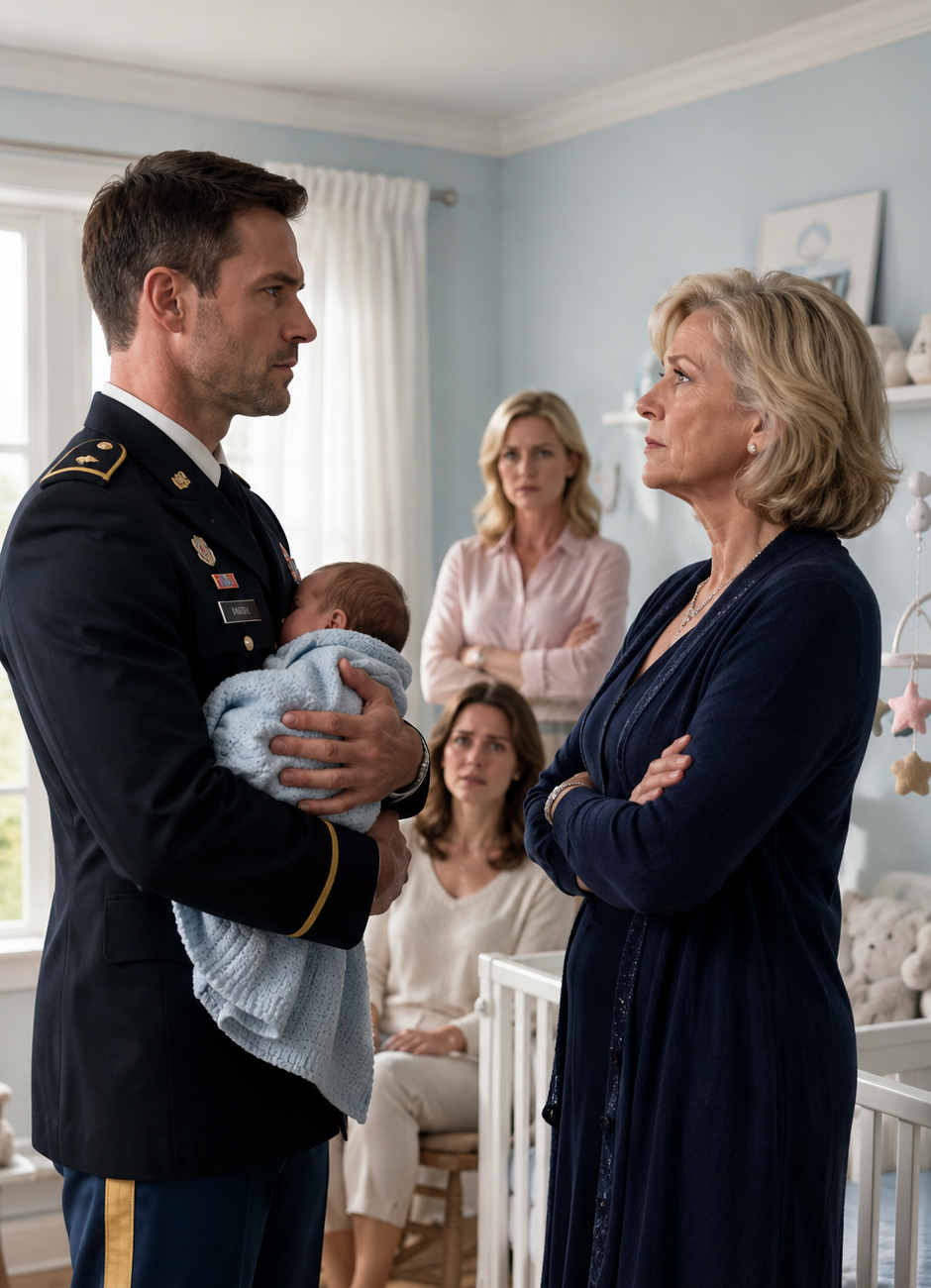
My mother, Patricia, filled the doorway in Emma’s robe, the silk one I’d bought for her the Christmas before I shipped out.
My sister Lauren stood behind her, swirling a glass of wine like we were at a dinner party.
Patricia crossed her arms.
“She needed discipline.”
Lauren rolled her eyes.
“And the baby is her responsibility.
We’re not servanTS.”
I crouched and pressed two fingers to Noah’s forehead.
He was burning.
“How long has he had a fever?”
Emma opened her mouth, but Patricia cut in before she could get a word out.
“Since yesterday.
She was being dramatic.”
“A hundred and four,” Emma whispered, so quiet I had to lean in.
“They took my phone.
They wouldn’t let me leave the house.”
Lauren laughed into her wine glass.
“You always did like fragile women, Mike.”
I looked at the two of them for a long moment and made myself breathe slow.
Rage makes a man careless.
Calm makes people talk, and I needed them talking.
“Why is Emma on the floor?”
Patricia smiled like the outcome of this conversation had already been decided in her favor.
“Because this is my house, and she forgot where she belongs.”
That was her first mistake.
The house had never belonged to her.
Three years before, after my grandfather died, I’d bought the house outright through the family trust set up for military dependenTS. Patricia lived there under a temporary occupancy agreement — no ownership, no lease, no legal claim over anyone who walked through the door.
She had chosen, for three years, to forget that on purpose, and I had let her, because correcting her felt like a fight not worth having.
During deployment, Emma’s messages had gotten shorter.
Then they’d stopped.
Patricia told me Emma was overwhelmed, avoiding everyone, needed space.
I let myself believe that for six weeks longer than I should have, right up until my gut told me otherwise and I stopped believing anything Patricia said without checking it first.
I lifted Noah out of the crib and wrapped him tight in the blue blanket folded at the foot of the mattress — the one Emma’s late mother had knitted before she passed, the one Emma never let anyone else touch.
Lauren stepped into my path.
“Where do you think you’re going?”
“To save my son.”
“You’ll calm down once you hear our side,” Patricia said.
I looked past both of them, out through the nursery’s front-facing window, where headlights were sweeping white bars of light across the wall.
“I already heard enough.”
Car doors opened outside, one after another, in an order too even to be coincidence.
Patricia’s smile faltered for the first time since I’d walked in.
Lauren’s wine glass stopped halfway to her mouth.
Neither of them knew I’d spent six weeks — quietly, from four thousand miles away — pulling bank records, screenshotting deleted messages Emma’s father had managed to save from her, and requesting the footage from the nursery camera they thought I believed was broken.
They’d been so certain they were dealing with a soldier trained to follow orders.
They’d forgotten I was trained to plan for exactly this.
“Michael Donovan?” a voice called from the front door.
“Police.
Open up.”
Part Two
For one full second, nobody in that nursery moved.
Noah whimpered against my chest, small and scorching.
Emma tried to push herself up off the floor and her arms gave out halfway.
I caught her before her shoulder hit the crib rail.
She weighed nothing.
That scared me more than the bruises did.
“I’ve got you,” I said.
“I’ve got both of you.”
Patricia’s composure cracked at the second knock, harder this time, followed by a voice announcing itself as Child Protective Services.
Lauren set her wine glass down on the changing table like it might get her arrested by association.
“Michael, don’t you dare open that door,” Patricia hissed.
“Do you understand what this will do to this family?”
“This family already did it to itself.” I carried Noah out of the nursery with my free arm around Emma, half-carrying her too.
“I’m just the one who called the ambulance.”
That stopped her.
“You called—”
“Twelve minutes ago.
Before I even walked in.” I hadn’t lied to her about that, because I hadn’t needed to explain anything to her at all.
My attorney, Colonel Reyes’ contact in the JAG office, and a family court advocate Emma’s father had hired the moment he got her panicked, half-finished text messages — they’d all been looped in for six weeks.
Tonight wasn’t a reaction.
It was a plan finally executing on schedule.
I opened the front door myself.
Two uniformed officers stood on the porch, and behind them, a woman in plain clothes with a CPS badge on a lanyard, and behind her, a paramedic already wheeling a gurney up the walk.
“Sergeant Donovan,” one officer said.
“We received a welfare call and a supporting affidavit from your attorney.
Is this the residence?”
“It is.
My son needs to go to the hospital right now.
My wife needs to be seen too.” I stepped aside so the paramedic could get past me.
“The two women inside assaulted her and withheld medical care from an infant for over twenty-four hours.”
Patricia’s voice rose behind me, sharp and performative.
“This is absurd.
I raised this man.
I would never hurt a child.”
“You didn’t hurt Noah,” I said, not turning around.
“You just decided his crying wasn’t worth your time.
That’s not the same as innocent.”
The CPS caseworker stepped past me into the house, already speaking into a small recorder.
“Ma’am, I’m going to need you to sit down and answer some questions.”
“I don’t answer to strangers in my own home.”
“It’s not your home,” I said.
“It never was.
Check the deed if you don’t believe me — my attorney has already sent copies to the department.”
The paramedic asked Patricia and Lauren to step outside while they assessed Emma.
Patricia refused at first, insisting she had every right to remain in “her” living room.
It was Lauren, oddly, who finally pulled her out onto the porch, muttering something about neighbors and appearances that had nothing to do with concern and everything to do with control of a different kind.
I watched them go through the window and thought, not for the first time, that cruelty in my family had never been loud.
It had always been polite, disguised as concern, dressed in the language of what was best for everyone.
They took Emma and Noah in the ambulance first.
I rode with them, Emma’s hand locked around two of my fingers the entire way, like she was afraid that if she let go I might turn back into someone who couldn’t be trusted to stay.
“I tried to leave twice,” she said in the ER, once Noah had been handed off to a pediatric team and a nurse was checking her blood pressure.
“The first time, Patricia took my keys.
The second time, she told me if I called you overseas and disrupted your deployment with ‘family drama,’ she’d make sure you came home believing I was the unstable one.”
“She almost did,” I admitted.
“For six weeks I told myself you just needed space.”
“I didn’t need space.” Emma’s voice cracked on the word.
“I needed someone to believe me before I stopped believing myself.”
That sentence sat in my chest for a long time.
I’d spent eight months learning to read danger in a war zone and I’d almost missed it sitting inside my own family, because the version of danger I was trained for wore a uniform, not my mother’s face.
“I believe you,” I said.
“I should have called sooner.
I should have trusted my gut instead of her voice.”
“You came home.
That’s what matters.”
I wanted to tell her it wasn’t enough — that I should have never left her in that house with those two women in the first place, that some failures don’t get erased by a rescue, only interrupted.
But Emma was exhausted and swollen-eyed and gripping my hand like it was the only solid thing left in her world, so I said nothing else, and let her sleep.
Part Three
Noah stabilized by morning — dehydration and a treatable infection, the pediatrician said, the kind that turns dangerous fast in infants when it’s ignored, and turns into nothing at all when it’s caught early.
Another six hours, she told me quietly in the hallway, and we’d be having a very different conversation.
I didn’t share that detail with Emma yet.
She had enough to carry.
Patricia and Lauren were both arrested that night — Patricia for felony child endangerment and assault, Lauren as an accessory for her documented refusal to seek medical care despite direct knowledge of Noah’s condition.
The CPS caseworker later told me it was Emma’s own scattered messages to her father, sent in fragments over six weeks whenever Patricia’s back was turned, that had built the timeline the state needed.
Emma hadn’t known, sending those messages, that she was building a case.
She’d just been trying to survive one more hour.
That detail mattered to me more than almost anything else in this whole mess.
She hadn’t waited to be saved.
She’d been fighting the entire time, in the only ways left available to her.
The trust attorney called two days later.
“You want them removed from the property,” he confirmed.
“Legally, since neither of them ever held title or lease, that’s a formality.
Practically, given the pending charges, it’s already underway.
I’d also recommend disinheriting both from the family trust while the criminal matter is active — the language in your grandfather’s original documents allows it on grounds of demonstrated harm to a beneficiary or dependent.”
“Do it,” I said.
“All of it.”
There was a pause on the line.
“Your mother will fight this.”
“She can fight it from wherever they hold her bail hearing.” I looked through the hospital window at Emma, asleep in the chair beside Noah’s bassinet, her hand resting on the blue blanket even in sleep.
“She had eight months alone with my family and she chose cruelty.
I’m not interested in giving her a ninth.”
The escalation, when it came, wasn’t the courtroom.
It was smaller than that, and worse.
Patricia’s bail hearing was set for the following week.
In the interim, she called me eleven times.
I answered the eleventh.
“You’re destroying this family over a few bruises,” she said, no greeting, no softness.
“I was raising a soldier’s wife the only way I know how.
Nobody coddled me either, Michael.
I turned out fine.”
“Did you,” I said.
It wasn’t really a question.
“I survived.
That’s more than most people manage.”
And here was the thing that unsettled me for days afterward — some small, ugly corner of that sentence rang true.
Patricia had survived a childhood I knew almost nothing about, a father she never spoke of except in flinches, a marriage to my own father that ended in his early death and her bitterness calcifying into something permanent.
She wasn’t lying about having endured something.
She was lying about what enduring it had taught her to become.
“Surviving isn’t the same as healing,” I told her.
“You never tried to heal.
You just decided everyone underneath you had to survive it too, the same way you did, or they didn’t deserve softness at all.”
“And you think you’re better? Off fighting wars while your wife—”
“Don’t,” I said.
“You don’t get to use her pain as a weapon against me.
Not after what you did to her.”
She was quiet for a moment — the first real quiet I’d heard from her in years.
Then: “I did what I thought was right.”
“I know,” I said, and meant it, which was somehow worse than if I hadn’t.
“That’s what scares me most about you.”
I hung up before she could answer.
Emma’s father, Robert, flew in three days after the arresTS. I’d never met him in person — Emma spoke of him rarely, and always carefully, the way people talk about a wound that’s mostly healed but still aches in cold weather.
He was a tall, quiet man who hugged his daughter for a long time in the hospital hallway and then turned to me and shook my hand like he was testing whether I’d let go first.
 Homeowner Refuses To Let Neighbour Dig Up Driveway For EV Charger, Cites Recent Renovations
“She used to send me half a sentence at a time,” he said, once Emma had gone back in to sit with Noah.
“Can’t talk.
She’s — nothing after that for two days.
Then sorry, dropped my phone.
I knew.
I’ve known something was wrong since March.
I should have gotten on a plane in March.”
“Why didn’t you?”
“Because the last time I showed up somewhere uninvited to save someone, I made things worse instead of better.” He looked down at his hands.
“I left this family once.
Badly.
I didn’t trust myself to know the difference between rescuing my daughter and running my own guilt through her a second time.”
I understood that better than I wanted to.
“You saved her anyway.
Every fragment she sent you, you saved.
That’s what built the case.”
Robert nodded slowly, like the sentence cost him something to accept.
“I kept telling myself collecting evidence wasn’t the same as helping.
Turns out it was the only kind of helping I still knew how to do without making it about me.”
It struck me, standing in that hallway, how much of this story was built out of people who had learned the wrong lesson from being left, and were only now, slowly, painfully, learning the right one.
Robert had learned that staying away was safer than being blamed for staying too close.
Emma had learned that asking for help got you abandoned.
I had learned that love was something you earned through obedience and guarded through vigilance.
None of us had been taught how to simply stay, uncomplicated, without a debt attached.
“She’s going to need you,” I told him.
“Not just this week.
After.
When the adrenaline runs out and it’s just the tired part left.”
“I know,” he said.
“This time I’m not leaving until she tells me to.”
Emma noticed the change in me over those days — not softer, not harder, just quieter, like I was carrying a conversation I hadn’t shared with her yet.
She found me one evening standing at the nursery window, watching the driveway the way I used to watch a perimeter.
“You’re doing the thing again,” she said.
“Counting exiTS.”
I hadn’t realized I was doing it until she said it.
Two doors, one window, distance to the car.
A habit built in places where not knowing the exits could get you killed.
I hadn’t been able to turn it off since coming home, not even in my own house, not even in the one room where nothing should have felt dangerous anymore.
“Old habit,” I said.
“I know why you do it.” Emma came and stood beside me, close enough that our shoulders touched.
“You’ve been doing it since before you left.
I just never understood why until Patricia.”
I looked at her.
“What do you mean?”
“Your mother taught you that safety was something you had to guard, not something you were allowed to have.
That’s why you left for the military in the first place, isn’t it? Not to serve.
To prove you could survive somewhere worse than home.”
I didn’t answer right away, because she wasn’t wrong, and I’d never said it out loud to anyone, not even to myself in those exact words.
“And you,” I said finally, “you never asked for help.
Not once in eight months, not until you had almost nothing left.
Why?”
Emma’s jaw tightened.
“Because the last time I asked someone for help, I was nine, and my father packed a bag the next morning and didn’t come back for four years.
I learned that needing people gets you left.
So I stopped needing people.
I just — endured.
Same as you count exiTS. Different room, same war.”
We stood there a while, two people who’d both learned to survive alone and had somehow found each other anyway, without ever quite admitting how similar the wreckage underneath them looked.
“I should have asked you to come home sooner,” she said.
“I kept telling myself I could handle it, that asking would make me weak, or worse — that you’d resent coming home to a mess I couldn’t manage.”
“I would never have resented that.”
“I know that now.” Her hand found mine on the windowsill.
“I didn’t know it then.”
That was the second choice of the story, though neither of us named it that way at the time — Emma choosing, in that quiet hospital-adjacent evening, to say the true thing out loud instead of swallowing it the way she’d swallowed everything else her entire life.
It cost her more than it looked like it cost.
I understood that even without her saying so.
Part Four
The bail hearing did not go the way Patricia expected.
She arrived expecting family loyalty to soften a judge who had never met her before and owed her nothing.
She got a courtroom that had, by then, reviewed six weeks of documented messages, hospital admission records showing an infection that could have turned septic within hours, and camera footage — restored, not broken, exactly the footage she’d assumed didn’t exist — of the two days before I came home.
The prosecutor played eleven minutes of it before the judge asked her to stop.
Eleven minutes of Emma trying to soothe a screaming infant with one arm while the other hung stiff at her side.
Eleven minutes of Patricia walking past the nursery door twice without slowing down.
Nobody in the gallery said a word.
I felt Emma’s hand tighten in mine and I did not let go.
Patricia’s attorney tried, once, to frame it as a difference in generational parenting philosophy — a harsh phrase, “cry it out,” stretched to cover bruises it was never built to explain.
The judge did not let him finish the sentence.
“Counsel,” she said, “I’d encourage you to choose your next words carefully, because the footage in front of me does not depict parenting philosophy.
It depicts a grown woman withholding medical care from a nine-month-old and a grown man’s wife for over twenty-four hours while both were visibly suffering.
I’m not interested in euphemisms today.”
I sat in the gallery with Emma beside me and Noah, healthy now, asleep against her chest in a sling.
Lauren sat two rows ahead with her own attorney, pale and silent, having apparently discovered somewhere in the last week that loyalty to Patricia had a much higher price tag than she’d budgeted for.
When it was my turn to speak — a victim-impact statement the prosecutor had asked me to consider, given the family relationship — I stood, and I did not raise my voice, because I’d learned a long time ago that calm cuts deeper than rage ever does.
“My mother taught me that love had to be earned through obedience,” I said.
“That safety wasn’t something you were given, it was something you fought for and guarded alone.
I spent most of my adult life proving I could survive anything, because survival was the only kind of worth she ever offered me.
I joined the military believing danger overseas would be more honest than the danger at home.
I was wrong.
The danger at home just wore a familiar face, which made it harder to see.”
I looked at Patricia.
She wasn’t looking back at me.
She was looking at the table in front of her, at her own hands.
“You told me once that surviving is more than most people manage,” I said.
“You were right about that.
But you never once asked whether the people around you were surviving you.
My wife survived you for eight months alone, with a newborn, and she never once got the chance to just live.
That’s the difference between us.
I learned to survive you and leave.
She had nowhere left to go.”
The judge denied bail on both counts and set the matter over for trial.
During recess, before the ruling, Patricia’s attorney approached me in the hallway with an offer: if I agreed to submit a statement recommending leniency — citing her age, her “otherwise unblemished record,” the toll a felony conviction would take on her health — the prosecution would consider a reduced plea that kept her out of a cell entirely, in exchange for a guilty plea to a lesser charge and mandatory counseling.
I stood there a long moment, and it was, without question, the hardest choice the whole ordeal had handed me.
Part of me — the part that was still, after everything, a son who had once wanted nothing more than a single unqualified “good job” from that woman — wanted to say yes.
Wanted to spare her the cell, spare myself the finality of watching my own mother be led away in restraints, spare Noah a story he’d one day be old enough to Google and read in a stranger’s words instead of mine.
“What does Emma think?” the attorney asked, perhaps sensing my hesitation.
“Emma isn’t the one being asked,” I said.
“I am.
Because Emma would tell me to do whatever makes this easier on me, and that’s exactly why I’m not asking her.”
I thought about the eleven minutes of footage.
I thought about Noah’s fever, one bad night from turning into something no leniency letter could undo.
I thought about Patricia’s voice on the phone — I survived, that’s more than most people manage — and understood, finally and completely, that leniency wouldn’t teach her anything new.
It would only confirm what she’d believed her entire life: that consequences were negotiable if you were patient enough, and love owed you a discount.
“No,” I told the attorney.
“No statement.
Let the evidence stand on its own.”
It wasn’t mercy I was choosing against.
It was the lie that mercy and accountability couldn’t exist in the same room — a lie Patricia had used my whole childhood to excuse cruelty as love.
I wasn’t going to hand her one more year of it, not even wrapped in forgiveness.
Patricia looked up as they led her out — not at the judge, not at the prosecutor, but at me, one last time.
There was no apology in her face.
There was something closer to confusion, like she genuinely could not locate the moment where love and control had become, in her mind, the exact same thing.
That was her truth, ugly as it was, and it was the one thing she’d said to me that entire week that I believed completely: she really had thought this was right.
That didn’t make it forgivable.
It just meant the wound went back further than either of us would ever fully untangle, and it would end with her, whether she wanted it to or not, because I was never going to hand it to Noah.
Part Five
The house felt different in the weeks after — quieter in a way that had nothing to do with Patricia’s absence and everything to do with the fact that Emma and I had finally started saying things out loud that we used to carry silently, separately, like two people guarding the same fort from opposite walls without ever telling each other they were under attack.
There were bad nights too, and I don’t want to pretend there weren’t.
Emma had a panic attack in the grocery store three weeks after the hearing, triggered by nothing more than an older woman’s raised voice two aisles over scolding a child for dawdling.
I found her crouched by the cereal boxes, breathing in short, ragged pulls, and I sat down on the floor next to her in front of God and every stranger with a cart, and I didn’t say anything useful, I just stayed there until her breathing evened out.
“I’m sorry,” she said afterward, in the car.
“I know it wasn’t even about us.”
“Don’t apologize for what your body remembers,” I told her.
“I still can’t sleep with the bedroom door closed.
You don’t owe anyone an explanation for how long healing takes.”
Robert came by most Sundays after that, sometimes just to sit on the porch with Noah in his lap while Emma napped, undoing four years of absence one uneventful, unremarkable afternoon at a time.
He never brought up Patricia.
Neither did we.
Some silences, I was learning, weren’t the same kind of silence Emma used to keep.
Some silences were just peace, finally arrived, with nothing left underneath them to hide.
We didn’t fix everything overnight.
Emma still flinched sometimes when a door opened too fast.
I still counted exits without meaning to, still woke some nights convinced I’d heard Noah crying even when the monitor was silent.
Trust, once broken by the people who were supposed to guard it first, doesn’t come back because a court date closes a file.
It comes back in small, unglamorous repetitions — a phone call answered instead of screened, a hard thing said instead of swallowed, a second bowl of dinner Emma used to quietly set aside out of habit, some private ritual of hope she’d never explained to anyone, finally explained to me one night at the kitchen table.
“After my father left,” she said, “I used to set an extra plate at dinner.
My mother never said anything about it.
I think she understood I wasn’t doing it because I thought he’d come back.
I think I was doing it so the table didn’t look like what it actually was.
Empty.”
“Do you still do it?”
She looked down at the two plates in front of us — just two, for the first time since I’d come home.
“Not tonight,” she said.
“Tonight it’s just us, and that’s enough plates.”
I didn’t say anything.
I just reached over and took her hand, the same one that used to shake pouring formula in a kitchen where no one was watching to see if it shook.
Six months later, the trial concluded.
Patricia was convicted on the endangerment charge and a lesser assault count; Lauren accepted a plea deal in exchange for testimony, avoiding jail but not the felony conviction that ended her position at the accounting firm where she’d worked for nine years.
Neither of them contacted us again — not out of respect, I suspect, but because there was nothing left to take.
The trust attorney sent over the final disinheritance paperwork not long after.
I signed it in the kitchen, at the same table where Emma had told me about the extra plate.
Noah was in his high chair beside me, nine months old now, healthy, loud, utterly unaware of how close the story had come to a different ending.
That night, after he was down, Emma found me standing at the nursery window again — old habit, still there, probably always would be a little.
But this time I wasn’t counting exiTS. I was just watching him sleep.
“You’re not doing the thing,” she said, coming to stand beside me.
I realized she was right.
My eyes were on the crib, not the door.
“Guess I don’t need to guard this room anymore,” I said.
“Nobody’s coming for him but us.”
Emma leaned her head against my shoulder.
On the dresser behind us sat the things we’d kept, without ever discussing it out loud, as if some part of both of us understood they’d become the proof of everything we’d survived to get here: the blue blanket, worn soft now from constant use instead of packed away in some drawer as a relic of grief.
The silver key my grandfather had given me the day he signed the house into the trust, telling me this will always be yours, whatever anyone tells you, which I’d finally understood wasn’t about property at all.
Emma’s old phone, cracked at the corner, the one she’d used to send those broken, desperate fragments to her father — retired now, replaced by a new one I’d given her the week after the trial ended, not as a gift exactly, but as a small, deliberate statement: you will never again need to hide a message from anyone in this house.
“I used to think surviving was the whole job,” Emma said quietly.
“Get through the day.
Don’t ask for help.
Don’t need anyone.
I thought that was strength.”
“And now?”
“Now I think the strength was always in the asking.
I just didn’t have anyone worth asking, until you.”
I thought about Patricia’s voice on the phone, I survived, that’s more than most people manage, and I thought about how wrong she’d been, and how long it had taken me to understand exactly why.
“Surviving keeps you alive,” I said.
“It doesn’t build anything.
This—” I nodded at the crib, at her, at the quiet house around us that finally, finally felt like ours, “—this is what you build after.
Nobody hands it to you.
You have to choose it, every single day, on purpose.”
A week before the verdict, I visited Patricia once, alone, at the detention facility.
I hadn’t told Emma I was going.
I wasn’t sure I could have explained why, even to myself, except that some part of me needed to see her without a courtroom’s distance between us, one last time, before I let the legal system finish what our family had never managed to.
She looked smaller across the plexiglass than she had in my memory — not weaker, exactly, just diminished, like the house and the title deed and the silk robe had all been load-bearing walls holding up a version of her that couldn’t stand without them.
“Come to gloat?” she asked.
“Come to ask you something.” I sat down across from her.
“Did your mother ever hit you?”
Something moved behind her eyes, quick and involuntary, gone before she could stop it.
“That has nothing to do with this.”
“I think it has everything to do with this.” I kept my voice level.
“I think you learned a long time ago that love came with conditions, and instead of breaking that pattern, you just decided to become the one setting the conditions instead of the one meeting them.
That doesn’t make what you did to Emma and Noah forgivable.
But I think it’s the truth, and I think you’ve never once said it out loud to anyone.”
Patricia was silent for a long time.
When she finally spoke, her voice had lost its usual edge.
“She used to lock me in the pantry when I cried too loud.
Said I needed to learn quiet was a virtue.” A humorless laugh.
“I never once locked either of you in anything.”
“No,” I agreed.
“You just made sure we always knew exactly how disappointing we were instead.
Different pantry.
Same lesson.”
She didn’t have an answer for that, and for the first time in my entire life, I watched my mother look genuinely uncertain of herself.
“I’m not telling you this so you’ll forgive me,” she said finally.
“I know,” I said.
“I’m not here for forgiveness either.
I just needed to understand it, so I don’t hand it to Noah by accident, the way it got handed to you and then to me.” I stood to leave.
“That’s the only inheritance I’m interested in stopping.”
I didn’t visit again after that.
It wasn’t cruelty.
It was the last door I needed to close before I could stop counting exits in my own home.
Emma slipped her hand into mine, and for the first time since I’d walked through that front door eight months of silence too late, neither of us was listening for the sound of a car pulling into the driveway that shouldn’t have been there.
We were just listening to our son breathe.
Downstairs, the kitchen table still had two plates in the sink from dinner, and no third one waiting in the cabinet for a guest who wasn’t coming.
Robert would visit Sunday, same as always, uninvited in the old sense but expected in the new one — a distinction I understood better now than I ever had before.
The silver key sat on its hook by the door, no longer a promise whispered by a dying grandfather to a grieving grandson, just a key, doing the ordinary, unremarkable work of locking a door that finally kept the right people out and the right people in.
It wasn’t a clean ending.
Patricia’s name still surfaced in Emma’s nightmares sometimes, and mine too, if I was honest about it.
There would be a parole hearing in a few years we’d have to decide whether to attend.
Noah would grow up and ask questions eventually, and there was no version of the answer that wouldn’t cost him something to hear.
Healing, I’d come to understand, wasn’t a door that closed behind you.
It was a room you kept walking back into, a little less afraid each time, until one day you noticed you’d stopped counting the exits altogether.
Some mornings I’d catch Emma humming while she made coffee, an unremarkable, tuneless little sound she probably didn’t even notice herself making, and it would stop me cold in the doorway every time, because I remembered a version of her eight months ago who couldn’t lift her own arm without flinching.
Some evenings Noah would reach both hands up toward me the second I walked through the door, no memory at all of the version of this house he’d almost grown up in instead, and I’d think that maybe that was the whole point of all of it — that he’d never have to know how close it came, that his only inheritance from any of this would be a father who came home and stayed.
I hadn’t gotten there yet.
Neither had Emma.
But standing in that nursery, watching our son sleep in a house that was, for the first time in its history, genuinely and legally and completely ours — not guarded, not fought for, just lived in — I thought that was close enough to call it home.
Emma turned off the nursery light, and in the dark, with Noah breathing slow and even in his crib and the whole house settled quiet around us, I finally let go of the doorframe I hadn’t realized I was still holding onto, and followed her out.