
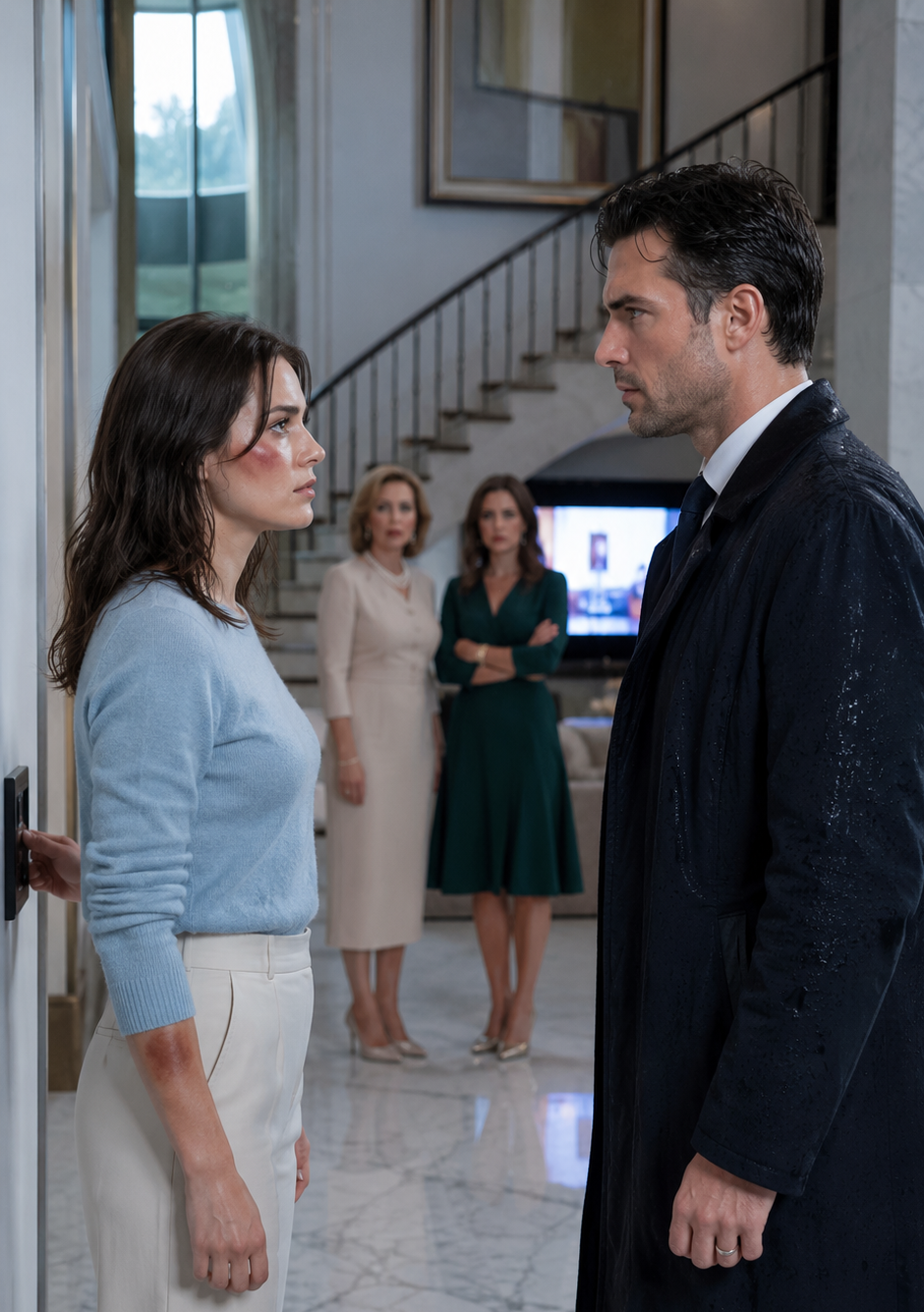
No One Leaves Until I Hear the Truth
Part 1
The makeup box struck the marble floor so hard that the mirror inside shattered.
“Cover those bruises and smile,” my mother-in-law hissed.
“Daniel is coming home, and you will not ruin this family with your pathetic face.”
Margaret stood over me in pearls and cream silk, perfectly composed.
Beside her, my sister-in-law Vanessa folded her arms, still wearing the heavy gold bracelet that had split my lip an hour earlier.
They had spent six days turning my own home into a prison while my husband was overseas — taking my phone, locking the gates, and demanding that I sign papers transferring my shares in Bellamy Medical Holdings to Vanessa.
They thought I was weak because I cried.
They had no idea I was counting.
Every threat.
Every signature they forged.
Every withdrawal from the company’s emergency fund.
Every blow.
“I won’t sign,” I whispered.
Vanessa crouched and gripped my chin.
“You already did.”
She waved a document in front of me.
My signature sat at the bottom, almost perfect.
Almost.
Margaret smiled.
“By tomorrow, Vanessa controls your voting shares.
Daniel will believe you had a breakdown and left voluntarily.
Men believe their mothers.”
My cheek throbbed, but I looked at the tiny red light beneath the antique clock on the wall.
Margaret had ordered the security system disconnected three days ago.
She did not know the visible cameras were decoys — or that I had designed the company’s fraud-monitoring network before marrying Daniel.
The backup system uploaded continuously to an encrypted server outside the house.
I lowered my eyes before she noticed my relief.
Then both women went silent.
Their faces drained of color as a suitcase rolled across the foyer.
I turned slowly.
Daniel stood in the doorway, rain on his coat, staring at the bruises covering my face and arms.
His gaze moved to the broken makeup box, the forged papers, then to his mother’s raised hand.
He closed the front door and turned the deadbolt.
“No one leaves,” he said quietly, “until I hear the truth.”
Margaret recovered first.
“Daniel, thank God.
She attacked us.
She has been unstable for days.”
Vanessa immediately began crying.
Daniel looked at me.
“Elena?”
For one dangerous second, I wanted to collapse into his arms.
Instead, I stood, though my knees trembled.
“Don’t ask them,” I said.
“Ask the house.”
Margaret’s smile vanished.
I reached beneath the clock, pressed the hidden panel, and the living-room television came alive.
On the screen, Vanessa struck me with the bracelet.
Margaret dictated the forged transfer.
Their voices filled the room, clear and merciless.
Daniel stared at them as if he had never seen them before.
But the recording was only the first thing I had prepared for them.
Part 2
Margaret lunged for the television, but Daniel stepped between us.
“Sit down.”
“You cannot speak to your mother that way,” she snapped.
“I can speak to an abuser any way I choose.”
Vanessa pointed at me.
“She edited it! She works with computers.
She manufactured everything because she hates us.”
That accusation might have worked on anyone else.
Unfortunately for them, I had spent twelve years investigating financial crimes for medical companies.
I knew how proof survived.
I opened the compartment behind the clock and removed a drive.
“This contains the original footage, authentication logs, cloud timestamps, and copies already delivered to my attorney,” I said.
“It also contains the documents you forged.”
Margaret laughed.
“Family disagreements are not crimes.”
“Assault is.
False imprisonment is.
Forgery is.
And stealing eight hundred thousand dollars from a public-health reserve is a federal offense.”
Daniel’s head snapped toward her.
Vanessa stopped crying.
Three months earlier, Bellamy Medical had discovered unexplained transfers from a fund for rural clinics.
Margaret chaired the charitable foundation controlling that account.
Vanessa served as its treasurer.
They blamed a junior accountant, who was fired before I quietly reopened the audit.
The money had purchased Vanessa’s condominium, Margaret’s jewelry, and a partnership in a luxury spa.
Daniel had returned two days early because I had sent him a scheduled message: Come home through the garden entrance and say nothing.
He had not known why.
I needed his reaction to be genuine, and I needed Margaret and Vanessa caught while they still believed they controlled him.
Daniel looked at me.
“You knew they might attack you?”
“I knew they would pressure me.
I did not know how far they would go.”
His voice broke.
“I should have protected you.”
“You should have believed me months ago when I told you the accounts were wrong.”
He flinched because it was true.
Margaret had called me jealous and controlling.
Vanessa said I wanted to steal the family company.
Daniel had asked me to let it go to keep the peace.
I had let him think I had.
Margaret rose slowly.
Her arrogance returned when she saw Daniel’s guilt.
“Your wife manipulated you.
Blood comes first.”
“No,” I said.
“Truth does.”
Outside, tires crunched across the gravel.
Blue and red light flashed through the curtains.
Vanessa rushed toward the back hallway, but the doors automatically locked.
The backup system had shifted the house into evidence-preservation mode.
Margaret stared at me.
“What did you do?”
“I gave my attorney permission to release the files if my biometric check-in failed.
You took my phone, so I missed two check-ins.”
The doorbell rang.
Detectives entered with warrants, followed by a financial-crimes investigator and two uniformed officers.
Vanessa screamed that she knew important people.
Margaret demanded Daniel dismiss everyone.
He did not move.
As an officer photographed my injuries, Margaret leaned close enough to whisper, “You think this ends with handcuffs? This family will destroy you.”
I met her eyes.
“This family,” I said, “belongs to me now.”
Part 3
Handcuffs make a specific sound.
Not dramatic.
A small metallic click, twice, like a door shutting on something that used to matter.
I had imagined this moment for four months and it still did not feel like winning.
An officer guided Vanessa toward the door.
She twisted around, mascara running, and screamed the only thing she had left.
“You’ll regret this, Elena.
You have no family without us.
You have nothing.”
I almost laughed.
Nothing was exactly what I had grown up with, and I had built an entire career out of it.
She did not know that.
She had never asked.
Margaret did not scream.
She simply stood very still while the second detective read her rights, watching me the whole time with an expression I had seen only once before — the night she found out I had a graduate degree in forensic accounting and had not told her.
Fear disguised as contempt.
“Elena,” she said, calm again, dangerously calm.
“You have won tonight.
But you should know — I built this family from nothing.
My husband gambled away half our fortune before he died, and I rebuilt it with these two hands.
Everything I did, I did to protect what I made.
What have you ever built that anyone could take from you?”
It was not an innocent question.
It was the one question that could still find the crack in me, because for eleven years the honest answer had been nothing, no one, no home of my own.
I had grown up in six different foster placements before I turned sixteen.
Not because I was difficult — because paperwork moved slower than money, and no one had ever fought hard enough to keep me anywhere.
I learned early that love was conditional and safety was temporary, so I built something no one could reassign or revoke: competence.
A skill so precise that institutions had to keep me.
I became the woman who found the fraud nobody else could find, who noticed the missing decimal point, who never let a room see her flinch.
That skill had saved my life tonight.
It had also cost me something I was only now willing to name.
“I built the proof that’s sending you to prison,” I said.
“That’s enough for one night.”
The detectives led her out.
The house went quiet in the specific way a house goes quiet after violence — the silence with a ringing underneath it.
Daniel sat down slowly on the bottom stair, his coat still dripping, and put his face in his hands.
“Twelve years,” he said.
“Twelve years I let her tell me who you were instead of asking you myself.”
I did not go to him.
This was the first choice of the night, and it was harder than pressing a hidden panel or handing a drive to a detective.
Every instinct in me wanted to sit beside him and say it’s fine, the way I had said it to every social worker, every temporary family, every person who had ever let me down and needed forgiving quickly so the discomfort would end.
I stayed where I was.
“I told you the accounts were wrong in March,” I said.
“I told you Vanessa was rerouting invoices in May.
I told you your mother had access to funds she shouldn’t have had in July.
Each time, you told me to let it go for the sake of peace.”
“I know.”
“You didn’t believe me.
You believed the version of me your mother gave you, because it was easier than believing your wife might be right about the people who raised you.”
His shoulders shook once.
When he lifted his head, his eyes were red.
“What do you need from me? Tell me and I’ll do it.”
“I don’t know yet,” I said, and it was the truth.
“I need you to sit with what you just watched.
Not explain it away tomorrow.
Not call it a misunderstanding at Thanksgiving next year.
Sit with it.”
He nodded, and for the first time in longer than I could remember, he did not try to fix it with words.
I went upstairs alone, locked the bathroom door out of habit rather than fear, and looked at my face in the mirror for the first time without an audience.
The bruise along my cheekbone had the shape of a bracelet clasp.
Beneath it, my own eyes looked back at me, dry.
I did not cry.
I had promised myself, six days ago on the first night they locked the gate, that I would not give them my tears while they could still use them as evidence of my instability.
Now that the danger had passed, I found I still did not have any to give.
Perhaps that would come later.
Perhaps it already had, in installments, over eleven quiet years of learning not to need anyone.
I thought of the second bowl of rice I had cooked every night that week out of pure habit, set across from my own at the table, then covered in plastic wrap and put away uneaten, because some part of me still expected Daniel to walk through that door and everything would go back to being simple.
Nothing was simple anymore.
I was not sure I wanted it to be.
I sat on the edge of the bathtub for a long time, listening to the house settle around me — the specific, unfamiliar sound of a house with no one left in it who wanted to hurt me.
It was a sound I had almost forgotten existed.
There was a scar on my left wrist, thin and old, from the third foster placement, the one with the woman who kept a garden and a temper in equal measure and confused the two so often that by age eleven I had learned to read a slammed cupboard the way other children read weather.
I had not thought of Mrs. Halloway in years.
I thought of her now, standing in my own marble bathroom with a Bellamy family bruise blooming under one eye, and understood something I had spent a decade avoiding: I had married into a house with locked gates and forged signatures because some buried part of me had recognized the shape of it immediately, the way you recognize a language you were never taught but somehow still speak.
 Her Neighbor Keeps Walking Around Barely Dressed, And She’s Considering Telling Her About The View
I did not tell Daniel that night.
I was not ready to hand him a wound that old, not while he was still holding his own mother’s handcuffs in his memory.
But I wrote it down, in the small notebook I had kept since I was fourteen, the one habit no foster home or husband had ever managed to take from me.
Some things you survive twice, I wrote.
Once when they happen, and once when you finally say them out loud.
Downstairs, I heard Daniel moving through the kitchen, opening cabinets he had not opened in years, looking, I realized later, for the box of tea I used to make him when he couldn’t sleep — a small, ordinary kindness from a marriage that had somehow continued underneath all the wreckage.
He did not find it.
Margaret had thrown it out months earlier, calling it clutter, the same week she had started calling me unstable to anyone who would listen.
I went down eventually, not because I had decided to forgive him, but because a house this large should not hold two people awake and alone in separate rooms after a night like that.
He was sitting at the kitchen table with his coat finally off, staring at nothing.
“I called Whitford,” he said, without looking up.
“Before the police even arrived.
I don’t know why.
I think some part of me knew the board would need to hear it from me directly, and I think another part of me was afraid if I didn’t say it out loud to someone else immediately, I’d find a way to talk myself out of believing what I’d just seen.”
“What did you tell him?”
“That my mother and my sister had been keeping my wife prisoner for six days, and that I intended to press every charge the law allowed, personally, regardless of what it did to the family name.” He finally looked at me.
“I meant it.
I still mean it in the morning.
I need you to know that, because I understand you have no reason yet to believe anything I say will still be true tomorrow.”
It was not an apology.
It was better than one — it was a testable claim, something I could watch prove itself true or false over the weeks ahead instead of a sentence designed to end the conversation.
I had spent my whole life distrusting words that were only meant to produce comfort.
This was the first thing he had said to me in months that sounded like it was meant to produce accountability instead.
“Ask me again in a year,” I said, “whether you still mean it.
That answer will matter more than tonight’s.”
He nodded, and something in his face suggested he understood, for the first time, that I was not asking him to fix anything quickly.
I was asking him to be a different kind of man for longer than a single crisis required.
Part 4
The company did not survive the scandal quietly, and neither did our marriage — not in the shape it had been.
Bellamy Medical’s board called an emergency session two days after the arresTS. I sat across from nine men and women who had spent a decade treating me as Daniel’s wife first and the company’s head of internal audit second.
This time, they needed me more than they needed him.
“The foundation’s accounts are compromised beyond salvage,” I told them.
“Eight hundred thousand from the rural clinic reserve.
Another three hundred thousand we haven’t traced yet, moving through two shell accounts registered to Vanessa’s spa partnership.
I recommend a full forensic audit, immediate freezing of remaining foundation assets, and a public statement before the press finds it first.”
“You built this case entirely on your own,” said Whitford, the oldest board member, the one who had always called me “Daniel’s Elena” instead of by name.
“While your husband was traveling.
While you were —” he gestured vaguely at my healing cheek “— dealing with that.”
“I built it because no one else would look,” I said.
“I’m asking the board to look now.”
They voted seven to two to appoint me interim director of compliance, reporting directly to the board rather than to Daniel.
It was not a gift.
It was the board recognizing, finally, what I had been for a decade — not an accessory to the family name, but the only person in the building who had never once lied to them.
Daniel did not fight the appointment.
That surprised me more than anything Margaret had done.
“You should have had this role three years ago,” he said afterward, in the parking garage, both of us still in the clothes we’d worn to the hearing.
“I let my mother tell the board you weren’t executive material.
I never once said otherwise.”
“Why?”
He was quiet long enough that I thought he wouldn’t answer.
“Because if you had power in this company independent of me, I think some part of me was afraid you wouldn’t need me anymore.
And I was raised by a woman who taught me that being needed is the only kind of being loved that lasTS.”
It was the most honest thing he had said to me in three years of marriage, and it explained more than an apology would have.
Margaret had raised him on a single unbending rule: loyalty means obedience, and love is a debt collected.
He had spent his whole life paying it, and passing the collection notice to me without realizing it.
I did not forgive him in the parking garage.
That would have been too fast, too easy, exactly the kind of quick peace he had always wanted from me and exactly what I refused to give either of us this time.
“I hear you,” I said instead.
“That’s different from I forgive you.
I need to see it, Daniel.
Not for a week.
For a long time.”
He nodded like a man accepting a sentence rather than a chance, which told me he finally understood the difference.
The trial preparation stretched into a slow, grinding autumn.
Vanessa’s attorney tried three separate times to have the video evidence suppressed, arguing the home surveillance violated her privacy.
Each motion failed, because I had installed the backup system two years earlier for exactly this kind of contingency, with legal counsel reviewing every clause of consent buried in the household security agreement Margaret herself had signed without reading.
She had never read anything I gave her to sign.
She assumed, as she assumed most things about me, that I lacked the imagination to plan further ahead than she did.
Vanessa called me once from a number I didn’t recognize, out on bail, her voice thin and different from the woman who had struck me with a gold bracelet.
“You could still drop the personal charges,” she said.
“The company case can go forward without you testifying about the assault.
Please, Elena.
Prison changes people.
I’ve read about it.”
“You should have thought about that before you split my lip and forged my signature,” I said.
“You don’t understand what it’s like to grow up compared to someone your whole life.
Margaret always said Daniel married beneath the family, and I was supposed to prove I was worth more.
I was trying to prove I was worth something.”
For one unguarded second, I almost understood her — the wound was real, even if the choices built on top of it were indefensible.
She had spent her whole life being told her value was conditional on outperforming someone else, and when that someone else turned out to be the wife everyone underestimated, something in her had broken in a direction that hurt other people instead of her.
“I understand it better than you think,” I said.
“I was told my whole childhood that I wasn’t worth keeping.
I never once decided that made it acceptable to hurt someone weaker than me to prove otherwise.”
She hung up without answering, and I let her.
Whitford requested a private meeting with me in late November, in a coffee shop three blocks from the office rather than in a boardroom, which told me before he said a word that this conversation was not entirely about the audit.
“I called you Daniel’s Elena for ten years,” he said, turning his cup slowly on the table without drinking from it.
“I want you to know I’ve thought about why.
It wasn’t only Margaret’s doing.
I looked at a woman half my age with better instincts than the entire finance committee, and it was easier to file you under ‘wife’ than to admit the company had been underusing you the whole time because your husband’s name was easier to say than your credentials.”
“You don’t owe me an apology for that specifically,” I said.
“You owe the rural clinics an audit that actually catches the next Margaret before she does eight hundred thousand dollars of damage instead of after.”
“I’m proposing exactly that.
A standing forensic review board, independent of family leadership, reporting directly to shareholders.
I’d like you to design it.” He paused.
“I’d also like to say, off the record, that I’m sorry it took a felony in your own living room for this company to finally listen to you.”
It was not the apology I had needed six days locked behind a gate, but it was, I was beginning to understand, the only kind of apology institutions were built to give — structural, delayed, arriving in the form of authority rather than remorse.
I decided I could work with that.
I had spent my whole life learning to extract what was useful from people who would never give me what I actually wanted, and this, at least, was useful.
I began seeing a therapist that same month, a quiet, unhurried woman named Dr. Okafor who did not flinch when I described the six placements or the notebook or the particular calm I had felt watching Margaret’s face drain of color under the television light.
Most people, when I told that part of the story, wanted to reassure me that the calm was justified, that I had earned it, that anyone would have felt the same satisfaction.
Dr. Okafor did not do that.
“You don’t have to justify feeling something to be allowed to feel it,” she told me, in our fourth session.
“You can have wanted her caught, and planned for months to catch her, and also grieve that you had to become someone capable of that kind of patience in order to survive your own home.
Both things are true.
Neither one cancels the other.”
It was the third choice of that season, quieter than the ones in the living room or the courtroom, and it took me longer to make than either: the choice, every week, to sit in that office and let someone see the parts of me I had built my entire adult life to make invisible.
I had survived by being unreadable.
Healing, it turned out, required the opposite skill entirely, and I was slower to learn it than I had ever been at anything in my professional life.
Daniel came to two sessions that winter, at Dr. Okafor’s suggestion, and sat mostly in silence, listening to me describe, for the first time in his hearing, exactly what those six days in the locked house had done to the part of my mind that still, at thirty-one years old, expected safety to be temporary.
He did not try to defend himself once.
When the second session ended, he waited until we were in the parking lot to speak.
“I keep thinking about how many times you must have told yourself, growing up, that no one was coming,” he said.
“And then you married into a family that proved you right for three years before I finally showed up.”
“You showed up,” I said.
“That’s not nothing.”
“It’s not enough, either.
Not yet.”
“No,” I agreed.
“Not yet.”
Part 5
The trial in February was shorter than I expected.
Video evidence has a way of shortening things.
Margaret’s attorney tried one final argument in his closing statement, and it was, infuriatingly, not entirely wrong: “This case will be remembered as a story about a cruel mother-in-law.
But somewhere in that house, a wife who says she was powerless installed a professional-grade surveillance system, hired a private attorney months in advance, and orchestrated the precise moment of her husband’s return down to the entrance he used.
Ask yourselves whether a woman capable of that kind of control was ever truly a victim, or whether she simply won a war she’d already been planning.”
I watched the jury’s faces shift, just slightly, toward doubt.
He was not entirely wrong, and that was what made it dangerous.
I had planned.
I had waited.
I had, on some nights during those six locked-gate days, felt less like a victim gathering evidence and more like a general waiting for the battlefield to tilt in her favor.
There were choices I made in that house — letting Daniel walk in without warning him, letting the beating continue those final ten minutes so the footage would be undeniable instead of ambiguous — that I would carry for the rest of my life, because they were the coldest, most calculated decisions I had ever made about my own body.
This was the second choice of the trial, harder than staying silent on the stairs: whether to explain that calculation to the jury, and risk sounding as ruthless as the woman on trial, or to let the attorney’s framing stand unanswered and hope the video spoke for itself.
I asked to testify again, out of order, over my own attorney’s hesitation.
“He’s right that I planned,” I told the jury, my voice steadier than I felt.
“I did not plan to be assaulted.
I planned for what to do once I understood it was already happening and would keep happening until I had proof no one could argue away.
There’s a difference between engineering a crime and refusing to let a crime disappear.
I chose the second one, because the first time I told the truth about this family with no proof, I was called unstable and asked to apologize.”
Whitford, sitting in the gallery as a witness for the prosecution, later told me it was the sentence that turned three uncertain jurors.
Margaret took the stand in her own defense on the trial’s final day, and for a moment, watching her walk to the witness box in the same composed silk she had worn the night she threw the makeup box at my feet, I felt something close to respect for how completely she still believed her own story.
“I never touched her,” she told the jury, which was technically true and legally irrelevant.
“I asked her to compose herself before her husband returned from a difficult trip.
Is that a crime now — asking a woman to have some dignity?”
“Mrs. Bellamy,” the prosecutor said, “did you order the household security system disconnected?”
“I ordered privacy restored to my own home.”
“Did you dictate the terms of a document transferring your daughter-in-law’s company shares to your daughter, while your daughter-in-law had visible injuries and no phone with which to call for help?”
Margaret’s composure held, but her hands, folded in her lap, tightened around each other.
“I was protecting this family’s legacy from a woman who had already threatened to destroy it.”
“By what act had Elena Bellamy threatened the family?”
There was a pause, the first one all trial, long enough that even the jury seemed to lean forward.
“By existing,” Margaret finally said, “in a place she had not earned.”
It was the closest thing to a true confession she gave in three days of testimony, and it landed harder than any piece of financial evidence had, because it confirmed what I had suspected for three years and never been able to prove in a way anyone besides me would believe: that no accounting of my competence, no audit I ever completed, no year of marriage I survived, would ever have satisfied her, because the offense had never been my performance.
It had been my presence.
I watched Daniel’s face when she said it.
Something in him finally closed, the way a door closes not in anger but in simple, permanent recognition that it will not be opened again.
Margaret received six years for financial fraud and conspiracy; the assault and false imprisonment charges added four more, to run consecutively.
Vanessa took a plea agreement — two years, restitution, and a lifetime ban from any position with fiduciary responsibility.
She would not look at me when the judge read the sentence.
I found I did not need her to.
Outside the courthouse, reporters shouted questions about the Bellamy family legacy.
Daniel stood beside me, close but not touching, which had become its own kind of language between us over the past five monThS. He had gone to therapy every week since October, first alone, then twice with me, learning slowly how to tell the difference between keeping peace and keeping silence.
“Any statement, Mrs. Bellamy?” a reporter called.
I thought of the second bowl of rice, wrapped and thrown away months ago.
I thought of a girl in six different bedrooms who had promised herself that one day, no one would be able to decide her worth for her again.
“The company will publish the full audit next week,” I said.
“Everything else is private.”
Part 6
Spring came slower that year than any I remembered, but it came.
I stayed on as director of compliance, then, in April, the board offered me the chief operating officer position outright — not as Daniel’s wife, but as the person who had rebuilt the foundation’s accounts from the wreckage, restructured the audit division, and personally repaid, out of her own settlement from the civil suit against Margaret’s estate, the last forty thousand dollars still owed to a rural clinic in Millbrook that had gone eleven months without a functioning ultrasound machine because of the theft.
I kept that particular receipt.
Not out of sentiment.
Out of habit — the same habit that had once made me photograph every bruise, timestamp every threat, save every scrap of proof that my life mattered enough to document.
Some habits, it turned out, did not need to disappear once the danger did.
They simply changed jobs.
Daniel and I did not divorce, though for three months in the winter I genuinely believed we would.
What kept us together was not a single conversation, the way the guides on marriage after betrayal always promised it would be.
It was a hundred small ones.
It was him calling his mother’s remaining lawyer to formally withdraw from any inheritance tied to the frozen foundation assets, without asking me to approve it first, simply because it was right.
It was me, in March, finally telling him about the six foster homes, the specific bedroom in the fourth one where I had first learned to lock a door from the inside for my own protection, and watching him listen without trying to fix it.
“I used to think loving someone meant keeping them comfortable,” he told me one night in May, both of us on the back porch, the garden entrance he’d walked through that November night now edged with the first tulips I’d planted myself.
“I understand now that sometimes it means being willing to hear something that isn’t comfortable at all, and staying in the room anyway.”
“You did stay,” I said.
“That night.
You locked the door instead of walking away from what you saw.”
“That’s the only decision I made correctly in three years.”
“It was the one that mattered most.”
I will not say the marriage that survived was the same one I entered.
It was smaller, in some ways — fewer family dinners, no more pretending Margaret’s version of hospitality was warmth, an empty chair at holidays that used to belong to a woman now three states away in a federal facility, writing me letters I did not open.
It was also, in the ways that counted, larger than it had ever been.
Daniel asked before he assumed.
I told the truth before I was cornered into it.
Neither of us mistook silence for peace anymore.
The gold bracelet Vanessa had worn that night sat, for a while, in an evidence locker, then came back to me as part of the settlement, because it had been purchased with stolen foundation money and the court ordered it liquidated for restitution.
I sold it myself, in person, and used the proceeds to fund a small women’s shelter two towns over — the kind of place that would have changed everything for a sixteen-year-old girl who once had nowhere else to go.
I did not tell anyone at the company where the money came from.
Some proof does not need to be displayed to matter.
Some of it is enough just to know you kept it, and used it, and finally let it close.
On the anniversary of that November night, I stood in the kitchen and, without quite deciding to, cooked enough rice for two people.
This time, when Daniel came home, both bowls were eaten.
That was the whole of the truth I had wanted the world to hear a year ago, distilled down to something almost too small to notice: not the arrests, not the audit, not even the justice, satisfying as it had been.
Just two full bowls at one small table, and a door that finally, honestly, no longer needed to be locked to keep either of us safe.
I still have the notebook.
It sits in the drawer of my desk at the office now, not hidden beneath a clock but in plain sight, because I no longer need to keep proof of my own life a secret from the people around me.
Some evenings I open it and read the entry from that November night — three lines, written in handwriting so unsteady I can barely make out my own words — and I am reminded that survival and healing are not the same accomplishment, even though for a long time I believed one guaranteed the other.
It did not.
I am, most days, still learning the second one.
Vanessa wrote to me once, from the minimum-security facility upstate, a single page asking whether I would consider a character reference for her parole hearing in three years.
I have not decided yet whether I will write it.
Dr. Okafor tells me I don’t need to decide today, and for the first time in my life, I am letting a deadline simply not exist rather than manufacturing one out of old habit.
Margaret has not written at all.
I think, in her own rigid way, that silence is the only form of consistency she has left to offer, and I have stopped waiting for it to become anything else.
The garden entrance Daniel walked through that night is where we married again, quietly, on the second anniversary of the arrests — not because the law required a second ceremony, but because both of us wanted one memory in that doorway that did not belong to Margaret.
Just tulips, and two people who had finally learned that peace built on silence is not peace at all, only a longer, quieter kind of war.
I keep one more object now, in the same drawer as the notebook: the small red decoy light from beneath the old antique clock, disconnected and harmless, a museum piece from a night I no longer need to relive to remember.
Some people keep wedding photographs on their desks.
I keep a piece of surveillance equipment that once meant the difference between being believed and being erased.
It suits me better than any photograph ever could.
— End —