
I Buried My Name the Day I Married Him — Tonight I Dug It Back Up
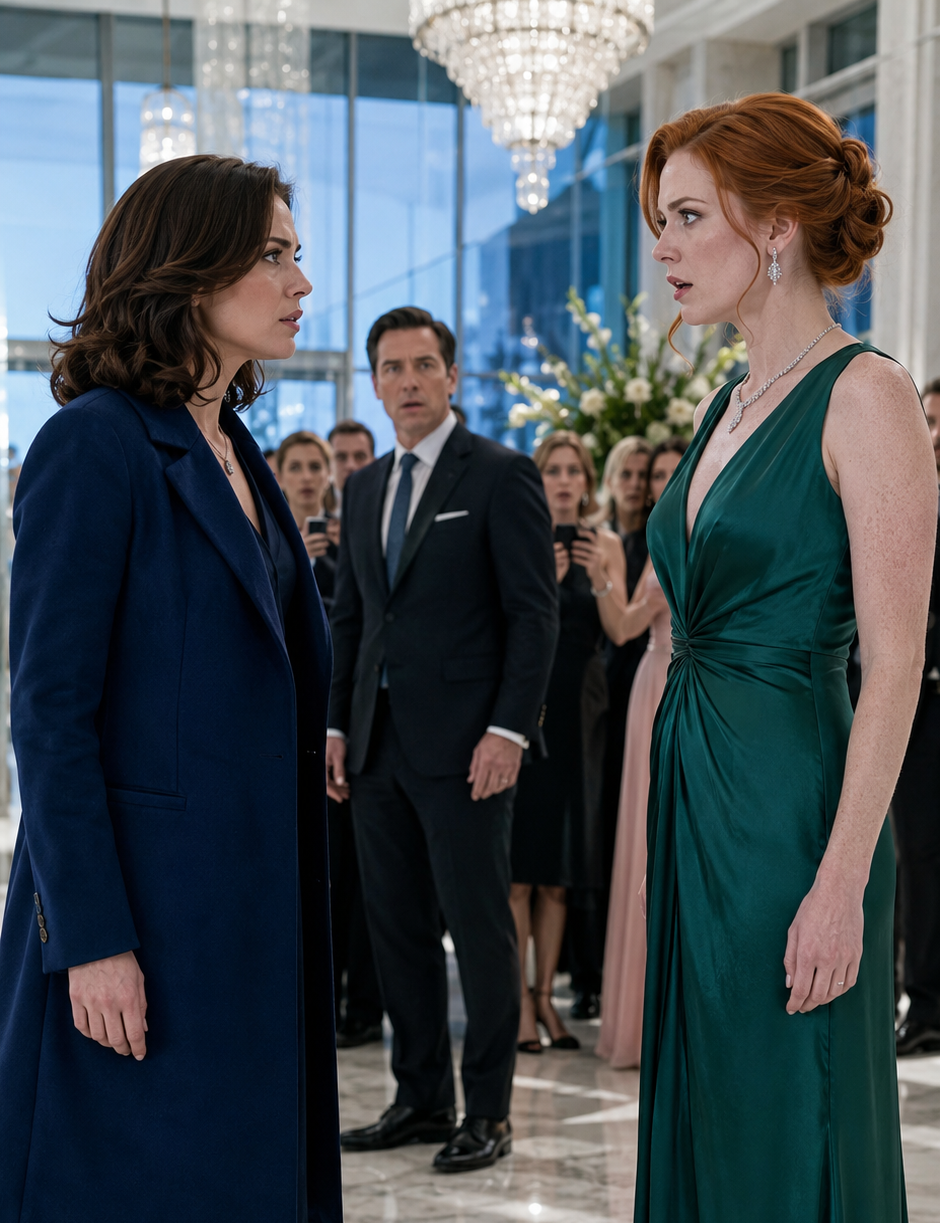
“My goodness, Julianne.
What are you doing here?” Khloe drawled, evaluating my off-the-rack coat with undisguised contempt.
“The gala is strictly restricted to invited corporate guests and legitimate family.”
“I brought Lily down to surprise Mitch,” I replied, holding my six-year-old daughter’s hand.
She was clutching a handmade paper necklace for her father.
Khloe’s laughter was a brittle, ugly sound.
“Surprise him? Your presence here is a massive liability.
The executive vice president’s real family is already networking upstairs.
His gorgeous fiancée, his brilliant young son, and his future in-laws.”
The air in my lungs turned to ash.
“Having you loitering down here is extremely distasteful,” she projected to the staring socialites.
“Leave before I call security.”
“Mommy, where’s Daddy?” Lily whimpered, burying her face in my coat.
Her trembling voice severed my paralyzing shock.
A dormant, tectonic rage began to rumble deep within my chest.
I dropped to one knee to cover Lily’s ears, then stood up, locking my gaze onto Khloe’s smirk with a clarity so freezing it could shatter glass.
I pulled out my phone and dialed the private, encrypted line of the most dangerous fixer on the eastern seaboard.
“Who are you calling?” Khloe sneered.
“Your poor mother in the suburbs to cry about it?”
She had no idea that my maiden name was Vance.
Julianne Vance.
In the United States, anyone operating within high finance, federal politics, or elite commercial real estate spoke the Vance name with hushed, absolute reverence.
We were an old-money empire.
I was the youngest sibling to three titans: Arthur Vance, a prominent U.S.
senator; Edward Vance, executive vice president of Sovereign Heritage Trust; and Victor Vance, the CEO of Vance Capital and the undisputed shadow-king of corporate fixers.
I had hidden my lineage from Mitchell to ensure he loved me for me.
My brothers had furiously opposed the marriage but ultimately respected my stubbornness, secretly subsidizing his failing firm so he could play the successful provider.
The dial tone rang once.
A click echoed through the earpiece.
“Jules?” Victor’s deep, razor-sharp voice materialized, instantly detecting the abnormal silence on my end.
“What’s wrong?”
I stared at Khloe, the storm brewing in my eyes matching the hurricane outside.
Victor’s voice sharpened instantly.
“Jules, tell me who touched you.”
“No one touched me,” I said, keeping my eyes on Khloe.
“But Mitchell has another family upstairs.”
Silence filled the line.
Not surprise.
Calculation.
Behind Khloe, two security guards moved closer, encouraged by her smug expression.
“Remove her,” she ordered.
“And don’t let the child cause a scene.”
Lily pressed the paper necklace against her chest.
“Mommy, is Daddy mad at us?”
I covered her ears gently, then lowered my voice.
“Victor, I want the house dismantled.”
Khloe laughed.
“You’re threatening private property now?”
Victor heard her.
“Which house?” he asked.
“The Halston estate on Briar Ridge.
Every contract, permit, mortgage, shell company, and concealed account connected to it.”
His answer came without hesitation.
“Give me twenty minutes.”
“Make it ten.”
I ended the call.
Khloe’s smile weakened, but only briefly.
“You really expect us to believe that performance?”
“No,” I replied.
“I expect you to remember it.”
A sudden commotion erupted near the ballroom stairs.
Executives began checking their phones.
A gray-haired director stumbled toward the reception desk, his face drained of color.
“Our accounts are frozen,” he whispered.
Another man shouted from the mezzanine.
“The city revoked the occupancy permit!”
The music stopped.
Conversations fractured into panic.
Khloe stared at me.
“What did you do?”
Before I could answer, the elevator doors opened.
Mitchell stepped out beside a glamorous red-haired woman and a boy of perhaps eight.
His hand rested possessively at the woman’s waist.
Lily pulled away from me before I could stop her.
“Daddy!”
Mitchell froze.
The handmade necklace slipped from her fingers and landed between us.
For one terrible second, no one moved.
Then the boy beside him looked at Lily and frowned.
“Dad,” he asked loudly, “who is she?”
Mitchell’s fiancée turned toward me, confusion flickering across her face.
But it wasn’t guilt.
It was recognition.
She stared at my necklace — the Vance family crest hidden beneath my coat — and suddenly went pale.
“You’re Julianne Vance,” she whispered.
Then she stepped away from Mitchell.
“No,” she said, her voice trembling.
“He told me you were dead.”
Behind us, black SUVs surrounded the building.
And the man who entered first wasn’t Victor.
It was my eldest brother, Senator Arthur Vance, carrying a federal warrant with Mitchell’s name on it.
Nobody in that lobby moved.
Somewhere behind the reception desk, a phone kept ringing and ringing, and no one picked it up.
Six years earlier, Mitchell Reyes had told me his one rule for love: no titles, no ledgers, just us.
He’d said it over cheap diner coffee, both of us twenty-six and broke on paper, and I had believed him so completely that I let him build our whole marriage on a lie of omission.
I never told him what my last name used to be worth.
I told myself that was romantic.
I told myself that was proof he loved me.
I understand now that it was proof of something else: that I was so afraid of being loved for my money instead of my face that I had handed a man six years, a daughter, and a version of myself with the load-bearing walls removed.
Arthur crossed the lobby floor like weather arriving.
He did not look at Mitchell first.
He looked at me, then at Lily, still frozen with her hand outstretched toward the necklace on the marble.
“Jules.” His voice, so different in person than on television, was almost gentle.
“Take her outside.
This part isn’t for her.”
I picked Lily up.
She weighed nothing and everything.
“Mommy,” she said into my collarbone, “Daddy didn’t say hi.”
“I know, baby.”
Behind me, I heard Arthur’s voice change register, the senator’s warmth curdling into the prosecutor’s precision.
“Mitchell Reyes.
Federal Bureau of Investigation.
You’re being detained pending charges of wire fraud, falsification of federal disclosure statements, and misappropriation of funds from Sovereign Heritage Trust.”
“That’s insane,” Mitchell said.
I heard the particular pitch of a man discovering, in real time, that his floor had become a trapdoor.
“I run legitimate acquisitions for—”
“For a firm that exists because my sister quietly wired eleven million dollars into it through three shell entities so you could believe you built it yourself,” Arthur said.
“We have the wire transfers.
We have the falsified investor documents you used to secure additional capital under her name without her knowledge.
We have the second mortgage you took out on a house she has never once set foot in.”
The redheaded woman — Vanessa, I would learn her name was Vanessa — made a small, wounded sound.
I did not stay to watch the rest.
I carried my daughter out into the freezing October air, past the black SUVs, past the doorman who did not know whether to bow to me or call the police on me, and I sat her on the low stone wall outside the building and held both her small cold hands in mine.
“Is Daddy going to jail?” she asked.
There is no version of that question that a six-year-old should have to ask her mother in a cocktail dress on a Tuesday night.
I did not lie to her.
I have spent my whole life around men who lied smoothly, beautifully, and I promised myself in that moment on the cold stone wall that I would not become one of them, not even to spare her the truth.
“I don’t know yet,” I said.
“But whatever happens, you and I are going to be okay.
That part I do know.”
She considered this with the terrible gravity only children have.
“Uncle Victor will fix it,” she decided.
“Uncle Victor,” I said, “fixes buildings and companies.
Not people.”
She didn’t understand that yet.
I wasn’t sure I fully understood it myself.
My phone buzzed.
Victor.
Ten minutes, like you asked.
The Halston house’s title reverted to a Vance Capital holding company eleven months ago when Reyes defaulted on the second loan he took against it without telling you.
Legally, it was never his to give another woman as a wedding gift.
I had the locks changed at 8:47 tonight.
I read that twice.
He’d changed the locks on the house Mitchell had promised Vanessa before he’d even walked into this building.
He must have started the moment I called.
Victor, I typed back, I didn’t ask you to move on the house.
I asked you to gather the documenTS.
You asked me to dismantle it, he wrote.
I dismantled it.
You can be angry with me tomorrow.
Tonight, go home.
Arthur has the rest.
I should have been angrier.
I found, instead, that I was crying — not from grief, exactly, but from the specific vertigo of watching six years of careful smallness collapse in under an hour, and discovering underneath it a self I hadn’t used since college.
She had teeth.
I had forgotten she had teeth.
Edward called at midnight, once Lily was asleep in the guest room at my apartment, the one with the low ceiling and the water stain shaped like a rabbit that she liked to point at.
My brother’s voice on the phone was quieter than Arthur’s, quieter than Victor’s — Edward had always been the one who did the actual arithmetic of our family’s damage, the one who read the fine print none of the rest of us wanted to.
“You never told him,” Edward said.
Not a question.
“No.”
“Six years, Jules.”
“I know how long it was, Edward.” I sat at my kitchen table, the one Mitchell and I had bought secondhand and refinished together in the first apartment, back when refinishing furniture felt like a romantic act instead of a warning sign that we could not afford new things and were pretending that was a lifestyle choice.
“I didn’t hide it because I was ashamed of it.
I hid it because I watched what happened to you.
What happened to Arthur’s first wife.
What happened to every woman who dated Victor before he decided love was a liability he could no longer afford.
I didn’t want to become a line item in someone’s business plan.”
 Man Refuses To Let Girlfriend’s Sister Stay After She Disrespects Him In Front Of Family
“Instead you became invisible in your own marriage.”
That landed exactly where he intended it to.
“He has a second family, Edward.
A whole second life.
A fiancée who thought I was dead.
A son who doesn’t know my daughter exisTS. Don’t lecture me about what invisibility cost me.
I know precisely what it cost me.
I’m asking what it’s going to cost him.”
There was a pause, the particular pause of a man deciding how much truth a person can hold at midnight.
“Twenty to thirty years, if the fraud charges alone stick, which they will.
Vance Capital’s lawyers built the case airtight before Arthur ever walked in that door.
He used your name — your actual legal name, on documents you never signed — to secure loans he then used to fund a life with another woman.
That’s not just betrayal, Jules.
That’s a federal crime with your signature forged on it.”
I hadn’t known that part.
The floor under my careful anger tilted again, opening onto something colder.
“He forged my name?”
“Multiple times.
We found it three hours ago.
I wasn’t going to tell you tonight, but you’d have found out tomorrow and I’d rather you hear it from me than from a headline.”
I thought of every document I had ever signed at our kitchen table without reading closely, trusting the marriage more than I read the fine print, and I understood with sudden, sick clarity that my carefully hidden identity had not protected me from being used.
It had simply made me a more convenient tool to use, because a Vance who insisted on invisibility left a very large, very quiet space for someone else to fill in her name.
“There’s something else,” Edward said.
“Vanessa Cole — the fiancée.
Her father is Richard Cole, majority stakeholder in Halcyon Partners.
Mitchell wasn’t just marrying up for love, Jules.
Halcyon has been trying to acquire distressed logistics companies for two years, and a Vance-adjacent marriage would have made him untouchable to due diligence.
He needed your money to look successful enough to attract Vanessa.
He needed Vanessa’s family to launder that success into legitimacy.
You weren’t collateral damage, Jules.
You were the seed capital in a plan you never knew you were funding.”
I sat with that for a long moment, in my dim kitchen, listening to my daughter breathe through the baby monitor I still hadn’t taken out of the guest room, six years after she’d outgrown the crib.
“Thank you for telling me straight,” I said finally.
“That’s the only way I know how to love anybody,” Edward said, and for the first time all night, I heard something almost like tenderness under the ledger-keeper’s voice.
“Get some sleep, Jules.
Tomorrow’s going to be worse before it’s better.”
Vanessa Cole came to my apartment three days later, without calling first, wearing sunglasses indoors and no makeup, which told me more about her state of mind than anything she could have said.
I almost didn’t let her in.
Lily was at my mother’s house in Connecticut for the week — my mother, who had never once in twenty-nine years asked me to prove I loved her by using the family name, who had simply held me on the phone the night of the gala and said, “Bring her here, I’ll teach her how to make the bread,” as though a six-year-old’s entire universe hadn’t just cracked open.
I let Vanessa in because she was crying in a way that didn’t look performed, and because some old, unhelpful part of me still believed that women owed each other clarity even when men had denied them all of it.
“I didn’t know about you,” she said, before I’d even closed the door.
“I want you to believe that.
I need you to believe that.”
“I believe you,” I said, and meant it.
“You looked at my necklace like you’d seen a ghost, not a rival.”
She sat down without being asked, on the same secondhand couch Mitchell and I had bought at a flea market in our third year of marriage.
“He told me he’d been married before.
Briefly.
That his first wife died in a car accident two years before we met.
He had a whole story.
A cemetery he said he visited on her birthday.
I used to feel guilty for being jealous of a dead woman.”
“I’m not dead.”
“I can see that.” A short, wrecked laugh.
“My son thinks his father has been visiting his stepbrother’s grave for two years.
He’s eight.
He drew a picture for the anniversary once.
A little headstone with flowers.” She pressed the heel of her hand against her mouth.
“I don’t even know what’s real anymore.
Is my engagement real? Is the house real? My father invested four million dollars in Mitchell’s firm based on the story that he was a self-made man who’d overcome tragedy.
Was any single piece of that true?”
“The house isn’t yours,” I said, gently as I could manage.
“Legally, it reverted to a Vance Capital holding company months ago.
He mortgaged it without telling either of us.
I’m sorry.
I know that’s not the worst thing you’re going to hear this week, but I’d rather you hear it from me before the paperwork does.”
She looked at me for a long moment, red-rimmed eyes assessing something in my face I couldn’t name.
“You’re not gloating,” she said, sounding almost confused by it.
“I thought you’d want to gloat.”
“I did, for about six hours,” I admitted.
“Then I remembered you have an eight-year-old who thinks he has a dead stepbrother, and I have a six-year-old who watched her father not say hello to her in a marble lobby, and I couldn’t find the gloating anymore.
There wasn’t room for it.”
Vanessa was quiet for a while, twisting the enormous ring on her finger — a ring, I now understood, funded by money my brothers had quietly poured into Mitchell’s firm believing they were subsidizing my happiness.
“What do the kids do now?” she asked finally.
“Sebastian and — Lily, is it? They’re going to find out about each other eventually.
What do we tell them?”
It was, I realized, the first genuinely useful question anyone had asked me since the gala.
Not how do we destroy him, not how do we protect the family name.
Just: what do we tell the children, who did none of this and will carry all of it.
“I don’t know yet,” I said.
“But I think it should be the truth.
Just — smaller than the whole truth, and kinder than the version their father would tell it.”
She nodded slowly, and something in her posture eased, just slightly, the posture of a woman who had come braced for a fight and found, instead, an unlikely ally.
“For what it’s worth,” she said at the door, “he talked about you sometimes.
Drunk, mostly, late at night.
He never used your name.
He called you ‘the one who saw through me before I built anything worth seeing.’ I thought it was about the dead wife.
I think now it might have been about you.”
I closed the door after she left and stood very still in my own hallway for a long time, holding that sentence like a coal I couldn’t decide whether to drop.
Khloe Whitfield resigned from Sovereign Heritage Trust the week after the gala, before anyone could fire her, which I understood immediately as the maneuver of a woman who had survived worse falls before and knew that resignation looked like choice while termination looked like guilt.
I hadn’t expected to hear from her again.
She called Edward’s office instead, asking — through his assistant, careful even in defeat to preserve some scrap of the hierarchy she’d built her whole identity around — for ten minutes of my time.
I almost said no.
Then I thought of the way she’d looked at Lily in that lobby, not with cruelty exactly, but with the particular contempt of someone who believed rank was the only honest currency in the world, and I decided I wanted to look at that contempt again, up close, now that it had nothing left to stand on.
She met me at a coffee shop three blocks from the building she no longer worked in, dressed down in a way that looked like a costume of humility rather than the real thing.
“I want you to know I didn’t know the full extent of it,” she said, before I’d even sat down.
“I knew there was another wife.
I didn’t know about the forged documenTS. I didn’t know about the fraud.”
“You called my daughter a scene to be managed,” I said.
“You called me a liability standing in a lobby with a six-year-old holding a paper necklace.
I’m not here to relitigate what you did or didn’t know about the money, Khloe.
I’m here because I want to understand why you thought that was an acceptable thing to say to a child’s mother, regardless of whose money was involved.”
She was quiet for a moment, turning her coffee cup a slow quarter-turn, the kind of gesture people make when they’re deciding whether to perform contrition or defend themselves, and haven’t yet chosen.
“Because I believed him,” she said finally.
“Completely.
He told me you’d left years ago — walked out on him and Lily both, some story about postpartum depression and an affair, and that Vanessa was the one who’d stayed and rebuilt everything with him.
I thought I was protecting a good man’s family from an unstable ex-wife making a scene at the worst possible moment.
I have spent eleven years at that firm learning that loyalty to the people above you is the only thing that gets you promoted.
I gave Mitchell that loyalty completely, and it turns out he’d built an entire fiction just to make sure people like me would defend him without ever needing to ask a single real question.”
It was, I recognized slowly, almost exactly the same trade Mitchell had made with everyone in his orbit — trading a convincing story for unearned protection, over and over, in every direction he could reach.
Khloe hadn’t been evil.
She had been useful to him in precisely the way I had once tried to make myself useful to no one at all, and we had both ended up, by different roads, standing in service of a lie neither of us had built.
“I’m not going to tell you that makes it acceptable,” I said.
“You looked at a six-year-old’s necklace like it was garbage on your floor.
That wasn’t loyalty.
That was cruelty you’d trained yourself not to notice because it was convenient not to.
But I believe you didn’t know about the fraud.
And I’m not interested in destroying you the way Vance Capital could, if I asked them to.”
“Why not?” she asked, and there was something almost naked in the question, as though she’d expected punishment and didn’t know what to do with its absence.
“Because I spent six years making myself smaller so no one would ever look at me and see a target,” I said.
“And I watched what that cost me.
I’m not interested in spending the next six years making myself bigger just to prove I can flatten people who were cruel to me once.
That’s Mitchell’s whole story, Khloe.
Prove your worth by what you can dismantle.
I’d rather prove mine by what I choose not to.”
She didn’t thank me.
I hadn’t expected her to.
But something in her shoulders came down half an inch, the posture of a person setting down a weight she hadn’t realized she was still braced to carry, and when she left the coffee shop, she didn’t look back at me the way she had in the lobby — not evaluating, not measuring, just leaving, ordinary and diminished and finally, perhaps, honest.
Victor came to see me that weekend, without Lily present, which was how I knew it was a business conversation dressed as a family visit.
“You’re angry with me,” he said, settling into the chair across from mine like a man who had learned patience the hard way and still hated every second of practicing it.
“I asked you to gather documenTS. You seized a house and froze accounts before Arthur even had a warrant signed.”
“I moved on the collateral before Mitchell could move it first.
If I’d waited for due process, he’d have liquidated everything traceable within forty-eight hours and left you holding six years of debt with your name forged across half of it.
I didn’t do it for satisfaction, Jules.
I did it because I know exactly how fast a cornered man with something to lose moves, and I was not going to let you be the one left cleaning up what he stripped out the back door.”
I wanted to argue with him.
I had wanted, for three days, to hold onto my anger at my brothers for the same reason I’d hidden my name from Mitchell in the first place: because it was easier to resent the Vance machine for solving my problems than to admit I had needed it solved.
“I hid myself from you for years,” I said instead, quieter.
“Not just from Mitchell.
From all of you.
I moved three states away.
I changed how I dressed.
I let people believe I came from nothing so no one would ever again look at me and see a bank account instead of a person.
And it didn’t protect me, Victor.
It just meant that when someone finally decided to use me, I had no instincts left for spotting it, because I’d spent a decade making myself small enough that no one would bother.”
Victor was quiet for a moment — a rare enough thing in him that I looked up.
“I did the same thing after Elena,” he said finally.
Elena, his fiancée of a decade ago, the one none of us were allowed to mention, the one whose family had tried to bleed Vance Capital dry through her before Victor found out and ended it with a coldness that had frightened even Arthur.
“I decided the lesson was: never be soft again.
Never let anyone close enough to use you.
I built an empire out of that lesson, Jules, and I am forty-one years old and I eat dinner alone four nights out of five and call it discipline.” He looked at me evenly.
“You built the opposite lesson out of the same wound.
You decided the answer was to erase the parts of yourself that made you a target.
Neither of us solved anything.
We just picked which half of ourselves to amputate.”
It was the most honest thing my brother had said to me in fifteen years, and it cracked something open in my chest that I had been keeping carefully mortared shut since the night of the gala.
“So what do I do instead?” I asked.
“Because small didn’t work, and I don’t want to become you, Victor.
I don’t want to spend the next decade turning every relationship into due diligence.”
“You stop treating your name like a weapon or a disguise,” he said.
“It’s neither.
It’s just true.
You’re allowed to be Julianne Vance and still let people close enough to hurt you.
The mistake wasn’t hiding the name.
The mistake was believing hiding it would keep you safe.
Nothing keeps you safe, Jules.
Not money, not anonymity.
The only thing that changes is who you get to choose to let in, with your eyes open, instead of finding out afterward who let themselves in through the gap you didn’t know you’d left.”
The federal case moved faster than any of us expected, largely because Edward’s forensic accountants had already assembled a paper trail so complete that Mitchell’s defense attorney reportedly told him, in a conversation Arthur’s staff later relayed to me almost verbatim, that his best option was a plea agreement rather than a trial he could not win.
I did not attend the arraignment.
I sent no message.
I did, however, agree to one supervised meeting with Mitchell, at Edward’s insistence, because Lily had started asking every night at bedtime whether her father knew that she still had the necklace, whether he was sorry, whether it was her fault for surprising him instead of waiting to be invited.
No six-year-old should carry that question.
I decided I would rather absorb one more hour of him than let her keep absorbing that question alone.
We met in a small conference room at Edward’s downtown office, a lawyer present, Mitchell in a suit that no longer fit him the way it had a month ago — grief and fear both burn calories, it turns out.
“You look good,” he said, which was such an absurd thing to open with that I almost laughed.
“Mitchell.
I’m not here for that.”
“I know.” He rubbed his face with both hands, an old gesture, one I used to find endearing, back when I thought exhaustion in him meant he was working hard for us instead of working hard to keep two lives from touching.
“I don’t know where to start.”
“Start with why you forged my name.”
He flinched.
Good.
I wanted him to flinch.
“I told myself it wasn’t really forgery,” he said.
“You never asked what the money was for.
You never asked where the second mortgage went.
I told myself if you really wanted to know, you would have asked, and since you didn’t ask, some part of you must already have known and just — allowed it.
I built a very convincing story where your silence was consent.”
“My silence was trust, Mitchell.
I didn’t ask because I believed you.
That’s what marriage was supposed to be.
Not a loophole you found in my willingness not to interrogate you.”
“I know that now.” His voice cracked.
“I’ve had a month in a cell with nothing to do but know things I didn’t want to know.
You want to hear the ugliest part? I don’t think I did this because I stopped loving you.
I think I did it because I never believed a man like me deserved to keep a woman like you without also proving himself some other way.
I grew up in a two-bedroom apartment with four siblings and a father who worked three jobs and still couldn’t cover rent some monThS. I married you thinking I’d married up, even though you swore you had nothing, and some sick part of me always suspected you were lying about that, and I hated how much it bothered me that I couldn’t prove I’d have chosen you anyway if you really had been poor.
So I went and built the version of success I thought I needed, on the side, quietly, so that even if it turned out you did have money hiding somewhere, I’d have earned my half of the marriage on my own.
Except I didn’t earn it.
I stole it.
From you.
And then I fell in love with the woman I stole it in front of, and told her you were dead, because it was easier than explaining that I already had everything I was pretending to build.”
It was, I registered with a strange, cold clarity, almost entirely true, and almost entirely insufficient.
His wound was real — the childhood shame, the belief that his worth had to be manufactured and proven rather than simply lived.
But a real wound is not a receipt.
It does not purchase forgiveness.
It only explains the shape of the damage; it does not repair it.
“I believe that you believe that,” I said.
“I also believe you forged my name on federal loan documents and told a woman I was dead so you wouldn’t have to explain me, and told our daughter nothing at all, for six years, because explaining any of it might have cost you the story you needed to keep telling yourself.
Your wound is real, Mitchell.
It doesn’t undo what you built out of it.”
“What happens to Lily?” he asked, and for the first time, his voice didn’t sound like a performance.
It sounded like fear.
“She’s going to grow up knowing her father loved her and also failed her, sometimes on the same day, because that’s the truth, and she deserves the truth more than she deserves a story.
She’s going to visit you when the terms allow it, if you want her to, and if she wants to.
I’m not going to poison that.
I watched what it did to Vanessa’s son to build a family out of a lie about a grave.
I won’t build my daughter’s understanding of her father out of a lie about a villain, either.
You get to be exactly as complicated as you actually are.
Nothing more, nothing less.”
He was crying now, unguarded in a way I hadn’t seen since Lily was born and he’d held her for the first time in the hospital and sobbed like something in him had broken open with relief instead of grief.
“I don’t deserve that,” he said.
“Probably not,” I agreed.
“I’m not doing it for you.”
The plea agreement came down eight weeks later: fourteen years, with the possibility of parole after nine, restitution to Vance Capital and to Richard Cole’s firm, and a permanent bar from any position involving fiduciary responsibility.
Arthur told me the terms over the phone in the flat, careful voice he used for delivering verdicts he knew would hurt regardless of how deserved they were.
Vanessa’s engagement dissolved, obviously, though she and I kept talking, an unlikely friendship built out of shared wreckage — she introduced Sebastian to Lily eventually, at a park, slowly, the two of them working out between themselves in the uncomplicated logic of children that they were not enemies, just two people who’d been lied to by the same man in different rooms.
I moved, finally, out of the apartment with the low ceiling and the water-stain rabbit, into a house Edward found for me — not the Halston estate, which Vance Capital eventually sold, but a smaller place, older, with a garden gone half-wild that Lily immediately claimed as her kingdom.
I stopped introducing myself as Julianne Reyes.
I went back to Vance, not as armor and not as apology, but simply because it was true, and I had spent long enough deciding that truth about myself was a liability to manage rather than a fact to live inside.
The paper necklace sat on my dresser for months before I finally framed it, alongside the small brass compass Mitchell had given me on our first anniversary — the one he’d said meant you’re the direction I always find my way back to, which I’d once found devastatingly romantic and now understood, more accurately, as the first small lie in a marriage built almost entirely out of things that sounded true.
On Lily’s seventh birthday, nearly a year after the gala, my brothers all came to the house with the wild garden — Arthur late from a floor vote, Edward early with a spreadsheet he pretended was a birthday card, Victor arriving last, alone, carrying a gift too expensive for a seven-year-old and a bottle of wine he clearly intended for me.
Lily ran the whole party barefoot through the overgrown grass, shrieking with a joy that had nothing careful in it at all, and for the first time in longer than I could accurately measure, I did not feel like I was managing a story.
I simply felt like I was living one, badly and honestly, in real time, with people who had stopped requiring me to be smaller than I actually was.
Late that evening, after the cake and the candles and the long process of convincing an overtired seven-year-old that bedtime was not, in fact, a form of punishment, I sat on the back porch with Victor while he nursed his wine and watched the fireflies start up over the wild garden.
“You seem different,” he said.
“I feel different.” I considered it honestly before I said the rest.
“I spent six years thinking the safest thing I could do was disappear a little at a time.
Turns out the safest thing was just being exactly who I already was, out loud, and finding out who stayed.”
“And Lily?”
“Lily’s going to grow up knowing both her parents were people, not saints and not monsters.
I think that’s better than what either of us got, growing up.” I looked out at the dark garden, at the small solar lights Lily had insisted on planting along the path like a runway for fireflies.
“It’s not a happy ending, Victor.
Mitchell’s in a facility upstate.
Vanessa’s rebuilding a life she didn’t choose to need rebuilding.
I still flinch sometimes when the phone rings after nine at night.
But it’s a true one.
I’ll take true over happy, most days.
Happy was always going to run out eventually.
True just keeps being true.”
Victor raised his glass slightly, an old habit from our father, who used to do it at the end of every difficult year, as though acknowledging the wreckage was itself a kind of toast.
“To true, then,” he said.
Somewhere in the dark garden, a firefly rose off the grass, blinked once, twice, and kept climbing — small, unhidden, entirely visible — until it disappeared into the ordinary, star-filled dark.