
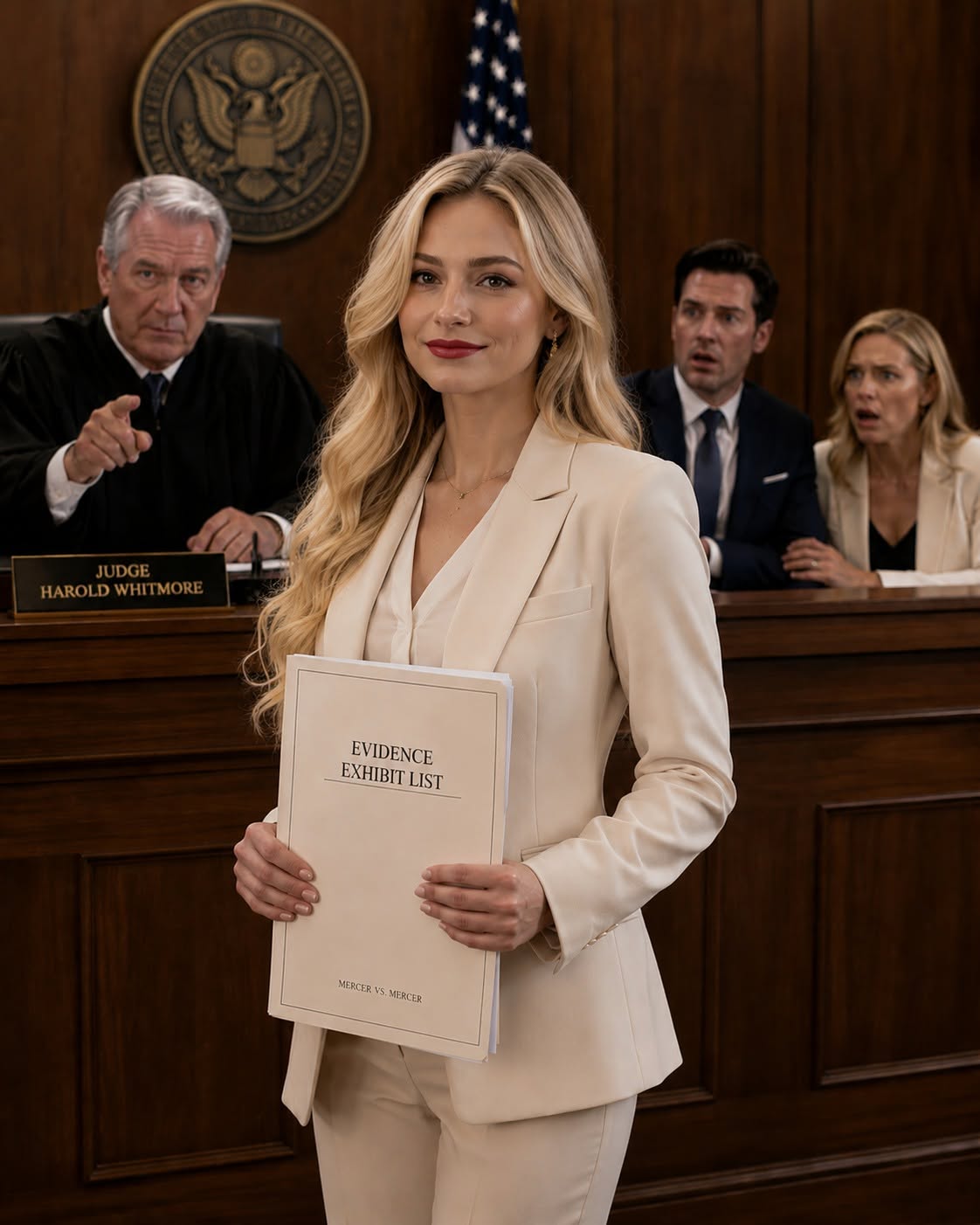
PART 3 — The Letter Wasn’t a Plea.
It Was a Trap.
The courtroom became so quiet I could hear the faint buzz of the fluorescent lights above us.
Judge Whitmore was still looking at the pages in his hand, but now his amusement had sharpened into something else.
Interest.
Recognition.
Maybe even disbelief.
Grant’s lawyer, Martin Kessler, cleared his throat.
“Your Honor, with respect, we have not been provided—”
“You will be,” the judge said.
Grant’s jaw tightened.
“What is this?”
I finally turned my head toward him.
For twelve years, he had mistaken my softness for weakness.
He had confused grief with surrender.
He had seen me quiet and decided I was empty.
But grief had not emptied me.
It had taught me how to wait.
Judge Whitmore tapped the letter against the desk.
“Mrs. Mercer has made a rather unusual request.”
Vanessa’s fingers dug into Grant’s sleeve.
“She has asked,” the judge continued, “that before this court considers enforcing the prenuptial agreement, Mr. Mercer be required to affirm under oath that Mercer Dynamics was created solely by him, funded solely by him, and that no intellectual property, trust assets, or concealed marital funds were transferred out of reach during the marriage.”
Grant laughed once, but it came out wrong.
“Of course.
I’ll swear to that.”
Lena lifted her eyes at last.
“Wonderful.”
That single word landed like a blade.
Judge Whitmore looked at Grant.
“Mr. Mercer, you understand that a sworn statement in this court carries penalties.”
Grant leaned back, trying to recover his arrogance.
“My wife is desperate.
She has been unstable for years.
She never understood the business.”
I felt the old wound open, but this time I didn’t bleed from it.
Lena slid a folder forward.
“Your Honor, we have the original incorporation documents of Mercer Dynamics.”
Kessler frowned.
“Those documents are irrelevant.”
“They list Mrs. Mercer as the original majority shareholder,” Lena said calmly.
“Sixty-two percent.”
Grant’s face drained of color.
Vanessa whispered, “Grant?”
Lena continued.
“We also have patent filings naming Mrs. Mercer as sole inventor of the fraud-detection architecture Mr. Mercer later presented as his own.
We have signed investor correspondence in which Mr. Mercer described himself as ‘commercial lead’ and Mrs. Mercer as ‘technical founder.’”
Judge Whitmore glanced at Grant.
“Technical founder?”
Grant’s mouth opened, then closed.
Lena placed another document on the table.
“And the prenuptial agreement Mr. Mercer wishes to enforce contains a clause he apparently forgot.”
My heart was pounding now, but my hands were still.
Lena read aloud, “Any deliberate concealment of jointly held business assets, any fraudulent transfer, or any extramarital relationship involving a company officer that results in financial harm to either spouse shall void the settlement limitation and trigger full equitable review.”
Vanessa stopped breathing for a second.
Judge Whitmore raised an eyebrow.
“Company officer?”
Lena smiled faintly.
“Ms.
Vanessa Vale, Vice President of Strategy.”
Grant slammed his palm on the table.
“This is ridiculous.”
The judge’s smile vanished.
“Mr. Mercer, strike your hand on my table again and you will continue this hearing from a holding cell.”
Grant swallowed.
Then Lena reached for the final envelope.
“This,” she said, “is why Mrs. Mercer wrote a letter instead of filing a standard motion.”
She turned toward me briefly, and for the first time that morning, her expression softened.
“Because the last item is personal.”
The room tilted.
I had prepared myself for the company.
For the patenTS. For the money Grant had hidden behind names like Northstar Holdings and ValeBridge Capital.
But even preparation has limiTS.
Lena’s voice lowered.
“For years, payments have been made from a trust established for Mrs. Mercer’s late father’s first grandchild.
Those payments continued after the child’s alleged death.”
Grant whispered, “Don’t.”
It was the first honest word he had spoken all morning.
Judge Whitmore looked down at the page again.
Then he understood.
And so did Vanessa.
Their faces went pale not because they were losing money.
They went pale because the grave they had buried my son in had never held his body.
PART 4 — The Mistress Started Talking Before Anyone Accused Her
For several seconds, I could not hear anything.
The courtroom was full of moving mouths, scraping chairs, papers shifting across polished wood, but all sound had gone underwater.
My son.
My baby.
Oliver.
The name tore through me like something alive.
I remembered his weight against me for one impossible second before the nurses took him away.
I remembered Grant’s hand on my forehead, his voice telling me there had been complications.
I remembered waking to white walls, empty arms, and a grief so large I thought it would swallow the world.
I had signed papers through a fog of sedatives.
Grant had told me they were hospital forms.
Lena’s hand found mine under the table.
She squeezed once.
Do not break yet.
So I didn’t.
Judge Whitmore’s voice cut through the silence.
“Ms.
Ortiz, explain.”
Lena stood.
“Mrs. Mercer’s father, Thomas Ellery, created the Ellery Grandchild Trust before his death.
The trust was to provide medical, educational, and personal support for his first grandchild.
That child was Oliver James Mercer.”
Grant stared at the floor.
Lena continued, “Mrs. Mercer was told Oliver died shortly after birth.
However, the trust administrator continued receiving invoices for pediatric care, therapy, residential schooling, and medical guardianship for a minor identified only as O.M.”
Vanessa suddenly pushed away from Grant.
“That was not my idea,” she said.
Every eye turned toward her.
Grant hissed, “Vanessa.”
She recoiled as if his voice burned her.
“No.
No, you don’t get to drag me under this alone.”
Kessler rose quickly.
“Your Honor, my client’s companion is not—”
“Sit down,” Judge Whitmore said.
Vanessa’s lips trembled, but not from remorse.
From fear.
“He told me the child was already gone,” she said.
“He said the trust was just paperwork.
He said if we didn’t keep the account active, Eliza’s family lawyers would start asking questions.”
Eliza.
She used my name like she had earned the right to speak it.
I looked at her.
“Where is my son?”
Vanessa’s eyes flicked toward Grant.
Grant’s expression changed then.
The mask fell away.
Behind the expensive suit, behind the polished teeth, there was nothing visionary or brilliant.
There was only a cornered man.
“I did what I had to do,” he said.
Judge Whitmore leaned forward.
“You may want to choose your next words carefully.”
Grant turned to me with sudden fury.
“You were useless after the birth.
You couldn’t get out of bed.
You couldn’t speak.
You couldn’t run a company.
You couldn’t be a mother.”
The words struck hard, but they no longer owned me.
He pointed at me.
“Oliver needed care.
Real care.
I made arrangemenTS.”
“Arrangements?” My voice was barely a whisper.
Lena placed another document before the judge.
“We have a sworn affidavit from Celia Rowe, the neonatal nurse on duty the night Oliver Mercer was removed from the hospital.”
Grant went rigid.
Lena said, “Ms.
Rowe states that the infant was alive when he left the hospital.
She further states that Mr. Mercer signed documents representing himself as sole medical guardian and instructed staff that Mrs. Mercer had suffered a psychological collapse and was not to be consulted.”
I tasted metal.
Vanessa began crying for real now.
Judge Whitmore’s face had turned to stone.
“Where is the child?”
Lena answered, “Rosebridge Children’s Residence.
Under a sealed guardianship arrangement funded by the Ellery Grandchild Trust.”
My chair scraped backward.
I stood before anyone could stop me.
“Alive?” I asked.
No one answered quickly enough.
I turned to Grant.
“Is he alive?”
Grant looked at me for one long, terrible moment.
Then, with hatred in his eyes, he said, “He was better off without you.”
The sound that escaped me was not a sob.
It was not a scream.
It was the sound of twelve years of silence being ripped apart.
Judge Whitmore slammed his gavel.
“This court orders immediate preservation of all records related to Oliver James Mercer.
Mr. Mercer’s accounts are frozen pending investigation.
No one leaves this jurisdiction without court approval.”
Grant’s lawyer looked as though he wanted to disappear.
The judge looked at me, and his voice softened.
“Mrs. Mercer, I am ordering an emergency welfare inquiry.
Today.”
I gripped the edge of the table.
For twelve years, I had come to court wanting justice.
In one sentence, justice became something smaller, brighter, and more terrifying.
Hope.
PART 5 — The Boy Who Should Have Been a Ghost
The drive to Rosebridge took forty minutes.
I remember none of it.
Lena drove.
I sat in the passenger seat with my hands locked together so tightly my fingers ached.
Outside the window, the city blurred into gray roads, bare trees, and afternoon rain.
No mother should have to practice breathing before meeting her child.
But I did.
Inhale.
He may not know you.
Exhale.
He may hate you.
Inhale.
He may not want you.
Exhale.
He is alive.
Rosebridge Children’s Residence stood behind a wrought-iron gate at the end of a long gravel road.
It was not a hospital, not exactly.
More like a school built by someone who wanted sadness to look expensive.
Brick walls.
White columns.
Perfect hedges.
Windows too clean to feel warm.
A woman waited for us in the lobby.
She was small, silver-haired, and holding an old blue blanket folded over one arm.
The moment I saw the blanket, my knees weakened.
I knew it.
My mother had embroidered the corner before Oliver was born.
A tiny moon.
Three crooked stars.
His initials.
O.J.M.
The woman’s eyes filled with tears.
“Mrs. Mercer?”
I nodded, unable to speak.
“I’m Celia Rowe.”
The nurse.
Lena stepped forward.
“Ms.
Rowe, thank you for meeting us.”
Celia looked at me, not Lena.
“I kept it because I knew one day you might come.”
The lobby spun around me.
“You knew?” I whispered.
“I suspected,” she said.
“But I was young.
Afraid.
Mr. Mercer had lawyers.
The hospital administration told me everything was authorized.
Later, when I tried to check on you, I was told you had moved away and wanted no contact.”
I closed my eyes.
Grant had built my prison out of forged signatures and other people’s cowardice.
Celia’s voice broke.
“I’m sorry.”
I looked at the blanket in her hands.
“Where is he?”
She led us down a hallway lined with children’s paintings.
Suns.
Houses.
Trees.
Birds with wings too large for their bodies.
At the end of the hall was a music room.
A boy sat at the piano, his back to us.
He was slender, dark-haired, and too still for a child.
His fingers moved slowly over the keys, not playing a song exactly, but searching for one.
A melody rose, hesitant and soft.
My breath stopped.
I knew that tune.
I had hummed it to my belly every night when I was pregnant, one hand on the curve of him beneath my ribs.
Celia whispered, “He plays it when he’s anxious.
He says he dreamed it.”
The room disappeared.
There was only the boy.
My son.
Oliver turned at the sound of the door.
He had Grant’s chin.
But he had my eyes.
Those dark, searching eyes looked at me with polite confusion.
Not recognition.
Not joy.
Just the guarded calm of a child who had learned not to expect anyone to stay.
Celia said gently, “Oliver, this is Eliza.”
His brow furrowed.
Not Mom.
Not yet.
Just Eliza.
I forced myself not to rush to him.
Every instinct in my body screamed to cross the room and gather him into my arms, but motherhood is not ownership.
Not after twelve stolen years.
So I knelt on the floor where I was.
“Hi, Oliver,” I said.
My voice broke on his name.
He studied me.
“Are you crying because you know me?”
I laughed and sobbed at the same time.
“Yes,” I whispered.
“I know you.”
He glanced at Celia, then back at me.
“People usually know my file.”
“I know your song.”
His fingers hovered above the keys.
I sang the first three notes.
His face changed.
It was small.
Almost invisible.
But something inside him heard me.
He turned back to the piano and played the next notes.
I finished the line.
The rain tapped against the windows.
No one moved.
Then Oliver asked, “Did you leave me here?”
The question opened me clean down the center.
“No,” I said.
“Never.”
His lips pressed together.
“That’s what they said.”
“I know.”
“Are you going to say they lied?”
I wiped my face.
“Yes.”
He looked away.
“Adults always say that when they want something.”
I nodded, because he deserved honesty more than comfort.
“You don’t have to believe me today,” I said.
“You don’t have to hug me.
You don’t even have to like me.
But I am going to tell you the truth every time you ask.
And I am going to come back every time I say I will.”
Oliver’s eyes returned to mine.
The silence stretched.
Then he said, “Tomorrow?”
My heart shattered and remade itself in the same beat.
“Yes,” I said.
“Tomorrow.”
He looked at the blanket in Celia’s arms.
“Is that mine?”
I nodded.
Celia handed it to him.
Oliver touched the crooked moon with one finger.
Then he looked at me again and asked, “Did you make the stars crooked?”
“No,” I said, smiling through tears.
“Your grandmother did.”
He considered this.
Then, softly, he said, “They look like real stars.”
That was the first gift he gave me.
Not forgiveness.
Not love.
A door left unlocked.
PART 6 — The Empire Began to Eat Itself
Grant Mercer did not fall all at once.
Men like Grant do not collapse like towers.
They rot from the inside, then act surprised when the walls give way.
Within a week, the story reached every place he had once worshipped himself.
Financial journals.
Tech blogs.
Investor circles.
The same reporters who had called him a genius now printed phrases like “asset concealment,” “founder dispute,” “forged guardianship,” and “emergency injunction.”
Mercer Dynamics stock trembled.
Board members who had ignored my emails for years suddenly remembered my phone number.
“Eliza,” one of them said, voice oily with concern, “we always valued your contribution.”
I hung up before he finished.
I had no interest in being valued by people who only noticed me when the roof caught fire.
 Woman Stops Being Her Boyfriend’s Emergency Contact After He Secretly Replaces Her With Family
The forensic audit moved fast because Grant’s arrogance had made him careless.
He had hidden millions, yes, but not cleverly.
Shell companies connected to Vanessa.
Consulting fees paid to nonexistent firms.
Transfers marked as “strategy development” that ended in private accounTS.
And beneath it all, the cruelest ledger: payments made from Oliver’s trust, then skimmed, redirected, disguised.
Grant had not only stolen my work.
He had stolen from the child he claimed to protect.
Vanessa tried to save herself first.
She appeared at Lena’s office wearing no makeup, her hair scraped into a bun, clutching a flash drive like a rosary.
“I’ll testify,” she said.
Lena folded her hands.
“Against whom?”
Vanessa’s eyes darted toward me.
“Grant.
The board.
Anyone.”
I said nothing.
Vanessa swallowed.
“He told me you were unstable.
He told me Oliver was better off.
He said you would destroy the company if you came back.”
I looked at her carefully.
“Did you believe him?”
She began to cry again.
“I wanted to.”
There it was.
The closest thing to truth she had.
She wanted my office, my husband, my life.
So she believed whatever made the theft feel like destiny.
“Why are you here?” I asked.
Vanessa placed the flash drive on the table.
“Because Grant is going to blame me for everything.
And because there’s something else.”
Lena’s expression sharpened.
“What?”
Vanessa looked at me.
“He was planning to declare you mentally incompetent after the divorce.
Permanently.
He had a doctor ready to sign paperwork.
If you fought the settlement, he wanted control of your remaining shares placed into a conservatorship.”
The room went cold.
“For whose benefit?” Lena asked.
Vanessa’s mouth twisted.
“His.”
I almost laughed.
Not because it was funny.
Because Judge Whitmore had been right.
The letter was good.
It had forced Grant to lie under oath before he knew how much evidence we had.
It had dragged the hidden company assets into the divorce record.
It had opened the door to Oliver’s trust.
Most importantly, it had made Grant show his hand.
At the next emergency hearing, Grant looked smaller.
His navy suit was wrinkled.
His tan had faded.
His famous grin was gone.
But his anger remained.
When Judge Whitmore asked whether he disputed the authenticity of the incorporation records, Grant said, “She was never capable of running Mercer Dynamics.”
I stood.
Lena touched my wrist, but I shook my head.
“Your Honor,” I said, “may I respond?”
The judge nodded.
I turned toward Grant.
“You built a stage,” I said.
“I built the engine underneath it.
You learned to smile for cameras.
I learned to make the code work.
You called me unstable because I grieved our son.
You called me useless because I trusted you.
You called my work yours because I was too broken to fight you.”
My voice steadied.
“But I am not broken today.”
Grant’s face tightened.
“And I was never useless.”
For the first time since I had known him, Grant had no audience willing to applaud.
Judge Whitmore reviewed the filings in silence.
Then he issued the orders.
The prenuptial limitation was suspended pending full review.
My ownership claim would proceed.
Grant’s voting rights were frozen.
Vanessa was barred from corporate access.
The trust records were transferred to court supervision.
A criminal referral would be made regarding Oliver’s guardianship documents and financial exploitation.
Grant exploded.
“You can’t do this!” he shouted.
Judge Whitmore removed his glasses.
“Mr. Mercer,” he said, “I believe you will find that I can.”
PART 7 — The Day He Lost Everything He Said Was His
The final divorce hearing took place six months later.
By then, I had visited Oliver one hundred and eighty-three times.
I knew because he counted.
At first, he marked each visit on a calendar in pencil, as if ink might tempt fate.
Then, after visit thirty, he began using blue pen.
After visit seventy, he let me bring him books.
After visit ninety-four, he asked whether my house had a piano.
After visit one hundred and twelve, he called me “Mom” by accident.
We both pretended not to cry.
The custody process was careful, slow, and painful in ways no courtroom victory could soften.
Oliver had been raised with lies.
Love could not erase them overnight.
But love could arrive on time.
Love could keep showing up.
Love could sit quietly in a music room until a frightened boy believed the chair would not be empty tomorrow.
By the time Grant and I returned to court, Oliver was living with me three days a week.
His room was painted midnight blue.
There were crooked stars on the ceiling.
Grant tried one final performance.
He arrived clean-shaven, somber, wearing gray instead of navy, as if humility could be tailored.
His new lawyer argued that Grant had made “imperfect decisions under extraordinary pressure.” Vanessa, who had accepted an immunity arrangement on limited financial charges in exchange for testimony, sat three rows behind him and stared at her lap.
Judge Whitmore listened without expression.
Then Lena rose.
She did not shout.
She did not need to.
She laid out the truth piece by piece.
The original company structure.
The patenTS. The forged board minutes.
The transfers.
The affair.
The attempt to erase me.
The false statements about Oliver.
The trust theft.
Each fact entered the room like a nail sealing a coffin.
Grant stared straight ahead until Lena played the recording.
His own voice filled the courtroom.
“She’ll sign anything if she thinks the baby’s gone.
Let her grieve.
Grief makes people obedient.”
A sound moved through the courtroom.
Even Judge Whitmore flinched.
I did not.
I had heard the recording before.
I had survived it already.
Grant turned slowly toward Vanessa.
She would not look at him.
The judge’s ruling took nearly forty minutes to read.
The divorce was granted.
The prenuptial cap was voided due to fraud.
My founder shares were restored.
Grant was ordered to disgorge concealed asseTS.
A substantial portion of his holdings was placed into a protected trust for Oliver.
Control of Mercer Dynamics passed to a temporary board led by me, pending shareholder approval.
Grant’s remaining claims were denied.
Then Judge Whitmore looked at him over the top of the order.
“Mr. Mercer, you repeatedly stated that Mrs. Mercer would never touch your money again.”
Grant’s face twisted.
The judge continued, “After reviewing the evidence, this court finds that a great deal of what you called yours was never yours at all.”
That sentence destroyed him more completely than any prison threat could have.
Because men like Grant can survive hatred.
They can survive scandal.
They can even survive losing money.
What they cannot survive is being revealed as ordinary.
As court adjourned, Grant turned toward me.
For a moment, I saw the man I had married, or maybe only the man I had invented because I needed him to exist.
“Eliza,” he said, voice ragged.
“You got what you wanted.”
I looked at him.
Across the aisle, Oliver stood beside Lena, holding the blue blanket under one arm.
He had insisted on coming for the ruling, though the judge had allowed him to wait outside during the hardest parTS.
Oliver looked nervous.
But he did not look alone.
I turned back to Grant.
“No,” I said quietly.
“I got back what you took.”
Then Oliver crossed the courtroom.
He stopped beside me and slipped his hand into mine.
Grant stared at him as if seeing him for the first time.
Oliver looked at his father for a long moment.
Then he said, “You told them my mom didn’t want me.”
Grant’s mouth trembled.
“Oliver, I was trying to—”
“No,” Oliver said.
One word.
Small.
Clear.
Final.
Then he turned away.
And Grant Mercer, who had built an empire from stolen brilliance, stood in the ruins of it with nothing left to command.
PART 8 — The Crooked Stars
A year later, I stood in the lobby of Mercer Dynamics for the first time since security had escorted me out.
The same marble floor gleamed beneath my shoes.
The same glass walls reflected the city skyline.
The same front desk stood near the elevators.
But my name was back on the wall.
Not as Grant’s wife.
Not as a footnote.
Not as a ghost.
Eliza Ellery Mercer — Founder and Chief Executive Officer.
Beneath it, newly installed in brushed steel, was another name.
Oliver Initiative for Medical Guardianship Reform.
Oliver stood beside me in a suit he hated and sneakers he loved.
He had grown an inch, maybe two.
His hair refused to behave.
He still played the piano when anxious, but now he also played when happy.
“Too many people are staring,” he whispered.
“They’re impressed.”
“They’re nosy.”
“That too.”
He smiled.
The board had voted unanimously to reinstate me.
Of course they had.
Cowards often become practical once the danger changes direction.
Mercer Dynamics survived, though leaner, cleaner, and stripped of the men who had treated silence as consent.
Vanessa left the country before sentencing on the civil charges connected to the asset transfers, then returned when she realized running made her look guiltier.
She pleaded down, paid heavily, and disappeared from every room that once welcomed her.
Grant’s criminal case moved slowly, as wealthy men’s cases often do, but it moved.
His assets were frozen, his reputation ruined, and his name removed from the company history he had rewritten.
I did not attend every hearing.
I had a life to build.
That was the part no one tells you about revenge.
The best part is not watching someone fall.
The best part is realizing you are no longer standing at the edge of their shadow.
That evening, after the company ceremony, Oliver and I drove home through soft spring rain.
He had chosen the music, which meant jazz, then movie scores, then a podcast about deep-sea creatures.
He changed interests like weather.
I loved every version of him.
At home, he went straight to the piano.
I stood in the doorway while he played the old lullaby, no longer hesitant, no longer searching for the missing notes.
Halfway through, he stopped.
“Mom?”
The word still had the power to undo me.
“Yes?”
“Do you think Grandpa knew?”
“My father?”
“About me.”
I sat beside him on the bench.
“I think he hoped for you before you existed,” I said.
“That’s why he made the trust.
I think he wanted you protected.”
Oliver considered that.
“It didn’t work.”
“No,” I said softly.
“Not the way it should have.”
He leaned against my shoulder.
“But maybe it helped you find me.”
I closed my eyes.
Outside, rain moved gently over the windows.
Inside, the house smelled like lemon polish, old books, and the chocolate cake Oliver had insisted we buy even though neither of us had finished dinner.
On the table lay the final page from Judge Whitmore’s order.
I had framed the first page restoring my shares, but this one I kept folded in a drawer.
It said Oliver’s transition into my custody was complete.
Complete.
Such a small word for a miracle.
Later that night, after Oliver went to bed, I opened the box Celia Rowe had given me.
Inside were the things Grant had not managed to destroy: the hospital bracelet, the blue blanket, a photograph of Oliver at three months old, and a sealed envelope in my father’s handwriting.
I had waited months to open it.
Some grief takes courage even after joy arrives.
My hands trembled as I broke the seal.
Inside was a letter dated two weeks before my father died.
My dearest Eliza,
If you are reading this, then I have missed more of your life than I wanted to.
Forgive me for that.
I have made arrangements for the child you may one day have, not because I distrust you, but because I know the world often asks brilliant women to prove what mediocre men are handed freely.
Do not ever let anyone convince you that love requires disappearance.
Build loudly.
Own what is yours.
And when the time comes, tell my grandchild the stars are crooked because perfect things are usually fake.
I laughed then.
Not loudly.
Not like Judge Whitmore had laughed in court.
This laugh came through tears, soft and astonished.
From the hallway, Oliver called, “Mom? Are you okay?”
I wiped my face.
“Yes.”
And I was.
Really.
Finally.
A moment later, his door creaked open, and he appeared in striped pajamas, squinting suspiciously.
“You’re crying.”
“Happy crying.”
“That sounds fake.”
“It usually is,” I admitted.
“But not tonight.”
He walked over and leaned against me, reading the letter over my arm.
When he reached the line about crooked stars, he smiled.
“Grandpa was funny.”
“He was.”
Oliver looked up at me.
“Can we change my ceiling?”
“To what?”
“More crooked stars.”
I touched his hair.
“We can paint the whole sky.”
The next morning, reporters waited outside the courthouse for Grant’s arraignment, hoping for one more picture of his downfall.
But I was not there.
I was at home in old jeans, standing on a ladder, painting crooked gold stars across my son’s ceiling while he directed me with the seriousness of an architect.
“More left,” he said.
“This left?”
“No, your other left.”
I laughed so hard I nearly dropped the brush.
Sunlight spilled through the windows.
Paint dotted my hands.
Oliver’s song played from the speaker, the old lullaby turning into something brighter.
For years, Grant had promised I would never touch his money again.
In the end, he was right.
I never touched his money.
I took back my name.
I took back my work.
I took back my son.
And under a ceiling full of imperfect stars, I finally understood the most shocking ending of all:
After everything Grant had stolen, after every lie he had buried me beneath, he had failed at the one thing he wanted most.
He had failed to erase me.
And my son, looking up at the crooked sky we made together, reached for my paint-stained hand and smiled.
“Tomorrow,” he said, “can we do the hallway?”
I squeezed his fingers.
“Yes,” I said.
“Tomorrow.”
This time, I knew I would be there.