
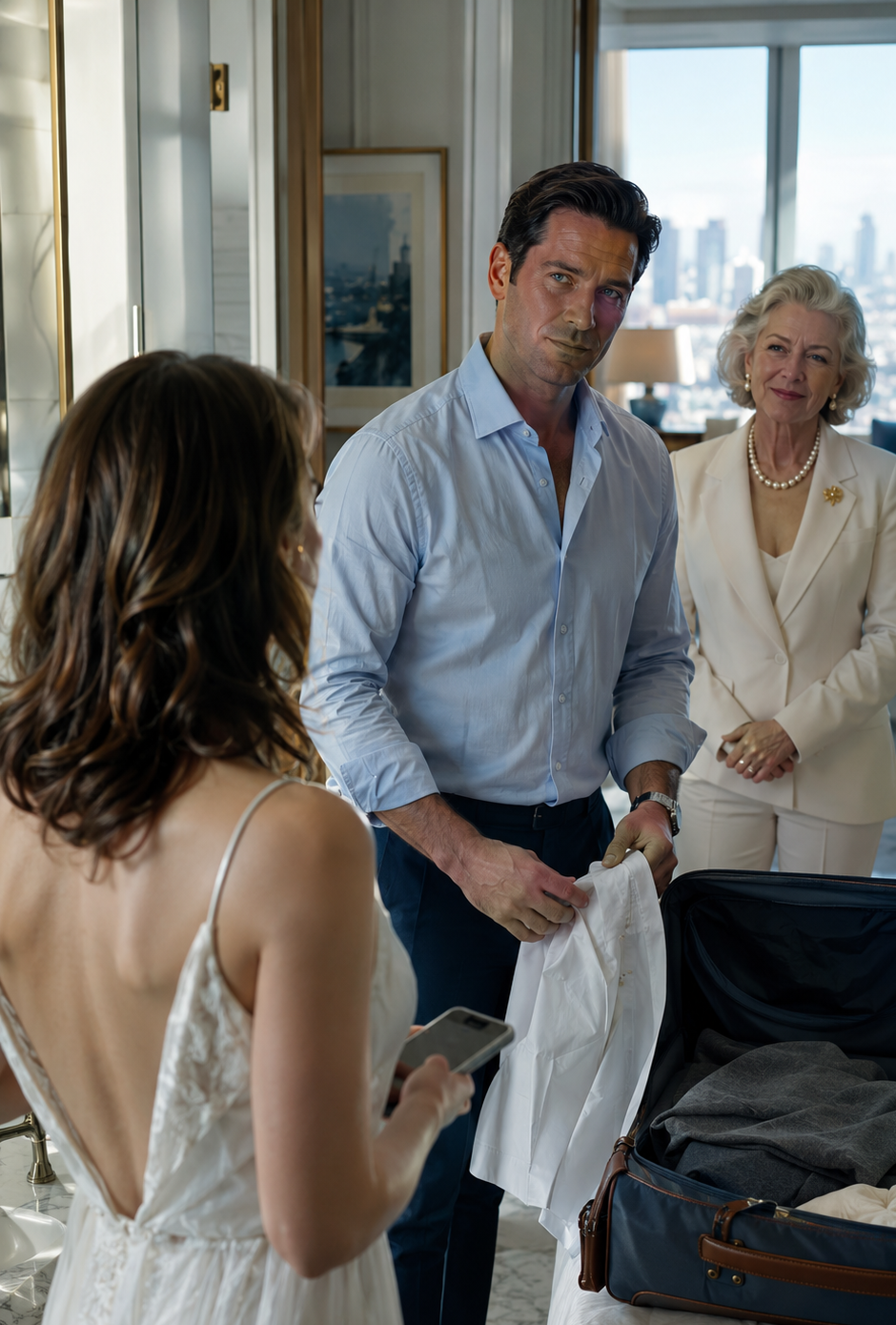
The Cripple I Pretended To Be — Until The Night I Stood
The first time my fiancée called me a useless burden, the whole room laughed.
The second time, I decided to let them keep laughing.
I sat in the center of my family’s grand ballroom, my legs hidden beneath a thin gray blanket, my hands resting weakly on the rims of my wheelchair.
Under the blazing crystal chandeliers, champagne glasses clinked as everyone gathered to “welcome me home” after a horrific accident that supposedly shattered my spine.
But only my private doctor, my lawyer, and I knew the explosive truth.
The crash had been real.
The paralysis was nothing more than an act.
Vanessa swept toward me in a silver gown, the diamond engagement ring I bought her flashing like a weapon.
Behind her, my business partners and so-called loyal family members watched with cruel, lingering curiosity.
“Look at you,” she sneered, leaning close enough for me to smell the vintage Merlot on her breath.
“Now you’re nothing.
Just a useless cripple.”
The ballroom fell dead silent.
My uncle looked away.
My best friend lowered his eyes.
Vanessa’s mother actually smiled.
Not a single person stepped up to defend me.
“Vanessa,” I replied quietly, keeping my face perfectly blank.
“We are still engaged.”
She let out a sharp, mocking laugh.
“For now.
At least until the board of directors realizes you can’t even walk into a meeting.
I was supposed to marry a powerful man, not a burden.”
Just as I was about to end this little charade, a small figure knelt beside my chair.
Clara.
Our young maid.
Her trembling hands gently adjusted the blanket Vanessa had just kicked aside.
“Sir…” she whispered, her voice shaking but fiercely defiant.
“You still deserve to be treated kindly.”
Vanessa rolled her eyes in disgust.
“How touching.
The servant pities the master.”
I looked down at Clara’s hand resting on my blanket — the only genuine touch in a kingdom built entirely on lies.
And then, I smiled.
It was a cold, predatory smile that made the arrogant smirk on Vanessa’s face instantly freeze.
“You’re absolutely right, Vanessa,” I whispered softly, my grip tightening on the armrests of my chair.
“A burden can’t possibly run an empire.”
I slowly grabbed the blanket on my lap and tossed it onto the marble floor.
“So let me show you…”
But I did not stand.
Not yet.
I let the blanket lie there like a dropped flag, and I watched her decide it meant nothing.
That was the lesson I had learned in the six weeks since the crash: people believe exactly what lets them keep what they want.
Vanessa wanted my company.
She needed me broken to get it.
So she chose to see a broken man, even when the evidence sat three feet away, folded on the floor, saying otherwise.
Part Two — The Room With No Cameras She Knew About
Three days later, Vanessa began planning my removal from my own company.
She thought I was trapped upstairs in my bedroom, helpless beneath silk sheets and expensive lies.
She did not know there were cameras in the library, microphones in the study, and a private elevator that opened into my security room.
At midnight, I watched her on six monitors.
She stood beside Daniel, my so-called best friend, pouring whiskey with a smile sharp enough to cut glass.
“He won’t last,” Daniel said.
“The board will panic.”
Vanessa laughed.
“Good.
Once I marry him, I’ll push for medical guardianship.
Then we transfer voting power.
After that…” She lifted her glass.
“Poor Adrian can recover in some quiet facility.”
My jaw tightened.
Daniel leaned closer.
“And the maid?”
Vanessa’s smile vanished.
“Fire her.
She looks at him like he matters.”
I saved the recording.
The next morning, Vanessa entered my room carrying flowers like a performance.
Clara stood near the window, folding towels.
“My poor darling,” Vanessa said loudly, in case anyone was listening.
“I’ve spoken to a specialist.
A private care center.
Very peaceful.”
I looked up.
“You want to send me away?”
“For your own good.” Her eyes flicked toward Clara.
“And we’ll need to reduce staff.
Some people are getting too attached.”
Clara’s fingers paused.
Vanessa stepped closer to her.
“Pack your things by tonight.”
“No,” I said.
The room went silent.
Vanessa turned slowly.
“Excuse me?”
“Clara stays.”
Her face hardened.
“You don’t give orders anymore, Adrian.”
I let the silence stretch.
Then I smiled faintly.
That was the first time fear touched her eyes.
She recovered fast.
“Fine.
Keep your little maid.
It won’t matter.”
But it did matter.
Because Clara had already found something.
That evening, after Vanessa’s car pulled out of the driveway, Clara knocked on my door with a folder pressed flat against her chest, as though she was afraid it might catch fire in her hands.
“I wasn’t looking for anything,” she said quickly.
“I was cleaning the study.
The drawer was already open.”
I waved her in and closed the door myself, my legs working perfectly beneath a robe no one else would see.
Inside the folder were bank transfer records — small amounts, moved from a shell account linked to Vanessa’s mother into Daniel’s personal fund, every month for the last year.
Payment for what, the papers didn’t say.
But I recognized the account.
It belonged to Halcyon Freight, a logistics company that had been quietly underbidding my firm on three major contracTS. A company Daniel had personally recommended I trust.
“You could get fired for finding this,” I said.
Clara shook her head.
“I could get fired for a lot of things.
I’d rather get fired for the truth.”
I looked at her for a long moment — this woman who owned nothing in my house but a narrow room on the third floor and a uniform she pressed herself every morning — and I understood, with an ache I hadn’t expected, that she was the only person under my roof who had never once asked me for anything.
“Thank you, Clara,” I said.
She nodded, and for the first time since the accident, someone in this house looked at me like I was still a person and not a liability to be managed.
Part Three — The Weight Of Waiting
Two weeks passed.
I let Vanessa believe her plan was working.
I let the board members visit my room and watch me struggle, on cue, to lift a spoon.
I let Daniel bring documents for me to “sign with assistance,” his pen guiding my trembling hand across contracts that would have quietly diluted my shares had my lawyer not intercepted every single one before they reached the county recorder.
Every failure they witnessed was a performance.
Every performance bought me time.
Clara became careful in ways that broke my heart a little.
She stopped smiling at me in front of others.
She stopped adjusting my blanket in the hallway where cameras — the real ones, the ones Vanessa’s people had installed — might catch tenderness and mistake it for scandal.
Instead, she left small things where only I would find them: a folded newspaper article about Halcyon Freight’s founder, a napkin with a phone number for a forensic accountant, a single sentence written on the back of a grocery receipt.
You don’t have to do this alone.
I kept that receipt in the drawer of my nightstand, beneath the false paperwork of my false diagnosis, and some nights I took it out just to remember that not everyone in my life was auditioning for a piece of me.
My mother visited once, brought by Vanessa “for support,” and spent the entire hour talking about wedding venues as though my legs were an inconvenient scheduling conflict rather than a tragedy.
My father had died four years earlier, and in his absence, my mother had learned to worship whoever controlled the money, which currently, on paper, was becoming less and less me.
“The Wilmington Estate has beautiful gardens,” she said, scrolling through photos on her phone while I sat two feet away in a chair I did not need.
“Very accessible.
Ramps everywhere.”
“I’m still here, Mother,” I said.
She looked up, startled, as if she’d forgotten.
“Of course you are, darling.”
That was the moment I understood something I had suspected but not yet let myself believe: this family did not love me.
They managed me.
And Vanessa was simply the most efficient manager among them.
Part Four — The Man Who Underestimated Me
Daniel had been my closest friend since business school, the man who stood beside me at every product launch, every funeral, every late night when the company nearly folded during its second year.
I had trusted him with passwords, with secrets, with the eulogy at my father’s funeral.
Watching him now, on grainy security footage, laughing about my “recovery timeline” like it was a punchline, did something to me that the crash itself never had.
The crash had broken metal and bruised bone.
This broke something else.
I asked my lawyer, Marcus, to trace every transfer Clara had found back to its source.
It took him nine days.
What he uncovered was worse than I expected: Daniel hadn’t simply taken a bribe from Halcyon Freight.
He had been feeding them our shipping routes, our client contracts, our internal cost structures, for fourteen months — long before my accident.
The crash, investigators quietly confirmed, had not been random.
My car’s brake line had been tampered with, and the only person who’d had access to the vehicle that week besides my driver was Daniel, who had “borrowed” it for a service appointment I never authorized.
I sat with that information for three full days before I told anyone, because once you know a friend tried to kill you, there is no version of your life that looks the same afterward.
Clara noticed the change in me before I said a word.
She found me at two in the morning, sitting by the window in the dark, and instead of asking what was wrong, she simply sat down on the floor beside my chair and stayed there, saying nothing, until the sky began to lighten.
“You don’t have to tell me,” she finally said.
“But you don’t have to carry it by yourself either.”
“He tried to kill me, Clara.”
Her breath caught.
“Daniel?”
I nodded.
 Substitute Teacher Demands A Student Turn Off Her Insulin Pump, Then Realizes She Made A Huge Mistake
She didn’t gasp, didn’t perform shock the way Vanessa performed grief.
She simply reached over and took my hand, the same way she had straightened my blanket that first humiliating night, like kindness was not a strategy for her but a reflex.
“Then we make sure he never gets the chance again,” she said.
We.
It was the first time in months someone had used that word about my life and meant it.
Part Five — Building The Trap
I called an emergency board meeting for the following Friday, framed publicly as a “health update” from my doctor.
Vanessa organized it herself, delighted at the opportunity to formally introduce the guardianship paperwork she believed the board was primed to approve.
She had no idea Marcus had spent the week quietly buying back proxy votes from three minority shareholders who’d grown suspicious of Daniel’s sudden wealth.
She had no idea the “specialist” she’d hired to evaluate my mental competency was, in fact, working for me, feeding her false updates about my “declining cognitive function” while documenting every instruction she gave him.
Clara’s role was smaller but sharper: she was the only person with unrestricted access to every room in the house, and over four careful days, she photographed every document left unguarded on Vanessa’s desk, every message left open on Daniel’s laptop when he stepped away for coffee, every draft of a press release announcing my “voluntary” transition into a “quiet advisory role.”
The night before the board meeting, I stood — actually stood, for the first time in front of anyone but my doctor and my lawyer — in the middle of my study, and Clara watched from the doorway with her hand pressed over her mouth.
“You can walk,” she said, not really a question.
“I could always walk.”
She didn’t look angry, the way I’d half-expected.
She looked relieved, and then, slowly, she started to laugh — a real laugh, the first I’d heard from her since I’d known her.
“God.
The whole house has been tiptoeing around a man who could have chased them down the stairs this entire time.”
“I needed to see who they really were,” I said.
“Without a chair, everyone plays a part.
In one, only the truth survives.”
Clara’s laughter faded into something gentler.
“And what did you see?”
I looked at her for a long moment.
“I saw exactly one person kneel down to fix my blanket instead of stepping over it.”
She looked away first, her cheeks coloring, and busied herself straightening a stack of files that did not need straightening.
“Anyone would have done that.”
“No,” I said quietly.
“They wouldn’t have.”
Part Six — The Board Meeting
The boardroom on the fortieth floor overlooked the harbor, all glass and cold light, and every seat was filled by nine in the morning.
Vanessa arrived in white, which struck me as either an ignorant choice or a deliberate one, considering what I planned to do to her by lunch.
Daniel sat two seats down from her, tapping his pen against a legal pad, rehearsing a version of the future that was never going to happen.
My wheelchair was pushed into the room by an assistant, blanket over my knees, head slightly bowed, exactly the portrait of decline Vanessa had spent two months building for this exact morning.
“Thank you all for coming,” Vanessa began, standing at the head of the table as though she already owned it.
“As you know, Adrian’s condition has continued to deteriorate.
Today, with heavy hearts, we’re presenting a guardianship proposal that protects both his wellbeing and the company’s future.”
Daniel slid a folder toward the center of the table.
“The transition plan includes full voting authority transferring to a caretaker committee, effective immediately upon board approval.”
Heads nodded around the table.
Not because they believed it was right.
Because it was easier than asking questions.
“Before we vote,” I said.
My voice was steady, and it was mine, no tremor rehearsed into it, and the entire room turned as one, the way a crowd turns toward a sound it doesn’t expect to hear again.
Vanessa’s smile flickered.
“Adrian, sweetheart, you don’t need to strain yourself—”
I stood up.
The blanket fell to the floor exactly the way it had at the engagement party, except this time there was nothing underneath it pretending to be broken.
I walked, unassisted, to the head of the table, and I did not look at Vanessa once on the way there, because for the first time in two months, she was no longer the most important person in the room.
The silence that followed was the loudest sound I had ever heard in that building.
“For the record,” I said, opening my own folder, “I have not been paralyzed in six weeks.
I have been watching.”
Marcus stood and began distributing copies of everything: the wire transfers to Daniel, the Halcyon Freight contracts, the tampering report on my vehicle’s brake line, the recorded conversation from the study, the guardianship paperwork rewritten in Vanessa’s own handwriting months before any doctor had signed off on my “decline.”
Daniel’s face went the color of the folder in his hands.
“Adrian, I can explain—”
“You can explain it to the district attorney,” I said.
“I already have.”
Two officers who had been waiting quietly in the hallway, arranged by Marcus the night before, stepped into the room.
Vanessa didn’t move.
She stood frozen at the head of the table she’d believed was hers by that afternoon, and for the first time since I’d known her, I watched real fear replace the practiced sympathy she wore like a second engagement ring.
“You planned this,” she said, her voice cracking.
“This whole time, you were—”
“Watching,” I said again.
“Yes.
The way you watched me, calculating how much longer you’d have to pretend to care before the company was worth more to you than I ever was.”
Part Seven — The Choice She Never Saw Coming
Here is the part no one in that boardroom expected, including, I think, myself, until the words were already out of my mouth.
I did not have Vanessa arrested.
I had every legal right to.
The guardianship fraud alone would have been enough, and Marcus had built a case airtight enough to survive any appeal she could afford.
But watching her stand there, stripped of every performance she’d built her entire adult life around, I understood something about her that almost made me feel sorry for her, in the brief, bitter way you feel sorry for a wolf caught in a trap it built for someone else.
Vanessa had grown up the way I had — surrounded by people who loved leverage more than they loved her — except no one had ever handed her a company to inherit, only a face and a talent for reading rooms, and she had spent her entire life turning that talent into the only currency she’d ever been taught was worth anything.
It didn’t excuse what she’d done.
It didn’t undo the brake line, or the guardianship papers, or the way she’d looked at me and called me a burden while an entire ballroom laughed along.
But it meant her cruelty had a shape I recognized, and recognizing it was not the same as forgiving it.
“I’m not calling the police on you, Vanessa,” I said.
Relief broke across her face for exactly one second before I kept speaking.
“But you will resign from every position tied to my company, effective today.
You will return the ring.
And you will sign an NDA broad enough to keep your name out of every business article that gets written about this for the next decade, because the only thing worse for you than prison is irrelevance, and I intend to make sure you experience exactly that.”
Her jaw tightened.
“You’re punishing me by making me disappear.”
“No,” I said.
“I’m punishing you by letting you live with what you did, in a world that no longer has any use for you.
Prison would have given you a story.
This gives you nothing.”
Daniel didn’t get the same mercy.
The evidence of attempted vehicular tampering left me no room, and no desire, to be generous.
He was escorted out in handcuffs while the board sat in stunned silence, watching two years of careful lies collapse in the span of twenty minutes.
Vanessa left the room without another word, and I never saw her again except once, eighteen months later, in the society pages of a magazine, standing beside a man I didn’t recognize, her smile exactly as practiced as it had always been, and I felt nothing at all when I turned the page.
Part Eight — What Was Left When The Lie Ended
The board voted unanimously to reinstate my full authority that same afternoon, along with a formal apology for the two months they’d spent quietly planning my exit rather than asking a single question.
I accepted the apology the way you accept an umbrella after the storm has already soaked you through — politely, and without any illusion that it changed what had happened.
I found Clara in the kitchen that evening, still in her uniform, washing a single teacup by hand instead of using the dishwasher, the way she always did when she needed her hands to be busy while her mind worked through something.
“I heard what happened,” she said, not turning around.
“The whole staff heard.”
“I imagine so.”
She set the cup down carefully.
“You could have called the police on her.
Instead you stood in front of the board and gave a speech about mercy.”
“It wasn’t mercy,” I said.
“It was strategy dressed up as mercy.
I wanted her to disappear, not become a headline I’d have to manage for the next ten years.”
Clara finally turned around, drying her hands on a towel, studying me the way she’d studied that folder full of bank transfers weeks earlier — carefully, like she was deciding what to trust.
“And what happens to me now?” she asked.
“Now that the wheelchair’s gone and the lie’s over and you don’t need someone kneeling beside you at parties.”
The question landed harder than I expected, because underneath it was the real one she wasn’t asking out loud: was any of this real, or was I just another prop in your performance?
“Clara,” I said, “you’re the only person in that ballroom who knelt down when everyone else stayed standing.
You’re the only person in this house who’s never once asked me what I could do for you.
The wheelchair was a lie.
You were never part of it.”
Her hands stilled on the towel.
“I don’t know how to be someone’s equal,” she admitted quietly.
“I’ve spent six years being staff in this house.
I don’t know what it looks like to just be a person here.”
“Neither do I,” I said.
“I’ve spent my whole life being an asset first and a person second, to my mother, to Vanessa, to the board.
Maybe that’s something we’d have to learn together, if you were willing.”
She didn’t answer right away, and I didn’t push her to.
Some choices are too large to make standing in a kitchen with a wet towel still in your hands, and I had learned, over two months of pretending to be broken, exactly how much damage it does to rush someone into a decision before they’re ready to trust that it’s real.
Part Nine — Six Months Later
The company recovered faster than the tabloids expected and slower than I would have liked, the way most things worth rebuilding tend to go.
Daniel took a plea deal that kept him out of the worst of it, three years instead of the ten he deserved, and I stopped checking the news for updates on his case sometime around month four, because some grudges cost more to carry than they’re worth holding.
My mother apologized once, in a letter I still haven’t fully forgiven, though I keep it in the same drawer as Clara’s grocery receipt, because some things deserve to be remembered even when they don’t deserve to be revisited.
Clara still works in the house, though her title changed twice — first to executive assistant, then, after she finished the business certification I quietly funded and she loudly insisted on paying back, to director of operations for the foundation we started together, funding legal aid for people whose families had used guardianship laws against them the way Vanessa had tried to use them against me.
We are not engaged.
I haven’t asked, and she hasn’t waited for me to.
Some nights we sit in the same study where Clara once handed me a folder with trembling hands, and we talk about nothing important, and I no longer feel the need to perform anything for her, not weakness, not strength, not recovery.
Last week, at a charity gala neither of us particularly wanted to attend, someone recognized me from the tabloid coverage and asked, half-joking, whether I’d ever consider faking an illness again, just to see who’d stick around.
“No,” I said.
“I already know who stays.”
Clara, standing beside me in a green dress instead of a maid’s uniform, didn’t say anything at all.
She just reached over and took my hand — the same steady grip she’d offered a broken man in a wheelchair who’d never actually been broken — and for once, neither of us needed the moment to mean anything more than exactly what it was.
Real.
Chosen.
Unhurried.
And, after everything, still standing.