
PART 2:
By the time the elevator reached the lobby, Rosa had stopped crying.
That frightened me more than the tears.
She stood beside me with one trembling hand over her stomach and the other gripping the sleeve of my coat, her face emptied by shock.
The girl who had pleaded on the marble floor had vanished somewhere inside herself, leaving behind someone who looked as if she had learned too late that kindness could be used as a trap.
“My bag,” she whispered.
“What?”
“My documenTS. My passport.
He keeps them in the laundry room cabinet.”
The elevator doors opened to the polished lobby of Adrian’s townhouse building.
A doorman looked up from his desk, smiled at me automatically, then noticed Rosa’s face and dropped the smile.
I kept my voice calm.
“Rosa, listen to me.
We’re not going back upstairs.”
“But my passport—”
“We will get it back.
Not alone.
Not today.”
She swallowed hard.
“He said no one would believe me without papers.”
That single sentence settled into my chest like ice.
I guided her toward my car, and as soon as the doors locked behind us, I called Simone Patel, the attorney who handled emergency cases for my nonprofit.
She answered on the second ring.
“Evelyn?”
“I need you,” I said.
“Now.”
Simone did not waste time asking whether I was exaggerating.
That was one of the reasons I trusted her.
“Where are you?”
I gave her the address, then added, “Employee.
Pregnant.
Employer coercion.
ThreaTS. Possible document withholding.”
A pause.
“Is the employer Adrian?”
I looked through the windshield at the townhouse entrance.
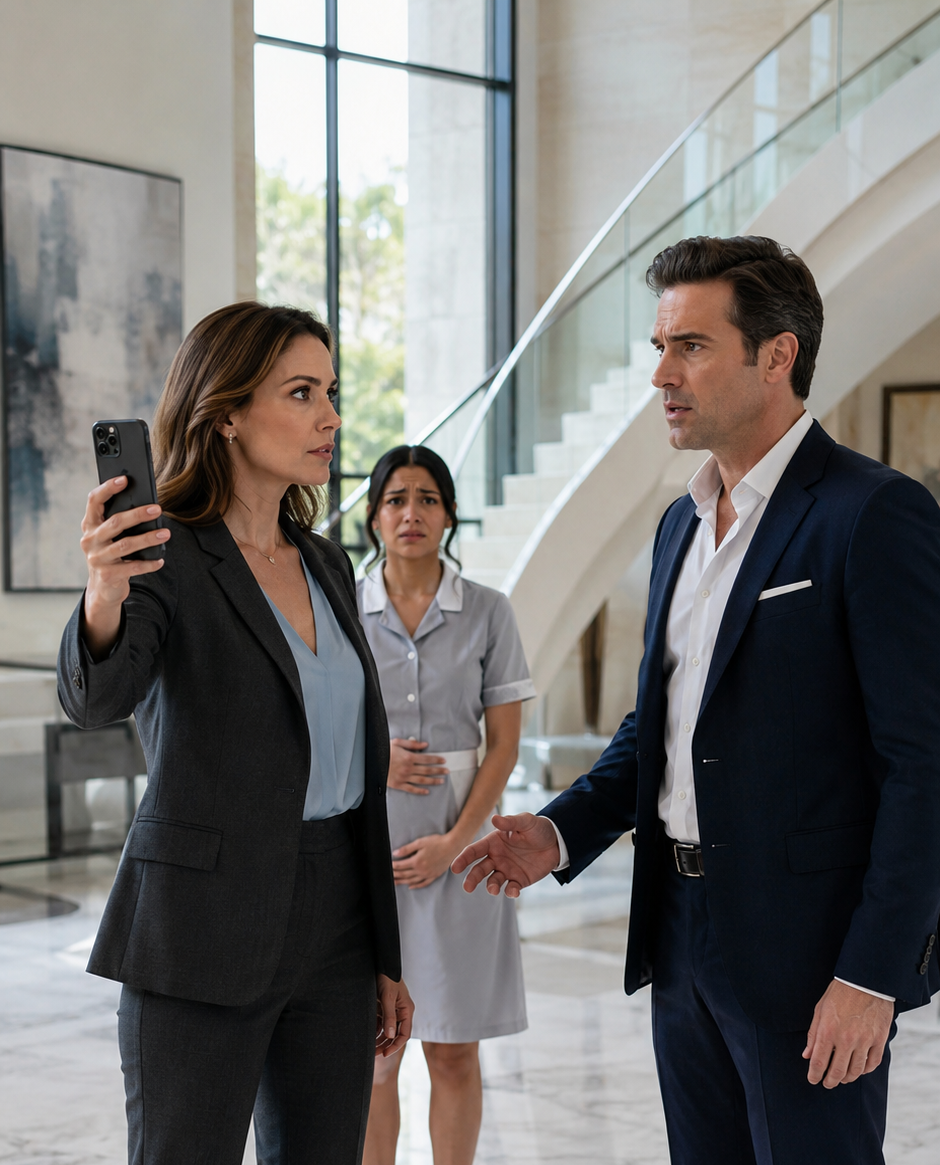
Adrian had appeared behind the glass doors, his phone pressed to his ear.
Even from across the driveway, I could see his expression had changed.
The charming man had been peeled away.
What stood there now was calculation.
“Yes,” I said.
Simone exhaled once.
“Drive to the office.
Do not stop.
Do not answer his calls.
Send me the recording.”
By the time I pulled away from the curb, Adrian had called six times.
By the time I reached the first traffic light, he had texted.
Evelyn, you’re emotional.
Come back so we can discuss this privately.
Then:
You have misunderstood everything.
Then:
That girl is unstable.
Then:
If you share that video, I will ruin you too.
Rosa stared at the messages as they lit my screen.
“He talks like that,” she whispered.
“Soft first.
Then mean.”
“Yes,” I said, gripping the wheel.
“Men like Adrian think cruelty is only ugly when other people can see it.”
At Simone’s office, we entered through the rear door.
Within an hour, Rosa was in a private room with water, food, and a social worker named Nia who spoke to her gently and never stood too close.
Simone and I sat at the conference table while my phone rested between us, the recording playing in a silence so sharp it seemed to scrape the walls.
Get rid of that baby.
It will hurt my career.
Take the money, leave this city, and never contact me again.
If you say a word, I’ll report you and say you stole from me.
When the video ended, Simone pressed her palms flat against the table.
“Tell me you didn’t send this to anyone else.”
“Not yet.”
“Good.” She looked at me carefully.
“You need to understand something.
The video is powerful, but powerful evidence handled carelessly becomes a weapon against the person it was supposed to protect.
Adrian will try to make this about consent, privacy, reputation, theft, immigration status, everything except what he did.”
“I know.”
“Do you?”
I looked toward the closed door behind which Rosa sat.
“I spent eight years warning clients about men like him.
I never thought I was sleeping beside one.”
Simone’s expression softened for half a second.
Then the attorney returned.
“We move clean.
We preserve the video.
We document Rosa’s statement.
We file for immediate protection regarding her documenTS. We contact the ethics certification board only through proper channels.”
At that, my phone buzzed again.
This time it was Adrian’s mother.
I let it ring.
Then his sister.
Then his chief of staff.
Then a number I did not recognize.
Simone glanced at the screen.
“The family has formed a circle.”
“They always do.”
“Then don’t stand inside it.”
I laughed once, though nothing was funny.
By evening, I had removed my wedding website, frozen vendor payments, and sent one message to our coordinator:
The wedding is canceled.
Please communicate only through my attorney.
I typed it without shaking.
But when I opened the drawer in Simone’s guest office and saw my engagement ring sitting in my palm, the diamond caught the overhead light and flashed with all the dinners, photographs, congratulations, and lies it had been polished to reflect.
I placed it in an evidence envelope.
Simone raised an eyebrow.
“Dramatic.”
“It was bought with a bonus he earned after cutting healthcare benefits for contract staff.”
“Then poetic.”
Rosa gave her statement after sunset.
Piece by piece, the truth emerged.
She had come from Honduras eighteen months earlier.
Adrian’s family had hired her through a private domestic staffing agency that served executives, diplomats, and old-money families who preferred their help invisible.
At first, Rosa cleaned two days a week.
Then Adrian requested her permanently.
“He said I was different,” she told us, twisting a tissue until it tore.
“He said I was smart.
He asked about my English classes.
He bought me books.”
I watched her speak, every word another thread pulling the mask from the man I had planned to marry.
“He started coming home during the day.
He said Miss Evelyn was busy and didn’t understand him.
He said he was lonely.” Her cheeks burned with shame she had no reason to carry.
“When I tried to quit, he said the agency would blacklist me.
Then he said my visa papers were wrong and he could help fix them.
Then he said I belonged with him.”
Simone’s pen paused.
“Did he ever put that in writing?”
Rosa hesitated.
“Some messages.
But he made me delete many.”
“Did he keep your passport?”
Rosa nodded.
“Where?”
“In a blue folder.
Laundry room cabinet.
With other papers.”
“Other papers?”
Rosa looked up.
“There were names,” she said.
“Other girls.
I thought maybe workers.”
Something passed between Simone and me.
“What kind of names?” I asked.
She closed her eyes, trying to remember.
“Maria.
Lien.
Petra.
Amal.
There were copies of IDs.
Pay envelopes.
Some had numbers.”
Adrian had not merely crossed a line.
He had built a system behind it.
At nine that night, my former law partner, Marcus Bell, called me.
Marcus now served as independent ethics counsel for the merger that was supposed to transform Adrian from wealthy into untouchable.
The Cole Group’s acquisition of a European logistics firm required certification that its executives had no active misconduct, labor exploitation exposure, or pending integrity concerns.
Adrian had spent six months grooming investors, regulators, and journalists for the announcement.
He had also spent six months planning a wedding to me.
Perhaps he thought marrying a nonprofit founder who protected exploited workers would make him look compassionate.
Perhaps he thought I would be too grateful to notice the shadows behind his polished doors.
“Evelyn,” Marcus said.
“I received an unusual call from Adrian Cole.”
“I imagine you did.”
“He claimed you are experiencing a breakdown and may attempt to sabotage his merger because of a private relationship dispute.”
“Did he sound frightened?”
“Professionally frightened.”
“Then he should be.”
Marcus was quiet.
I did not send him the video.
Not yet.
Simone was right.
Evidence needed a path, not a temper.
So I told him only this:
“Marcus, preserve your independence.
Do not certify anything until you receive formal correspondence from counsel.”
His voice sharpened.
“Is there credible concern?”
“Yes.”
“How serious?”
I looked through the conference room glass at Rosa curled beneath a blanket on the couch, one hand still resting over her stomach even in sleep.
“Career-ending,” I said.
“Maybe more.”
The first attack came before midnight.
A gossip account posted a blind item about a “charity princess” who had allegedly “snapped” after discovering her fiancé had shown kindness to a housekeeper.
By morning, the item had my initials.
By noon, it had my full name.
Then came the commenTS.
Gold digger.
Bitter.
Jealous of the maid.
Crazy women always ruin good men.
Adrian’s people worked fast, but they made one mistake.
They assumed public embarrassment still frightened me.
It once had.
When I was younger, I measured myself by who approved, who invited me, who smiled across rooms with crystal glasses in hand.
Adrian had loved that version of me: polished, agreeable, beautifully useful.
But I had built my nonprofit in shelters, court hallways, hospital waiting rooms, and kitchens where women whispered the worst things that had ever happened to them while stirring soup for children they still had to feed.
Those places had burned vanity out of me.
By afternoon, our first formal letter went out.
Not to the press.
Not to Adrian.
To the domestic staffing agency.
To Adrian’s corporate counsel.
To the ethics certification board.
To the attorney representing the building management company.
And finally, to Adrian himself.
Demand: immediate return of Rosa Martinez’s passport and personal documenTS.
Notice: preservation of all employment records, communications, security footage, payment logs, staffing agency contracts, and household surveillance data.
Warning: destruction of evidence would invite consequences far more durable than scandal.
Adrian called me from a blocked number twenty minutes later.
I answered only because Simone nodded.
“Evelyn.” His voice was low, intimate, wounded.
The voice he used after arguments, when he wanted me to feel cruel for expecting honesty.
“You’ve made your point.”
“No,” I said.
“I’ve only begun making it.”
A soft laugh.
“You think you’re saving her? She’s using you.”
“Return her passport.”
“She is confused.”
“Return her passport.”
“She stole from me.”
“Then file a police report and say that under oath.”
Silence.
I continued, “You won’t.
Because then you’ll have to explain why her passport is in your house.”
His breathing changed.
“You don’t know what you’re touching,” he said.
At last, there he was.
Not the regretful fiancé.
Not the misunderstood executive.
The man behind the door.
“Then enlighten me.”
“You think this is about one maid and one mistake? Evelyn, people like my family don’t fall because someone records one uncomfortable conversation.”
“People like your family always say that right before they discover gravity.”
He hung up.
That evening, building management delivered a sealed envelope to Simone’s office by courier.
Inside was Rosa’s passport, her birth certificate, her work documents, and a handwritten note from Adrian’s attorney stating that the items had been “inadvertently retained.”
Rosa cried when she saw them.
Not dramatically.
Not loudly.
She simply pressed the passport against her chest and folded forward as if someone had returned a piece of her body.
Nia sat beside her.
“You’re safe tonight.”
Rosa nodded, but her eyes found mine.
“He will not stop.”
“No,” I said.
“But now he has to chase us in daylight.”
The next morning, the merger certification was paused.
That single word—paused—hit the financial world like a dropped match.
By noon, three business journalists had called me.
I declined comment.
By three, Adrian’s company stock had dipped enough to make people who worshipped numbers suddenly care about ethics.
By five, the Cole family attorney requested a private meeting.
Simone told them no.
At six, Adrian appeared at my apartment.
I knew he would.
Men like Adrian could delegate smear campaigns, legal threats, and reputation management, but they needed to see with their own eyes whether the woman they thought they owned was still afraid.
I watched him through the security camera.
He stood in the hallway holding the small velvet box I had mailed back that morning.
The ring.
“Evelyn,” he said toward the camera.
“Open the door.”
I pressed the intercom.
“Leave.”
“We need to talk.”
“No.”
His jaw tightened.
“I loved you.”
That almost made me angry.
Not because it hurt.
Because he still believed the word could buy him entry.
“You loved having me beside you in photographs,” I said.
“You loved mentioning my nonprofit at investor dinners.
You loved what my conscience did for your image.”
 Salesman Wouldn\'t Stop Calling During Her Cancer Treatment, Until He Saw Where The Call Was Coming From
“You’re being cruel.”
“I learned from a master.”
His eyes flicked upward at the camera.
Then he changed tactics.
“Rosa is lying.
She wanted money.
She became obsessed with me.
You know how people like her get around men like me.”
People like her.
Men like me.
There it was, the whole ugly cathedral of him in four words.
I leaned closer to the speaker.
“I hope you say that in deposition.”
His face darkened.
“You will regret choosing a stranger over your future husband.”
“No, Adrian.
I regret not choosing strangers sooner.”
He lifted the velvet box.
“Take the ring back.
We’ll issue a statement.
We’ll say the wedding is postponed because of stress.
I’ll give the girl money.
Quiet money.
Enough that she disappears comfortably.”
Behind me, my laptop chimed.
An email from Marcus.
Subject: Urgent.
My eyes moved across the preview.
Ethics board has opened preliminary inquiry.
Need to speak.
There is another complainant.
I looked back at Adrian through the camera.
For the first time, I smiled.
“You should go home,” I said.
“You’re going to need your sleep.”
He stared at me for a long moment, and I saw the precise instant he realized I knew something new.
“What did you do?”
“I opened a door.”
His mouth tightened.
“Then pray you like what comes through.”
He left the ring on my doorstep.
I never picked it up.
The building superintendent did, wearing yellow gloves, and placed it in a plastic bag for Simone.
By the end of the week, the second complainant had a name.
Maria Alvarez.
She had worked for the Cole family three years earlier, first for Adrian’s mother, then briefly at Adrian’s townhouse.
She had left the city suddenly after being accused of stealing a bracelet no one ever proved existed.
The accusation had ruined her agency profile.
She had spent two years cleaning motel rooms under the table.
Marcus’s investigator found her through an old payroll notation Adrian’s lawyers forgot to bury.
When Maria arrived at our office, she was thirty, thin, and carried herself with the wary dignity of someone who had survived by never sitting with her back to a door.
She did not cry.
She did not tremble.
She placed a folder on Simone’s desk and said, “I kept copies.”
Inside were photographs of bruises.
Text messages.
A nondisclosure agreement.
A settlement draft she had refused to sign.
And a copy of a check from a private account controlled by Adrian’s mother.
At the bottom of the check memo line were two words:
House matter.
I thought of all the dinner parties where Celeste Cole had tilted her champagne glass and praised loyalty among staff.
I thought of the way she had kissed my cheek after the engagement and said, “You’ll learn, darling.
Families like ours survive by discretion.”
I had mistaken it for snobbery.
It had been doctrine.
Maria looked at Rosa through the office window.
“Is she the new one?”
The new one.
As if Adrian’s harm had seasons.
Rosa met Maria the following afternoon.
They sat together in the quiet room, two women separated by years but joined by the same man’s appetite for power.
I expected awkwardness.
Pain.
Maybe jealousy, because victims are so often encouraged to measure one another against the scraps powerful men throw them.
Instead, Maria asked, “Are you eating?”
Rosa nodded.
“Sleeping?”
“Not much.”
Maria reached into her purse and pulled out a small pouch of ginger candies.
“These helped me.”
Rosa stared at the candies, then began to cry.
Maria put an arm around her, and I had to leave the room before they saw my face.
The real collapse began on Monday.
The ethics board referred the matter to outside counsel.
The merger partner requested a delay.
Two board members resigned from Adrian’s company’s advisory council.
A major donor quietly withdrew from Celeste Cole’s cultural foundation.
Then someone leaked the blind item’s origin.
Not the video.
Not Rosa’s name.
Just the fact that the smear campaign had been coordinated by a public relations firm retained by Adrian Cole two hours after a legal preservation notice concerning employee misconduct.
That was enough.
The same commentators who had mocked me began using phrases like “troubling pattern” and “questions remain.” They did not apologize.
People rarely do when the tide turns; they simply swim in the new direction and pretend they had always known where the shore was.
Adrian was placed on administrative leave pending review.
His photograph vanished from the company homepage.
The promotion he had protected so viciously disappeared first, then his board seat, then the merger role, each one stripped away in language polished enough to conceal panic.
He did not lose everything at once.
Men like Adrian lose power the way chandeliers fall in old houses: first a tremor, then a crack, then a magnificent crash everyone insists they could not have predicted.
On Wednesday, Celeste Cole requested tea with me.
She did not call it a meeting.
Women like Celeste never requested meetings when manipulation would do.
She invited me to the club where she had hosted my bridal luncheon, the one with velvet chairs and portraits of men who looked as if they had spent centuries approving one another.
I went because Simone approved it.
And because I wanted to look into the eyes of the woman who had taught Adrian how to survive without shame.
Celeste wore ivory silk and pearls large enough to look medicinal.
“My dear,” she said when I sat.
“You look tired.”
“And you look prepared.”
Her smile barely moved.
“I always am.”
A waiter poured tea.
Neither of us touched it.
Celeste folded her hands.
“This has gone too far.”
“It went too far when your son threatened a pregnant employee.”
Her nostrils flared delicately.
“Allegedly.”
“Careful.
You’re not speaking to a reporter.”
“No,” she said.
“I’m speaking to a woman who was almost family.”
“Almost is doing a lot of work there.”
For a moment, the mask slipped.
Not fully.
Celeste had worn hers longer than Adrian had been alive.
But one corner lifted, and I saw contempt underneath.
“You think you are noble,” she said.
“You collect broken women and call it purpose.
But you have no idea how many lives depend on my son’s company, on our foundation, on the partnerships you are so eager to destroy.”
“I’m not destroying them.
I’m exposing what they were built on.”
“Such pretty language.” She leaned closer.
“Here is plain language.
Rosa Martinez will be taken care of.
The other woman too.
You will receive compensation for the embarrassment of ending the engagement.
Your nonprofit will receive a donation large enough to fund your little crusades for a decade.”
“My little crusades?”
“A generous phrase, considering.”
I smiled.
Celeste misunderstood it as interest.
She opened a leather folder and slid a paper across the table.
The number printed there had seven zeros.
For one wild second, I thought of what my nonprofit could do with that money.
Housing.
Counsel.
Medical care.
Emergency relocation.
A fund that would mean no woman had to choose between safety and rent for years.
Celeste saw the calculation.
Her eyes warmed with victory.
Then I turned the paper over and wrote one sentence on the back.
Attempted witness interference discussed at 2:14 p.m.
I slid it back.
Celeste’s warmth died.
“You recorded this?”
“No,” I said.
“But you just showed me how afraid you are of records.”
Her hand closed over the paper.
“Adrian was right about you,” she said softly.
“You are sentimental and dangerous.”
“No.
I’m organized and angry.”
I stood.
She did not.
At the door, she said, “Ask Rosa who paid her medical bill last month.”
I turned.
Celeste’s expression was calm again.
“That girl has not told you everything.”
The sentence followed me all the way back to Simone’s office.
Rosa was in the kitchen, laughing softly at something Nia had said.
It was the first time I had heard her laugh.
It sounded small and startled, like a bird testing an injured wing.
I hated Celeste for planting suspicion.
I hated myself for feeling it grow.
Later, when Rosa and I were alone, I asked gently, “Did Celeste pay a medical bill for you?”
The laugh vanished.
“Yes.”
“Why didn’t you tell us?”
Rosa pressed her lips together.
“Rosa.”
“She said if I told anyone, Adrian would know.”
“What would Adrian know?”
Rosa’s hand went to her stomach.
For a long moment, she said nothing.
Then she whispered, “The baby may not be his.”
The room seemed to tilt.
Not because I judged her.
Not because the truth changed Adrian’s cruelty.
He had still threatened her.
He had still held her documenTS. He had still tried to force her silence.
But secrets inside cases were like cracks inside glass.
Under pressure, they spread.
“Rosa,” I said carefully, “you need to tell me everything.”
She began to shake her head.
“I can’t.”
“Why?”
“Because if I say his name, Adrian will not be the one who kills me.”
The air left the room.
Before I could answer, Simone burst through the door holding her phone.
“We have a problem.”
On the screen was a headline posted three minutes earlier.
DISGRACED EXECUTIVE’S EX-FIANCÉE ACCUSED OF FABRICATING SCANDAL WITH PREGNANT HOUSEKEEPER
Beneath it was a photograph.
Not of me.
Not of Adrian.
Of Rosa entering a women’s clinic.
Her face was visible.
Her location was visible.
Her fear, when she saw it, was immediate and animal.
“No,” she whispered.
“No, no, no.”
Simone was already moving.
“Nia, relocation protocol.
Now.”
My phone rang.
Unknown number.
I answered before Simone could stop me.
For several seconds, there was only breathing.
Then a man spoke.
His voice was older than Adrian’s.
Quieter.
Much more dangerous.
“Miss Vale,” he said, “you should have stayed interested in passport numbers.”
My blood went cold.
“Who is this?”
A pause.
Then, almost kindly, he said, “Ask Rosa what name is on the baby’s real file.”
The call ended.
Across the room, Rosa had gone white.
“What file?” I asked.
She looked at the door as if expecting someone to come through it.
“The blue folder,” she whispered.
“The one in Adrian’s laundry room.”
I remembered what she had said.
Names.
IDs.
Pay envelopes.
Numbers.
My pulse beat once, hard.
“Rosa, whose name is on that file?”
Her lips parted.
Before she could answer, my phone buzzed again.
A message arrived from Adrian.
Just four words.
Now you understand nothing.
Attached was a photograph of my wedding invitation, burned black around the edges.
And behind it, half visible on a desk I recognized from Adrian’s house, lay the corner of a blue folder marked in block letters:
EVELYN VALE.
…If you want to know what happened next, please type “YES” and like for more.