
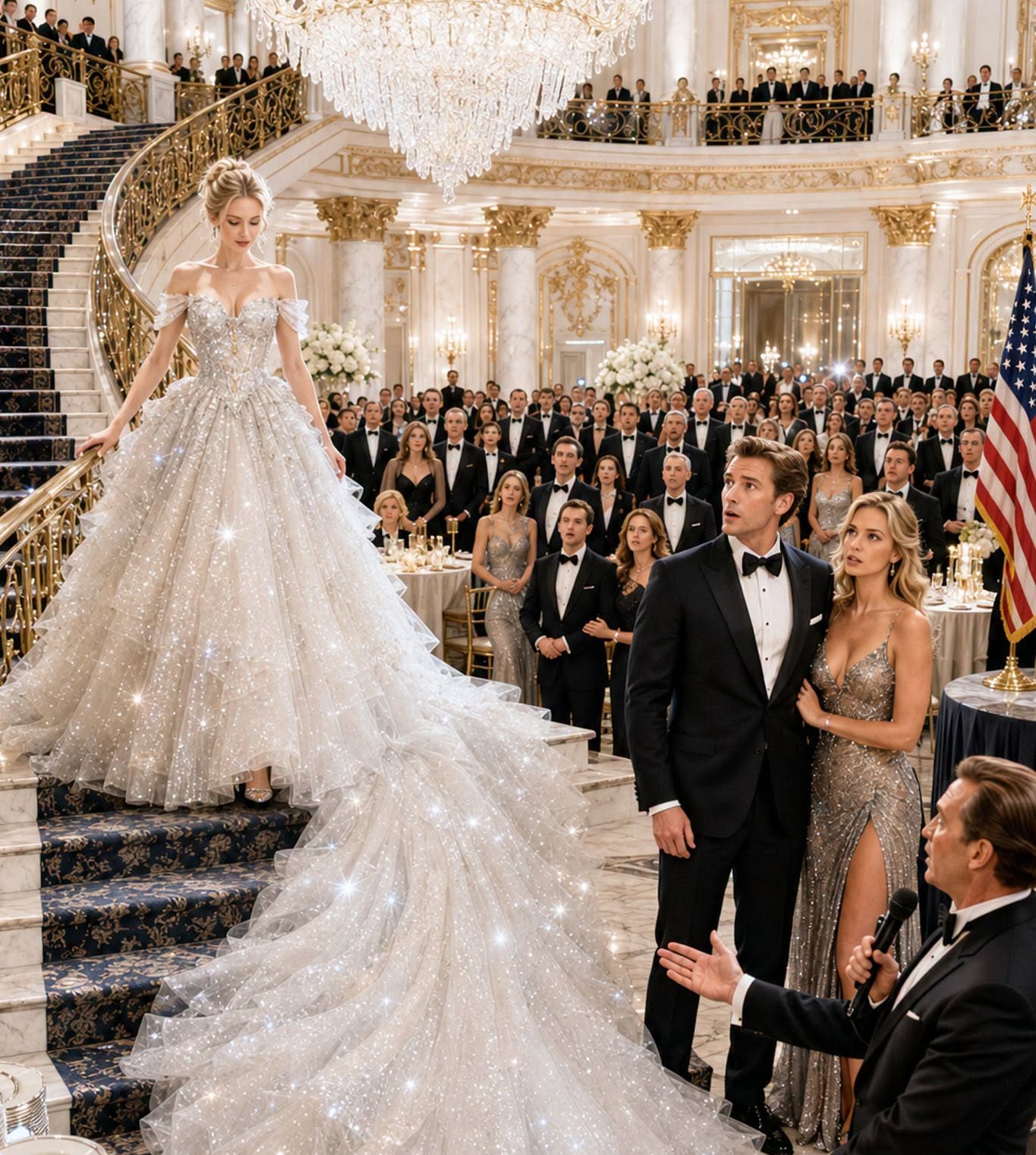
PART 2 — THE DIAMOND GALA
Adrian Mercer entered the Grand Halcyon Hotel believing the night had been designed to celebrate him.
The hotel stood above Michigan Avenue like a palace carved from gold and glass.
White spotlights crossed the winter sky.
Reporters waited behind velvet ropes while luxury cars delivered politicians, celebrities, industrialists, and heirs whose surnames appeared on hospitals and university libraries.
Savannah tightened her grip on Adrian’s arm.
“Everyone is looking at us.”
“They should be,” Adrian replied.
His mother walked behind them in an emerald gown purchased with money diverted from Adrian’s company.
Franklin wore a tuxedo charged to a consulting account.
Brooke carried a diamond handbag listed in corporate records as specialized computer equipment.
They looked like wealth.
None of them knew they were wearing evidence.
At the entrance, a security director examined Adrian’s invitation.
“Mr. Mercer,” he said.
“Your family has been assigned to the Founder’s Table.”
Margaret gasped.
Adrian smiled smugly.
“I was told there might be special recognition tonight.”
“There will be,” the security director answered.
For the briefest moment, something in the man’s expression unsettled Adrian.
It resembled pity.
Then the ballroom doors opened.
Inside, enormous chandeliers illuminated marble columns and walls draped in midnight velvet.
A diamond sculpture rotated above the central stage.
An orchestra played beside windows overlooking the frozen lake.
Adrian’s confidence swelled.
He had spent years trying to enter rooms like this.
Tonight, those rooms seemed to be opening for him.
Grant Ellison, the founder of a rival investment fund, stood near the bar speaking with a former treasury secretary.
Adrian guided Savannah toward them.
“Grant.”
Grant looked at Savannah, then at Margaret, Franklin, and Brooke.
“Adrian.
I didn’t realize the invitation included your entire household.”
“The Vale family requested us personally.”
“Did they?”
“They’ve been observing Mercer Capital’s success.”
Grant took a slow sip of champagne.
“Mercer Capital has had extraordinary luck securing funding from companies that appear from nowhere.”
“Luck is what unsuccessful people call strategy.”
“Of course.”
The former treasury secretary turned toward Adrian.
“Have you met the Vale heiress?”
“No one has,” Adrian replied confidently.
“She’s probably an elderly recluse whose lawyers control everything.”
Margaret joined them.
“My son will bring the Vale family into the modern world.
Adrian has a gift for making frightened people trust him.”
Grant nearly choked on his drink.
Savannah leaned against Adrian.
“He makes women trust him, too.”
Margaret pretended not to hear.
“Where is Eleanor?” Grant asked.
Adrian rolled his eyes.
“At home.”
“Your wife wasn’t invited?”
“She would have embarrassed us,” Margaret explained.
“Sweet girl, but terribly ordinary.”
Brooke laughed.
“She probably thinks the Diamond Gala is a jewelry sale.”
Grant’s expression changed.
“What was her maiden name?”
Adrian frowned.
“Vale.”
The former treasury secretary lowered his glass.
Margaret waved dismissively.
“A coincidence.
Her father was a mechanic.”
Grant stared at Adrian for several seconds.
“You never researched your wife’s family?”
“Why would I?”
Before Grant could answer, the orchestra stopped.
The lights dimmed.
Five hundred conversations disappeared at once.
A spotlight illuminated the grand staircase above the ballroom.
At its base, an announcer stepped to a microphone.
“Ladies and gentlemen, welcome to the sixty-fifth Diamond Legacy Gala.
Tonight, the Vale Dominion Group begins a new chapter.”
Applause spread through the ballroom.
“For generations, the Vale family has built companies, funded hospitals, preserved communities, and invested in innovation without seeking public attention.
Tonight, for the first time in twelve years, the chairwoman of the Vale Dominion Trust has chosen to appear before the world.”
Adrian straightened his jacket.
Savannah whispered, “Maybe she’s going to announce your partnership.”
Margaret clasped her hands beneath her chin.
The announcer continued.
“The Vale Dominion Group currently oversees an international network of assets approaching one trillion dollars.
Its chairwoman controls this hotel, the Dominion National Bank, NorthStar Medical Systems, Halcyon Energy, and more than three hundred private companies.”
Adrian felt every number as a promise.
He imagined himself standing beside the mysterious heiress while cameras flashed.
Perhaps the Founder’s Table was proof that she intended to make Mercer Capital her newest acquisition.
“Please welcome,” the announcer declared, “the chairwoman and principal heiress of the Vale Dominion Group—Mrs. Eleanor Catherine Vale Mercer.”
Adrian stopped breathing.
Margaret’s jeweled purse slipped from her hand.
The staircase doors opened.
Eleanor appeared beneath a flood of white light.
Her midnight-blue gown moved like liquid darkness, and thousands of diamonds scattered light across the ceiling.
The Vale Sapphire rested against her throat.
Her hair fell in polished waves around her shoulders.
But it was not the gown or the jewels that silenced the room.
It was the way she stood.
The woman Adrian had ordered to clean his dining room was gone.
In her place was someone composed, commanding, and untouchable.
Four members of her security team descended behind her.
At her side walked Daniel Callahan, chairman of Dominion National Bank and one of the most feared financiers in America.
Callahan offered Eleanor his hand.
She did not need it.
She descended alone.
Savannah’s fingers loosened around Adrian’s arm.
“Why does she have your last name?”
Adrian could not answer.
Eleanor reached the ballroom floor.
CEOs stepped forward to greet her.
A senator bowed his head.
The hotel’s executive staff formed a line.
Grant leaned toward Adrian.
“The ordinary wife you left at home seems to have arrived before you.”
Eleanor moved through the crowd.
Every person stepped aside.
Her eyes remained fixed on Adrian.
He searched her face for hesitation, affection, or some sign that this was a game they could discuss privately.
He found none.
She stopped in front of him.
Savannah instinctively moved closer to Adrian, although her face had turned pale.
Margaret forced a laugh.
“Eleanor, what a remarkable costume.”
Callahan looked at Margaret with open disbelief.
Eleanor did not acknowledge her.
Instead, she reached toward Adrian’s collar.
He flinched, expecting her to strike him.
She gently removed a strand of Savannah’s blond hair from his tuxedo.
“You missed one,” Eleanor said.
Cameras turned toward them.
Adrian lowered his voice.
“What is happening?”
“You said tonight was about building our future.”
“Eleanor—”
“So I came to watch.”
Savannah lifted her chin.
“Adrian told me you were separated.”
Eleanor’s gaze moved to her.
“He also told investors he earned the money in his company.”
Savannah stepped away from him.
Adrian recovered enough to speak.
“We need to discuss this privately.”
“No.”
The word was quiet, but it stopped him.
Eleanor accepted the microphone from the announcer.
“Good evening.”
The room became completely silent.
“I apologize for arriving separately from my husband.
Adrian believed I was at home washing his dishes.”
Several guests laughed.
Adrian’s face burned.
Eleanor looked toward the Founder’s Table, where Margaret, Franklin, and Brooke stood frozen among the most powerful people in the city.
“My husband also believed tonight’s invitation was a reward.”
She smiled.
“It was not.”
Behind the stage, a massive screen illuminated.
The Mercer family photograph appeared first.
Then the image split into dozens of bank transfers, contracts, expense reports, hotel receipts, and surveillance photographs.
Eleanor turned toward Adrian.
“Tonight’s gala is a fundraiser for families destroyed by financial crime.”
Her smile vanished.
“And before we ask anyone else to donate, my family and I are going to provide the evening’s first case study.”
PART 3 — THE MONEY BEHIND THE MAN
Adrian stared at the screen as if he could force it to go dark.
At its center was the Mercer Capital logo—a silver crown above the words Vision, Integrity, Legacy.
Beneath it appeared a second corporate chart.
Lines connected Mercer Capital to twelve investment firms Adrian believed were independent backers.
Each company led upward through layers of ownership until every line reached the same name.
VALE DOMINION GROUP.
“That’s false,” Adrian said.
His voice carried farther than he intended.
Eleanor stepped onto the stage.
“For five years, Adrian has described himself as a self-made investment genius.
He has given interviews about building Mercer Capital from nothing.”
She pressed a button.
A video appeared of Adrian speaking at a business conference.
“No one gave me a handout,” the recorded Adrian boasted.
“I risked everything.”
The video stopped.
Eleanor looked toward him.
“You risked nothing.”
A quiet murmur moved through the ballroom.
“The first two million dollars invested in Mercer Capital came from a Vale Dominion subsidiary.
When Adrian lost most of it on an unlicensed medical startup, another subsidiary replaced it.
When his creditors threatened to close the company, Dominion National Bank extended a loan under my personal guarantee.”
Adrian stood.
“You told me your inheritance was small.”
“I told you I had family money.
You never asked how much.”
“You deceived me.”
“No, Adrian.
I protected myself.”
Margaret rushed toward the stage.
“This is a private marital matter.”
Eleanor faced her.
“You made it a family matter when you accepted money from his company.”
“I accepted gifts from my son.”
“You accepted stolen funds.”
Margaret stopped.
Eleanor changed the screen.
A photograph of Margaret’s suburban mansion appeared beside its mortgage statement.
“Three years ago, your home entered foreclosure.
Adrian told you he negotiated with the bank and paid the balance.”
Margaret’s eyes moved toward her son.
Eleanor continued, “The bank belonged to me.
I canceled the foreclosure because I believed protecting Adrian’s parents would protect our marriage.”
Franklin gripped the back of a chair.
Eleanor displayed his medical records with private details concealed.
“When Franklin required emergency heart surgery, your insurance refused part of the treatment.
Adrian claimed Mercer Capital covered the remaining four hundred thousand dollars.”
Franklin’s face collapsed.
“The Vale Family Medical Trust paid every cent.”
Brooke began backing away from the table.
Eleanor noticed.
“And Brooke.”
The screen changed to photographs from Brooke’s failed clothing company.
“Your brother told you he secured a private investor after every bank rejected your business plan.”
Brooke shook her head.
“He did.”
“I was the investor.”
“You?”
“I invested because Adrian said his sister only needed one chance.
You used the first investment for your company.
The second paid for a vacation in Greece.
The third purchased the diamond handbag you are carrying tonight.”
Everyone looked at the bag.
Brooke dropped it.
Adrian pointed toward Eleanor.
“You volunteered that money.
You cannot humiliate my family because you regret helping them.”
“I do not regret helping them.”
Eleanor’s eyes moved across the Mercer family.
“I regret believing gratitude would eventually appear.”
Margaret’s shock hardened into anger.
“You entered our family under false pretenses.”
“I entered your family as a woman who loved your son.”
“You tested us.”
“I lived modestly.”
“You allowed us to think you were poor.”
Eleanor gave a sad smile.
“Would you have treated me with greater kindness if you had known I was rich?”
Margaret said nothing.
That silence answered for her.
Eleanor turned back to the guesTS.
“My grandfather taught me never to reveal wealth before understanding character.
My father, Thomas Vale, chose to work as a mechanic even after inheriting millions because he loved repairing engines.
Adrian met him twice.
Instead of asking about his life, Adrian mocked the grease under his fingernails.”
Adrian’s expression shifted as a memory returned.
Years earlier, Thomas had taken him into an old garage and attempted to explain a fuel-efficiency component he had invented.
Adrian had pretended to listen, then complained to Eleanor about wasting an afternoon with “a nobody in work booTS.”
That component later became essential to commercial transportation systems around the world.
Its patent had funded the Vale empire’s expansion.
“My father died believing Adrian was capable of becoming a good man,” Eleanor said.
“Before his death, he asked me to support my husband without allowing money to destroy him.”
Her voice tightened for the first time.
“I honored half of that request.”
Adrian stepped toward the stage.
“You made me dependent on you.”
“No.
I gave you opportunity after opportunity.
You chose deception every time.”
Callahan walked forward carrying a black portfolio.
Eleanor nodded.
He opened it.
“Mercer Capital’s genuine market earnings over the past five years total seventy-three thousand dollars,” Callahan announced.
“Its losses total eighteen million.
Vale Dominion covered those losses to prevent employees and legitimate clients from being harmed.”
Laughter did not follow.
The numbers were too devastating.
Adrian had presented himself as a financial master.
In reality, he had earned less in five years than some of his employees earned in one.
“Those calculations are manipulated,” Adrian said.
“They were prepared by three independent forensic accounting firms.”
“I closed the San Diego shipping deal.”
“You negotiated with a Vale subsidiary.”
“The Washington technology acquisition?”
“Vale Dominion.”
“The Chicago hospital expansion?”
“NorthStar Medical Systems.
Also mine.”
Adrian looked around wildly.
“Then every major client—”
“Was me.”
Savannah moved another step away from him.
Eleanor’s voice softened.
“You told me I contributed nothing to our marriage.
Yet every morning, you drove to an office I paid for.
You sat behind a desk I purchased.
You commanded employees whose salaries I guaranteed.
At night, you returned to a house held by my trust and told me I should be grateful for the food you allowed me to cook.”
Adrian’s face twisted.
“You wanted me to fail.”
“I wanted you to succeed.”
“Then why reveal this publicly?”
“Because your failure is no longer financial.”
The screen changed again.
Savannah and Adrian appeared entering a hotel together.
Then another image.
And another.
Dates and corporate charges ran beneath each photograph.
Savannah covered her mouth.
Margaret whispered, “Turn that off.”
Eleanor’s eyes remained on Adrian.
“You used company funds to betray your marriage.
That made the affair a corporate matter.”
Adrian lowered his voice.
“We can fix this.”
“There is more.”
Callahan removed a second folder.
This one was red.
Eleanor looked toward Margaret, Franklin, and Brooke.
“Adrian did not steal alone.”
Margaret’s face drained of color.
Callahan placed the folder on the podium.
Inside were four federal subpoenas.
Eleanor opened the first.
“And now,” she said, “we will discuss what the Mercer family did with money meant for dying children.”
PART 4 — THE FAMILY ACCOUNT
The gala no longer felt like a celebration.
It felt like a courtroom without walls.
Eleanor displayed the logo of the Bright Tomorrow Foundation, a charity Adrian had created two years earlier.
Its public mission was to pay for medical treatment for children whose families lacked adequate insurance.
Photographs of smiling children filled the screen.
Some had shaved heads.
Others sat in wheelchairs or held the hands of exhausted parenTS.
Guests who had laughed at Adrian earlier now watched in silence.
“Bright Tomorrow raised eleven million dollars,” Eleanor said.
“Seven million came from Vale Dominion and its partners.”
Adrian’s mouth opened, but Callahan spoke first.
“Only one million, four hundred thousand dollars reached medical programs.”
The screen changed to a flow of transactions.
“The remaining funds were transferred through consulting companies controlled by Adrian, Margaret, Franklin, and Brooke Mercer.”
Franklin’s face turned gray.
“I didn’t know.”
Callahan removed a signed document.
“This authorizes a transfer of nine hundred thousand dollars to Franklin Mercer Consulting.”
“My son told me it was a tax structure.”
“You withdrew the money three days later.”
Franklin looked at Adrian.
“You said it was legal.”
Adrian’s voice became sharp.
“Don’t blame me for your signature.”
The betrayal happened instantly.
Franklin stared at his son, understanding that Adrian had just sacrificed him in front of hundreds of witnesses.
Margaret stepped between them.
“We used some of the money for family necessities.
We intended to repay it.”
Eleanor pressed the control.
A photograph of Margaret’s renovated kitchen appeared, followed by receipts for imported marble, custom cabinets, and a temperature-controlled wine room.
“The renovation cost six hundred and eighty thousand dollars.”
Margaret’s lips trembled.
A second photograph showed Brooke on a yacht off the coast of Greece.
“Brooke transferred charity money to her clothing company, then used the account to lease this yacht.”
Brooke started crying.
“Adrian said he would replace it before the audit.”
Eleanor looked at her husband.
“He did replace some of it.”
Adrian’s shoulders relaxed slightly.
“Using money from employee retirement accounts,” Eleanor finished.
Several business leaders in the room stood.
Mercer Capital employed nearly two hundred people.
Some had worked there since its first year.
Adrian’s own chief financial officer sat at a table near the back.
His face showed horror as he studied the numbers.
“You moved six million dollars from protected retirement funds,” Callahan said.
“You then falsified statements so employees would not notice.”
“It was temporary capital,” Adrian argued.
“Investment companies move money constantly.”
“Not that money.”
“I was about to close a major deal.”
“With whom?”
Adrian had no answer.
Every major deal had been Eleanor’s.
Savannah began walking toward the exit.
Two security officers blocked her.
“I didn’t work in accounting,” she said quickly.
Eleanor turned toward her.
“You submitted expense reporTS.”
“Adrian told me what to write.”
“You classified your jewelry as medical diagnostic equipment.”
Savannah touched the diamond necklace around her throat.
“He said that was normal.”
“You classified your apartment as an emergency housing facility.”
Savannah looked around desperately.
“You accepted a company car purchased with charity funds,” Callahan added.
“You also signed reimbursement forms for business trips that occurred while you and Adrian were vacationing together.”
Adrian grabbed her wrist.
“Say Eleanor approved it.”
Savannah stared at him.
“What?”
“Tell them she knew.
Tell them she controlled the company.”
Eleanor watched the last trace of affection disappear from Savannah’s face.
“You told me she was stupid,” Savannah whispered.
“You said she couldn’t understand a bank statement.”
“I was protecting you.”
“You told me you owned this hotel.”
Adrian lowered his voice.
“Savannah, listen—”
“You told me you were divorcing her.”
“I am.”
“You told me the house was yours.”
Adrian tightened his grip.
Savannah pulled away and slapped him.
The sound echoed through the ballroom.
“You don’t own anything.”
Adrian’s humiliation transformed into rage.
He turned toward Eleanor.
“This is your fault.”
The security team shifted closer.
“You fed me money and waited for me to make mistakes.”
“I gave you money and waited for you to make choices.”
“You treated our marriage like an experiment.”
“I trusted you with freedom.”
“No—you watched me!”
Eleanor’s composure remained intact, but her eyes glistened.
“For six years, I waited for you to come home and recognize the woman sitting across from you.
I waited for you to ask why I never complained about money.
I waited for you to notice that executives returned my calls, that bankers knew my name, that contracts changed after I offered suggestions.”
She descended from the stage.
“I made myself smaller so your pride would feel safe.
Every year, you demanded I become smaller still.”
Adrian’s breathing grew uneven.
Margaret approached Eleanor.
“You cannot send your husband’s family to prison.”
“I am not sending anyone anywhere.
I am turning over evidence.”
“We are your family.”
“You reminded me tonight that I was never truly one of you.”
Margaret’s face crumpled.
“You should have told us.”
 Her Boyfriend Wants To Be On The Title Of The House, But She Says No Unless He’s On The Mortgage
“You should not require a woman to possess billions before treating her with dignity.”
A wave of applause began near the back.
It spread through the room until hundreds of guests were standing.
Eleanor did not smile.
This was not victory yet.
Callahan handed her one final envelope.
She held it toward Adrian.
“There is another matter.”
He did not take it.
“What now?”
“Your identity.”
Margaret looked confused.
Eleanor opened the envelope and removed a birth certificate, a court petition, and an old employment record.
“Adrian Mercer was born Aaron Pike.”
Franklin sank into his chair.
Margaret whispered, “No.”
Eleanor continued, “Your biological mother was Margaret Pike.
Franklin became your stepfather when you were twelve.
At twenty-eight, you changed your first and last names because you believed ‘Adrian Mercer’ sounded wealthier.”
“That isn’t a crime.”
“No.
But lying on federal investment documents about your education and employment history is.”
Callahan displayed Adrian’s résumé beside university records.
Adrian claimed degrees from Northwestern University and the University of Chicago.
He had attended neither.
Before meeting Eleanor, he had been dismissed from a used-car dealership for forging customer signatures.
Grant Ellison looked toward the floor, almost embarrassed for him.
Adrian’s expensive identity disintegrated in seconds.
Margaret reached for her son.
He pushed her hand away.
“You knew,” she said.
“You told me never to mention Pike again.”
“I wanted you to have confidence, not become a criminal.”
Adrian looked at Eleanor, and for the first time that night, genuine fear replaced his anger.
“What are you going to do?”
Eleanor removed her wedding ring.
“I already did it.”
She placed the ring inside the red folder.
“I filed for divorce this morning.”
The ballroom doors opened.
Federal agents entered beside officers from the Chicago Police Department.
Adrian backed away from the stage.
Eleanor’s voice followed him.
“But before they take you, there is one last person you need to meet.”
From behind the agents stepped a silver-haired woman holding a photograph of one of the sick children from Bright Tomorrow.
Her eyes were filled with tears.
Adrian recognized her immediately.
She was the federal judge whose granddaughter’s treatment had been delayed when the charity money disappeared.
PART 5 — THE NIGHT THE MERCERS FELL
Judge Caroline Whitmore did not approach Adrian as a judge.
She approached him as a grandmother.
“My granddaughter, Lily, was scheduled to receive an experimental treatment last spring,” she said.
“Bright Tomorrow approved the funding.
Three days before her appointment, the hospital was told the money was unavailable.”
Adrian’s lips moved, but no sound emerged.
“She survived because another organization intervened,” Judge Whitmore continued.
“Two other children on that waiting list did not.”
Margaret began sobbing.
“We didn’t know.”
“You knew the money belonged to sick children,” Eleanor said.
“You simply convinced yourselves your comfort mattered more.”
Adrian looked toward the exiTS.
Agents stood at each door.
The lead investigator stepped forward.
“Adrian Mercer, also known as Aaron Pike, you are under arrest on suspicion of wire fraud, embezzlement, falsification of financial records, conspiracy, tax fraud, and theft from protected employee-benefit accounTS.”
The agent turned toward Margaret, Franklin, and Brooke.
“You are also being detained for questioning regarding conspiracy and receipt of stolen funds.”
“No,” Margaret cried.
“Eleanor, please.”
She rushed toward her daughter-in-law.
Security stopped her.
Margaret reached across the distance between them.
“You know I love you.”
Eleanor stared at the woman who had criticized her clothes, mocked her father, entered her bedroom without permission, and encouraged Adrian to replace her with someone “more presentable.”
“No,” Eleanor said.
“You loved having someone beneath you.”
Franklin removed his glasses.
“I will cooperate.”
Adrian spun toward him.
“You’re not saying anything.”
“I signed documents because I trusted you.”
“You spent the money.”
“And I will answer for that.”
Franklin’s voice shook, but his gaze remained steady.
“You should answer for what you did.”
Adrian stared at him with contempt.
“You were never my real father anyway.”
Franklin flinched.
Even the agents paused.
Margaret’s grief changed into something harder.
She slapped Adrian across the face.
“You may have changed your name,” she whispered, “but no name could hide what you became.”
Brooke sank into a chair, crying into her hands.
Savannah stood apart from them, speaking rapidly with an attorney provided by the gala’s security staff.
She had already agreed to surrender her phone and testify.
Adrian suddenly lunged toward Eleanor.
He never reached her.
Two agents forced him against the Founder’s Table.
Crystal glasses shattered on the floor as they pulled his arms behind his back.
“You ruined me!” he screamed.
Eleanor did not move.
“You ruined yourself.”
“I would have loved you if you had told me the truth.”
“You knew every truth that mattered.”
“What truth?”
“That I was your wife.”
The handcuffs closed around his wrisTS.
“You knew I cared for your parents,” Eleanor continued.
“You knew I supported you when your company failed.
You knew I waited through every late night and every cruel word.
You did not need to know my net worth to decide whether I deserved loyalty.”
Adrian struggled against the agenTS.
“You think these people respect you? They respect your money.”
“Some of them probably do.”
Eleanor looked around the ballroom.
“That is why I stopped confusing attention with love.”
As Adrian was pulled toward the doors, he shouted to Margaret, Franklin, and Brooke.
“Tell them Eleanor controlled everything! Tell them she ordered the transfers!”
No one answered him.
At the threshold, he twisted toward Savannah.
“You loved me.”
She removed the necklace he had given her and threw it onto the floor.
“I loved the man you invented.”
The doors closed behind Adrian.
For several seconds, the ballroom remained silent.
Eleanor looked down at the broken glasses and the abandoned necklace.
The evening had unfolded exactly as her investigators predicted, yet she felt no triumph.
Only exhaustion.
Callahan came to her side.
“The board can end the event.”
“No.”
“You have nothing left to prove.”
“This gala was never truly about Adrian.”
Eleanor returned to the stage.
She waited until every guest had taken a seat.
“What you witnessed tonight was ugly,” she began.
“It involved betrayal, vanity, and criminal greed.
But the worst damage did not happen in this ballroom.”
Photographs of Bright Tomorrow’s patients returned to the screen.
“It happened in hospital rooms.
It happened in employees’ homes when retirement statements lied about their futures.
It happened every time someone trusted a name, a title, or a polished speech instead of demanding accountability.”
She announced that Vale Dominion would restore every stolen dollar to Mercer Capital employees.
The company would be placed into independent receivership.
Innocent workers would keep their jobs.
Legitimate clients would be protected.
The Bright Tomorrow Foundation would receive twenty million dollars under new leadership, enough to restore the missing funds and expand treatment programs.
Judge Whitmore stood first.
Then the entire ballroom rose.
The applause was not for Eleanor’s diamonds.
It was for what she chose to repair after others had destroyed it.
Later, as the orchestra resumed and guests began donating, Eleanor stepped onto a private balcony overlooking Chicago.
Snow drifted between the towers.
For six years, she had imagined freedom as the moment Adrian finally understood her value.
Standing alone beneath the winter sky, she realized his understanding no longer mattered.
Callahan joined her.
“Preliminary reports indicate tonight’s donations have passed thirty-eight million dollars.”
“That is good.”
“Mrs. Mercer—”
“Eleanor Vale.”
Callahan nodded.
“Ms.
Vale, the board is waiting for your decision about the chairmanship.”
Her father’s final letter rested in a safe beneath the mansion.
In it, he had told her that hiding could protect the heart for a time, but eventually it could also become a prison.
For years, Eleanor had governed through representatives because public attention frightened her.
Adrian’s betrayal had forced her into the light.
Now the light felt different.
“I’ll accept,” she said.
Callahan smiled faintly.
“The board will be pleased.”
“I am not doing it for the board.”
She looked through the glass at the ballroom—the employees, doctors, families, and donors who needed the Vale empire to become more than a silent machine accumulating wealth.
“I am done allowing other people to speak in my name.”
Inside, Margaret, Franklin, and Brooke were escorted separately toward waiting vehicles.
Margaret looked through the glass doors and met Eleanor’s eyes.
For once, she did not look superior.
She looked small.
Eleanor felt neither pleasure nor hatred.
She simply turned away.
At midnight, she returned to the mansion.
The roast still sat beneath the foil.
Dirty dishes covered the dining table exactly as Margaret had left them.
Eleanor walked to the wedding portrait.
She removed it from the wall.
Behind it was a smaller photograph of Eleanor and her father standing in his Ohio workshop.
Thomas Vale wore stained overalls, and Eleanor, seventeen years old, held a wrench while laughing.
She placed that photograph above the fireplace.
Then she carried the wedding portrait outside and left it beside the trash bins.
For the first time in years, Eleanor did not clean the dining room.
She went upstairs, locked her bedroom door, and slept without waiting for Adrian to come home.
PART 6 — THE PRICE OF A NAME
Six months later, Adrian sat behind thick glass in a federal detention center outside Chicago.
The tailored tuxedo had been replaced by a beige uniform.
His expensive haircut had grown uneven.
Without the watch, the cuff links, and the confidence supplied by other people’s money, he looked younger and older at the same time.
A telephone rang beside him.
He picked it up.
On the opposite side of the glass sat Franklin.
Adrian frowned.
“Where is Eleanor?”
“She isn’t coming.”
“My lawyer said she might.”
“Your former lawyer worked for Mercer Capital.
The court appointed a new one.”
Adrian leaned closer to the glass.
“I need Eleanor to withdraw the complaint.”
“She cannot withdraw federal charges.”
“She can tell them it was a misunderstanding.”
“It was not.”
Adrian’s jaw tightened.
“Did she send you to threaten me?”
“No.”
“Then why are you here?”
Franklin looked down at his hands.
“I came because I spent twelve years trying to be your father.
I kept thinking there was still something inside you worth reaching.”
Adrian laughed bitterly.
“Now you want to judge me?”
“I am pleading guilty to receiving stolen funds and falsifying tax records.”
Adrian’s expression changed.
“You can’t.”
“I already agreed to cooperate.”
“You’ll implicate me.”
“You implicated yourself.”
Adrian slammed his palm against the glass.
Franklin did not react.
“Your mother is also negotiating a plea.
Brooke surrendered the yacht, the jewelry, and her company.
She will likely serve time.”
“They’re blaming me to save themselves.”
“They are accepting responsibility.”
Adrian lowered his voice.
“Eleanor manipulated all of you.”
“Eleanor paid for my heart surgery.”
“She could afford it.”
“That does not erase the gift.”
Franklin’s eyes filled with tears.
“She protected us when she owed us nothing.
We rewarded her by helping you steal from children.”
“I never wanted anyone to die.”
“You wanted money badly enough not to care what happened after you took it.”
Franklin placed a hand against the glass.
“I loved you as my son.
I still do.
But love cannot mean helping you escape the consequences of who you chose to become.”
Adrian stared at the hand without lifting his own.
Franklin hung up the phone and walked away.
Adrian remained alone with his reflection.
The divorce decree arrived that afternoon.
Under the prenuptial agreement, he received no claim to Eleanor’s inheritance, the mansion, or Vale Dominion asseTS. Property he purchased with stolen funds had been seized.
His remaining legitimate assets would go toward restitution.
His attorney estimated that the criminal case could result in more than twenty years in federal prison.
For the first time, Adrian understood that there would be no hidden investor arriving to rescue him.
There had always been only Eleanor.
And he had spent six years teaching her how to live without him.
Across the city, Eleanor entered the Vale Dominion headquarters for her first annual shareholder meeting as public chairwoman.
The building’s lobby contained no portrait of her family.
Instead, its walls displayed photographs of workers, patients, researchers, engineers, and communities supported by the group.
Eleanor wore a white suit and the simple watch that had belonged to her father.
She had sold the Vale Sapphire.
The forty-eight-million-dollar proceeds established the Thomas Vale Emergency Treatment Fund, designed to provide immediate medical grants without the administrative delays that had once threatened Lily Whitmore.
Some members of the board objected.
Eleanor overruled them.
“Jewels are beautiful,” she said, “but they do not breathe.”
Mercer Capital was reorganized under a new name: Northlight Ventures.
Employees elected an ethics committee with authority to investigate executives.
Every retirement account was restored with interest.
Savannah testified against Adrian and returned most of the gifts she had received.
In exchange for cooperation, she avoided prison but was ordered to perform community service and repay a portion of the funds.
Margaret sold her mansion.
Franklin moved into a small apartment while awaiting sentencing.
Brooke entered a financial-rehabilitation program and worked at a department store under court supervision.
None of them contacted Eleanor.
Then, one evening, a letter arrived from Margaret.
Eleanor nearly threw it away.
Instead, she opened it.
Margaret did not ask for money or forgiveness.
She wrote about the first night Eleanor visited the Mercer home.
Eleanor had brought homemade bread and flowers.
Margaret remembered deciding within minutes that the quiet young woman was unworthy of her son.
She admitted that Eleanor’s supposed poverty had made cruelty feel safe.
“I thought kindness was something powerful people offered to weaker people,” Margaret wrote.
“You taught me that kindness was the power, and I was the weak one because I could not return it.”
Eleanor read the letter twice.
She placed it in a drawer.
Forgiveness did not arrive immediately, and she refused to pretend otherwise.
But the anger no longer controlled her.
That winter, Franklin received probation because of his cooperation and serious health condition.
Margaret served eight months in a federal facility.
Brooke was sentenced to fourteen monThS.
Adrian rejected a plea agreement.
He insisted a jury would believe Eleanor had trapped him.
The trial lasted three weeks.
Jurors saw the transfers, forged résumés, retirement theft, hotel bills, false charity reports, and messages in which Adrian told Savannah he would “drain the invisible wife before replacing her.”
They deliberated for four hours.
Guilty on every major count.
Before sentencing, the judge asked Adrian whether he wished to speak.
He stood in a dark suit provided by his attorney.
“I built a company,” he said.
“I created jobs.
My wife secretly controlled the money and used my mistakes to destroy me.”
The judge studied him.
“Mr. Pike, the evidence shows your wife repeatedly saved your company, your employees, and your family.
You interpreted mercy as weakness and generosity as permission.”
Adrian’s face tightened at the name Pike.
The judge sentenced him to twenty-two years.
As deputies led him away, Adrian looked toward the gallery.
Eleanor was not there.
She was in San Diego, opening a children’s research hospital named after her father.
For Adrian, that absence hurt more than any public humiliation.
He had finally become irrelevant to the woman whose life he once believed revolved around him.
PART 7 — THE WOMAN IN THE LIGHT
Five years after the Diamond Gala, Eleanor stood inside a new community center on Chicago’s South Side.
Children ran through hallways painted with planets, oceans, and bright city skylines.
The building contained a medical clinic, legal-aid offices, classrooms, and a financial-literacy program for families recovering from fraud.
Above the entrance were the words Thomas Vale Center for Working Families.
Eleanor’s father would have disliked seeing his name displayed so prominently.
He would have loved everything happening beneath it.
Judge Whitmore attended the opening with Lily, now twelve years old and healthy.
Lily wore a blue ribbon in her hair and carried the ceremonial scissors.
“You should cut it,” Eleanor told her.
Lily shook her head.
“We should do it together.”
They each held one side.
When the ribbon fell, the crowd cheered.
Reporters asked Eleanor about Vale Dominion’s growth.
The company now managed more than a trillion dollars in assets, but she redirected every question toward the doctors, teachers, and community leaders operating the center.
She had learned that power did not require hiding.
It required purpose.
Margaret stood near the back.
Her hair had turned almost completely white.
After leaving prison, she had begun volunteering with families of incarcerated people.
She and Eleanor were not close, but they had built something honest from the wreckage.
No expensive gifTS.
No false affection.
No demands for instant forgiveness.
Franklin helped at the center’s automotive workshop, where teenagers learned mechanical skills.
He kept a photograph of Thomas Vale above his workbench.
Brooke had rebuilt her life slowly.
She worked for a nonprofit that taught young entrepreneurs how to recognize financial fraud.
She never regained the glamorous social circle she once prized.
She no longer seemed to miss it.
After the ceremony, Margaret approached Eleanor.
“There is something you should know.”
Eleanor waited.
“Adrian sent me another letter.”
He had written dozens from prison.
Eleanor returned every one unopened.
“What did he say?”
“He finally admitted what he did.”
“That is between him and his conscience.”
“He asked whether you were happy.”
Eleanor looked across the center.
Lily was showing a group of children how to use a microscope.
Franklin was laughing with two teenagers beside a disassembled engine.
Brooke helped a mother complete an application for a business grant.
Callahan stood near the entrance discussing security arrangements, although he was officially retired and claimed he attended only because the cake was excellent.
“Yes,” Eleanor said.
“I am.”
Margaret nodded.
“I told him.”
That evening, Eleanor returned to the Grand Halcyon Hotel for the annual Diamond Legacy Gala.
The ballroom had changed since the night of Adrian’s arrest.
The dark velvet had been replaced by warm ivory fabric.
The Founder’s Table was gone.
Eleanor had ordered the room arranged without a hierarchy, placing donors beside doctors, students beside executives, and investors beside families whose lives their decisions affected.
She wore a midnight-blue gown, but there were no diamonds sewn into it.
Around her neck hung a small steel nut polished into a pendant.
Her father had carried it in his pocket for twenty years.
Before the event began, she walked onto the balcony where snow had fallen five years earlier.
Callahan joined her carrying two glasses of sparkling water.
“Do you miss the sapphire?” he asked.
“Not once.”
“It would have matched the gown.”
“It became twenty-three emergency surgeries last year.”
“An improvement, then.”
“A considerable one.”
Inside the ballroom, the announcer called Eleanor’s name.
She no longer felt the fear that once accompanied public attention.
When she entered, guests applauded.
Eleanor crossed the room without needing anyone to part for her.
She greeted nurses, hotel workers, investors, scholarship recipients, and children.
The evening raised more than one hundred million dollars.
Near midnight, Eleanor delivered the final speech.
“Years ago, I believed hiding my identity would reveal who loved me,” she said.
“Instead, hiding taught me something more important: people reveal themselves whenever they believe there will be no consequences for cruelty.”
The room became quiet.
“We often imagine betrayal arrives suddenly.
Usually, it enters through small permissions.
The insult we excuse.
The lie we ignore.
The boundary we abandon because protecting it might cause conflict.”
Margaret listened from the second row.
“Leaving a harmful life does not begin when the person hurting us understands our worth.
It begins when we understand it ourselves.”
Eleanor looked toward the windows, where the lights of Chicago stretched across the winter night.
“I once thought power meant owning buildings like this one.
Now I believe power is choosing what those buildings are used for.”
She raised her glass.
“To honest work, second chances, and the courage to stop becoming smaller for people who refuse to grow.”
The guests rose.
Five years earlier, their applause had felt like a coronation.
Tonight, it felt like a promise.
After the gala, Eleanor returned alone to her lakefront home.
The mansion no longer felt like the Mercer residence.
She had removed the cold marble dining room and replaced it with a warm library and long wooden table where foundation leaders gathered every month.
The old wedding portrait was gone.
Her father’s photograph remained above the fireplace.
Eleanor made tea and carried it to the window.
Somewhere in a federal prison, Adrian was living with the name he once tried to bury and the choices he could no longer disguise.
Eleanor did not celebrate his suffering.
She simply refused to carry it.
Her phone illuminated with a photograph from Lily: dozens of children inside the new community center, smiling beneath painted stars.
Eleanor placed the phone beside her father’s watch.
Outside, snow began falling over the lake.
Years earlier, Adrian had taken his mistress to the Diamond Gala because he believed his wife belonged at home.
He had been right about one thing.
Eleanor did belong there.
The difference was that the home, the hotel, the company, the fortune, and the future had always belonged to her.
She had only needed the courage to claim them.
THE END