
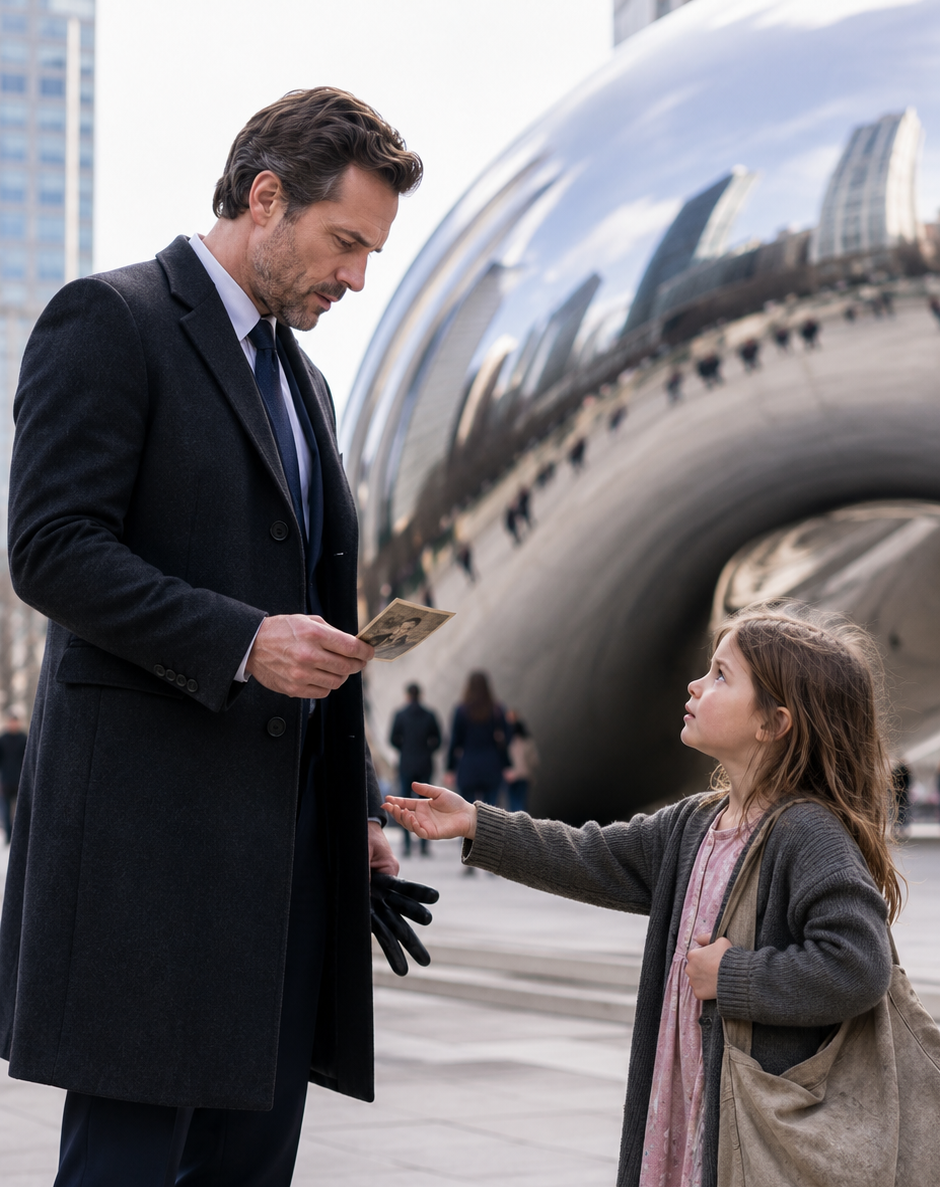
For several seconds, I could not breathe.
The photograph trembled in my hands, though I was gripping it so tightly the edges bent beneath my fingers.
It had faded at the corners, softened by time and too many folds, but there was no mistaking the two people in it.
Mary stood beside me outside a small diner on Wabash Avenue, her hair pinned loosely at the back of her neck, her smile shy and bright all at once.
I remembered that day.
I remembered the smell of rain on the pavement, the scrape of a taxi’s brakes nearby, the way she had laughed when the waitress offered to take our picture because, according to her, we looked like people who were about to either get married or break each other’s hearTS.
I had laughed then.
Mary had not.
She had only looked at me, her eyes searching mine as if she already knew which one it would be.
The man in the photograph was younger than I felt now.
Less careful.
Less polished.
He wore a cheap gray suit with sleeves half an inch too short and shoes he had shined himself in a bathroom sink.
His arm was around Mary’s shoulders, but his eyes were not on her.
They were somewhere beyond the camera, focused on an invisible future he thought he had to chase alone.
I stared at that younger version of myself until shame rose hot in my throat.
“Sir?”
Lauren’s small voice pulled me back.
She was watching me with quiet concern, still holding the last piece of pretzel in both hands.
“Are you sick?”
I swallowed, but my mouth had gone dry.
“No,” I whispered.
“No, sweetheart.
I just…”
Mrs. Higgins stepped closer, her expression changing as she looked from my face to the photograph.
“You know Mary,” she said.
It was not a question.
I looked at her, and for the first time in years, I did not know how to make my face obey me.
In boardrooms, in courtrooms, in interviews, I could turn emotion into steel.
I could hide fear, anger, uncertainty, even grief.
But not this.
Not Mary.
“I knew her,” I said.
Mrs. Higgins’s eyes narrowed, not with anger, but with the careful suspicion of someone who had lived long enough to learn that people often arrived too late and expected to be welcomed like saviors.
“How well?”
I looked down at Lauren.
She had Mary’s eyes.
Not exactly the color.
Mary’s were softer, almost hazel in the sunlight.
Lauren’s were darker, serious and steady.
But the way she looked at me—directly, almost too honestly—was Mary entirely.
“Well enough to have no excuse for not knowing about her daughter,” I said.
Mrs. Higgins inhaled sharply.
The wind moved around us, cold and sharp, tugging at Lauren’s thin dress.
I took off my coat and wrapped it around her shoulders.
It swallowed her whole.
She blinked up at me from inside the heavy wool, looking suddenly even smaller.
“We need to get to the hospital,” I said.
Mrs. Higgins opened her mouth, perhaps to argue, but Lauren spoke first.
“Is my mommy awake now?”
None of us answered quickly enough.
Her little face changed.
Not dramatically.
She did not cry.
She simply tightened her grip on the Bible inside her bag, as if the book might hold her steady.
“She was still unconscious when I last checked,” Mrs. Higgins said gently.
“But the doctors are helping her.”
Lauren nodded.
“Mommy sleeps deeply when she’s tired.”
The sentence nearly broke me.
I turned away and pulled out my phone.
There were eleven missed calls from my office, four messages from my assistant, and a calendar alert reminding me that I was supposed to be in a meeting with a group of investors worth more than most small towns.
For once, none of it mattered.
I called my driver.
“Bring the car to the east side of Millennium Park,” I said.
“Now.”
“Mr. Whitmore, the board call—”
“Cancel it.”
A pause.
“Cancel it, sir?”
“Yes.”
“Is everything all right?”
I looked at Lauren, bundled in my coat, her worn bag pressed to her chest like a shield.
“No,” I said.
“But I’m going to make it right.”
The hospital was twenty minutes away, though it felt longer.
Lauren sat between Mrs. Higgins and me in the back seat, her legs sticking straight out because they were too short to bend over the edge properly.
My coat covered her like a blanket.
She did not ask many questions.
That worried me.
Children should ask questions.
Children should complain about the cold, about hunger, about being scared.
But Lauren only watched Chicago pass outside the tinted window, her reflection faint against the gray city.
At one point, she looked at me and asked, “Do you work in a castle?”
I glanced at Mrs. Higgins, confused.
“A castle?”
She pointed to my suit.
“Mommy says men with shiny shoes either work in castles or banks.”
Despite the heaviness in my chest, I almost smiled.
“I work in an office.”
“Is it very tall?”
“Yes.”
“Do you like it?”
I had been asked that question by reporters, partners, rivals, and once by a senator at a dinner where everyone pretended not to hate each other.
I had always answered the same way.
Of course.
I built it.
But from Lauren, the question felt different.
It did not ask whether I was successful.
It asked whether the life I had chosen had made me happy.
“I used to think I did,” I said.
She considered this with grave seriousness.
“Mommy says tall places can make people dizzy if they forget to look down.”
Mrs. Higgins turned her face toward the window, but not before I saw her wipe at her eyes.
At the hospital, I moved quickly—not with panic, but with the practiced authority of a man used to doors opening because he expected them to.
The emergency desk clerk looked ready to tell me visiting hours were restricted until I gave Mary’s full name.
“Mary Grace Fitzgerald,” I said.
“She was admitted after a fall.
Head injury.”
The clerk typed, checked something on her screen, and hesitated.
“Are you family?”
The question landed harder than it should have.
I looked at Lauren.
“She is,” I said.
The clerk softened when she saw the child.
“One moment.”
We waited beside a row of plastic chairs bolted to the floor.
The air smelled of antiseptic, coffee, and worry.
Somewhere down the hall, a machine beeped in an uneven rhythm.
Lauren leaned against Mrs. Higgins.
Her eyelids drooped, but she fought sleep.
“Lauren,” I said quietly, crouching in front of her.
“You can rest.
We’re here now.”
“I have to see Mommy first.”
“You will.”
“She gets scared when she wakes up and I’m not there.”
I could not speak.
A nurse came out and introduced herself as Dana.
She was in her forties, with tired eyes and a kind face.
“Mary is stable,” she said.
“She regained consciousness briefly earlier today, but she was confused and agitated.
She’s sleeping now.
The doctor will explain more.”
“Can Lauren see her?” Mrs. Higgins asked.
The nurse hesitated.
“Just for a few minutes.
She needs quiet.”
Lauren slid down from the chair immediately.
I stood, but Nurse Dana stopped me with one glance.
“Family only for now.”
Again, that word.
Family.
Lauren looked back at me from the doorway.
“Can he come?” she asked.
The nurse’s eyes moved between us.
“Sweetheart, do you know him?”
Lauren looked at the photograph still in my hand.
“He’s in Mommy’s picture.”
The nurse’s expression changed.
Mrs. Higgins looked at me, then sighed as if surrendering to a truth she did not fully trust.
“He should come,” she said.
“But only because Mary may need answers when she wakes.”
The room was dim.
Mary lay beneath a white blanket, her face pale against the pillow, a bandage near her temple.
Her hair was shorter than I remembered and threaded with strands of fatigue, not age exactly, but hardship.
There were shadows beneath her eyes, and one hand rested outside the blanket, thin and still.
For years, memory had preserved her as she had been when I left: standing in the hallway of our old building, wearing my oversized sweater, smiling bravely while pretending not to cry.
But this Mary was real.
This Mary had lived all the years I had missed.
She had worked.
She had worried.
She had raised a child.
She had carried burdens I never saw because I had trained myself not to look back.
Lauren walked to the bed and climbed carefully onto the chair beside it.
“Mommy,” she whispered.
Mary did not wake.
Lauren reached for her hand and tucked her tiny fingers into Mary’s palm.
“I didn’t lose the Bible,” she said softly.
“And Mrs. Higgins found me.
And the shiny-shoes man bought me a pretzel.”
The shiny-shoes man.
That was all I deserved to be.
I stood near the wall, unable to move closer.
Mrs. Higgins watched me from beside the door.
“You really didn’t know?” she asked under her breath.
I shook my head.
“I left before…”
Before what? Before Mary could tell me? Before I gave her a chance? Before I became the kind of man who measured silence by convenience?
“She never came after me,” I said, but the words sounded weak even as I spoke them.
Mrs. Higgins’s mouth tightened.
“Maybe she did.”
I turned to her.
“What do you mean?”
She looked toward Lauren, then lowered her voice further.
“Mary kept letters.
A whole box of them.
Some she sent.
Some came back.
Some she never mailed.
I only know because I helped her move once, years ago.” Her eyes studied me carefully.
“She didn’t talk much about you.
But when she did, she called you Daniel.”
No one called me Daniel anymore.
To everyone else, I was Daniel Whitmore, founder, chairman, donor, problem-solver, dealmaker.
But Mary had been the only one who said my name like it belonged to a person, not a signature at the bottom of a contract.
“What happened to the letters?” I asked.
“In her apartment, I assume.
Unless the landlord threw them out with everything else.”
The landlord.
A cold focus came over me then, familiar and useful.
Emotion had nearly drowned me, but anger gave me something solid to stand on.
“What’s his name?”
“Gerald Pike,” Mrs. Higgins said.
“Owns three buildings on the South Side.
Cheap repairs, high rent, always a notice taped to someone’s door.
Mary was behind, yes, but she was trying.
She cleaned office windows during the day and took laundry at night.”
“She never asked anyone for help?”
Mrs. Higgins gave me a sad look.
“She asked God.
She asked herself.
Sometimes she asked me to watch Lauren for an hour.
But no, Mr. Whitmore, she did not ask rich men who had already taught her they could disappear.”
I took it because I deserved it.
Lauren leaned over Mary’s hand.
“Mommy,” she whispered again.
“I’m here.”
Mary’s fingers twitched.
Lauren gasped.
“Mommy?”
Mary’s eyes moved beneath her lids.
Her breathing shifted.
Slowly, painfully, she opened her eyes.
At first, she seemed to see only the ceiling.
Then the room.
Then Lauren.
Her face crumpled.
“Baby,” she breathed.
Lauren climbed onto the bed before anyone could stop her, curling carefully against Mary’s side.
“I’m sorry,” Lauren whispered.
“I tried to stay in the hallway but it got dark.”
Mary closed her eyes, tears sliding silently into her hair.
“No, no, my sweet girl.
You did nothing wrong.”
I stepped forward without meaning to.
Mary heard the movement.
Her eyes opened again.
And found me.
The room went impossibly still.
Recognition came slowly, not because she had forgotten me, but because pain and medication forced her mind to cross the years one at a time.
Her lips parted.
“Daniel?”
My name in her voice struck something deep enough to hurt.
“Mary.”
Her gaze moved over my face, taking in the expensive suit, the watch, the years, the man I had become.
Then she looked at Lauren.
Panic flickered across her face.
“Why is he here?”
Lauren lifted her head.
“He helped me, Mommy.
I asked him if he knew someone who could help me.”
Mary’s eyes shut briefly.
The nurse stepped forward.
“Ms.
Fitzgerald, you need to stay calm.”
“I am calm,” Mary said, though her voice trembled.
“I just need to understand why Daniel Whitmore is standing in my hospital room.”
Mrs. Higgins cleared her throat.
“Because Lauren found him at the park.”
Mary looked at me again, and there was no hatred in her expression.
Somehow, that made it worse.
Hatred would have been easier.
Hatred would have given me a place to put my guilt.
Instead, Mary looked exhausted.
As if life had demanded so much from her that she had no strength left for anger.
“I didn’t know,” I said.
The words were small.
Useless.
The kind of words people use when the truth is too large to fit into language.
Mary’s hand tightened around Lauren.
“No,” she said softly.
“You didn’t.”
“I should have.”
“Yes.”
I flinched.
Not because she raised her voice.
Because she did not.
“I came back to the apartment,” I said.
“Months later.
You were gone.”
Mary stared at me.
“Months?”
I nodded.
Her laugh was breathless and broken.
“You promised you would come back in three days.”
“I know.”
“No, Daniel.
I don’t think you do.”
The nurse moved again, but Mary lifted a weak hand.
“Please.
Just a minute.”
Lauren looked between us, sensing something she could not understand.
“Do you know the shiny-shoes man, Mommy?”
Mary’s eyes softened as she looked at her daughter.
“I knew him a long time ago.”
“Was he nice?”
The question opened a silence no one knew how to fill.
Mary looked at me.
“He was trying to be,” she said at last.
That mercy nearly undid me.
The doctor arrived before more could be said.
Dr. Patel was calm and efficient, explaining that Mary had suffered a concussion and a hairline fracture near her wrist from the fall.
She would need observation, rest, and follow-up care.
There were concerns about dizziness and memory gaps, but nothing that surgery could fix.
Time, he said.
Care.
Stability.
Stability.
The word felt like an accusation.
After Lauren was persuaded to go with Mrs. Higgins to find something warm to drink, I remained in the doorway, unsure whether I had the right to stay or leave.
Mary stared at the ceiling.
“Did you really not know about her?”
“No.”
“I tried to tell you.”
My chest tightened.
“Mrs. Higgins mentioned letters.”
Mary turned her head slowly toward me.
“I sent three to the address you gave me in New York.
They came back.
Then I called the number on your old business card.
Disconnected.” She swallowed.
“I went to your office, the little one above the print shop.
It was empty.
The landlord said you had left no forwarding address.”
“I changed everything after the investors came in,” I said, hearing how hollow it sounded.
“New office.
New phone.
New people handling calls.”
“New life.”
“Yes.”
Mary smiled faintly, but there was no warmth in it.
“I understood that part.”
“No, Mary.
I didn’t leave because of you.”
“People rarely think they do.”
I closed my eyes.
“I was ashamed.”
That made her look at me.
The truth, once started, came faster than I expected.
“I had nothing.
I was tired of being refused, tired of being poor, tired of watching every door close.
When Harrington offered me funding, I thought it was my one chance.
I told myself I would come back once I had something worthy of you.” My voice lowered.
“Then the meetings became more meetings.
The money came with conditions.
The company grew.
And every week I waited, it became harder to explain why I had waited.
So I told myself you were better off.
I told myself you had moved on.”
Mary listened without interrupting.
When I finished, she looked away.
“You made a story where you were noble.”
“Yes.”
“And I became convenient.”
The words cut cleanly.
I nodded.
“I’m sorry.”
Her eyes filled, but she blinked the tears away.
“I needed you,” she whispered.
“Not money.
Not rescue.
You.
I was twenty-four, pregnant, terrified, and still foolish enough to believe that if I prayed hard enough, you would walk through the door.”
I could not answer.
“Then Lauren was born,” Mary continued, her voice softer.
“And I stopped praying for you to come back.
I started praying she would never feel unwanted.”
“She isn’t,” I said immediately.
Mary’s gaze sharpened.
“You don’t get to decide that in one afternoon.”
“I know.”
“Do you?”
I stepped closer, stopping beside the chair.
“No.
But I want to learn.”
Mary studied me.
The machines hummed quietly.
Outside the window, Chicago was turning blue with evening.
“You can help with the hospital bill,” she said.
“You can help Mrs. Higgins.
You can make a call and frighten Mr. Pike into unlocking my apartment.
But do not walk into Lauren’s life like a man claiming lost property.”
“I wouldn’t.”
“You might without meaning to.
Men like you are used to possession sounding like responsibility.”
Again, I took it.
“What do you want me to do?”
“For tonight?” She closed her eyes, exhausted.
“Make sure my daughter is warm.
Make sure she sleeps somewhere safe.
And don’t tell her anything you are not ready to live up to.”
It was the most honest instruction anyone had given me in years.
“I promise.”
Mary opened her eyes.
Her expression changed at the word.
“Don’t,” she said quietly.
“Not yet.”
I understood.
Promises from me had already cost her too much.
That night, Lauren slept in a hospital recliner with two blankets tucked around her and Mary’s Bible under her arm.
Mrs. Higgins refused a hotel room but accepted coffee and a ride home to collect a few of Lauren’s clothes, though she warned me three times that charity did not make us friends.
I called my legal team from the hallway.
Not to threaten.
Not to destroy.
Simply to document, to verify, to ensure a child’s belongings were returned and Mary’s tenancy handled lawfully.
I heard my own voice carefully instructing restraint, and that surprised me.
A younger version of me would have wanted to crush Gerald Pike by morning.
But Mary had asked for stability, not spectacle.
After that, I called my assistant, Caroline.
“Clear my schedule for the week.”
“Daniel,” she said, stunned, “you have the acquisition vote Friday.”
“Move it.”
“We can’t just move it.”
“Then attend without me.”
There was a silence.
“You’ve never missed one.”
“I know.”
“Are you ill?”
I looked through the glass at Lauren sleeping, her mouth slightly open, one hand resting against Mary’s blanket.
“No,” I said.
“I’m becoming aware of something.”
Caroline, who had worked for me for seven years and had never once asked a personal question, spoke more softly.
“Is there anything I can do?”
“Yes.
Find a family attorney.
Quiet.
Ethical.
No headlines.
And have someone locate every record connected to Mary Grace Fitzgerald and Lauren Fitzgerald—medical, housing, employment, school enrollment, everything available through proper channels.
Nothing invasive.
Nothing illegal.”
“Understood.”
“And Caroline?”
 Substitute Teacher Demands A Student Turn Off Her Insulin Pump, Then Realizes She Made A Huge Mistake
“Yes?”
“Find out whether anyone in my office ever received a letter from Mary Fitzgerald.”
Another silence.
“That may take time.”
“Start with the old archived mail logs from the New York office.”
“We only kept those because you insisted everything be scanned.”
I leaned against the wall.
Of course I had.
I had archived contracts, memos, invoices, receipts, parking passes.
Every trace of business mattered to me.
Had Mary’s letters been somewhere in that cold, efficient system all along?
“Look carefully,” I said.
At dawn, I found Lauren awake.
She was standing beside the window in Mary’s room, still wrapped in one of the hospital blankets, watching the city pale under the first light.
“Couldn’t sleep?” I asked.
She shook her head.
“Mommy makes toast in the morning.”
I stood beside her, leaving enough space that she did not feel crowded.
“What kind?”
“Too brown.”
I smiled faintly.
“Burnt?”
“No.
Toasty.” She gave me a serious look.
“Burnt is when the smoke alarm sings.”
“I see.”
She looked back out the window.
“Will Mommy be mad that I talked to a stranger?”
“She’ll be glad you found help.”
“You were a stranger.”
“Yes.”
“Are you still?”
The question slipped under my ribs.
“I don’t know,” I said honestly.
Lauren seemed to accept that.
A minute later, she asked, “Did you love my mommy?”
The room behind us was quiet.
Mary was still asleep.
I looked at the little girl’s reflection in the glass.
“Yes,” I said.
“I did.”
“Did she love you?”
My throat tightened.
“I think so.”
Lauren nodded as if confirming a theory.
“That’s why she keeps the picture.”
I looked at her.
“She looks at it?”
“When she thinks I’m sleeping.”
The morning unfolded carefully.
Dr. Patel approved Mary for another day of observation.
Mrs. Higgins returned with a small backpack of clothes she had managed to retrieve after arguing with the building superintendent for an hour.
My attorneys confirmed what Mrs. Higgins had said: the lockout was improper, and Mary’s possessions were still inside the apartment, though the landlord claimed he had acted after “abandonment.”
Abandonment.
That word followed me everywhere.
By noon, I was standing in the hallway outside Mary’s room when Caroline called.
“We found something,” she said.
I straightened.
“The letters?”
“One scanned envelope from twelve years ago.
It was logged at the New York office.
Addressed to you by hand.
The mailroom marked it ‘Return to Sender’ because you had transitioned to the corporate headquarters and your personal mail was being filtered.”
“Filtered by whom?”
A pause.
“By executive administration at the time.”
“Harrington’s people.”
“Yes.”
Arthur Harrington had been my first investor, mentor, and, for a time, the closest thing I had to a father after mine died.
He had taught me how to negotiate, how to leverage silence, how to treat sentiment as a liability.
He had also told me, more than once, that attachment made men weak.
“What happened to the letter?” I asked.
“The scan includes the envelope only, not the contenTS.”
“Why?”
“It appears the contents were removed before scanning.”
A cold sensation moved through me.
“Removed by whom?”
“I’m still checking.”
I looked through the window at Mary, who was sitting up now while Lauren showed her the worn Bible as though presenting proof of survival.
“Keep digging,” I said.
“There’s more,” Caroline added.
I closed my eyes briefly.
“Tell me.”
“There was a note attached to your personnel transition file from that same week.
It references ‘personal correspondence from M.G.F.’ and says, ‘Handled per A.H.’”
A.H.
Arthur Harrington.
My hand tightened around the phone.
Arthur had died three years ago.
There would be no confrontation.
No demanding answers from the man who had shaped my ambition and perhaps quietly severed the last thread tying me to Mary.
But why?
To protect an investment? To keep me focused? To ensure the poor girl from Chicago did not complicate his rising star?
Or had there been something inside Mary’s letter that Arthur did not want me to see?
“Send me everything,” I said.
I did not tell Mary immediately.
Not because I wanted to hide it, but because I could see how fragile she was.
She had survived one disaster only to wake inside another old wound.
Truth mattered, but timing did too.
That afternoon, we went to her apartment.
Mary was not allowed to leave the hospital, so Mrs. Higgins came with me.
Lauren stayed behind with a nurse Mary trusted, coloring quietly beside her bed.
The building was narrow and tired-looking, wedged between a corner store and a shuttered laundromat.
The front steps were cracked.
The hallway smelled of boiled cabbage, dust, and old radiator heat.
Mrs. Higgins led me to the third floor.
Mary’s door had a new lock.
A man in a brown jacket opened it after my attorney called the building owner.
Gerald Pike was shorter than I expected, with a face made cautious by the sight of my lawyer and the housing advocate standing beside him.
“I didn’t know there was a kid,” he said before anyone accused him.
Mrs. Higgins’s eyes flashed.
“She lived here five years.”
“I mean, I thought the neighbor had her.”
“You thought,” Mrs. Higgins said, “because thinking was cheaper than asking.”
I stepped inside before I said something I would regret.
Mary’s apartment was small, clean, and heartbreaking.
There was a sofa with a knitted blanket folded over one arm, a tiny kitchen table with two mismatched chairs, a row of children’s drawings taped carefully to the wall.
A paper snowflake hung in the window.
Beside the sink sat a chipped mug.
Blue.
My breath caught.
Not the same mug.
It couldn’t be.
And yet for a moment, I saw Mary years ago, bringing me coffee in a chipped blue mug, telling me I looked too thin, too serious, too determined to fight the whole world with no breakfast.
In the bedroom, Lauren’s clothes were folded in a plastic basket.
A stuffed rabbit sat on the pillow.
On Mary’s nightstand lay a stack of bills, a bottle of aspirin, and a small wooden box.
Mrs. Higgins saw me looking at it.
“That’s hers.”
“I won’t open it without permission.”
“Good.”
But then she hesitated.
“There is something you should see.”
She went to the closet and pulled down a shoebox from the top shelf.
It was tied with string.
On the lid, in Mary’s handwriting, was one word.
Daniel.
I sat on the edge of the bed because my knees no longer felt reliable.
Mrs. Higgins placed the box beside me but did not untie it.
“She kept it all this time,” she said.
My hand hovered over the lid.
“I don’t have the right.”
“No,” she agreed.
“You don’t.
But maybe Lauren does.”
I looked up.
Mrs. Higgins’s face had softened a little, though her caution remained.
“Mary carried too much alone.
Maybe some of what’s in there belongs to the truth.”
We brought the box back unopened.
When Mary saw it, her face changed.
“Where did you find that?”
“In your closet,” Mrs. Higgins said.
“I’m sorry.
I thought…”
Mary looked at her for a long moment, then sighed.
“It’s all right.”
I stood near the doorway.
Lauren sat beside her, coloring a sun with a purple crayon.
Mary touched the string on the box.
“I used to think I’d burn it one day,” she said.
“Why didn’t you?”
She glanced at Lauren.
“Because some things hurt and still matter.”
She untied the string slowly.
Inside were letters.
Some addressed to me.
Some written but never mailed.
A dried flower pressed between wax paper.
A subway card.
A hospital bracelet with Lauren’s birth date printed across it.
Mary lifted one envelope and held it out.
“This was the first one that came back.”
My name was written across the front in her careful handwriting.
Daniel Whitmore.
The postmark was from twelve years ago.
The return stamp marked it undeliverable.
I turned it over, but it had been opened.
“Did you open this after it came back?” I asked.
Mary frowned.
“No.
I remember sealing it.
When it came back, I couldn’t bear to read it again.
I put it away.”
I looked at the slit along the top of the envelope.
Someone else had opened it.
Mary saw it too.
Her face slowly drained of color.
“What is it?” she asked.
I told her about the archive.
The envelope scan.
The note marked A.H.
As I spoke, Mary’s fingers tightened around the blanket.
“Arthur Harrington,” she said.
“You knew his name?”
She looked down at the box.
“He came to see me.”
The room seemed to tilt.
“When?”
“Before Lauren was born.” Mary’s voice was quiet, distant.
“I was about seven months along.
He came to the diner where I was working.
Expensive coat.
Calm voice.
He said you were under enormous pressure and that contacting you would only hurt your future.”
I could not move.
“He told you that?”
Mary nodded.
“He said you had made your choice, but that you were too kind to say it plainly.
He gave me an envelope.”
“What was in it?”
“A check.”
I knew the answer before she spoke again.
“Ten thousand dollars,” Mary said.
“And a note asking me not to contact you again.”
I gripped the back of the chair.
“I never wrote that.”
“I know that now,” she said.
Now.
The word held twelve years of damage.
“I didn’t take it,” she continued.
“I gave it back.
He seemed almost amused.
He said pride was expensive.”
Lauren looked up from her coloring.
“Mommy?”
Mary immediately softened her face.
“It’s okay, baby.”
But it was not okay.
The life we might have had had been altered by decisions made in rooms where Mary had no power and I had no courage.
“I should have found you,” I said.
Mary met my eyes.
“Yes.”
No cruelty.
No comfort.
Just truth.
That evening, after Mrs. Higgins took Lauren to the cafeteria, Mary and I sat together in the quiet room with the shoebox between us.
“I don’t know how to be in her life,” I admitted.
Mary looked surprised by the confession.
“That may be the first useful thing you’ve said.”
A tired laugh escaped me.
“I deserved that.”
“Yes.”
Then, after a moment, she smiled faintly.
“But it was not only an insult.”
“I know how to provide,” I said.
“I know how to arrange things.
Schools, doctors, housing, security.
But I don’t know how to…” I stopped, searching for a word that did not sound foolish.
“Stay.”
Mary looked toward the doorway where Lauren had gone.
“Staying is mostly ordinary,” she said.
“People make it dramatic because leaving feels dramatic.
Staying is breakfast, appointments, listening to the same story twice, showing up when it’s inconvenient, apologizing without making the other person take care of your guilt.”
I absorbed every word.
“And you?” I asked quietly.
“What do you need?”
Mary’s eyes returned to me.
“For you not to confuse regret with love.”
I looked down.
“I don’t know what I feel.”
“That’s honest.”
“It feels like grief.”
“It probably is.”
“And fear.”
“That too.”
“And something else,” I said.
“Something I thought I had buried so deeply it couldn’t move anymore.”
Mary did not ask what.
Maybe she knew.
Maybe she was afraid to.
Later, Lauren returned with a pudding cup and a paper napkin folded into a triangle because Mrs. Higgins had taught her how.
She climbed into the chair beside Mary and offered me the pudding.
“You can have some,” she said.
I shook my head.
“That’s yours.”
“We can share.”
The spoon was plastic.
The pudding was chocolate.
She took one bite, then held out the spoon to me with solemn generosity.
I had signed contracts worth hundreds of millions of dollars and felt nothing.
That spoon nearly broke me.
I took the smallest bite.
Lauren smiled.
“You’re family now?”
Mary went still.
I set the spoon down carefully.
“That’s something your mommy and I need to talk about,” I said.
Lauren considered this.
“But you were in the picture.”
“Yes.”
“And Mommy kept it.”
“Yes.”
“And you found me.”
I looked at Mary.
Her eyes were wet.
“I did,” I said.
Lauren leaned back, satisfied in the simple way children can be when adults are still drowning in complication.
“Then maybe God remembered you.”
No one spoke.
Outside the window, snow began to fall lightly over Chicago, softening the rooftops and streetlighTS. For a brief moment, the city looked almost gentle.
By the next day, arrangements had begun—not grand ones, not the kind that made me feel powerful, but careful ones.
Mary would not return to that building.
Not because I declared it, but because Mrs. Higgins, Mary, a housing advocate, and I discussed options until Mary agreed to temporary accommodation near the hospital and later a modest apartment she could afford without depending entirely on me.
That mattered to her.
So it mattered to me.
I paid what needed paying through proper channels.
I arranged care, but I did not announce decisions as if generosity were leadership.
I listened.
Badly at first, then better.
On the third morning, Mary was discharged.
Lauren insisted on carrying her own bag.
The worn fabric bag looked even smaller now, but she held it proudly.
The Bible was inside.
So was the photograph.
At the hospital entrance, while Mrs. Higgins argued with the nurse about whether Mary needed another blanket, my phone buzzed.
Caroline.
I almost ignored it.
Then I saw the message preview.
FOUND CONTENTS OF LETTER.
URGENT.
I stepped away and opened the scanned file.
The first page was Mary’s handwriting.
Daniel,
I don’t know whether this letter will reach you.
I don’t know whether you want it to.
I’ve written it three times and torn it up twice because there is no graceful way to say what I need to say.
I am pregnant.
I stopped breathing.
The letter continued, but halfway down the page, Mary’s handwriting ended.
Attached behind it was another sheet.
Typed.
Unsigned.
Mr. Harrington,
Per your instruction, the Fitzgerald matter has been handled.
The original correspondence was intercepted before delivery.
The woman refused financial settlement.
However, there is an additional concern.
The child may not be Daniel Whitmore’s.
I stared at the words until they blurred.
That was not possible.
Mary had not said that.
Had she? Arthur’s people could have invented it.
They could have twisted some detail, some rumor, some cruel assumption to justify keeping the letter from me.
My first instinct was anger.
My second was fear.
Because beneath the typed page was a third scan.
A copy of an old medical form.
Mary Grace Fitzgerald.
Emergency contact: Daniel Whitmore.
Father of child: Unknown.
I looked up slowly.
Across the hospital entrance, Lauren was laughing because Mrs. Higgins had wrapped Mary in two scarves at once.
Mary smiled weakly, one hand resting protectively on her daughter’s shoulder.
My daughter.
Maybe.
Maybe not.
And then I saw something I had missed before.
A man stood outside near the curb, half hidden beneath the hospital awning, watching them.
He was older now, heavier, with a gray beard and a dark cap pulled low.
But I knew him.
Not from business.
Not from Mary’s past.
From the photograph in Lauren’s bag.
There had been another person in the original picture once.
Someone carefully torn away.
The man looked directly at me.
Then he turned and disappeared into the falling snow.