
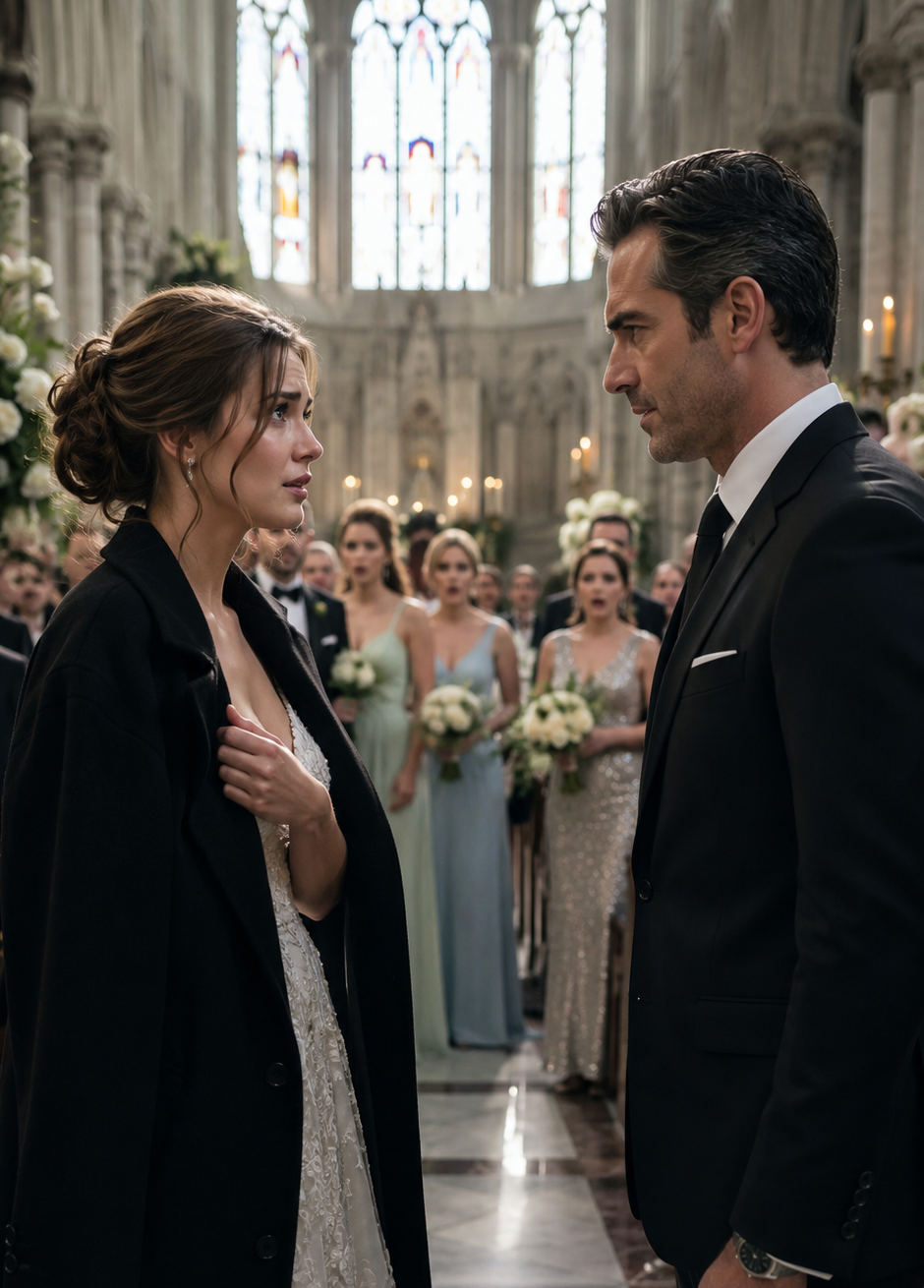
A whisper moved through the guests like wind disturbing dry leaves.
Heads turned.
Eyes shifted from Dante’s hand to Veronica, then to me, standing in the middle of the aisle wrapped in a black coat that smelled faintly of cedar, rain, and expensive wool.
Veronica’s face changed only for a second.
The corner of her mouth tightened.
Her gaze flickered to the row of bridesmaids beside her, as though silently asking which one of them had failed to hide the evidence.
Then she laughed.
Not loudly.
Not naturally.
A brittle little sound meant to dismiss the entire room.
“That proves nothing,” she said.
“Buttons fall off.
It’s a wedding.
Everyone is emotional.”
Dante closed his fingers around the button.
“Then you won’t mind explaining why it was beside the scissors.”
The second whisper was louder than the first.
Nathan finally moved.
Not toward me.
Toward Dante.
“Mr. Moretti,” he said, his voice low and strained.
“I appreciate your concern, but this is a family matter.”
Dante looked at him as if he had only just remembered Nathan existed.
“A bride standing half-dressed in front of four hundred people while her groom watches silently is not a family matter,” he said.
“It is a character matter.”
Nathan’s face flushed.
His mother, Celeste Whitmore, rose from the front pew like a queen disturbed during court.
She wore silver silk, diamonds at her throat, and the icy expression she had perfected over years of making people feel grateful for her disapproval.
“This spectacle has gone far enough,” she said.
I almost laughed.
Spectacle.
As if I had planned any of it.
As if I had taken a blade to my own dress, walked trembling down the aisle, and invited humiliation because I wanted attention.
But my voice was trapped somewhere behind my ribs.
Dante turned slightly toward me.
“You don’t have to stand here,” he said quietly.
The gentleness of it startled me more than the coat had.
Everything about him suggested command: the tailored black suit, the calm posture, the way silence organized itself around him.
But his voice, when directed at me, offered choice instead of instruction.
Choice had become rare in the weeks leading to the wedding.
Celeste had chosen the cathedral.
Veronica had chosen the bridesmaids’ luncheon, the flowers, the seating chart, the photographer.
Nathan had chosen to let them because, as he often reminded me, “It’s easier not to fight them on everything.”
And I had chosen my dress.
That one thing had been mine.
My mother’s old sewing machine still lived in the corner of my apartment, the metal wheel stiff with age, the cream enamel scratched from years of use.
She had taught me to sew when I was eight, placing my hands beneath hers and saying, “Beautiful things are not fragile, Clara.
They only look that way.”
After she died, sewing became the language I used when grief made ordinary words too heavy.
I stitched curtains for my first apartment.
Altered thrift-store coaTS. Hemmed trousers for neighbors when money was tight.
And when Nathan proposed, I decided to make my own wedding dress not because I could not afford one, but because I wanted to carry something of my mother with me.
Every flower along the bodice had been embroidered by hand.
Every bead had been chosen under lamplight.
Every seam had been pressed with hope.
Now those seams hung open behind me.
I looked at Nathan.
He stood three steps below the altar, caught between embarrassment and irritation, between the woman he said he loved and the family whose approval he still craved like oxygen.
“Clara,” he said carefully, “let’s go somewhere private and fix this.”
Fix this.
The words landed softly, then opened.
Fix the dress.
Fix the moment.
Fix my face so the guests could feel comfortable again.
Fix the inconvenience of my visible hurt.
But he had not asked if I was all right.
He had not stepped into the aisle when I needed him.
Dante had.
I pulled the coat tighter around myself.
“No,” I said.
It was the first word I had spoken since the laughter began.
It was not loud, but the cathedral heard it.
Nathan blinked.
“No?”
“No private room.
No pretending this didn’t happen.”
Veronica’s expression sharpened.
Celeste’s lips parted in disbelief.
Several guests leaned subtly forward, the way people do when real life begins to exceed the entertainment they expected.
Dante stepped aside, giving me the aisle as if it belonged to me.
Perhaps it always had.
I turned toward the bridesmaids.
There were six of them, all chosen by Celeste except my younger cousin, Ava, who stood at the far end pale with worry.
Veronica was in the center, of course.
Veronica always found the center.
She had grown up beside Nathan in the same buildings, attended the same schools, vacationed in the same seaside houses with white balconies and private docks.
Celeste had once told me Veronica was “practically family,” which I later learned meant “preferred.”
Veronica had welcomed me with smooth politeness at first.
Then came little corrections.
Not cruelty exactly.
Not the kind one could name without sounding sensitive.
A suggestion that my shoes were “sweetly simple.” A reminder that handmade did not always mean elegant.
A laugh when I admitted I had never been to Saint Moritz.
She wielded refinement like a needle and smiled while pressing it under the skin.
“Clara,” she said now, her voice softening for the audience, “I know you’re upset, but accusing people during your own ceremony is not wise.”
“I didn’t accuse anyone,” I said.
“He asked a question.”
Her gaze flashed to Dante.
Dante did not move.
“Fine,” she said.
“I touched the dress.
You asked me to help with the clasp.”
Ava’s head snapped toward her.
“No, she didn’t,” my cousin said.
Veronica turned slowly.
“Excuse me?”
Ava’s hands tightened around her bouquet.
She was twenty-three, still more comfortable in libraries than ballrooms, and she had been trying all week to disappear beneath Veronica’s instructions.
But now her voice, though shaking, was clear.
“Clara didn’t ask you.
You told her there was a loose thread.
Then you made everyone else leave the dressing room.”
The bridesmaids went still.
Veronica laughed again, but this time there was no air in it.
“Ava, you were nervous all morning.
You probably misunderstood.”
“I didn’t.”
Celeste stepped into the aisle.
“This is completely inappropriate.
Ava, sit down.”
Ava glanced at me.
I had spent so much of my adult life trying not to be a burden that I had forgotten how it felt when someone chose to stand beside me without being asked.
She did not sit.
Dante’s eyes moved briefly to Ava, then back to Veronica.
“Where are the scissors?” he asked.
A bridesmaid named Elise swallowed hard.
“Under my chair.”
Veronica whipped around.
“Elise.”
Elise’s cheeks reddened.
“I didn’t put them there.”
Dante’s voice remained even.
“Who did?”
“I don’t know.”
But the way she looked at Veronica said otherwise.
Nathan dragged a hand down his face.
“This is insane.”
At last, I faced him fully.
The man I had almost married looked handsome and miserable beneath the carved angels.
His black tuxedo fit perfectly.
His hair was neatly styled.
His boutonniere matched the flowers I had chosen months ago, back when I still believed compromise was a bridge and not a slow surrender.
“Nathan,” I said, “did you know?”
His eyes widened.
“What?”
“Did you know someone planned to ruin my dress?”
“No.” The answer came quickly.
Too quickly, perhaps, but I believed him.
Or I wanted to.
“Then why didn’t you come to me?”
The question did what accusations had not.
It reached him.
For one second, the room disappeared from his face.
I saw only Nathan from our early days: the man who brought soup when I had the flu, who stood in my tiny kitchen eating burnt toast and said he liked the way my apartment felt lived-in, who listened when I told him about my mother.
Then the cathedral returned.
His family returned.
The watching crowd returned.
“I froze,” he said.
It might have been honest.
It was not enough.
Before I could answer, the priest, who had been standing with the stunned patience of a man praying not to become part of a scandal, finally stepped forward.
“Perhaps,” he said gently, “we should pause the ceremony.”
A pause.
Such a delicate word for a collapse.
Celeste looked as if the priest had insulted her bloodline.
“There will be no pause,” she said.
“This is a misunderstanding.
Clara can change into the reception gown, and we can continue.”
The reception gown.
Another item Celeste had insisted on.
Sleek, expensive, approved by her friends.
It hung in the bridal suite like a replacement version of me.
“No,” I said.
This time, my voice did not shake.
Celeste stared at me.
“I beg your pardon?”
“I’m not changing into a different dress so everyone can pretend this one wasn’t destroyed.”
Nathan took a step toward me.
“Clara, please.
We can talk about all of this after the ceremony.”
“After?”
His jaw tightened.
That was the first time I understood.
He did not want to marry me in that moment because he loved me.
He wanted the ceremony completed because stopping it would embarrass him.
The distinction was small enough to hide inside a polite sentence.
It was large enough to change a life.
I looked at Dante.
“Could I have a moment somewhere quiet?”
“Yes.”
He did not ask where my maid of honor was, because I did not have one.
My closest friend, Mara, was filming in Vancouver and had cried over FaceTime because she could not get away.
My father had died when I was nineteen.
My mother when I was fourteen.
Nathan’s world had filled the empty chairs so thoroughly that I had almost forgotten they were empty.
Almost.
Dante turned to the nearest usher.
“Clear the side chapel.”
The usher obeyed before thinking better of it.
Celeste bristled.
“You do not give orders here.”
“No,” Dante said.
“But people seem relieved when someone does.”
I should not have smiled.
I did anyway.
The movement surprised me.
It felt like a crack in a frozen lake, dangerous and bright.
Dante walked beside me down the side aisle, close enough to shield me from view but not so close that I felt handled.
Ava joined us without asking.
Behind us, voices rose at last—guests murmuring, Celeste demanding composure, Nathan saying my name once, then stopping when I did not turn.
The side chapel was smaller, warmed by amber candles and the scent of lilies.
A statue of the Virgin stood beneath a blue glass window, her stone face serene above rows of wooden chairs.
I stepped inside and finally let my bouquet fall.
White roses scattered across the floor.
My knees trembled.
Ava caught my hand.
“Clara, I’m so sorry.”
I sat on the front pew.
The coat swallowed me, heavy and warm.
My ruined dress pooled around my feet like spilled moonlight.
Dante remained near the doorway with his back turned slightly, giving me privacy while ensuring no one entered.
The gesture was so careful that it nearly undid me.
Ava knelt and gathered the torn edges of the gown.
“It’s clean,” she whispered, more to herself than to me.
“The cut.
This wasn’t a rip.
Someone sliced through the reinforcement stitching.”
I looked down.
“You can tell?”
She nodded.
“You taught me enough.”
When Ava was sixteen, she had spent a summer with me after her parents’ divorce, angry at everyone and speaking mostly in shrugs.
I taught her to mend denim, then to fit a bodice, then to use embroidery to hide mistakes instead of ripping them out.
She later called it the summer she learned broken things could still become beautiful.
Now her fingers moved over the damaged seam with a grief I recognized.
“I saw Veronica near your dress bag yesterday,” she said.
My heart slowed.
“At the rehearsal dinner?”
Ava nodded.
“In the coatroom.
I thought she was checking on the bouqueTS. She said Celeste asked her to make sure everything was ready.”
Dante turned slightly.
“Did anyone else see her?”
“I don’t know.”
His gaze returned to me.
“Was the dress unattended?”
“For ten minutes,” I said.
“Maybe fifteen.
The coordinator brought me downstairs to approve the aisle candles.”
Ava stood.
“Clara, there’s something else.”
The way she said it made me look up.
“What?”
She glanced toward Dante, then back to me.
“I didn’t want to tell you today.
I thought it would ruin everything.”
A quiet laugh escaped me before I could stop it.
“Ava.”
“I know.” Her eyes filled.
“I know.
But I found a message on Nathan’s phone last night.”
Everything in me went still.
Dante’s expression did not change, but his attention sharpened.
“You went through his phone?” I asked.
“No.
He left it on the table in the library at the hotel.
It lit up while I was looking for my clutch.” She swallowed.
“It was from Veronica.”
“What did it say?”
Ava shut her eyes briefly, as if reading it again hurt.
“It said, ‘Tomorrow will show her she doesn’t belong.
After that, he’ll remember what he owes us.’”
The chapel seemed to grow colder.
Not what he owes me.
What he owes us.
“Us,” I repeated.
Ava nodded.
Dante stepped away from the door and took out his phone.
“I know someone who can preserve the cathedral’s security footage before it disappears.”
I looked at him.
“Why are you helping me?”
He paused.
It was the first question that seemed to unsettle him.
The candles flickered along the wall.
For a moment, the powerful, composed man from Manhattan’s whispered stories looked almost tired.
“Because I knew your mother,” he said.
The answer was so unexpected that I forgot to breathe.
“My mother?”
“Yes.”
His voice softened around the words, as though they belonged to a room he rarely opened.
“Elena Voss.
She made costumes for the Arden Theater before she opened her shop.”
My mother’s name sounded different in his mouth.
Not like a fact.
Like a memory.
“You knew her from the theater?”
“I was seventeen,” he said.
“My father was alive then, and I was already being taught to become someone people crossed the street to avoid.
I spent one winter hiding in the back of that theater because it was the only place no one expected me to be.
Your mother found me sleeping behind a rack of coaTS.”
Ava stared at him.
I could not speak.
Dante smiled faintly, though it did not reach the sadness in his eyes.
“She brought me soup.
Then she made me carry bolts of fabric and sweep the floor.
She had a way of helping people without letting them feel pitied.”
That was my mother exactly.
Warmth rose painfully behind my eyes.
“She never mentioned you.”
“She was kind enough not to.” He looked toward the blue window.
“Years later, I saw your name on a small design label.
Clara Voss.
Bridal alterations and custom work.
I meant to send business your way.
Then I heard you were marrying Nathan Whitmore.”
“Why come today?”
“Your mother once repaired my coat when I had no money and no place to go.” His gaze returned to the black wool around my shoulders.
“It seemed right that I return one when I could.”
I looked down at the coat differently then.
Not as a shield from a powerful stranger.
As a thread from my mother, somehow reaching across years.
A knock sounded at the chapel door.
Dante opened it only halfway.
Nathan stood outside.
His face was pale.
His confidence had thinned into something rawer.
Behind him, the cathedral remained restless, a sea of murmured speculation and polished discomfort.
“Clara,” he said.
“Please.”
Dante looked at me.
My choice.
I nodded.
Nathan stepped inside.
Dante remained by the door.
Ava stood beside me like a small, determined guard.
Nathan saw that and flinched.
“I didn’t know about the dress,” he said.
I studied his face.
“I believe you.”
Relief crossed his features.
“But you knew Veronica wanted to hurt me.”
His relief vanished.
He looked down at the scattered roses.
“Veronica says things.
She’s dramatic.”
 She Walks Away From Family Drama To Focus On School And Personal Growth, Leaving Her Dad Behind
“She sent you a message last night.”
His eyes flicked to Ava.
Ava did not look away.
“I didn’t respond,” Nathan said.
“That isn’t the same as stopping her.”
His mouth opened, then closed.
He sat on the pew across from me, careful not to touch the fallen roses.
“My mother and Veronica planned this wedding like it was a merger,” he said quietly.
“Every time I tried to push back, there was another argument, another reminder of money, family, expectations.
I thought if we just got through today, everything would calm down.”
The sadness in his voice was real.
So was the weakness.
“Nathan,” I said, “today was not something to get through.
It was supposed to be the beginning of our marriage.”
“I know.”
“Do you?”
He looked at me then, wounded and defensive.
“I love you, Clara.”
“I think you love me when loving me doesn’t cost you anything.”
The words were not cruel.
That made them more devastating.
He sat back as if I had struck a bell inside him.
Ava wiped her cheek.
Dante looked away.
Nathan’s voice dropped.
“What do you want me to do?”
I had imagined that question so many times before the wedding.
I had imagined asking him to set boundaries with Celeste, to stop letting Veronica sneer behind compliments, to remember that I was not auditioning for his family.
Now, the answer felt both simple and impossible.
“I want you to tell the truth,” I said.
“In there.
To everyone.”
He stared at me.
“About what?”
“About Veronica’s message.
About your mother pressuring me to change every part of this wedding.
About the fact that you saw me humiliated and froze because you were embarrassed.”
His face tightened.
“Clara, that would destroy my mother.”
“No,” I said softly.
“It would disappoint her.
Those are different things.”
He looked toward the door.
Toward the waiting guesTS.
Toward the world that had raised him.
And I knew before he spoke.
“I can’t do that right now,” he whispered.
Ava made a small sound.
I closed my eyes.
There it was.
Not a scream.
Not a dramatic betrayal.
Just a quiet refusal wearing the face of helplessness.
When I opened my eyes again, I felt strangely calm.
“Then I can’t marry you right now.”
Nathan’s head snapped back.
“You don’t mean that.”
“I do.”
“Because of a dress?”
The words slipped out before he could dress them properly.
I watched him realize it.
My heart did not break all at once.
It folded inward, carefully, like something being put away.
“No,” I said.
“Because you think this is about a dress.”
He stood.
“Clara, wait.”
But I had already risen.
The torn gown shifted beneath Dante’s coat.
For a moment, I nearly stumbled.
Ava reached for me, but I steadied myself.
“No more waiting,” I said.
Dante opened the chapel door.
The cathedral quieted as we emerged.
It was astonishing, really, how quickly people could transform from participants into witnesses.
Guests sat stiff-backed and wide-eyed.
Some looked ashamed.
Others looked hungry for whatever would happen next.
The photographer stood frozen near a pillar, camera lowered.
Celeste was speaking to the priest in urgent whispers.
Veronica stood near the altar with her arms crossed, her expression carefully rearranged into injured innocence.
When she saw Nathan behind me, something like victory flashed across her face.
She thought he had brought me back to continue.
Perhaps a part of me wished he had.
Not because I wanted the wedding anymore, but because I wanted proof that love could become brave when asked.
I walked to the front of the cathedral.
Every step felt longer than the aisle had before.
At the altar, I turned to face the guesTS.
My voice was not loud, but the acoustics carried it.
“Thank you for coming today,” I said.
A ripple moved through the pews.
“This ceremony will not continue.”
Celeste rose instantly.
“Clara—”
I looked at her.
For once, she stopped.
I did not explain further.
I did not accuse Veronica publicly.
I did not produce the scissors or the button like evidence in a courtroom.
There would be time for truth.
There would be private consequences.
There would be recordings, security footage, conversations, decisions.
But I would not turn my pain into a performance for people who had laughed before they understood.
“My dress was damaged,” I continued.
“And something more important was revealed.
I wish everyone a safe journey home.”
That was all.
A strange dignity settled over the room.
Perhaps because I had not given them the scene some expected.
Perhaps because restraint made the truth louder.
Then Dante moved.
He stepped to the side of the aisle and offered his arm.
I looked at it.
In the stories people told about Dante Moretti, he was ruthless, untouchable, a man whose influence moved quietly through boardrooms and private clubs.
But standing beside me in the cathedral, he was simply a man offering steadiness without demanding gratitude.
I took his arm.
The walk back down the aisle felt nothing like the first.
No organ played.
No guests laughed.
Some lowered their eyes as I passed.
One older woman touched her hand to her heart.
A man near the middle row whispered, “Shameful,” though I could not tell whether he meant what had happened to me or my refusal to continue.
At the rear of the cathedral, Mara appeared.
For one irrational second, I thought grief had conjured her.
She stood just inside the doors, breathless, curls escaping from a scarf, wearing jeans beneath a long camel coat.
Her eyes were red from either travel or rage.
“Clara,” she said.
I let go of Dante and walked straight into her arms.
The moment she held me, I broke.
Not dramatically.
Not for the room.
Just with the exhausted, shaking relief of someone who had carried herself too long and finally found a place to lean.
“I tried to get here sooner,” she whispered into my hair.
“My flight was canceled, then delayed, then I rented a car from Philadelphia.
I’m so sorry.”
“You’re here,” I said.
That was enough.
Behind us, the cathedral emptied slowly.
Nathan did not approach.
Perhaps Celeste stopped him.
Perhaps he stopped himself.
Veronica watched from the altar steps, her face unreadable.
Dante spoke quietly to a man in a dark coat near the side door.
The man nodded and disappeared toward the administrative offices.
Mara pulled back and saw the state of my dress beneath the coat.
Her expression went very still.
“Who did this?”
“I know part of it,” I said.
“Good.
Then we’ll find the rest.”
That was Mara.
No speeches.
No delicate horror.
Just allegiance.
A cathedral coordinator approached with trembling professionalism.
“Ms.
Voss, I’m so sorry.
Would you like to use the bridal suite?”
“No,” Mara said before I could answer.
“Is there a private exit?”
The coordinator nodded quickly.
“This way.”
We followed her through a side passage lined with old stone and framed photographs of past ceremonies.
Brides smiling in satin.
Grooms beaming beneath flowers.
Families gathered in golden light.
I wondered how many of those photographs concealed stories.
In the bridal suite, my reception gown hung untouched in its garment bag.
Someone had placed champagne on ice.
Lipsticks lined the vanity.
My veil lay folded beside a silver compact.
The room looked ready for a woman who no longer existed.
Mara locked the door.
Ava helped me out of the ruined gown while Mara stood behind me, hands covering her mouth as the damage came fully into view.
The cut had been made with care.
Not a wild slash, not a last-minute accident.
The blade had followed the center back seam, slicing through hidden stitches meant to support the bodice.
The gown had held just long enough for me to enter the aisle.
Whoever did it wanted the reveal to happen in front of everyone.
Ava folded the dress gently over a chair.
“We should preserve it,” she said.
“For evidence.”
Mara looked at her with immediate approval.
“Smart cousin.”
Ava managed the ghost of a smile.
I changed into the plain cream slip dress I had worn beneath my robe that morning.
Dante’s coat went back over my shoulders.
It looked absurd with the delicate dress and my wedding shoes, but I had no desire to wear anything chosen by Celeste.
Mara began packing my things with brisk, loving fury.
“You’re coming to my hotel,” she said.
“I have a room at the Langford.
Two beds.
Terrible view.
Excellent locks.”
“I need to speak with Nathan.”
“No, you need tea, privacy, and possibly a pastry the size of your head.”
“I mean eventually.”
Mara softened.
“Eventually is allowed.
Today is not required.”
A knock interrupted us.
Mara opened the door a crack, then relaxed slightly.
Dante stood outside, now without his coat, his black suit immaculate despite the chaos around him.
“The cathedral security footage is being copied,” he said.
“It may show the hallway outside the bridal suite.
Not inside.”
“Thank you,” I said.
He inclined his head.
“There’s more.”
Of course there was.
Ava reached for my hand.
Dante held up an envelope.
“This was given to the coordinator this morning.
She was instructed to deliver it to you after the ceremony.”
I recognized the envelope immediately.
Not because I had seen it before, but because of the handwriting.
My mother’s handwriting.
My name curved across the front in dark blue ink.
Clara.
The room disappeared.
I took the envelope with both hands.
“That’s impossible,” I whispered.
Mara moved closer.
“Clara?”
“My mother died twelve years ago.”
Dante’s face was grave.
“The coordinator said it came from Mrs. Whitmore’s office along with the final ceremony documenTS.”
Celeste.
My fingers went numb.
Ava guided me to the chair before I could fold.
For years, I had kept only a few pieces of my mother’s handwriting: recipe cards, notes in sewing patterns, birthday messages tucked into books.
I knew the slope of her letters, the confident loop of her C, the small star she sometimes placed instead of a dot over an i.
This was hers.
No question.
Mara crouched beside me.
“You don’t have to open it here.”
But I did.
I had already lost too many hours to people deciding what I could bear.
Inside was a single page, folded carefully.
My dearest Clara,
If this reaches you, it means someone finally decided you were old enough to know what I was too afraid to explain.
I stopped reading.
The room tilted toward silence.
Ava whispered, “What is it?”
I forced myself to continue.
I made your first white dress when you were five because you asked if ordinary girls could look like moonlight.
You stood on the kitchen chair and told me you would marry someone kind one day, someone who would clap when you entered the room.
I hope he does.
But if he doesn’t, I hope you remember this: love that requires you to become smaller is not love asking for compromise.
It is fear asking for shelter.
My vision blurred.
Mara put a hand over her mouth.
There is another truth, sweetheart.
One I should have told you long before illness made cowards of us all.
Dante Moretti can be trusted.
Not because he is gentle.
He has had to become many things to survive, and gentle is not always one of them.
But he owes me a promise, and unlike many men, he understands the weight of one.
If you are ever surrounded by people who smile while taking pieces of you, ask him about the blue thread.
The blue thread.
My mother used blue thread to mark hidden seams before final stitching.
She said it reminded her where strength had been placed before beauty covered it.
I looked up at Dante.
His expression had changed completely.
The controlled distance was gone.
In its place was recognition, and something like sorrow.
“You knew about this letter?” I asked.
“No.”
But his voice was too quiet.
Mara stood.
“That was not convincing.”
Dante’s gaze remained on me.
“I knew your mother left something with a lawyer.
I didn’t know it would come through the Whitmores.”
“Why would Celeste have my mother’s letter?” I asked.
No one answered.
The question opened in the room, widening around us.
Dante took the page carefully when I handed it to him.
His eyes moved over the lines.
When he reached the phrase blue thread, he closed them for a moment.
“What does it mean?” I asked.
He looked toward the ruined gown folded over the chair.
“Your mother once hid documents inside a costume hem,” he said.
“Blue thread marked the seam.”
Ava turned sharply to the dress.
My heart began to pound.
“No,” I whispered.
Mara crossed the room first.
She lifted the torn gown with surprising tenderness and spread the skirt across the vanity chair.
Ava dropped beside her, searching the inner seams.
“There,” Ava said suddenly.
Near the left side of the skirt, almost invisible against ivory lining, was a line of pale blue thread.
My mother’s blue thread.
But I had not sewn it there.
I knew every inch of that dress.
Every seam.
Every mistake.
This had been added after the final fitting.
After the rehearsal dinner.
After Veronica had been seen near the garment bag.
Ava carefully opened the seam with a small pair of nail scissors from the vanity kit.
Her hands shook, but her work remained precise.
A folded piece of oilskin slid out.
Inside was a thin flash drive and a photograph.
The photograph showed my mother much younger, standing outside the Arden Theater.
Beside her was Dante at seventeen, lean and unsmiling, wearing a repaired dark coat.
On her other side stood a woman I recognized with a shock that stole my breath.
Celeste Whitmore.
Not older, not polished into icy perfection, but unmistakably Celeste.
Her arm was linked through my mother’s.
They were smiling like friends.
Mara whispered, “What in the world?”
Dante took one step closer, staring at the photograph.
“I never saw this,” he said.
I turned the photo over.
On the back, in my mother’s handwriting, were four words.
Celeste knows the truth.
I stared at the sentence until the ink seemed to move.
The ruined dress lay between us.
The wedding outside had collapsed.
Nathan had failed me.
Veronica had cut something she thought was only fabric.
But hidden inside the gown was a secret my mother had left behind, a secret someone in Nathan’s family had kept from me for twelve years.
Dante looked at the flash drive in Ava’s hand.
“Clara,” he said carefully, “before we open that, you need to decide who you trust.”
I looked from Mara to Ava, then to Dante, then back to the photograph of my mother standing arm in arm with the woman who had spent months trying to make me disappear inside my own wedding.
For the first time all day, I understood that the dress had not been destroyed to humiliate me.
It had been destroyed because someone was searching for what was hidden inside.
And the person who knew why was waiting just beyond the door, wearing silver silk and my future mother-in-law’s smile.