
PART 2:
The footsteps belonged to Officer Higgins and a woman in navy scrubs carrying a clipboard.
Officer Higgins was younger than I had imagined from his voice, perhaps thirty-five, with tired eyes and a careful expression that suggested he had already heard three incompatible versions of the same morning.
He looked from me to Lawrence, then to Paige and Cordelia.
“Mrs. Mercer?”
“That’s me.”
“You called emergency services?”
“Yes.”
Lawrence moved before I could say anything else.
“Officer, this is a misunderstanding.
My wife is upset.
She’s just learned some difficult personal information, and I think emotions are running high.”
It was almost impressive how quickly he found his professional voice.
Smooth.
Reasonable.
Concerned.
The same voice he used with difficult tenants, nervous investors, and waiters who had brought him the wrong wine.
Officer Higgins did not appear impressed.
“I’ll decide whether it’s a misunderstanding after I’ve spoken to everyone separately.”
The woman in scrubs stepped forward.
“Mr. Mercer, Ms.
Dunlap’s obstetrician has asked that she avoid unnecessary stress.
Her initial assessment is reassuring, but we still need to monitor her.”
Paige clutched her stomach.
“I need Lawrence with me.”
“You’ll be taken back shortly,” the nurse said.
“For now, please sit down.”
Cordelia placed an arm around Paige’s shoulders and guided her toward the row of chairs.
She did it with such instinctive tenderness that something inside me tightened.
Cordelia had never touched me that way.
Not when my father died.
Not when I lost a pregnancy four years into my marriage.
Not even when I came out of surgery afterward, hollowed by grief and anesthesia, and she stood beside my bed arranging lilies because she disliked the flowers Lawrence had ordered.
I had spent years telling myself that she was simply reserved.
Watching her stroke Paige’s hair, I understood that reserve had never been the problem.
Officer Higgins motioned toward a quieter alcove near the vending machines.
“Mrs. Mercer, may I speak with you?”
Lawrence followed.
The officer held up one hand.
“Alone.”
“I’m her husband.”
“At the moment, you’re also a person connected to the vehicle and the driver.
Please remain here.”
Lawrence’s jaw tightened.
I walked away before he could answer.
The alcove contained two plastic chairs, a table scattered with outdated hospital brochures, and a tall artificial plant with dust gathered on its leaves.
Through the glass doors, ambulances moved beneath a gray Indiana sky.
Officer Higgins opened a small notebook.
“Start from the beginning.”
So I did.
I told him where I had been that morning.
I showed him my office access log, my parking receipt, and the time-stamped security notification from the building elevator.
I explained that my sedan had been locked in my garage when I left home because I had taken a rideshare to work after Lawrence claimed his SUV needed repairs and asked to borrow mine later in the week.
For one suspended second, the hospital corridor disappeared.
I no longer heard the squeak of nurses’ shoes, the muted intercom announcements, or Cordelia demanding that the officers remove the handcuffs from her son.
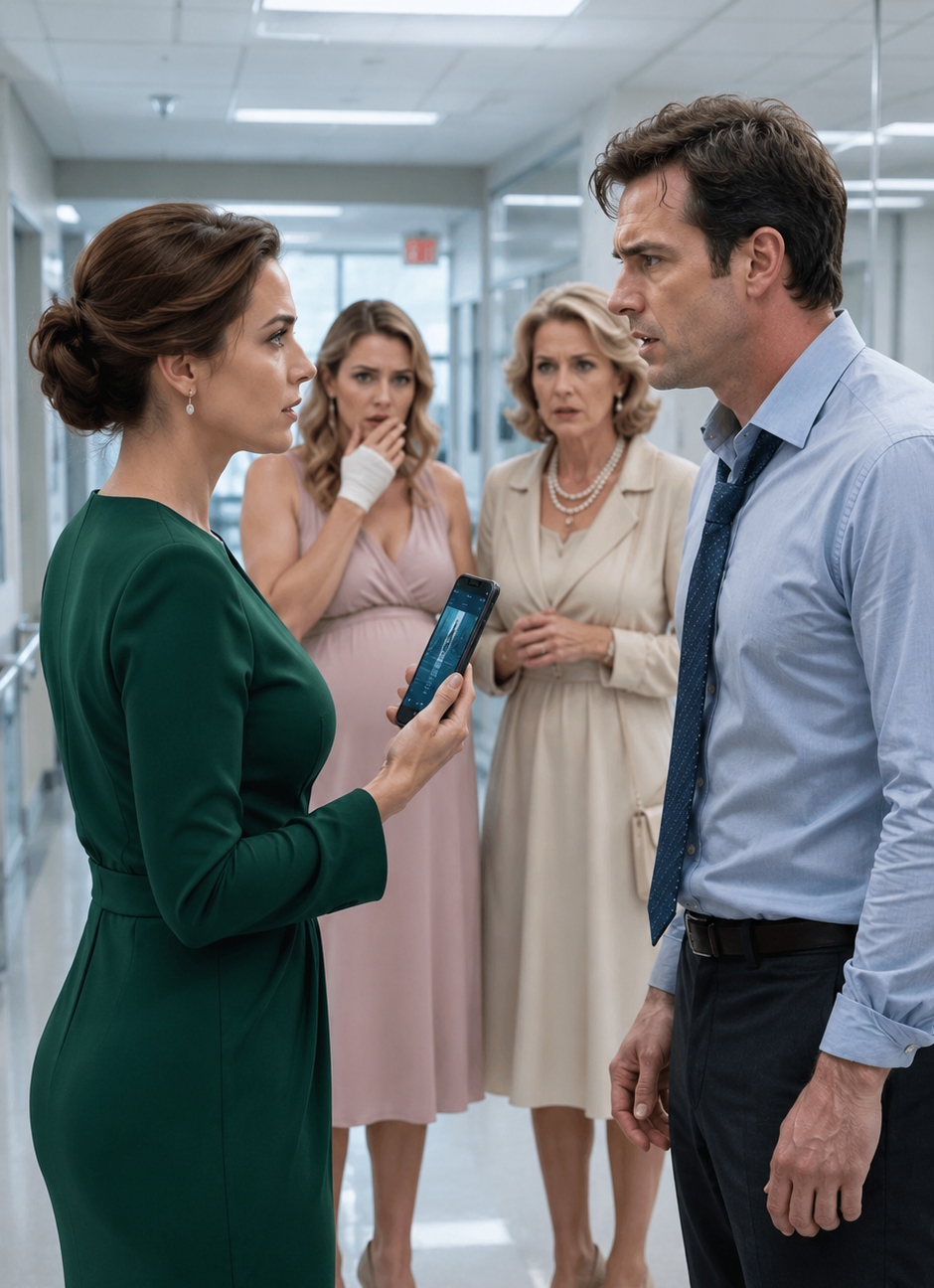
All I could see was the photograph on my phone.
My basement.
My locked evidence cabinet.
Cordelia standing beside it in the same camel coat she was wearing now.
And behind her, unmistakable even in the dim light, was my federal supervisor, Martin Voss.
The man who had hired me.
The man who had mentored me through my first major fraud investigation.
The man who had once told me that trust was not a feeling but a chain of verified facTS.
I enlarged the image with trembling fingers.
The timestamp read 9:31 that morning.
Forty-seven minutes after Lawrence and Paige had taken my car.
My breath caught.
Martin had been in my house while I was at work.
“Who sent that?” Officer Higgins asked.
I looked up.
Lawrence had gone still.
Not frightened.
Not confused.
Recognizing.
That frightened me more than anything else.
“You know what this is,” I said.
His jaw tightened.
Officer Higgins stepped between us.
“Mrs. Mercer, let me see the message.”
I handed him the phone without taking my eyes off Lawrence.
Cordelia noticed the photograph over the officer’s shoulder.
Her face drained so quickly that even the powder across her cheeks could not hide it.
“Where did you get that?” she whispered.
The question confirmed more than a confession might have.
“You were in my basement,” I said.
She drew herself up.
“I have been in your home hundreds of times.”
“Not in my locked cabinet.”
“I don’t know anything about a cabinet.”
The denial came too quickly.
Officer Higgins studied her.
“Ma’am, were you at Mrs. Mercer’s residence this morning?”
Cordelia glanced toward Lawrence.
It was a tiny movement, but I saw it.
So did Higgins.
Lawrence shifted in the grip of the officer holding him.
“My mother has nothing to do with this.”
“Then she can answer for herself,” Higgins said.
Cordelia’s mouth opened, but Paige spoke first.
“She was there.”
Everyone turned.
Paige sat beneath the harsh fluorescent lights, one arm wrapped protectively around her stomach.
Her face was pale, and the bandage around her wrist looked startlingly white against her skin.
Cordelia stared at her.
“Be quiet.”
Paige flinched.
Then something changed in her expression.
Perhaps she remembered Lawrence calling her stupid.
Perhaps she saw how quickly the family she had wanted to join had begun closing ranks against her.
Whatever it was, she lifted her chin.
“You told me you were going to Fiona’s house,” she said.
“You said you had to make sure the basement was clean before the police started asking questions.”
Cordelia’s voice sharpened.
“You’re confused.
You were just in an accident.”
“No.” Paige’s hand tightened over the fabric of her hospital gown.
“I remember.”
Lawrence jerked against the officer’s grip.
“Paige, stop talking.”
She looked at him.
The tenderness that had once been in her face was gone.
“You told me I was your new beginning,” she said quietly.
“But I was just someone you thought would be easier to control.”
A muscle moved in Lawrence’s cheek.
“Don’t do this here.”
“Where should I do it?” Paige asked.
“At the house you said would be mine? In the nursery you never built? Or in the car you stole from your wife?”
Cordelia stepped toward her.
“That is enough.”
“No,” I said.
My voice came out calmer than I felt.
“It isn’t.”
Higgins handed my phone to another officer.
“Send a unit to the Mercer residence.
No entry until we confirm whether someone is still inside.
Treat it as a possible evidence-tampering scene.”
My pulse quickened.
“My father is at that house.”
The words escaped before I could soften them.
Lawrence’s expression flickered.
Officer Higgins immediately turned to me.
“Your father lives with you?”
“He’s been staying in the guest suite since his surgery.
He had a physical therapy appointment this morning, but he should have been home by ten.”
“What’s his name?”
“Edwin Hale.”
Higgins relayed the information over his radio.
I called my father.
The phone rang once.
Twice.
Five times.
No answer.
I tried again.
Straight to voicemail.
Cold spread beneath my ribs.
Lawrence watched me with an unreadable expression.
I stepped close enough that he could see I was no longer asking as his wife.
I was asking as an investigator.
“What happened at my house?”
“Nothing.”
“Where is my father?”
“I don’t know.”
“You knew Martin was there.”
His eyes flicked toward the officers.
That was all I needed.
“You knew,” I repeated.
Cordelia interrupted, her voice suddenly soft.
“Fiona, this is becoming unnecessarily dramatic.”
I turned toward her.
She tried to gather herself, smoothing the front of her coat as if dignity were something she could press back into shape.
“Your father is probably with one of his friends,” she continued.
“Edwin has always been independent.
Surely you don’t believe Lawrence would involve an elderly man in a marital disagreement.”
“This stopped being a marital disagreement when your son forged my signature.”
“He made a mistake.”
“He planned around my death.”
The words echoed down the corridor.
Cordelia’s composure cracked.
For the first time in seven years, I saw her without performance or polish.
She looked afraid.
Not for Lawrence.
For herself.
Officer Higgins’s radio crackled.
“Unit twelve to Higgins.
We’re at the Mercer residence.
Front door is unsecured.
No response from inside.”
My knees nearly gave way.
Higgins raised the radio.
“Proceed with caution.
Check for the homeowner’s father.”
I pressed my hands together to stop them from shaking.
Paige watched me.
Then she whispered, “There’s a second phone.”
I looked at her.
“What?”
“Lawrence has another phone.
He keeps it in a storage locker at the leasing office.” Her voice quivered, but she kept speaking.
“He said it was for private deals.
I saw him use it to message someone named M.V.”
Martin Voss.
Lawrence closed his eyes.
Cordelia looked at him as though he had betrayed her by being careless.
“Where is the locker?” Higgins asked.
“Basement level.
Number sixteen.”
“Access code?”
Paige hesitated.
Lawrence shook his head once.
She saw it.
So did I.
Her face hardened.
“Four-two-zero-seven,” she said.
“His birthday backward.”
Officer Higgins directed another unit to the office building.
Then the radio spoke again.
“House is clear.
No persons located.
We found signs of entry in the basement.
Evidence cabinet appears open.”
My throat tightened.
“And Mr. Hale?”
“Not here.”
I stared at the floor.
My father’s cane was probably beside the kitchen table.
His reading glasses would be folded on top of the newspaper.
He had planned to make vegetable soup for dinner, though he always used too much pepper and pretended it was intentional.
He would not leave without telling me.
Not after the surgery.
Not without his medication.
I looked at Lawrence.
“You have one chance.”
His face remained blank.
“Tell me where my father is.”
“I told you, I don’t know.”
I studied the slight tension around his mouth, the way his shoulders had pulled inward, the silence that had replaced his earlier arrogance.
He was afraid.
But not because he knew where my father was.
Because he did not.
That realization was somehow worse.
Martin was operating beyond Lawrence’s control.
I turned to Officer Higgins.
“I need to go to the house.”
“You need to remain available for a statement.”
“My father is missing.”
“We’ll have officers search—”
“I can tell them what’s gone.
I know the cabinet contenTS. I know the house.
And I may know why Martin was there.”
Higgins looked at me carefully.
“May?”
For years, I had kept my professional cases out of my home life.
Lawrence complained that I was secretive, but the truth was simpler: I had believed boundaries protected people.
Now my boundaries had been turned into blind spoTS.
“Three months ago, I began reviewing a series of insurance claims involving commercial properties owned through shell companies,” I said.
“The losses looked unrelated—flood damage, electrical failures, structural repairs—but the payments kept passing through the same group of subcontractors.”
“And your husband is in property leasing,” Higgins said.
“Yes.”
Lawrence spoke at last.
“That has nothing to do with me.”
I ignored him.
“I found irregularities in one property Lawrence’s firm managed.
Before I could escalate the case, Martin ordered me to suspend the review.
He said another division had jurisdiction.”
Higgins’s gaze sharpened.
“Did you keep records?”
“Copies.
Notes.
Payment maps.
Everything I wasn’t supposed to take home but did because something felt wrong.”
“In the basement cabinet?”
I nodded.
Cordelia gave a brittle laugh.
“So this is your fault.
You brought confidential government material into your home.”
Lawrence turned toward her sharply.
The damage was immediate.
Higgins stared at Cordelia.
“How did you know the files were government material?”
She froze.
I watched the truth reach her face one second too late.
“I assumed,” she said.
“No,” I replied.
“You didn’t.”
The officers moved closer to her.
Cordelia’s shoulders sagged a fraction, but she recovered quickly.
“I will not be interrogated in a public corridor.”
“You’re not being interrogated,” Higgins said.
“Not yet.”
A nurse approached Paige and quietly reminded her that the doctor wanted to monitor the baby’s heart rate.
For the first time, Lawrence looked genuinely concerned.
“Is the baby all right?”
Paige looked at him for a long moment.
Then she turned away.
The nurse helped her to her feet.
Before leaving, Paige looked at me.
“I’m sorry.”
The words were nearly soundless.
I had imagined confronting my husband’s mistress many times during the twenty minutes between the clinic photograph and the hospital.
In every imagined version, Paige was confident, cruel, delighted by what she had taken.
The woman before me looked frightened and foolish and painfully young.
But she had still driven my stolen car.
She had still agreed to let me be blamed.
She had still sat beside my mother-in-law and waited for me to sacrifice myself.
“I believe you’re sorry now,” I said.
Her eyes filled.
It was not forgiveness.
But it was the first honest thing either of us had given the other.
She nodded and followed the nurse away.
Lawrence watched her disappear.
Something in his face softened, and for one dangerous second, I remembered the man he had been when we met.
He had carried groceries for an elderly neighbor in the rain.
He had driven across the city at midnight when my father’s furnace failed.
He had once filled our apartment with paper stars because I told him I had never seen a clear night sky as a child.
I had not imagined those things.
That was the hardest truth.
People did not have to be false in every moment to betray you completely.
Officer Higgins arranged for me to travel to the house with a detective.
Before we left, Lawrence called my name.
I stopped.
He stood with his hands cuffed in front of him, his wedding ring still visible.
“Fiona, I never wanted you hurt.”
I looked at the man who had slept beside me while building a future that required my silence, my guilt, or perhaps my absence.
“Then why did every version of your plan depend on hurting me?”
He had no answer.
For once, I did not need one.
Rain had begun by the time Detective Naomi Bell drove me home.
It streaked the windshield in silver lines, softening the familiar streets into something distant and unreal.
Bell was in her early forties, with observant eyes and a voice that never hurried.
“Tell me about your father,” she said.
“He taught high school history for thirty-eight years.
He thinks every problem can be solved with tea and a timeline.”
 Ex-Husband Tries To Get Back At Her After Their Divorce, But Her Brother Has A Hilarious Payback
“Health issues?”
“Hip surgery six weeks ago.
He can walk, but not far.
He forgets his phone more often than he remembers it.”
“Any reason he might have left suddenly?”
I shook my head.
Then I remembered our conversation from the night before.
Dad had stood in the kitchen peeling an orange, watching Lawrence through the window as he took a call in the backyard.
“He walks like a man carrying a glass he doesn’t want anyone to see,” Dad had said.
I had laughed.
“What does that mean?”
“It means he’s careful because something is full.”
I had told him he was being dramatic.
Now I gripped the edge of the seat.
“He suspected something,” I said.
Bell glanced at me.
“Your father?”
“He was watching Lawrence.”
“Did he say why?”
“No.
But he asked whether our basement camera still worked.”
The camera.
I sat upright.
“We have an old security camera over the basement stairs.
It isn’t linked to the home system.
My father installed it after a pipe burst because he wanted to monitor contractors coming in and out.”
“Where does it record?”
“To a memory card in a small monitor inside the guest suite.”
Bell radioed the officers at the house and told them not to touch anything in my father’s room until she arrived.
When we pulled up, two police cars were parked beneath the maple tree.
My front door stood open.
The sight of it felt more intimate than seeing Lawrence kiss Paige.
A home was supposed to hold your life quietly.
Ours looked as though it had exhaled every secret onto the lawn.
Inside, nothing appeared disturbed.
A mug sat in the sink.
Dad’s newspaper rested on the table.
His cane leaned beside the chair.
His wallet was near the fruit bowl.
His medication container was open to Tuesday morning.
“He wouldn’t leave without this,” I said.
Bell noticed a teacup on the counter.
Two damp rings marked the wood beside it.
“Someone had tea with him.”
My chest tightened.
Dad only made tea for people he trusted.
We moved through the hall toward the basement.
The door had been forced near the lock, but carefully.
No splintered wood, no dramatic damage.
Whoever entered had wanted speed, not destruction.
Downstairs, the evidence cabinet stood open.
Empty folders lay across the floor.
My case maps were gone.
The external drive was gone.
But the cabinet’s lock had not been broken.
Bell crouched beside it.
“Who knew the code?”
“Only me.”
“Your husband?”
“No.”
The word felt automatic.
Then I remembered Lawrence standing behind me one evening months ago while I opened the cabinet.
He had been carrying laundry.
I had shielded the keypad with my hand out of habit.
Or thought I had.
Bell ran a gloved finger over the metal.
“No signs of force.
Someone had the code or a key.”
“There is no key.”
I looked toward the small workbench across the room.
One drawer was open.
Inside it, beneath batteries and measuring tape, I kept my father’s old magnifying glass.
It was missing.
“Dad was down here,” I said.
Bell followed my gaze.
A faint scuff marked the concrete beside the cabinet.
Near it lay a single brass button.
I picked it up with a tissue.
It belonged to Cordelia’s camel coat.
“She was here.”
Bell placed it in an evidence bag.
“Looks that way.”
My phone rang.
The number was blocked.
I answered immediately.
“Dad?”
Silence.
Then breathing.
Slow.
Uneven.
“Dad?”
A faint rustling sound came through the speaker.
Finally, my father whispered, “Bluebird.”
The line went dead.
I stared at the phone.
Bell was already tracing the call through dispatch.
“What does bluebird mean?” she asked.
“I don’t know.”
But the word stirred something.
A summer morning.
My mother humming while she painted a wooden bird blue.
A small object above a doorway.
I turned toward the far wall of the basement.
When I was nine, my father built me a playhouse under the stairs.
My mother had painted a bluebird above the tiny door.
Years later, the playhouse was dismantled, and the space was closed with drywall during a renovation.
I crossed the room.
“The wall.”
Bell followed.
“What about it?”
“Bluebird was here.”
I pressed my palm against the painted surface beneath the staircase.
It sounded hollow.
One of the officers brought a flashlight.
Bell found a seam near the baseboard, so fine it looked like a crack in the paint.
She pulled.
A narrow panel opened.
Behind it was a shallow storage space.
Inside sat a cardboard box, a folded blanket, and the missing magnifying glass.
My father had hidden something.
Bell lifted the box onto the workbench.
My name was written across the lid in Dad’s careful handwriting.
FIONA — VERIFY BEFORE TRUSTING.
My eyes burned.
That was his language.
His warning.
Inside, we found the basement camera monitor, several printed photographs, and a flash drive taped beneath a family recipe card.
The first photograph showed Cordelia entering the basement at 9:28.
The second showed Martin Voss behind her.
The third made Bell inhale sharply.
Martin was not following Cordelia.
My father was walking beside him.
Without his cane.
Without fear.
He was carrying my case files.
“What is this?” I whispered.
Bell placed the image beneath the work light.
Dad’s expression was serious, but calm.
He did not appear forced.
In the next photograph, he handed the files to Martin.
My knees weakened.
“No.”
Bell caught my arm.
“There may be an explanation.”
“My father gave him the files.”
“Or made it look like he did.”
I looked at the recipe card lying beside the flash drive.
It was my mother’s handwriting.
Lemon cake.
The dessert she made for every birthday until she died when I was fourteen.
On the back, Dad had written one sentence.
THE FIRST LIE STARTED BEFORE LAWRENCE.
My heart stumbled.
Bell inserted the flash drive into a police laptop.
A single video file appeared.
The timestamp was from the previous night.
My father sat at our kitchen table, wearing his blue cardigan.
The room behind him was dark.
He looked directly into the camera.
“Fiona,” he began, “if you’re seeing this, then Lawrence finally made his move.”
I covered my mouth.
Dad continued.
“You will want to believe this began with an affair, money, or cowardice.
It didn’t.
Lawrence was chosen because of you.”
Bell and I exchanged a glance.
On the screen, Dad leaned closer.
“I should have told you years ago, but I convinced myself the past had closed.
I was wrong.”
A sound came from somewhere outside the camera frame.
Dad turned his head.
The video flickered.
Then he spoke faster.
“Do not trust Martin Voss.
Do not trust Cordelia Mercer.
And whatever they tell you, your mother did not die in an accident.”
The recording stopped.
For several seconds, no one in the basement moved.
Rain tapped against the narrow windows near the ceiling.
My mother.
The official report said she had lost control of her car on a wet road.
I had been fourteen.
My father had identified the body.
He had raised me alone and never once suggested there was anything uncertain about her death.
Bell checked the file details.
“There’s more data here, but it’s encrypted.”
“Can you open it?”
“Not here.”
My phone vibrated.
A message from Officer Higgins.
They had opened Lawrence’s storage locker.
Inside were financial records, a passport under another name, and a photograph of Martin Voss standing beside Cordelia at a charity event twenty-five years earlier.
I read the message twice.
Twenty-five years.
Before I met Lawrence.
Before my career.
Before my mother died.
The rain intensified against the windows.
Then an officer called from upstairs.
“Detective Bell?”
His voice carried urgency.
We climbed quickly.
He stood in the kitchen holding my father’s phone.
“We found this in the mailbox.”
The screen was cracked, but one new voicemail had been saved.
Bell put it on speaker.
At first there was only static.
Then my father’s voice emerged, strained but clear.
“Fiona, listen carefully.
I’m safe for now.
The bluebird file is real, but it isn’t the whole truth.
Martin believes I gave him the original records.
I gave him copies.”
A door slammed in the background.
Dad lowered his voice.
“Your mother discovered the property scheme before any of us knew the Mercers.
Cordelia was not protecting Lawrence today.
She was protecting the secret that created him.”
The message ended.
I stared at the phone.
“What does that mean?” Bell asked.
Before I could answer, someone knocked on the open front door.
A courier stood beneath the porch light, rain dripping from the brim of his cap.
“I have a certified delivery for Fiona Mercer.”
Bell checked his identification before allowing him inside.
The envelope was heavy, yellowed at the corners, and sealed with tape.
The return address belonged to a law firm that had closed more than a decade ago.
My hands shook as I signed.
Inside was a letter, a small brass key, and an original birth certificate.
At first, I thought the certificate belonged to Lawrence.
Then I saw the name of the child.
Fiona Elise Hale.
My name.
My date of birth.
But beneath the line marked Father, Edwin Hale’s name did not appear.
The space was filled by another name.
A name I had seen every Christmas, every anniversary, and every time Cordelia displayed the Mercer family tree in her formal dining room.
Arthur Mercer.
Lawrence’s late father.
The room seemed to tilt.
Bell took the document before it slipped from my fingers.
“That would mean—”
“I know what it means.”
Lawrence was not only my husband.
If the birth certificate was genuine, we shared a father.
The affair, the forged policy, the crash, and the stolen evidence suddenly felt like pieces on the surface of something much older.
Something our parents had hidden before Lawrence and I ever met.
My phone rang again.
This time the number belonged to my father.
I answered with both hands.
“Dad?”
A man spoke.
Not my father.
Martin Voss.
His voice was calm, almost gentle.
“Fiona, you found the certificate.”
Bell signaled for the officers to begin tracing the call.
“Where is my father?”
“Edwin is alive.”
“Let me speak to him.”
“In time.”
My voice cracked despite every effort to control it.
“Why did my mother have Arthur Mercer’s child?”
Martin was silent.
Then he said, “That is the wrong question.”
I looked down at the certificate.
“What is the right one?”
His answer changed everything.
“Why did Edwin raise you as his daughter after your mother tried to expose what Arthur Mercer had done?”
A faint sound came through the phone.
My father calling my name.
Then Martin continued.
“Bring the bluebird drive to Union Station at midnight.
Come alone, and Edwin goes home.”
The call disconnected.
Bell’s officers rushed to their radios.
I remained beneath the kitchen light, holding the brass key from the envelope.
A number had been engraved along its edge.
Lawrence’s code.
His birthday backward.
Only the date on the birth certificate in my hand revealed something I had never known.
Lawrence and I had not simply shared a father.
According to the amended filing date stamped at the bottom, my birth record had been changed exactly three days after Lawrence was born.
I turned the certificate over.
A final message was written on the back in my mother’s handwriting.
Fiona, there were two babies at St.
Catherine’s Hospital—but Cordelia left with the wrong one.