
Twelve Hours Before Our Wedding, I Went Back for a Coat — and Heard the Truth Before I Ever Said “I Do”
Only twelve hours before I was supposed to walk down the aisle, I drove back to my future mother-in-law’s estate to retrieve a coat I had accidentally left in one of the upstairs guest rooms.
At the time, it felt like a small inconvenience.
By the following morning, I realized that forgotten coat had quietly protected everything I had spent years building.
The Halstead estate stood beyond rows of towering pine trees just outside Kennebunkport, Maine.
A long stone wall surrounded the property, while elegant black iron gates opened onto a winding driveway lined with perfectly trimmed gardens.
The mansion overlooked the Atlantic Ocean.
Sunlight reflected from its tall windows, white columns framed the entrance, and every detail seemed carefully designed to showcase the Halstead family’s wealth, reputation, and influence.
Or at least—
That was the image they wanted everyone else to believe.
The rehearsal dinner had taken place inside a beautiful glass conservatory overlooking the gardens.
Hundreds of candles glowed between white roses and pale blue hydrangeas while a string quartet filled the room with soft music.
Servers moved gracefully among the guests carrying polished silver trays as conversations drifted through the evening air.
Every detail had been arranged by my future mother-in-law, Celeste Halstead.
Throughout the night, she introduced me to every guest as though I were already part of the family.
“Adeline,” she said warmly, resting her perfectly manicured hand on my arm, “you were always meant to be here.
Tomorrow begins a wonderful new chapter.”
I smiled politely.
It was exactly the response everyone expected from a bride on the night before her wedding.
My name is Adeline Cross.
I was thirty-one years old, the chief executive officer of Crosswell Navigation, and only hours away from marrying Warren Halstead.
For nearly three years, I believed Warren loved me because of the woman I was—not because of the successful company I had inherited and worked tirelessly to expand.
That confidence began to fade after one quiet conversation near the fireplace.
The Document Celeste Wanted Signed
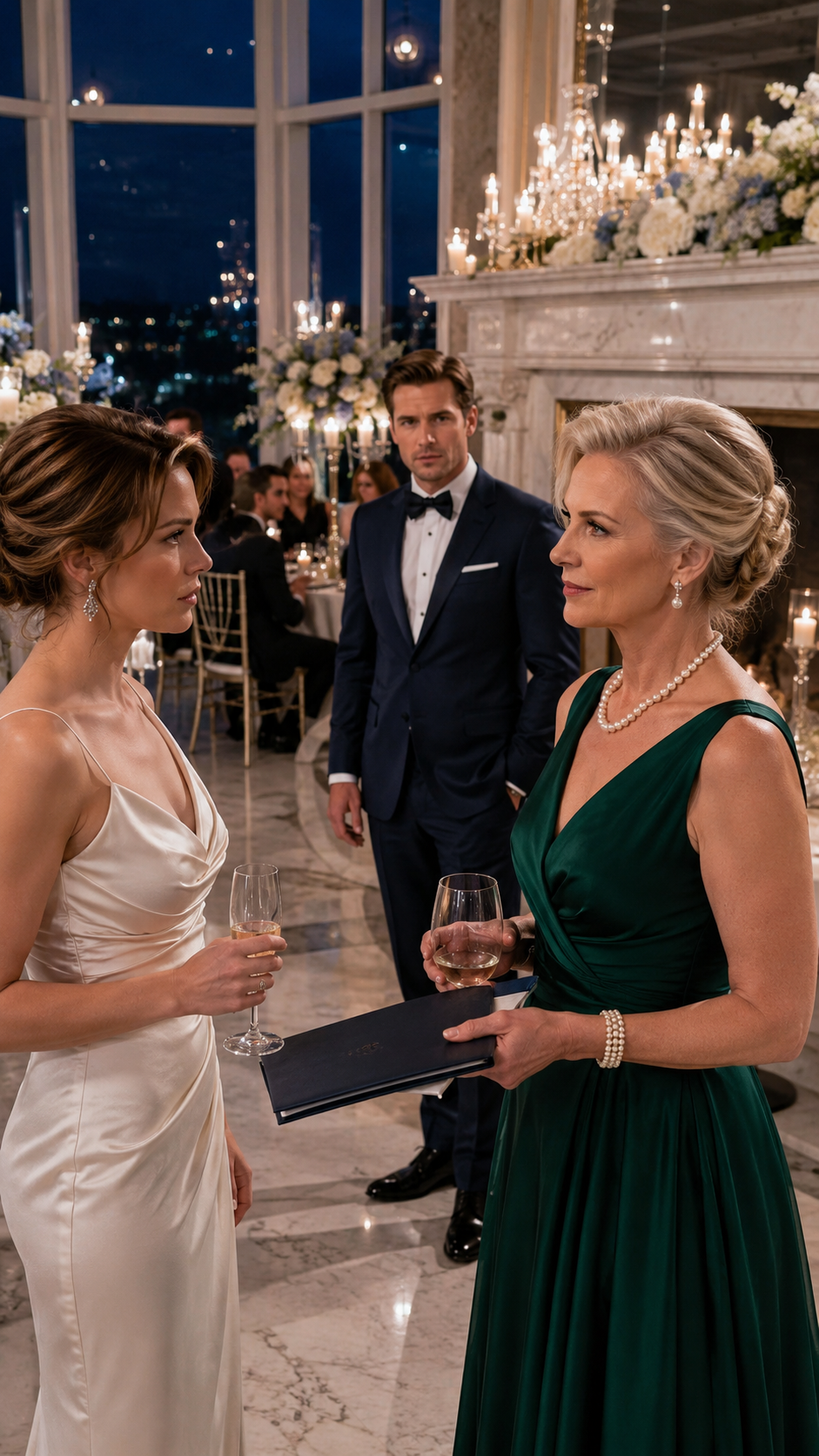
Celeste stood beside the marble fireplace, effortlessly holding a crystal wine glass.
Still wearing the same pleasant smile, she asked in an almost casual tone,
“You’ve signed the updated marriage agreement, haven’t you?”
I paused before answering.
“Not yet.
My attorney recommended revising a few sections first.”
Her smile didn’t disappear.
Only her eyes became noticeably sharper.
“The wedding is tomorrow, Adeline.”
“I know.”
“Warren feels your hesitation may suggest you don’t fully trust him.”
I answered as calmly as possible.
“The agreement gives him significant authority over shares connected to my company.
Wanting every detail to be clear isn’t the same as questioning someone.”
Celeste gently tightened her grip on the stem of her glass.
“Marriage requires two people to have complete faith in one another.”
I met her gaze without looking away.
“Trust is important.
Legal agreements deserve the same level of care.”
Silence settled between us for a few momenTS.
Then Warren walked over.
He looked exactly like the groom everyone admired.
A tailored navy suit.
Neatly styled brown hair.
The familiar gentle smile that had always made me feel safe.
He placed one hand lightly against my back.
“My mother simply wants tomorrow to go smoothly,” he said.
“We’ll review the paperwork together in the morning.”
I searched his face.
“So you’re not upset that I haven’t signed it yet?”
He smiled and softly kissed my forehead.
“Not at all.
I just want you to feel completely comfortable before we do anything.”
His answer should have reassured me.
Instead—
A quiet voice deep inside reminded me that something about the evening didn’t feel right.
Love has a strange way of teaching people to ignore what they notice.
The heart sees a crack and immediately searches for a reason to call it a shadow.
I wanted to believe Warren.
So I did.
For another forty minutes.
The Coat I Almost Left Behind
I left the estate shortly after ten in the evening.
The temperature had dropped, and a cold wind moved in from the ocean.
As I stepped toward the waiting car, I realized my charcoal-gray wool coat was still hanging in the guest room upstairs.
My driver offered to retrieve it.
“I can ask one of the staff members to bring it out, Ms.
Cross.”
“It’s all right,” I told him.
“I could use a few quiet minutes.”
The evening had exhausted me.
For hours, I had smiled for photographs, thanked distant relatives, and answered questions about flowers, music, and honeymoon plans.
Walking back into the house seemed easier than asking someone else to search for my coat.
The front door had not closed completely, so I stepped inside without ringing the bell.
The mansion felt different now.
The musicians had left.
The candles had been extinguished.
Without laughter and conversation filling the rooms, the estate looked less like a family home and more like a carefully constructed stage after the audience had gone.
I crossed the foyer quietly.
That was when I heard Warren laugh.
The sound came from Celeste’s private library at the end of the west hallway.
It was not the warm laugh I knew.
It sounded careless and confident, as though he had removed a mask the moment he believed I was gone.
I stopped walking.
The library door stood slightly open.
Celeste spoke first.
“She is delaying again.
I warned you she might refuse.”
Warren answered in a calm voice.
“She won’t refuse tomorrow.
There will be nearly two hundred guests waiting.
She cares too much about her reputation to stop the ceremony.”
I stood frozen in the hallway, one hand still holding my clutch, the other pressed flat against the cold plaster wall.
“And if she does refuse,” Celeste said, “the bank calls the loan in nine days.
Nine days, Warren.
Do you understand what happens to this family if Halstead Group cannot cover that payment?”
“I understand perfectly.”
“Then make certain the transfer clause survives whatever her lawyer tries to add tonight.
I don’t care how you do it.
Charm her.
Delay her.
Sign something in her sleep if you must.
By noon tomorrow, Crosswell’s shipping contracts need to sit inside our name, not hers.”
My chest tightened.
I did not move.
I did not breathe the way a person breathes when they are simply standing in a hallway.
A third voice entered the room—older, unfamiliar, precise.
Later I would learn it belonged to Desmond Pratt, the Halstead family’s longtime attorney.
“The clause is buried on page forty-one,” Pratt said.
“Under the joint-asset provision.
If she signs without a forensic read, the navigation contracts and the harbor licenses transfer to a joint holding company the moment the marriage is registered.
Her board can contest it, but by the time they do, we’ll already control voting rights on the licenses.
It will be too late to reverse.”
“And if her attorney catches it first?” Warren asked.
“He won’t,” Pratt said.
“He’s reviewing a draft I revised myself two days ago.
The language reads as boilerplate.
Even a careful lawyer skims boilerplate on a wedding week.”
Celeste’s voice dropped, softer now, almost tender—the way a woman speaks when she believes she is being reasonable.
“Warren.
Look at me.
I am not asking you to hurt her.
I am asking you to marry her, the way you agreed to fourteen months ago, when your father’s company was already drowning and you came to me in this very room and told me you would fix it.”
A pause.
“I remember,” Warren said.
“Then remember the rest of it too.
You don’t have to love the arrangement.
You only have to complete it.”
I stood in the dark hallway of a house I had almost called my second home, holding a coat I had not yet reached, listening to the man I was supposed to marry in twelve hours discuss me the way a shipping company discusses cargo.
Something inside me did not shatter.
It went still.
Very, very still—the particular stillness of a person deciding, in real time, exactly how much of herself she is willing to lose before she starts fighting to keep the rest.
I took out my phone.
My hand did not shake.
I would think about that later—how calm my fingers were as I opened the voice memo application and let it run, propped silently against my palm, angled toward the door.
Then I did something I had not planned to do.
I knocked.
The Woman Who Walked Back In
“Adeline.” Warren’s face rearranged itself in half a second—surprise into warmth, the way it always had, so smoothly that I almost admired the skill of it.
“I thought you’d already left.”
“I forgot my coat,” I said.
My voice came out light.
Unbothered.
A voice I had practiced for boardrooms, not for this.
“I hope I’m not interrupting.”
“Of course not,” Celeste said, rising from her chair with the same warm smile she’d worn all evening.
“We were only finishing a bit of family business.
Wedding logistics.
You know how these things go.”
“I do,” I said.
“I know exactly how these things go.”
I let my eyes move, briefly, deliberately, to the folder open on the desk between them.
Forty-something pages.
A pen resting on top, uncapped.
Desmond Pratt closed it without hurrying, as though closing a folder were the most natural motion in the world.
“Your coat’s upstairs, dear,” Celeste said.
“Second guest room on the left.
I’ll have someone walk you up.”
“I remember the way,” I said.
“I’ve stayed here before.”
I turned and left the library.
I did not run.
I did not look back to see whether Warren was watching me go, though some small, wounded part of me wanted to.
I walked upstairs, retrieved the coat exactly where I’d left it, folded over the arm of a wingback chair, and stood in the quiet guest room for a full minute with the recording still saved in my phone, my thumb hovering over the file.
Twelve hours.
I had twelve hours until a minister would ask me if I took this man, and two hundred guests would watch me answer.
I thought of my father.
Trust, but verify, he used to say, tapping two fingers against a contract before he signed it.
A handshake tells you what a man wants you to believe.
A signature tells you what he’s actually agreed to.
He had built Crosswell Navigation out of a single leased tugboat and forty years of stubbornness.
He had died four years ago and left the company to me instead of to the cousins who had spent his funeral asking about the will.
I had spent every year since proving, to a board that doubted a thirty-one-year-old woman could hold a shipping empire together, that I could.
I was not going to hand it to a family that had already decided, in a closed room, exactly how they would take it from me while I slept.
I put the coat on.
I walked back down the stairs, past the library door, which had been shut now, and out through the front entrance into the cold.
My driver was waiting exactly where I’d left him.
“Everything all right, Ms.
Cross?”
I looked back once at the mansion—white columns, glowing windows, every inch of it built to look like safety.
“Take me to my attorney’s office,” I said.
“Not home.
His office.
Call him on the way and tell him it’s an emergency.”
Setting the Table
Marcus Whitfield had been my father’s lawyer before he was mine.
He met me at his office at eleven-fifteen at night in a cardigan over pajama pants, his gray hair uncombed, a coffee mug in each hand before I’d even finished explaining.
He listened to the recording twice without speaking.
The second time, he closed his eyes.
“Page forty-one,” he said finally.
“The joint-asset provision.
I read that section three times this week, Adeline.
It’s dressed as standard co-mingling language for shared marital property.
It is not standard.
It’s a trigger clause.
The moment your marriage is legally registered, voting control on the harbor licenses and the West Atlantic shipping contracts transfers to a joint holding entity—Halstead Maritime Partners—that Pratt incorporated eleven days ago.”
“Eleven days,” I repeated.
“I checked the filing while you were talking.” He turned his laptop toward me.
A Delaware incorporation record, dated eleven days prior, two directors listed: Celeste Halstead and Desmond Pratt.
“He built the company before he built the clause,” I said quietly.
“He built the company to receive what the clause hands over.” Marcus rubbed his eyes.
“This isn’t a prenup dispute, Adeline.
This is a coordinated transfer of controlling interest in Crosswell Navigation, planned and drafted before you’d even agreed to sign anything.
If you’d married Warren tomorrow without a forensic read of that document, by Monday morning you would have been CEO of a company you no longer controlled.”
I sat very still, the recording open on the desk between us like the folder had been open between them.
“What are my options?”
“Legally? You don’t sign.
You never had to sign.
You walk into that wedding with clean hands and simply refuse the document, and there’s no case to build against you at all.” He paused.
“But that lets them walk away too.
Pratt destroys the filing, Celeste claims it was a misunderstanding, Warren claims he never agreed to any of it, and in six months they try again with someone else, or with you, in a different form.”
“So walking away isn’t enough.”
“No,” Marcus said.
“If you want this to actually end, you need them to say it themselves, in a room they can’t spin their way out of.
You need the truth to arrive before the vows, not after them.”
I looked down at my phone, at the small waveform of the recording, thirty-one minutes and forty seconds of Warren Halstead’s real voice.
“I have an idea,” I said.
“But I need you to call someone for me.
Two people, actually.”
“Who?”
“My head of legal at Crosswell.
And the wedding’s audiovisual coordinator.”
Marcus raised an eyebrow slowly, the way he used to when my father brought him an idea he privately thought was reckless and publicly agreed to support anyway.
“You’re not planning to confront them quietly,” he said.
“No,” I said.
“I’m planning to let them confront themselves.
In front of everyone who came to watch me disappear into that family.”
He almost smiled.
“Your father would have liked this.”
 Boyfriend Brags About His \\\\\\\"Size\\\\\\\" While Causing Her Pain, She Finally Snaps And Pushes Him Away
“My father would have done it faster,” I said.
“Call them.
We have twelve hours, and I’d like at least eight of them to sleep.”
The Weight of a Question Not Yet Asked
I did not sleep.
I lay in the dark of my apartment with the coat still draped over the chair by the window, and I let myself, finally, feel the thing I had been holding at arm’s length since the hallway.
Grief.
Not for a company nearly stolen—that was fury, clean and useful, something I could act on.
The grief was for something smaller and stupider: the version of the last three years I had believed in.
The Tuesday nights Warren brought soup to my office when I worked too late.
The way he’d learned to pour my coffee exactly the way I liked it without ever being told twice.
The morning he’d cried, actually cried, telling me his father’s failing business had taught him he never wanted to build something only to watch it collapse.
I had believed that man wanted to build something with me.
Instead he’d been sent to disassemble what I’d already built.
Cheap performance, I told myself.
He learned your coffee order the way a con man learns a mark’s birthday.
But some part of me—smaller, quieter, more honest than I wanted it to be—wondered whether all of it had been performance, or whether a person could genuinely love someone and still be too weak to refuse his mother when she told him to betray her.
Both could be true.
Both being true didn’t change what I had to do in the morning.
Around four a.m., I finally opened my closet and looked at the wedding dress hanging inside its garment bag, white silk catching the streetlight through the blinds.
I had chosen it eight months ago with my sister, both of us laughing too hard in a fitting room, neither of us imagining I would wear it into a room to detonate my own wedding instead of complete it.
I touched the fabric once.
Then I zipped the bag closed and went to make coffee.
There were still five hours left, and I intended to use every one of them.
The Setup
By seven a.m., I had made three calls.
The first was to Denise Okafor, my general counsel at Crosswell, who arrived at my apartment within the hour holding a laptop and a face carved out of pure professional calm, the kind I paid her generously to maintain even now.
“Walk me through it again,” she said, and I did, and when I finished she was quiet for a long moment.
“You understand,” she said carefully, “that if we do this in front of two hundred guests, there’s no controlling how it plays publicly.
This could end up on the news before the reception’s cleared the tables.”
“I know.”
“You could lose Warren’s family as investors entirely.
Halstead Group still holds a minority stake in two of our shared port contracTS.”
“They already tried to take a controlling stake in the entire company through fraud,” I said.
“I’m not worried about losing a minority stake in return.”
Denise almost smiled.
“Your father used to say something like that.”
“He said it better,” I told her.
“Can we have the clause independently verified by noon?”
“I already sent it to two outside firms at five this morning.
I’ll have written confirmation within two hours.
In writing, notarized, ready to hand to a courtroom if it comes to that.”
The second call was to Priya Anand, the wedding’s audiovisual coordinator, a woman I had personally hired three months earlier to handle the livestream for family members who couldn’t attend in person—my cousin stationed overseas, my father’s old business partner recovering from surgery in Florida.
I told her what I needed.
She was quiet for a beat, and then said, in the brisk, unbothered voice of someone who had clearly worked enough weddings to have seen everything, “You want me to route a specific audio file through the ceremony sound system, timed to a cue you’ll give me, instead of the processional music.”
“Yes.”
“And you want the livestream feed active and recording the whole time.”
“Yes.”
“Ms.
Cross, I have set up sound for four hundred weddings.
This is, without question, the most interesting request anyone has ever made of me.” A pause.
“I’ll need the audio file by nine, and I’ll need you to trust me to get the timing exactly right.”
“I do,” I said, and meant it more than I had meant the same two words directed at Warren in longer than I wanted to admit.
The third call was to my sister, Marion, who did not ask a single question about the plan once I explained it.
She simply said, “What do you need me to do,” and I loved her for that more than I had words to say.
By nine, the audio file—cleaned, trimmed, the clearest thirty-one seconds isolated from the rest—had been delivered to Priya.
By ten, Denise had written confirmation from both outside firms: the joint-asset provision on page forty-one was, in the words of one senior partner, “a deliberately obscured control-transfer mechanism inconsistent with standard marital co-mingling language, and inconsistent with any good-faith drafting practice.”
By eleven, I was in my dress.
Marion zipped it for me with steady hands, and in the mirror I watched myself become, for a moment, exactly what everyone at that wedding expected to see: a beautiful bride, radiant, ready.
“You don’t have to do this,” Marion said quietly, watching my face in the glass.
“You could just not show up.
Let Marcus send a letter.
Walk away clean.”
“They’d say I got cold feet,” I said.
“They’d say I was unstable, unpredictable, difficult—the same words men like Pratt use for any woman who refuses to sign what she’s told to sign.
They’d rebuild the story before the ink dried on the annulment.
I’m not going to let them write that version of what happened to me.”
Marion held my eyes in the mirror.
“Then let’s go write ours.”
The Man in the Hallway, One More Time
At half past ten, with less than ninety minutes before the ceremony, Warren called.
I almost didn’t answer.
Then I thought of my father again—a handshake tells you what a man wants you to believe—and decided I would rather hear whatever he wanted to say while I still had time to act on it.
“I need to see you,” he said.
“Before the wedding.
Please, Adeline.
Five minutes.”
I met him in the small garden behind the conservatory, where the staff hadn’t yet finished setting the chairs.
He looked like he hadn’t slept either—tie loose, eyes rimmed red, none of the polish from the night before.
“I know you’re upset,” he started.
“Upset isn’t the word I’d use.”
“Whatever it is.
I need you to know I told my mother, this morning, that I wasn’t going to let her push the clause through.
I told her I’d rather lose the company than lose you.”
I studied his face for a long moment.
Some part of me wanted, badly, for this to be the version of the story where he’d changed his mind in time.
“When did you tell her that?”
“An hour ago.”
“After I already knew,” I said quietly.
“After the recording.
After you understood I’d heard everything.
You didn’t refuse her when it mattered, Warren.
You refused her once refusing cost you nothing.”
His jaw tightened.
“That’s not fair.”
“Fair would have been walking into that library eleven days ago, when Pratt filed the paperwork, and telling your mother the marriage wasn’t for sale.
Fair would have been telling me, last night, the second I walked back in with my coat, instead of smiling at me across a library and pretending I hadn’t heard a thing.”
“I was scared,” he said, and for the first time all morning, his voice cracked in a way that sounded less rehearsed than everything else he’d said to me in twelve hours.
“I’ve spent my whole life being scared of her.
You don’t know what it’s like, growing up watching your father get smaller every year in that house, watching her decide everything because he wouldn’t.
I told myself if I just got through the wedding, I could fix it after.
Protect you and the company both, quietly, without a fight.”
“There’s no version of stealing my company quietly that ends with you protecting me,” I said.
“There’s only a version where I find out before the ink dries, or a version where I find out after.
You were hoping for after.”
He didn’t argue.
That, more than anything he’d said, told me everything I needed to know.
“I have to get ready,” I told him, and turned back toward the house, leaving him alone in a garden full of empty chairs.
I did not tell him about the recording, or the plan, or what was about to happen in ninety minutes.
Some decisions, I’d learned overnight, only mean something if the person on the other end of them doesn’t see them coming.
The Aisle
The ceremony was held in the same glass conservatory where the rehearsal dinner had taken place, transformed overnight into something out of a magazine—white orchids climbing wrought-iron arches, two hundred chairs arranged in perfect rows facing the Atlantic through floor-to-ceiling windows, morning light pouring gold across the aisle runner.
Warren stood at the altar in a black tuxedo, and when the doors opened and the quartet began to play, his face did exactly what a groom’s face is supposed to do.
It softened.
It looked, for one unbearable second, entirely real.
I walked toward him on my father’s business partner’s arm—the man who had known me since I was nine years old, who had flown up from Florida against his doctor’s orders because, he’d told me on the phone, your father would come back from the dead to walk you down that aisle himself if he had to, so the least I can do is show up with a working pair of legs.
I did not look at Celeste, seated in the front row in pale blue silk, her expression serene, victorious, already halfway to owning something that was never legally hers to take.
I looked at Warren the entire walk, searching his face for any sign that some part of him regretted what I’d overheard in that hallway.
I found nothing but the practiced warmth of a man executing a plan.
We reached the altar.
The minister began to speak—about love, about commitment, about two lives becoming one—and I let the words wash past me while I watched the small discreet earpiece Priya wore near the sound booth at the back of the conservatory, waiting for the nod I’d asked her to give.
“Marriage,” the minister said, “is built first and always on trust.”
I almost laughed.
I didn’t.
“Before we proceed to the vows,” the minister continued, glancing at a card in his hand, “I understand the bride has asked for a brief moment to share something with her guesTS. Adeline?”
Two hundred faces turned toward me.
I stepped slightly forward, my bouquet still in my hands, my voice steady in a way that surprised even me.
“Thank you all for being here,” I said.
“Truly.
Many of you have known my family for years.
Some of you knew my father.
He used to say that a wedding isn’t just a promise between two people—it’s a promise made in front of witnesses, because witnesses are what make a promise real.”
I let my eyes move, briefly, to Celeste.
Her serene expression had not yet cracked, but something behind it had gone very alert.
“Last night,” I continued, “I came back to this house to retrieve a coat I’d forgotten.
On my way out, I heard a conversation in the library that I think everyone here deserves to hear too—before I answer the question I’m about to be asked.”
I turned toward Priya at the back of the room and gave the smallest nod.
The processional silence that followed lasted only a second before the sound system carried Warren’s voice, calm and clear, across two hundred chairs and a room full of white orchids.
“She won’t refuse tomorrow.
There will be nearly two hundred guests waiting.
She cares too much about her reputation to stop the ceremony.”
Then Celeste’s voice.
“And if she does refuse, the bank calls the loan in nine days… By noon tomorrow, Crosswell’s shipping contracts need to sit inside our name, not hers.”
Then Pratt’s, precise and cold.
“If she signs without a forensic read, the navigation contracts and the harbor licenses transfer to a joint holding company the moment the marriage is registered… It will be too late to reverse.”
The recording ran for thirty-one seconds.
It felt considerably longer.
Two Hundred Witnesses
I have thought many times since about what that room sounded like in the silence right after the audio stopped.
Not gasps, exactly.
Something quieter and worse—the specific stillness of two hundred people simultaneously recalculating everything they thought they understood about the family hosting them.
Warren’s face had drained to a color I’d never seen on him.
“Adeline—that’s not—you have to understand the context—”
“I do understand the context,” I said, and I was proud, later, of how level my voice stayed.
“The context is that I came back for a coat, and I found out exactly what I was actually worth to this family.
Not love.
Not partnership.
A signature on page forty-one.”
Celeste rose from her seat, all pretense of serenity gone, her voice sharp enough to cut.
“This is a private family matter, and you have humiliated us in front of—”
“You planned to take my company from me while I slept, Celeste,” I said, turning to face her directly for the first time all morning.
“In front of two hundred witnesses feels like the appropriate place to say that out loud.”
Desmond Pratt had already begun moving toward the side exit, his face arranged into the particular blankness of a lawyer calculating liability in real time.
“Mr. Pratt,” I said, and he stopped.
“Halstead Maritime Partners was incorporated eleven days ago.
I have the filing.
I have two independent legal opinions confirming the joint-asset provision you drafted constitutes deliberate, bad-faith fraud designed to seize controlling interest in a publicly regulated shipping company.
My legal team has already been in contact with the state bar association this morning.”
His face did not change, but something in his shoulders did.
I turned back to Warren, who had not moved from the altar, who looked, for the first time since I’d known him, entirely without a script.
“Did you know,” I asked him quietly—quietly enough that the room leaned in to hear it—”before last night, or before this morning, when I understood?”
He opened his mouth.
Closed it.
“I told them I didn’t want to hurt you,” he said finally.
“I told my mother I wanted to find another way to save the company.”
“But you didn’t refuse,” I said.
“You just didn’t want to watch.”
“Adeline, please—we can still—if you’ll just let me explain, in private—”
“There isn’t going to be a private version of this, Warren,” I said.
“You made sure of that when you decided a signature was worth more than a conversation.”
What Celeste Said That I Almost Understood
It was Celeste, not Warren, who said the thing that stayed with me longest.
She had stopped shouting.
Something in her had gone brittle and exposed, the performance finally cracking all the way through.
“You think I wanted this,” she said, low enough now that only the front rows could hear.
“You think I enjoyed sitting in that library plotting to take a company from a woman who built it herself? I spent thirty years watching my husband’s company slide toward bankruptcy while he refused to admit it, refused to change anything, and when he died, he left me a name and a mortgage on a legacy I never asked to be responsible for.
I did what I had to do to keep this family from losing everything my husband spent his life pretending we weren’t losing.
You have no idea what it costs a woman to hold a family together with nothing but her own two hands and a smile everyone assumes means she’s fine.”
For one unwilling second, I felt something that was almost sympathy.
Because I understood, in a way very few people in that room could, what it meant to inherit a legacy you hadn’t built and be expected to save it anyway, alone, while everyone assumed your composure meant you weren’t struggling.
The difference—the whole entire difference—was that I had never once considered stealing someone else’s life to save mine.
“I understand wanting to protect what’s yours,” I told her.
“I don’t understand deciding my company was an acceptable price for it.”
She had no answer to that.
Nobody did.
What Happened After
I did not marry Warren Halstead that morning.
I walked back down the aisle alone, still holding my bouquet, past two hundred faces that would talk about this wedding for years, and I did not cry until I reached the small side room where Marion was waiting, and then I cried the way I hadn’t let myself cry since my father’s funeral—messily, loudly, without dignity, with my sister’s arms around me and white silk crushed between us.
The fallout took months, not hours.
Desmond Pratt was referred to the state bar for disciplinary review within the week; he surrendered his license eight months later rather than face a hearing he knew he would lose.
Halstead Maritime Partners was dissolved before its paperwork had time to gather dust.
Halstead Group’s loan came due nine days later exactly as Celeste had predicted, and without Crosswell’s contracts to leverage against it, the company entered receivership within the year.
I felt no triumph watching it happen.
Only the flat, tired relief of a threat that had finally stopped being a threat.
Warren called eleven times in the first month.
I answered twice.
The first time, he apologized in the exact tone he’d used to apologize for small things across three years—being late, forgetting an anniversary dinner reservation—as though the scale of what he’d allowed to happen could be addressed with the same register as everything else.
The second time, I told him I didn’t think he was a monster.
I told him I thought he was a man who had spent his whole life being told love meant obedience, and that he’d never once tested whether that was true before it cost him the one relationship where it mattered.
“Do you think you could have loved me for real?” he asked.
“If none of this had happened?”
“I think you loved the version of yourself who deserved me,” I said.
“You just never became him.”
He didn’t call again after that.
The Coat, Revisited
Six months later, I stood in my office at Crosswell Navigation, looking out over the harbor at the ships my father had spent a lifetime building a company around, and my assistant knocked to tell me a delivery had arrived.
It was a garment box.
Inside, folded with more care than I expected, was the charcoal-gray wool coat—the one I’d left in that guest room, the one I’d walked back inside to retrieve, the one that had, in its own strange way, walked me straight into the truth instead of away from it.
There was no note.
I didn’t need one.
I hung the coat by my office door, where I could see it every morning, not as a wound I was nursing but as a reminder of the exact moment I’d chosen to trust my own instincts over someone else’s comfortable version of evenTS.
Marion asked me, once, whether I regretted any of it—the recording, the ceremony, the two hundred witnesses.
“I regret that it happened,” I told her.
“I don’t regret how I answered it.”
I think about my father sometimes, standing at his desk with two fingers tapping a contract.
A handshake tells you what a man wants you to believe.
A signature tells you what he’s actually agreed to.
I never signed page forty-one.
I signed, instead, the version of my life I’d almost let someone else write for me, and I crossed it out, and underneath it, in my own handwriting, I started again.
Not perfectly.
Not without scars, or long nights, or a coat that still, occasionally, smells faintly of cold Maine air and a hallway I never should have had to stand in.
Some mornings I still catch myself bracing for a version of the story where I stayed quiet, where I let the coat go, where I walked down that aisle without ever climbing those stairs.
It’s a short, cold thought, and it never lasts long, because I know exactly how that version ends, and I have no interest in grieving a life I didn’t live.
Denise still runs legal at Crosswell, sharper now, if that’s possible, having learned the hard way what a well-hidden clause can cost a company that trusts too easily.
Marion got married the following spring, and I stood beside her in a dress I chose myself, and when the minister asked if anyone objected, the whole room laughed, gently, because by then the story of my own wedding had become the kind of thing people could finally laugh about, at a safe enough distance.
I never did marry that year, or the year after.
I told myself I wasn’t looking, and mostly that was true.
But it is mine.
Every clause of it.