
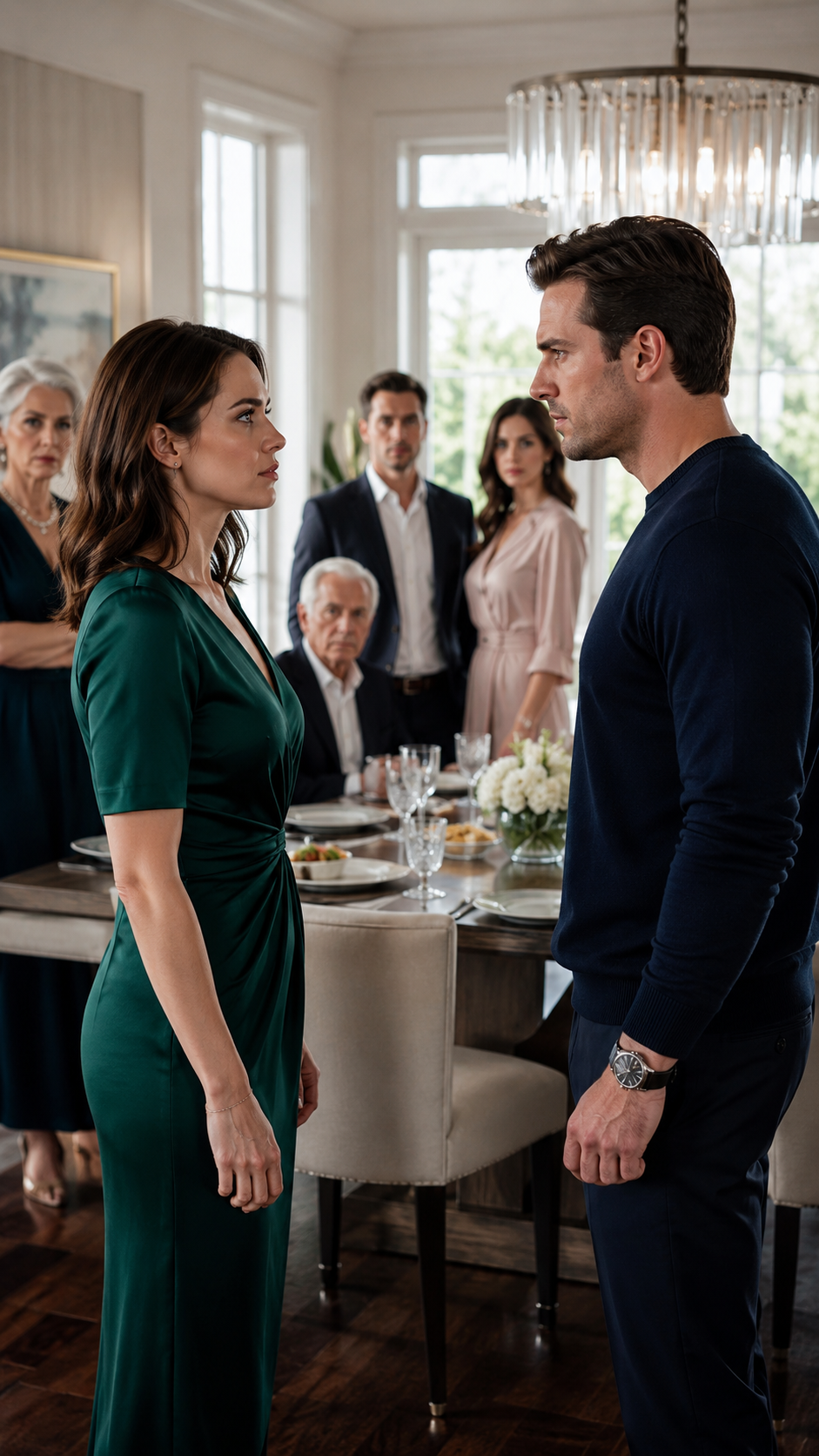
She Deserved That, They Said — Until the File I’d Been Building Proved Otherwise
Part One: The Birthday That Changed Everything
“She deserved that slap.”
My brother, Arthur, said it without the slightest hint of regret.
His hand was still hanging in the air while my two-year-old daughter, Gigi, burst into terrified sobs.
Everything had happened in a heartbeat.
We were gathered at my parents’ house in Brookline for my niece’s birthday.
Golden balloons floated across the ceiling.
A spotless white cake sat in the center of the table.
Nearly twenty relatives filled the living room with laughter and conversation.
Then Gigi noticed the shiny ribbons decorating the centerpiece.
Like any curious toddler, she waddled toward them with a smile.
She stretched out one tiny hand.
Before I could reach her, Arthur struck her.
The crack echoed through the room.
Her little head jerked sideways.
For one heartbreaking second, she simply stared at him, too shocked to understand what had happened.
Then her face crumpled.
She cried with a kind of fear I’d never heard from her before.
I rushed across the room and lifted her into my arms.
“What did you just do?” I demanded.
Arthur casually lowered his hand.
“Someone has to teach her manners.
Since you clearly won’t.”
Ice flooded my veins.
“You just hit a two-year-old.”
He rolled his eyes.
“She was about to ruin the decorations.”
Before I could say another word, my mother stepped between us.
Not to comfort Gigi.
Not to confront Arthur.
To protect him.
“Enough, Clara,” she snapped.
“Stop causing a scene.”
I stared at her in disbelief.
“A scene? He just slapped my daughter.”
My father folded his arms.
“Children need discipline.
You’ve been far too soft with her.”
Against my shoulder, Gigi shook uncontrollably.
Her tiny cheek was already turning bright red.
She wasn’t crying because she’d been scolded.
She was crying because someone she trusted had hurt her.
I slowly looked around the room.
No one spoke.
My aunts suddenly found the floor fascinating.
My cousins stared into their drinks.
One of my sisters-in-law quietly disappeared into the kitchen.
No one defended my child.
Arthur opened a beer, took a long drink, and shrugged.
“Somebody had to correct her before she grows into another spoiled brat.”
I waited.
I waited for my father to stop him.
For my mother to demand an apology.
For any adult in that room to acknowledge what had just happened.
Instead, my mother sighed impatiently.
“Honestly, Clara, you’re ruining your niece’s birthday.”
I looked down at Gigi’s swollen cheek.
Then back at my family.
In their eyes, I wasn’t the victim.
Neither was my daughter.
We were the problem.
Without another word, I picked up Gigi’s blanket from the sofa — the same gray rabbit-eared blanket she’d had since the hospital, worn thin at one corner from two years of small fists gripping it in her sleep.
I grabbed her diaper bag.
And I walked toward the front door.
“Are you really leaving because of one little slap?” my mother called after me.
I paused only long enough to answer.
“Yes.
Because of exactly that.”
No one came after us.
No one stopped Arthur.
No one apologized to my little girl.
My phone began ringing before I had even reached the parking lot.
My mother.
Then my father.
Then three different relatives.
Every message demanded the same thing.
Come back.
Apologize.
Stop embarrassing the family.
I ignored every call.
Instead, I drove straight to the emergency room.
The pediatric physician carefully examined Gigi.
Photographed the swelling.
Measured the bruise.
Recorded every detail in her medical chart.
Afterward, while Gigi slept against my shoulder, I opened a folder saved on my phone.
It wasn’t empty.
Arthur’s violence hadn’t started that afternoon.
This was only the latest entry.
Part Two: The Folder
I buckled her into her car seat while she continued whimpering softly.
I kissed her forehead and promised her that she was safe with me, that no one would ever touch her like that again.
Within minutes of pulling out of the driveway, my phone began to buzz in the console.
You’re overreacting.
You ruined your niece’s birthday.
Arthur was only trying to help.
Come back and act like an adult.
I didn’t reply to a single text.
Instead, I opened a new folder on my phone, titled it with the day’s date, and began saving every message, every incoming call log, and every defensive voicemail.
Because while they thought I had driven away crying out of mere anger, I had just realized something vital: I could never let this family rewrite the truth again.
The folder I’d opened at the hospital wasn’t new.
It had a name — G.
Incidents — and it went back fourteen months, to the first time Arthur had babysat Gigi alone.
She’d come home with a red mark on her upper arm shaped almost like fingers.
He’d said she fell off the couch.
I hadn’t believed him then, either, but I hadn’t had proof.
I’d only had a note in my phone, dated, with a photo I told myself I was probably imagining meaning into.
There were four more entries after that one.
A bruise on her thigh after a weekend visit to my parents’.
A time she flinched when Arthur raised his hand to wave hello, and everyone laughed like it was funny that a baby was afraid of her uncle.
A voicemail from my mother, eight months ago, saying, Arthur just needs you all to stop being so sensitive, he had a hard childhood too.
I had never been ready to use any of it.
I had told myself I was building a case against my own imagination.
I wasn’t imagining it anymore.
By the time I pulled into my driveway, Gigi had fallen asleep, her uneven breathing finally evening out.
I carried her inside, laid her in her crib, and sat on the floor of her nursery with my back against the crib rail, staring at the ceiling until the sky outside her window turned from black to gray.
My husband, Daniel, was three states away on a two-week installation job — the kind of contract that paid our mortgage but left cell service spotty in the mountains where he worked.
I didn’t call him that night.
I didn’t want him driving twelve hours on no sleep.
I wanted him to see it, all of it, when he could actually see it.
So instead, at four in the morning, I did the only thing that made the shaking in my hands stop.
I started writing everything down.
Part Three: What My Family Never Wanted Me to Remember
My mother has a saying she’s used my whole life: Family doesn’t air its laundry.
I heard it the first time when I was nine, after I told her that Arthur, then thirteen, had locked me in the garage for an hour because I’d used his bike without asking.
I heard it again at eleven, when he broke my arm “accidentally” wrestling and no one took me to urgent care until the swelling made it impossible to pretend anymore.
I heard it at sixteen, when he put his fist through my bedroom door because I’d borrowed his charger.
Every single time, the story ended the same way.
Arthur apologized, sort of, in the flat voice of someone reciting lines.
My parents accepted the apology on my behalf, whether I wanted to give it or not.
And within a week, it was as if nothing had happened — except that I understood, a little more each time, that keeping the peace was my job, and Arthur’s rage was simply weather.
Something you didn’t argue with.
Something you planned around.
I used to think it was because I was the older one, the responsible one, the one who was “supposed to understand him.” It took me twenty years and a daughter of my own to realize the truth: my parents hadn’t been managing Arthur’s temper.
They’d been managing witnesses to it.
Arthur had been eight when our older brother, Michael, died — a drowning accident at a lake house none of us ever spoke of again.
I don’t remember much; I was only five.
But I remember my mother after that summer, orbiting Arthur like he was the only thing keeping her upright.
I remember my father telling me, more than once, Your brother has been through enough.
Don’t make things harder for him.
Nobody ever said the same thing about me.
Nobody ever said it about Gigi.
That was the wound underneath everything — my mother’s belief, forged in a grief she never processed, that protecting Arthur from consequences was the same thing as protecting him from another loss.
She wasn’t evil.
She was terrified, and had been for thirty years, and had built an entire family religion around never testing whether Arthur could survive being told no.
Arthur had learned the lesson she taught him better than she ever meant for him to.
He didn’t see his hand striking a toddler as violence.
He saw it as care — the same brutal, misdirected care that had raised him.
Somebody has to teach her manners, since you clearly won’t.
He believed that, the way you believe the color of the sky.
And I had learned my own lesson, the mirror image of his: that speaking up got you nothing but blamed for the disruption.
That silence was the price of staying loved.
I was done paying it.
Three days after the birthday party, I called my pediatrician’s office and requested copies of every visit record involving Gigi over the past year.
I called the ER and requested the discharge paperwork and photographs from that night.
I sat down and, for the first time, wrote out a full timeline — dates, injuries, who had been present, what had been said afterward to explain it away.
It took me six hours.
When I finished, I had eleven pages.
I didn’t send them to anyone yet.
I wasn’t ready for what would happen when I did.
But I saved the document in three separate places, and for the first time in years, I slept through the night.
Part Four: The Campaign
My mother showed up on my porch four days later, unannounced, holding a casserole dish like an olive branch nobody had asked for.
“We need to talk about Sunday,” she said, stepping past me into the kitchen before I’d fully opened the door.
“There’s nothing to talk about, Mom.
Arthur hit my daughter.”
 Woman Leaves Her Former Friend And Her Kid On The Side Of The Road After The Child Endangers Her While Driving
“He tapped her.” She set the dish down with the particular firmness of someone establishing facTS. “You’re describing it like he beat her.”
“I have photographs of the bruise.”
“Toddlers bruise from nothing, Clara, you know that.”
I looked at her — really looked, the way you look at someone when you’ve finally stopped filling in the blanks with the version of them you wish existed.
“Would you say that if it were you who’d been hit?”
Something flickered behind her eyes, gone before I could name it.
“Don’t twist this into something it isn’t.
Arthur is going through a hard time.
His marriage is falling apart.
He’s been under enormous pressure at work.
And instead of anyone in this family showing him a little grace, you’re treating him like a criminal.”
“He hit a two-year-old, Mom.”
“And you humiliated him in front of the entire family for it.” Her voice cracked, just slightly, on entire family — and there it was, the thing she actually couldn’t survive: not what Arthur had done, but what everyone had seen.
“Do you have any idea what people are saying? Your aunt Rosalind hasn’t stopped calling me.
This is supposed to be a celebration for your niece, and now it’s a scandal.”
“It became a scandal the moment he raised his hand,” I said.
“I just wouldn’t pretend it hadn’t happened.”
She stood in my kitchen for a long moment, and when she spoke again, her voice had gone quiet in a way that was somehow worse than shouting.
“You’ve always done this.
Ever since you were small.
Made everything into something unforgivable.
Your father and I have spent this whole family’s life trying to hold us together, and you’d rather blow it all up over one moment.”
I thought about the eleven pages saved in three places.
I thought about the bruise shaped like fingers on my daughter’s arm fourteen months ago, and the note I’d been too afraid to trust.
“It’s not one moment, Mom,” I said.
“It never was.
You just never let anyone say that part out loud.”
She left without touching the casserole.
Over the following two weeks, the campaign intensified in ways I hadn’t anticipated.
My father called to remind me, in the careful language of a man used to negotiating, that the family lake house — the one property that had been promised, informally, to be split between the three of us someday — could just as easily be left entirely to Arthur and my niece.
My aunt sent a long message about forgiveness being a virtue I clearly lacked.
Two cousins I hadn’t spoken to in years reached out only to ask, almost identically, why I was “punishing the whole family” for something that happened “in two seconds.”
And then Arthur called.
I almost didn’t answer.
When I did, his voice was soft in a way I didn’t recognize, rehearsed in a way I did.
“Clara.
Look, I’ve had some time to think, and — I’m sorry.
Okay? I shouldn’t have hit her.
I was stressed, I wasn’t thinking, and I know that’s not an excuse.
I want to make it right.
Mom’s talking about doing a family dinner this weekend, everyone together, and I thought maybe I could apologize to Gigi in person.
Give her a stuffed animal, something.
Show her I’m not — that I’m not someone she should be scared of.”
For a moment, just a moment, I wanted to believe him.
I wanted it so badly it physically hurt — wanted my brother back, wanted my family whole, wanted this to be the single ugly exception in an otherwise decent history instead of the loudest entry in a long, quiet pattern.
“Arthur,” I said carefully.
“What happened to Gigi’s arm last spring? At Mom and Dad’s, when you were watching her for an hour while I helped set up for the yard sale.”
Silence stretched long enough that I could hear him breathing.
“She fell off the couch,” he finally said.
“I told you that.”
“The mark was in the shape of fingers.”
“Toddlers bruise, Clara.
Everyone bruises.”
There it was — the same sentence, almost word for word, that my mother had used.
Not a coincidence.
A script, handed down and rehearsed until it sounded like instinct.
“I’m not coming to dinner,” I said.
“And I’d like you to stop contacting me until you can say, honestly, what happened that day at the birthday party, and what happened to her arm last spring.
Not an apology written for an audience.
The truth, to me.”
“You’re seriously going to hold one bad afternoon over my head forever?”
“I’m holding a pattern over your head, Arthur.
There’s a difference.
You just don’t want to hear it.”
He hung up on me.
That night, my mother texted a photo of the whole extended family gathered at the “reconciliation dinner” I had refused to attend — Arthur at the head of the table, smiling, my niece on his lap.
The caption read: We missed you and Gigi tonight.
Hope you’ll come around soon.
I stared at that photo for a long time.
Then I added it to the folder.
Part Five: The Choice
Daniel came home nine days after the party, and I showed him everything — the photographs, the timeline, the eleven pages, the texTS. He read in silence at our kitchen table for over an hour, his jaw tightening more with every page, and when he finished, he didn’t say anything about Arthur at all.
He said, “Why didn’t you tell me about the bruise last spring?”
“Because I wasn’t sure.
And because if I said it out loud, I’d have to do something about it, and I didn’t know if I could survive doing something about it.”
He reached across the table and took my hand.
“You can survive it.
I’m right here.”
That was the second choice — harder than the first, which had only cost me an afternoon and a casserole dish.
This one would cost me my family, in the ordinary sense of the word: holidays, birthdays, the version of “family” where everyone shows up and nobody says the true thing out loud.
I could still, even now, choose the softer path.
Accept Arthur’s rehearsed apology.
Let my parents broker a peace that asked nothing of anyone but me and Gigi.
Go to the next dinner.
Smile in the photo.
Or I could file a formal report — not just a folder on my phone, but a real one, with the state’s Department of Children and Families, attaching the ER records, the pediatrician’s notes, the photographs, the timeline.
I could stop protecting a story that had never once protected me or my daughter.
I chose the report.
It took three weeks for a caseworker to schedule the interviews.
In that time, my mother called eleven times.
I answered twice.
Both times, she told me I was destroying the family to satisfy my own need to be right.
Both times, I said the same thing back: “I’m protecting my daughter to satisfy her need to be safe.
Those aren’t the same thing, and I need you to understand that before we talk again.”
The caseworker, a steady, unhurried woman named Priya, interviewed Gigi with a child psychologist present, using dolls and gentle, open-ended questions.
Gigi, not yet three, couldn’t give a courtroom-ready account of anything.
But she pointed to the doll’s cheek, unprompted, and said, “Uncle hurt.” She said it twice, in two separate sessions, weeks apart, without me in the room to influence her.
Priya also interviewed Arthur.
I wasn’t there for it, but I heard, secondhand and later, that he’d said something that I think about even now — something that landed closer to the truth than anything he’d said to me directly.
According to my aunt, who heard it from my mother, who heard it from Arthur himself, he told the caseworker: “Nobody ever stopped me.
Not once, my whole life.
You want to blame me, fine, but ask them why they never stopped me either.”
He wasn’t wrong.
That was the worst part.
My parents had spent thirty years building a version of love that never once told Arthur no, and calling it grace.
He had grown into a man who genuinely did not understand that a raised hand toward a frightened toddler was violence and not correction, because no one in his life had ever drawn that line for him.
His method was monstrous.
His diagnosis of how he got there wasn’t wrong at all.
That didn’t undo what his hand had done to my daughter’s face.
It didn’t mean I owed him a pass because his childhood had shaped his cruelty.
But it meant I understood, finally and completely, that the choice in front of me wasn’t really about punishing Arthur.
It was about refusing to let Gigi grow up inside the same unbroken line — refusing to be the next person who decided that keeping the peace mattered more than telling the truth.
Part Six: What the Truth Cost
The state’s finding came back substantiated for physical abuse regarding the birthday incident, with the prior spring bruise noted as “suspicious but inconclusive” — not enough on its own, but enough, combined with the newer finding, to mandate that Arthur complete a parenting and anger-management program and remain under supervised contact with any child in the extended family, including his own daughter, for the following year.
My mother did not call to check on Gigi after the ruling.
She called to tell me I had “made our family a case file.”
“You made her a case file the day you decided his hand mattered more than her face,” I told her, and for the first time in my life, I hung up on my mother instead of the other way around.
My father sent one email, three lines long, informing me that the lake house would go to Arthur’s daughter alone.
I read it twice and felt, strangely, almost nothing.
Some things stop being able to hurt you once you’ve already survived the thing that was supposed to hurt more.
Not everyone disappeared.
My aunt Rosalind — the one my mother had claimed was scandalized on Arthur’s behalf — called me privately, her voice low, like she was still afraid of being overheard even from three states away.
“I should have said something at that party,” she told me.
“I’ve watched that boy get away with things since he was ten years old, and I never once opened my mouth, because it was easier not to.
I’m not going to make that mistake again.
If you ever need someone in your corner, I’m here.”
My cousin Delia, Arthur’s own sister-in-law, sent a message a week later: For what it’s worth, I believe you.
I saw the mark on her cheek myself.
It was the first time anyone besides Daniel had said those four words to me without a qualifier attached.
Arthur, for his part, sent one letter — not a text, an actual letter, handwritten, three months into his program.
It wasn’t the polished apology he’d offered on the phone.
It was messier, angrier in places, self-pitying in others, and somewhere in the middle of it, genuinely honest for maybe the first time in his adult life: I don’t know how to be a person who doesn’t hit things when he’s angry.
Nobody ever taught me that not-hitting was a real option.
I’m not saying that to get out of what I did.
I’m saying it because I think I finally understand why you stopped giving me chances.
I used up all of them a long time before that birthday.
I just never noticed, because nobody ever made me look.
I didn’t write back right away.
But I kept the letter.
I put it in the folder, next to the photographs of Gigi’s bruised cheek, because it belonged there too — not as forgiveness, but as the truth, finally spoken instead of managed.
Part Seven: The Life We Chose
It’s been a year now.
Gigi is three and a half.
She still has the gray rabbit-eared blanket, though it’s thinner than ever, one ear held on now by three different colors of thread because I refused to throw it away and kept mending it instead.
Some nights she still flinches when someone raises a hand too quickly near her face — a wave, a high five, nothing at all — and in those moments I kneel down to her level, take her small hand in mine, and remind her that in this house, hands are for holding, not hitting.
She’s starting, slowly, to believe it.
Some nights she doesn’t flinch at all anymore, and those are the nights I have to leave the room for a minute so she doesn’t see me cry from relief.
Daniel and I moved the eleven-page timeline, along with everything else, into an actual filing cabinet, in a folder with a case number on it now instead of just a date.
I keep it not because I think I’ll need it again, but because I never again want to be a person who has to build proof of something everyone should have simply believed the first time.
My parents and I speak twice a year, at most, in clipped, careful conversations that never once mention Arthur, Gigi’s cheek, or the word “sorry.” I’ve made a strange kind of peace with that — not the peace they wanted from me, the kind that erases what happened, but a smaller, harder peace: the knowledge that I no longer need their version of the story to know which one is true.
Arthur finished his program in the spring.
He asked, through a family mediator, whether he could send Gigi a birthday card.
I said yes, on the condition that any future contact stay supervised and slow, built one small, earned step at a time — not the sweeping forgiveness he’d once wanted after a single phone call, but something real, if it ever comes at all.
The card arrived.
It was simple.
It didn’t try to explain anything.
Gigi doesn’t remember him well enough yet to know what it means, and some day, when she’s old enough to ask, I’ll tell her the truth — all of it, the ugly parts and the complicated ones — because pretending is exactly what almost cost her a childhood free of fear.
Last week, I sang her the same lullaby I’ve sung since she was born, the one my own mother used to sing to me before grief made her someone else.
Gigi fell asleep with her small fist wrapped in the worn ear of her blanket, breathing even and slow, safe in a way she wasn’t in that living room in Brookline a year ago.
I stood in the doorway of her room for a long time afterward, watching her sleep, thinking about the folder in the filing cabinet downstairs — not evidence anymore, not really.
A record.
Proof that once, everyone in a room full of people chose comfort over a two-year-old’s face, and one person didn’t.
That’s the whole of what I learned, in the end.
Love that requires your silence was never love at all.
It was just a family, protecting itself from the truth — and I was done being the price they paid for that protection.
Gigi never will be.
— The End —
—————————————
LEAVE “ANY ICON” BELOW HERE IF YOU WANT TO READ PART 3 TO END OF STORY 👇 Thank you so much!
I’ve updated the post with the FULL STORY.
If you can’t see it [the blue text], try this: In the comment section pick “Most relevant” and switch it to All comments – then see 𝐚 𝐥𝐢𝐧𝐞 𝐨𝐟 𝐛𝐥𝐮𝐞 𝐭𝐞𝐱𝐭—𝐭𝐚𝐩 𝐢𝐭 and it will take you to the full story.
Enjoy the read!