
Part 2
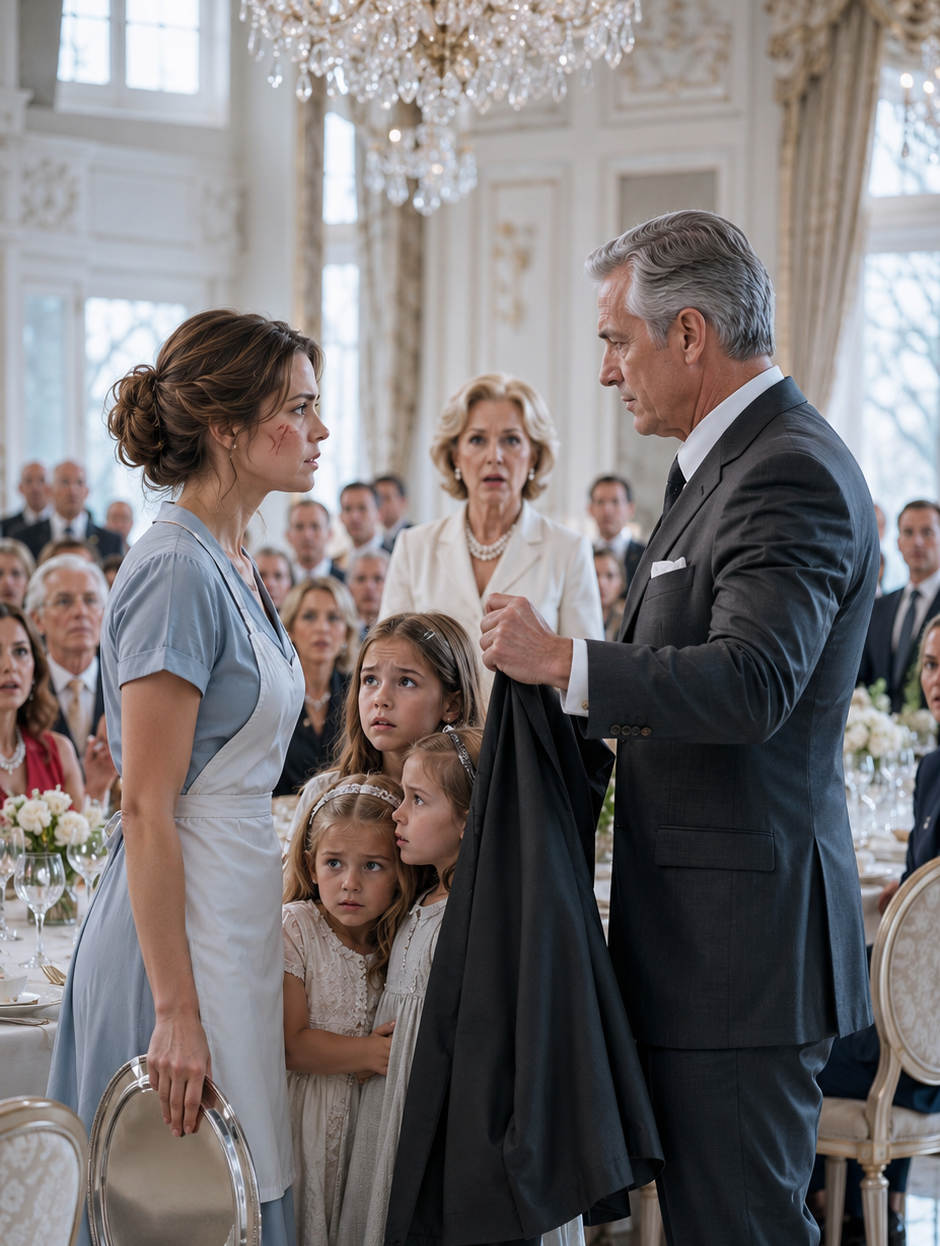
“You and your daughters are leaving with me.”
Richard Bennett’s voice carried through the grand dining room with a calmness that made the air feel colder.
Margaret Whitmore went still.
For one second, only one, the mask she had worn for decades slipped from her face.
Beneath the pearls, beneath the silk blouse and the perfect silver hair, there was something sharp and frightened.
Then she laughed.
A soft, elegant laugh meant for audiences.
“Richard,” she said, “you misunderstand.
Emily is unstable.
She has been unstable since Michael died.
Grief does strange things to women.”
I looked at the forty donors seated around the long polished table.
Some dropped their eyes to their napkins.
Some stared at their untouched plates.
A few looked genuinely uncomfortable, but not one of them stood.
That was what I remembered most clearly: the silence of people who had come to fund a foundation for abused women while watching one bleed in front of them.
Richard turned to me.
“Where are your daughters?”
“Upstairs,” I whispered.
“In the west guest room.
She locked them in.”
A murmur spread around the table.
Margaret’s face tightened.
“For their own safety.
They were being noisy.”
Richard moved toward the door.
Two security guards stepped in front of him.
They were both large men in dark suits, hired for events, loyal to whoever paid the invoice.
One reached a hand toward Richard’s shoulder.
Richard did not raise his voice.
“Touch me,” he said, “and by sunset your company will lose every contract connected to Bennett Medical Group.”
The guard’s hand stopped midair.
Richard walked past them as though they were furniture.
I followed, clutching the edge of my apron with trembling fingers.
My cheek burned.
My lip pulsed.
Behind me, Margaret’s heels struck the marble floor in furious little clicks.
“This is kidnapping,” she hissed.
“Those children are Whitmores.”
“They’re Carters,” I said, surprising myself with the force in my voice.
“Their father was a Whitmore.
They belong to me.”
Margaret grabbed my arm hard enough to make me gasp.
Richard turned.
“Let her go.”
Margaret released me, but her nails left crescent marks in my skin.
We climbed the curved staircase, past portraits of Whitmore men staring down from gilded frames.
There was Michael’s grandfather, stern and cold.
His father, smiling like a politician.
Michael himself in a navy suit, painted the year before he died.
I could not look at his eyes.
At the end of the hallway, Richard stopped before the west guest room.
The door was locked.
“Open it,” he said.
Margaret lifted her chin.
“I don’t have the key.”
I stared at her.
She was lying.
She always kept every key on the gold chain at her waist.
Richard looked at the nearest guard.
“Break it.”
The guard hesitated.
Richard’s gaze did not move.
“Now.”
The guard drove his shoulder into the door.
Once.
Twice.
On the third strike, the frame splintered and the door swung open.
My daughters were huddled together beside the bed.
Olivia had her arms around Grace and Lily.
Grace’s cheeks were wet.
Lily was asleep against her sister’s lap, her small thumb pressed to her mouth.
When Olivia saw me, she scrambled to her feet.
“Mommy!”
I dropped to my knees as all three girls ran into my arms.
I held them so tightly they squeaked, but none of them pulled away.
“I’m here,” I whispered into their hair.
“I’m here.
I’m sorry.
I’m so sorry.”
Grace touched my lip.
“Grandmother hurt you again?”
No one in the hallway spoke.
Richard’s expression changed when he heard that word.
Again.
Margaret recovered quickly.
“Children exaggerate.
Emily fills their heads with drama.”
Olivia turned toward her grandmother.
“No, she doesn’t,” she said.
Her voice was small, but steady.
Margaret’s eyes narrowed.
“Olivia.”
My oldest daughter stepped closer to me.
“You said Mommy should be grateful we weren’t boys because boys would have been worth keeping.”
The hallway seemed to shrink around us.
For once, Margaret had no reply.
Richard removed his jacket.
It was dark wool, expensive and warm, still carrying the faint scent of cedar and rain.
He crouched and wrapped it around my daughters’ shoulders, covering their thin cotton dresses and the old bruises on Grace’s arm from when Margaret had yanked her away from the piano.
“They’re coming home with me,” he said.
Margaret’s mouth twisted.
“You have no legal right.”
“Then call the police,” Richard replied.
“Please.”
She didn’t.
That was the first crack in the wall.
Richard carried Lily downstairs himself.
Olivia held my right hand.
Grace held my left.
As we descended, the donors watched us like a scene from a play whose ending had suddenly turned dangerous.
At the bottom of the stairs, one woman stood.
Her name was Helen Pryce, I later learned.
She owned three hotels and had donated to Margaret’s foundation for years.
“Emily,” she said carefully, “do you need help?”
I wanted to answer.
I wanted to tell her everything.
The storage room.
The unpaid labor.
The locked pantry.
The threaTS. The documents Margaret made me sign after Michael died when I could barely remember my own name.
But my throat closed.
Richard answered for me.
“She needs witnesses.”
Helen looked at Margaret, then back at me.
“I saw what happened in the dining room,” Helen said.
“I will give a statement.”
One by one, others stood.
Not all of them.
Some still chose their polished silence.
But enough.
Margaret’s face turned pale.
Richard’s driver brought the car around, a black Bentley that looked absurd against my daughters’ scuffed shoes and my stained apron.
Before I stepped outside, Margaret caught my wrist one last time.
Her voice dropped so only I could hear.
“You think he’s saving you? Men like Richard Bennett don’t save women like you.
They collect broken things until they bore him.”
I looked at her hand on my wrist.
Then I pulled free.
For the first time in six years, I walked out of the Whitmore estate without asking permission.
Richard’s home was not what I expected.
I imagined another mansion filled with cold marble and silent staff.
Instead, his house sat behind tall iron gates on a wooded property overlooking the water.
It was large, yes, but quiet in a different way.
The kind of quiet that belonged to libraries, rain, and old grief.
A housekeeper named Mrs. Alvarez met us at the door.
She took one look at my daughters wrapped in Richard’s jacket and pressed her hand to her mouth.
“Prepare the blue rooms,” Richard said.
“And call Dr. Mehta.
Tell her it’s urgent but private.”
Mrs. Alvarez nodded, then knelt before the girls with a warmth that nearly broke me.
“Would you like hot chocolate?” she asked.
Lily peeked from under the jacket.
“With marshmallows?”
“With too many marshmallows,” Mrs. Alvarez said.
That was when Lily smiled.
A tiny, cautious smile.
And I turned my face away so my daughters wouldn’t see me cry.
Dr. Mehta arrived within the hour.
She examined the girls first, then me.
She documented every bruise, every mark, every old scar I had hidden under sleeves and silence.
When she touched the swelling on my cheek, her eyes met mine with a question she did not ask aloud.
How long?
I looked down.
Too long.
That evening, Richard’s attorney arrived.
Her name was Cassandra Vale, and she had the focused, dangerous calm of a woman who enjoyed destroying people with paperwork.
She sat across from me in Richard’s study while my daughters slept upstairs for the first time in clean beds.
“I need to ask difficult questions,” Cassandra said.
I nodded.
She opened a leather notebook.
“After your husband died, did Margaret Whitmore present you with documents to sign?”
“Yes.”
“Did you have independent legal counsel?”
“No.”
“Were you told what the documents meant?”
“She said Michael had debTS. She said if I didn’t sign, creditors would take everything and the girls would end up in state care.”
Cassandra’s pen paused.
Richard stood near the window, facing the dark glass.
“What did you sign?” she asked.
“I don’t know.
She said it transferred the townhouse temporarily.
She said she would manage the insurance payout to settle debTS.”
“How much was the life insurance?”
“Two million dollars.”
Richard turned.
Cassandra’s expression sharpened.
“And you received none of it?”
I shook my head.
“Do you have copies?”
“Margaret kept everything.”
Cassandra smiled, but there was no kindness in it.
“Of course she did.”
For three days, the world outside Richard’s gates roared.
News leaked from the luncheon before Margaret could control it.
Someone had filmed the slap.
Someone else had recorded Olivia saying what her grandmother had told her.
By the second morning, the Whitmore Foundation’s website had gone dark.
Donors withdrew.
Sponsors demanded audiTS. Reporters gathered outside the estate gates in Greenwich.
Margaret released a statement.
It described me as emotionally disturbed, financially irresponsible, and cruelly manipulative.
She claimed Richard had been “misled by a grieving widow seeking attention.”
Then she made her first mistake.
She filed for emergency custody of my daughters.
According to her petition, I had abandoned the girls, lived without income, and displayed signs of mental instability.
She claimed the Whitmore estate was their rightful home and that she alone could preserve their father’s legacy.
When Cassandra read the filing aloud, my hands went numb.
“She can’t take them,” I whispered.
“She can try,” Cassandra said.
Richard was silent for a long moment.
Then he asked, “What does she fear most?”
Cassandra looked at him.
“Discovery.”
The court hearing took place on a rainy Thursday morning.
I wore a navy dress Mrs. Alvarez had bought for me.
Olivia, Grace, and Lily stayed at Richard’s home with Dr. Mehta and a child therapist.
I hated leaving them, but Cassandra said the judge didn’t need Margaret turning them into props.
Margaret arrived in black Chanel and pearls, surrounded by attorneys.
She looked like a grieving matriarch from a magazine cover.
I looked like what I was: a woman trying not to fall apart.
The judge listened while Margaret’s attorney painted a picture of sacrifice.
Margaret had provided shelter.
Margaret had managed family affairs.
Margaret had endured my “episodes.”
Then Cassandra stood.
She did not raise her voice.
She simply placed photographs on the screen.
The storage room beside the laundry.
Three thin mattresses on the floor.
A plastic bin of children’s clothes.
A lock installed on the outside of the door.
The courtroom shifted.
Margaret’s attorney objected.
The judge overruled him.
Then Cassandra played the video from the luncheon.
The slap echoed through the courtroom speakers.
I flinched even though I knew it was coming.
On the screen, Margaret’s voice rang clear.
Three daughters are useless when it comes to carrying on a family name.
The judge removed her glasses.
Margaret sat perfectly still.
But her fingers gripped her handbag so tightly her knuckles whitened.
Cassandra then presented Dr. Mehta’s report.
Helen Pryce’s sworn statement.
Testimony from two former Whitmore housekeepers who had seen Margaret lock the pantry, withhold my mail, and force me to work during fevers.
By the time Cassandra finished, Margaret’s custody petition had become something else entirely.
A confession she had accidentally invited into the room.
The judge denied her request before lunch.
Temporary protective orders followed.
Margaret was forbidden from contacting me or my daughters.
For the first time since Michael died, the law said what no one else had dared to say.
We were not hers.
Outside the courthouse, cameras flashed.
“Emily, did Margaret Whitmore abuse you?”
“Are you suing the foundation?”
“Is Richard Bennett supporting you financially?”
“Are you and Mr. Bennett involved?”
The last question made me freeze.
Richard stepped beside me, shielding me from the crush of reporters.
“Mrs. Carter and her daughters are under my protection,” he said.
“That is all.”
His words were controlled.
But his hand hovered near my back, never touching unless I leaned first.
That was Richard Bennett.
He could command boardrooms, silence attorneys, and terrify security guards, but with my daughters he knocked before entering rooms.
With me, he asked before offering help.
He seemed to understand that after years of being handled like an object, even kindness could feel like another kind of cage if it came without permission.
That night, Olivia found him in the library.
I watched from the doorway as she stood before his chair in her pajamas, Richard’s jacket folded in her arms.
“I washed it,” she said.
Mrs. Alvarez had washed it, but Richard accepted the explanation solemnly.
“Thank you.”
Olivia hesitated.
“Are you going to send us back?”
“No.”
“Even if Grandmother says bad things?”
“No.”
“Even if people believe her?”
Richard closed the book in his lap.
“When I was ten,” he said, “people believed lies about my mother because the truth made them uncomfortable.”
Olivia blinked.
“What truth?”
He looked toward the rain-dark window.
“That she asked for help before she died, and no one wanted to get involved.”
Olivia sat slowly on the edge of the rug.
“Is that why you helped us?”
Richard’s face remained composed, but his voice changed.
“Yes.”
I stepped away before they saw me.
Some conversations belonged to the wounded.
A week later, Cassandra uncovered the first document.
It was not from Margaret’s files.
It came from Michael’s old accountant, a nervous man named Paul Deveraux who called after seeing the luncheon video.
He had kept copies, he said.
For protection.
He insisted he had always felt “uneasy” about the way Margaret handled things.
Cassandra invited him to Richard’s house.
He arrived sweating through his collar and carrying a gray folder.
Inside were financial statements, insurance records, property transfers, and a letter.
Michael’s letter.
My hands shook when Cassandra gave it to me.
The envelope had my name on it in Michael’s handwriting.
Emily.
I could barely breathe.
Richard stood by the fireplace, silent as stone.
I opened it.
My dearest Em,
If you are reading this, something has happened to me, and my mother has done exactly what I feared she might do.
I know you will want to believe the best of her because that is who you are.
Do not.
Take the girls and leave the estate immediately.
The townhouse is in a trust for you and the children.
The life insurance is yours.
There are no debts large enough to threaten you.
I have enclosed the name of an attorney I trust.
Not Mother’s attorneys.
Yours.
I should have told you more.
I should have protected you better.
I thought I had time.
Forgive me.
All my love,
Michael
The paper blurred.
For six years, I had lived beside laundry machines because Margaret told me my husband had left me nothing.
But Michael had tried to protect us.
Margaret had buried his warning with his body.
Paul Deveraux wiped his forehead.
“There’s more,” he said.
Cassandra looked up.
Paul swallowed.
“The trust was dissolved using Emily’s signature.
But I don’t think she signed it.”
Cassandra took the papers.
My forged signature stared back at me.
Emily Carter Whitmore.
The letters were too smooth.
Too controlled.
Whoever had written them had never held a sleeping child on one hip while signing school forms with the other hand.
“That’s not mine,” I said.
“I know,” Cassandra replied.
Paul looked toward Richard, then quickly away.
“There’s something else,” he whispered.
Richard’s eyes narrowed.
Paul opened the folder’s back pocket and removed a flash drive.
“Michael came to me two weeks before the accident.
He said he had found irregularities in the foundation accounTS. Large transfers disguised as vendor paymenTS. Money meant for shelters and legal aid was being moved offshore.”
Margaret’s foundation.
The abused women’s charity.
My stomach turned.
“Michael was going to report her,” Paul said.
“He asked me to make copies.
Then he died.”
The room went silent.
Cassandra’s voice became very soft.
“Why didn’t you come forward?”
Paul’s face crumpled.
“Because Mrs. Whitmore told me she knew where my son went to school.”
No one spoke after that.
Not for a long time.
That night, I dreamed of Michael’s car.
Rain on the windshield.
HeadlighTS.
A road slick with black water.
I woke before impact, gasping.
Richard was in the hallway when I opened the door.
Fully dressed, as if he hadn’t slept either.
“I heard you,” he said.
I wrapped my arms around myself.
“Do you think his accident wasn’t an accident?”
Richard did not answer quickly.
That was answer enough.
The investigation began quietly.
Cassandra sent the documents to a forensic accountant.
Richard contacted a retired federal investigator who owed him a favor.
Paul Deveraux entered protective custody after receiving a message with only three words:
You talked, Paul.
Margaret, meanwhile, vanished from public view.
Her attorneys denied everything.
They claimed the video had been taken out of context, the signatures were legitimate, and Michael had been distraught before his death.
Then, on the twelfth day after we left the estate, a package arrived for me.
No return address.
Inside was a small velvet pouch.
My mother’s necklace.
The gold locket Margaret had taken from me the week after Michael’s funeral.
I pressed it to my lips, sobbing so hard I could not stand.
But beneath the necklace was a photograph.
It showed my daughters sleeping in Richard’s blue room.
Taken through the window.
On the back, written in elegant black ink, were the words:
You cannot watch them forever.
Richard read it once.
Then the house changed.
Security doubled.
Curtains stayed closed.
The girls were moved to interior rooms.
Richard’s calm became something colder and more dangerous.
But Margaret had made another mistake.
She had reminded me that fear had never saved us.
Only truth had.
The next morning, I asked Cassandra to arrange a press conference.
Richard opposed it immediately.
“No.”
I looked at him across the breakfast table.
“You don’t get to decide.”
His jaw tightened.
For a moment, the old terror rose in me.
The expectation of anger.
Punishment.
A hand grabbing my wrist.
But Richard only stepped back.
“You’re right,” he said.
Those two words nearly undid me.
At noon, I stood before reporters outside Cassandra’s office.
My knees shook.
My voice did too at first.
Then I saw Olivia standing behind the glass doors with Grace and Lily, all three holding Mrs. Alvarez’s hands.
I spoke louder.
“My name is Emily Carter.
For six years, Margaret Whitmore told the world she was protecting abused women while abusing one inside her own home.
She took my property, my husband’s insurance, my mother’s jewelry, and my daughters’ childhood.
She told me I was worthless because I had no son.”
Camera shutters clicked.
I held up Michael’s letter.
“My husband left protections for us.
Those protections were stolen.
His signature, my signature, and the purpose of his foundation are now part of an active investigation.”
A reporter shouted, “Are you accusing Margaret Whitmore of involvement in Michael Whitmore’s death?”
Cassandra leaned toward me, ready to stop the question.
But I answered.
“I’m accusing her of being afraid of what he knew.”
That sentence aired on every major network by evening.
At 8:17 p.m., Margaret called.
The protective order forbade it, but she called from an unknown number.
Richard wanted Cassandra to answer.
I took the phone myself.
For three seconds, there was only breathing.
Then Margaret spoke.
“You always were more theatrical than intelligent.”
I said nothing.
“You think Michael loved you because he left a letter? Sweet girl, Michael loved peace.
He would have signed anything to avoid conflict.”
My hand tightened around the phone.
“He was going to expose you.”
Margaret laughed quietly.
“Michael was weak.”
“Was?”
Silence.
It lasted less than a second, but I heard it.
So did Richard.
Margaret’s voice returned, smooth as polished glass.
“You should be careful, Emily.
Men who rescue women often expect repayment.”
I looked through the open library door.
Richard stood with Cassandra, watching me but not interrupting.
Letting me choose every word.
“No,” I said.
“That’s what people like you expect.”
I ended the call.
Cassandra immediately traced what she could, but the number had already gone dark.
Still, the call had given us something.
Margaret had spoken of Michael in the past tense in a way that felt too practiced, too intimate with finality.
Two days later, the retired investigator found the mechanic.
His name was Andre Bell, and six years ago he had worked at the garage that serviced Michael’s car before the crash.
After the accident, he moved to Arizona and bought a house he should not have been able to afford.
At first, he denied everything.
Then Richard’s investigator showed him the offshore transfers.
One payment from a shell company tied to the Whitmore Foundation.
One payment dated three days before Michael’s death.
One payment dated the morning after.
Andre broke.
His statement was sealed immediately.
Cassandra would not let me read all of it, not yet.
She only told me the part I needed to know.
Michael’s brake line had been tampered with.
The room tilted when she said it.
I did not faint.
I did not scream.
I thought of Michael’s letter.
I thought of six years stolen.
Then I walked upstairs, climbed into bed between my daughters, and held them until morning.
The arrest happened at dawn.
Margaret Whitmore was taken from the Greenwich estate in a cream silk robe, her silver hair unpinned, her face bare before the cameras she had once controlled.
I watched it live on Richard’s television.
Olivia sat beside me, her hand in mine.
“Is she gone?” Grace asked.
I turned off the screen.
“For now,” I said.
But something inside me did not relax.
By afternoon, the headlines were everywhere.
Foundation Fraud.
Forged Trust DocumenTS. Billionaire Donor Exposes Charity Queen.
Suspicion Reopened in Whitmore Heir’s Fatal Crash.
People who had once praised Margaret now rushed to condemn her.
Helen Pryce called to apologize.
Former donors sent flowers.
Women from shelters funded by the Whitmore Foundation sent letters, some angry, some grateful, all stunned.
Richard placed every bouquet in the hallway until Lily sneezed and Mrs. Alvarez banished them to the greenhouse.
For one fragile evening, the house felt almost peaceful.
The girls made pancakes for dinner.
Richard allowed Lily to pour syrup on his plate until it became a lake.
Grace played a simple song on the piano, her fingers hesitant at first, then stronger.
Olivia fell asleep in the library with Richard’s jacket over her knees.
I stood in the doorway, watching them.
Richard came beside me.
“They trust you,” I said.
“They trust safety,” he replied.
“I’m just nearby.”
I looked at him then.
Really looked.
At the tiredness beneath his eyes.
At the loneliness he wore like an old coat.
At the man who had not tried to own my gratitude.
“Thank you,” I said.
He looked away first.
 Father Banned His Ex\'s Abusive Partner From Their Daughter\'s Funeral, Despite Her Demanding He Attend
“You don’t owe me that.”
“I know,” I said.
“That’s why I can say it.”
Something unspoken settled between us.
Not romance.
Not yet.
Something quieter.
The first plank of a bridge neither of us was ready to cross.
Then Cassandra arrived.
It was nearly midnight.
She came through the front door without removing her coat, rain shining on her shoulders.
Richard saw her face and stood.
“What happened?”
Cassandra looked at me.
“Margaret made bail.”
The floor seemed to vanish.
“How?” I asked.
“The charges are serious, but her attorneys moved fast.
She surrendered her passport, posted bond, and agreed to house arrest.”
Richard’s voice turned icy.
“At the estate?”
“No.” Cassandra swallowed.
“At her sister’s property in Westchester.”
I knew before she finished that there was more.
“What aren’t you saying?”
Cassandra opened her briefcase and removed a sealed evidence bag.
Inside was a copy of Michael’s letter.
Not the one I had received.
Another copy.
This one had additional writing at the bottom.
A postscript.
Cassandra placed it on the table.
My eyes found Michael’s handwriting.
P.S.
If anything happens to me, do not trust Richard Bennett until you know why my mother feared him.
The room went utterly silent.
I turned to Richard.
For the first time since I had met him, his face had lost all color.
“What does that mean?” I whispered.
Richard did not answer.
Outside, thunder rolled over the dark water.
Then his phone rang.
He looked at the screen, and something in his expression hardened.
Cassandra stepped closer.
“Richard?”
He answered without putting it on speaker.
I heard only a woman’s voice, faint and distorted.
Then Richard closed his eyes.
When he opened them again, he looked not at Cassandra, but at me.
“Margaret escaped house arrest twenty minutes ago,” he said.
My breath stopped.
His phone buzzed again.
This time, it was a message.
Three words.
Not from Margaret.
From Michael’s old number, inactive for six years.
Protect the girls.
Part 3 — The Door Margaret Forgot Could Break
The room did not breathe again until Richard Bennett moved.
He walked past Margaret as if she were furniture, climbed the sweeping staircase two steps at a time, and called over his shoulder, “Where are the children?”
Margaret’s smile hardened.
“You are overstepping.”
“No,” Richard said, stopping halfway up.
His voice was quiet, but somehow it reached every corner of the mansion. “You locked three little girls in a bedroom during a charity luncheon for abused women.
I am finally stepping exactly where I should have stepped years ago.”
My knees weakened.
For six years, Margaret Whitmore’s word had been law inside that house.
Servants lowered their eyes.
Lawyers returned my calls through secretaries.
Guests smiled politely at bruises they pretended were shadows.
But Richard did not lower his eyes.
He reached the guest hallway and found the locked door by the sound of Lily crying behind it.
“Open it,” he ordered.
Margaret appeared below him, breathing fast now.
“Those children are dramatic.
Emily teaches them to perform.”
Inside the room, Olivia shouted, “Mommy?”
The single word split something in me.
I ran upstairs, but a security guard stepped in front of me.
Richard turned so sharply the man stepped back without being touched.
“Move,” Richard said.
The guard moved.
Margaret refused to hand over the key.
“This is my house.”
Richard looked at the brass lock, then at me.
“Cover your ears.”
I covered mine.
Grace and Lily screamed on the other side.
Richard drove his shoulder into the door once.
The wood cracked.
Twice.
The frame splintered.
On the third blow, the door burst inward, and there they were—my three daughters huddled beneath a silk bedspread like abandoned kittens, barefoot, pale, and shaking.
Lily crawled toward me first.
Grace followed, sobbing into my waist.
Olivia stood frozen, trying to be brave at eight years old, her little chin trembling so hard it broke me.
Richard removed his tailored black jacket and wrapped it around all three of them.
Then he looked down at Olivia and said, “You are not disappointmenTS. Not one of you.”
Olivia stared at him, uncertain whether kindness could be trusted.
“Are we in trouble?” she whispered.
“No,” Richard answered.
“The trouble is over there.”
He pointed toward Margaret.
By then, half the donors had gathered at the foot of the staircase.
Someone was recording on a phone.
Someone else was crying.
I saw a woman in pearls press a napkin over her mouth.
Margaret realized, perhaps for the first time, that the room was no longer hers.
“You cannot simply take them,” she snapped.
“Emily has no money, no home, no legal standing.
She is unstable.”
Richard descended the stairs slowly, keeping himself between us and Margaret. “She has witnesses.
She has injuries.
She has three children who were locked in a room.”
Then he took out his phone.
“I need Greenwich police and child protective services at the Whitmore estate,” he said calmly.
“Yes.
Immediately.”
Margaret went white.
For the next twenty minutes, the mansion became something I had never seen before: not a palace, but a crime scene.
Officers photographed the broken bedroom door, the storage room beside the laundry, the thin mattress where my daughters slept, the cracked plastic drawer where we kept all our clothes.
A female officer named Denise knelt in front of Lily.
“Do you sleep here, sweetheart?”
Lily nodded and pointed at the washing machine.
“It shakes at night.”
Grace added, “Grandmother says boys get rooms.”
The officer’s jaw tightened.
Margaret tried to interrupt every answer.
Richard interrupted her only once.
“Let the children speak.”
When the police asked if I had somewhere safe to go, I opened my mouth and realized I did not.
My friends had disappeared after Michael died.
My bank account had been emptied.
My identification documents were in Margaret’s office safe.
Richard answered before shame swallowed me.
“She and the girls can stay at my guest residence.
My legal team will coordinate with the authorities.”
Margaret laughed bitterly.
“How touching.
The billionaire wants a charity case.”
Richard did not even glance at her.
But I did.
For the first time in six years, I met Margaret Whitmore’s eyes without flinching.
“No,” I said.
“I am not your charity case.
I am your witness.”
That was the moment her face changed.
Not anger.
Not disgust.
Fear.
And somehow, that frightened me most of all.
Part 4 — The Letter Hidden Behind the Laundry Wall
Richard’s guest residence was not a house.
It was a quiet stone cottage behind iron gates, surrounded by winter trees and soft yellow lights that glowed like lanterns.
The girls fell asleep in a bed so large they looked lost inside it.
Lily clutched Richard’s jacket even after he told her she could keep it for the night.
Grace slept with one hand wrapped around my sleeve.
Olivia did not sleep at all.
She watched me from the pillow.
“Mommy,” she whispered, “are we really not going back?”
I brushed hair from her face.
“Not tonight.”
“Ever?”
I wanted to promise.
I wanted to say never, never, never.
But promises had been stolen from me before.
So I kissed her forehead and said, “I will fight with everything I have.”
The next morning, Richard’s lawyers arrived before sunrise.
They spoke in low voices around the kitchen island while my daughters ate pancakes with strawberries, staring at the food as if it might disappear.
One lawyer slid papers toward me.
“Mrs. Carter, we need to recover your personal documents from the estate.
The police can escort you.”
The thought of returning made my stomach twist.
But Olivia suddenly looked up.
“Mom,” she said, “we have to get Daddy’s box.”
My breath stopped.
“What box?”
She lowered her voice.
“Daddy told me not to tell unless the washing room became scary.”
Richard looked at her gently.
“Where is it, Olivia?”
“In the wall,” she whispered.
“Behind the dryer.”
Two hours later, with officers present, I stood once more in that narrow laundry room where my daughters and I had spent six years breathing bleach and dust.
The dryer was pulled away.
Behind it, hidden beneath a loose panel, was a metal box wrapped in old towels.
My hands shook so badly Richard had to steady the lid while I opened it.
Inside lay a sealed envelope, a flash drive, a small velvet pouch, and a letter written in Michael’s hand.
My name was on the front.
Emily.
My love, if you are reading this, then my mother has done what I feared she would do.
The room blurred.
Richard stood near the door, silent.
I read the letter aloud because if I did not, I thought I might collapse.
Michael wrote that there were no debTS. None.
The townhouse had been paid off.
His life insurance had been placed in a trust for me and the girls.
The Whitmore Foundation accounts were full of false invoices, shell companies, and missing donations.
Then came the line that made my blood turn cold.
“If anything happens to me before I can expose her, do not believe the accident was simple.”
I pressed the paper to my chest.
Margaret had told me Michael died instantly.
She said the body was too damaged for me to see.
She arranged the funeral.
She controlled everything.
The velvet pouch contained my mother’s jewelry—the sapphire earrings Margaret claimed had been “sold for Michael’s debTS.”
Underneath was another folded page.
This one was addressed to our daughters.
“Olivia, Grace, Lily—my three miracles.
If anyone ever tells you a family name requires a son, remember this: a name survives through love, courage, and truth.
You are my legacy.”
Olivia began to cry without making a sound.
Richard turned away, but not before I saw his expression.
It was not pity.
It was recognition.
“You knew him,” I said.
Richard was quiet for a long moment.
Then he nodded.
“Michael contacted me three weeks before the crash.
He said he had evidence Margaret was stealing from abused women through the foundation.
He wanted my help shutting it down quietly before donors were humiliated.”
My voice shook.
“Why didn’t you tell me?”
“Because after the accident, Margaret told everyone you had suffered a breakdown.
She claimed you blamed people for Michael’s death.” His jaw tightened.
“I believed there might be more to the story, but I let lawyers handle it.
That was my mistake.”
He looked at the letter in my hands.
“And I am going to correct it.”
Part 5 — The Billionaire’s Old Wound
That evening, Richard showed me the truth behind his cold reputation.
We sat in the cottage library while rain tapped against the windows.
My daughters slept upstairs under clean blankets, with nightlights glowing beside every bed because darkness still made Lily cry.
Richard placed a worn photograph on the table.
A young woman stood outside a hospital, smiling weakly.
She had Richard’s eyes.
“My mother,” he said.
“Anna Bennett.”
I studied the picture.
“She was beautiful.”
“She was poor,” he replied.
“And desperate.
When I was seven, she went to the Whitmore Foundation for help escaping my father.
Margaret promised shelter, legal aid, protection.”
His mouth tightened.
“Instead, Margaret used her story at fundraising dinners.
My mother never received the money raised in her name.”
My heart sank.
“What happened to her?”
“She survived,” he said, surprising me.
“Barely.
A nurse helped us disappear.
That nurse became the reason I built hospitals.” He looked toward the rain-dark windows. “But my mother spent the rest of her life believing powerful people could sell a woman’s pain and call it charity.”
For years, Richard had donated to the Whitmore Foundation because Margaret convinced him the organization had changed.
Michael’s call had raised his suspicions again.
The flash drive confirmed everything.
Richard’s forensic accountants worked through the night.
By morning, they had traced foundation funds to private renovations, luxury travel, fake consulting firms, and accounts controlled by Margaret.
But the cruelest discovery was personal.
Michael’s life insurance had not vanished.
Margaret had forged my signature and transferred the funds into an account labeled “household reimbursement.”
My townhouse had been transferred the same way.
My daughters’ trust had been buried under fraudulent paperwork.
Richard’s lead attorney, Clara Monroe, looked at me across the table.
“Emily, your mother-in-law did not just abuse you.
She robbed you.
She robbed your children.
And judging by these documents, she may have obstructed the investigation into Michael’s crash.”
The word “crash” made Olivia appear in the doorway.
She had heard enough to understand.
“Did Grandma hurt Daddy?” she asked.
The room fell silent.
I stood, but my legs felt hollow.
Richard knelt so he was eye level with her.
“We don’t know yet.
But we are going to find the truth.”
Olivia looked at him for a long time.
Then she reached into her pajama pocket and pulled out something small.
“I kept this,” she said.
It was a silver key.
“Daddy gave it to me before his trip.
He said if the grown-ups got confused, I should remember the blue door.”
My hands covered my mouth.
Richard turned to Clara.
“What blue door?”
Clara checked the inventory from the Whitmore estate.
“There is no blue door listed.”
Olivia shook her head.
“Not there.
At Daddy’s office.
Behind the books.”
Michael had not trusted only one hiding place.
By noon, police obtained access to his old private office downtown.
Behind a wall of legal books was a narrow blue-painted door leading to a storage room.
Inside were boxes of files, recordings, bank statements, and one locked cabinet opened by Olivia’s key.
At the back of the cabinet was a hospital bracelet.
The name printed on it was not Michael Whitmore.
It read: Matthew Weller.
Admitted October 18.
Male.
Unidentified trauma patient.
Michael’s accident had happened October 18.
Richard stared at the bracelet as if the room had tilted beneath him.
Then he said words that changed everything.
“Emily… this hospital was one of mine.”
Part 6 — The Dead Man in Room 417
Richard did not sleep for thirty-six hours.
His hospital network spanned five states, but old records had been archived, renamed, transferred, and hidden under layers of bureaucracy.
The patient listed as Matthew Weller had been admitted the night of Michael’s crash with severe head trauma, facial injuries, and no identification.
Three days later, he had been transferred to a private long-term neurological facility.
The payment source was a Whitmore-linked account.
Margaret’s account.
I refused to believe it at first.
Hope was too dangerous.
Hope could be another room with a locked door.
But when Clara found a transfer note signed by Margaret’s personal physician, my hands went numb.
Richard drove us to the facility himself.
Snow began falling halfway there, soft and silent over the windshield.
The building sat at the edge of a wooded road, clean and expensive and terrifying.
A nurse led us down a corridor that smelled of antiseptic and lavender.
Room 417.
She opened the door.
A man sat by the window in a wheelchair, thinner than memory, his dark hair streaked with gray, his hands folded over a blanket.
For six years, I had carried his death like a stone inside my chest.
Then he turned his head.
And Michael looked at me.
Not fully.
Not the way he once had.
His eyes were clouded with confusion, his face marked by old scars, his body weakened by years stolen from him.
But it was him.
My knees gave out.
Richard caught me before I hit the floor.
“Michael,” I whispered.
The man by the window blinked.
His lips moved.
No sound came.
I crawled toward him because standing felt impossible.
“Michael, it’s Emily.”
His fingers twitched.
Then his eyes filled with tears.
He lifted one shaking hand and touched my hair like he was afraid I might vanish.
“Em…” he breathed.
The sound broke me.
I sobbed against his knees, and when Olivia, Grace, and Lily entered the room, Michael stared at them with wonder so raw it seemed almost holy.
Olivia stepped forward first.
“Daddy?”
Michael’s face crumpled.
He could not speak their names at first.
His mind had been damaged.
His memories came like torn pages in the wind.
But when Lily climbed into his lap, he wrapped both arms around her with sudden strength.
“My girls,” he whispered.
“My girls.”
Richard stood in the doorway, one hand braced against the frame.
Clara was already calling the police.
The facility director claimed Margaret had presented legal authority.
She had said Michael was a distant relative with no surviving immediate family.
She had paid for privacy.
She had forbidden visitors.
Margaret had not killed her son.
She had buried him alive in paperwork.
And she had buried me beside the laundry machines to keep me from asking questions.
That night, Margaret Whitmore was arrested in the same marble foyer where she had slapped me.
The news crews caught her shouting that everything she had done was “for the family name.”
But the family name was already upstairs in a hospital room, learning to say Lily again.
Part 7 — The Trial Where the Girls Took the Name Back
Margaret’s trial became the kind of scandal wealthy families fear most: one with documents, witnesses, recordings, and children who remembered too much.
She arrived every day in tailored suits, pearls at her throat, chin high.
I arrived with my daughters’ hands in mine.
Michael could not attend every session.
Recovery was slow.
Some mornings, he remembered everything.
Other mornings, he woke believing only weeks had passed since the accident.
But on the day I testified, he insisted on coming.
Richard wheeled him into court himself.
Margaret saw him and lost every trace of color.
For a moment, she looked not like a queen, but like an old woman surrounded by the ruins of her own lies.
The prosecutor played recordings from Michael’s hidden files.
Margaret’s voice filled the courtroom.
“The donors do not need rescued women.
They need stories.
Stories bring checks.”
Then another recording.
“Emily is weak.
If Michael disappears, she will fold.”
My body trembled, but I did not look away.
When I took the stand, Margaret’s lawyer tried to paint me as greedy, unstable, resentful.
He asked why I had stayed in the Whitmore estate for six years if conditions were so terrible.
I looked at my daughters.
Then at Michael.
Then at the jury.
“Because she convinced me I had nowhere else to go,” I said. “That is how cages work.
They do not always need bars.
Sometimes they only need paperwork, shame, and children you are trying to protect.”
The courtroom went silent.
Olivia did not testify in open court.
The judge protected her from that.
But her recorded statement was played privately for the jury.
Her small voice said, “Grandma told Mommy that girls were practice children.
But Daddy said we were lanterns.”
The jury deliberated for less than four hours.
Margaret was convicted of fraud, unlawful confinement, identity falsification, embezzlement, and conspiracy connected to Michael’s disappearance.
The investigation into the crash revealed bribed officials, altered reports, and a driver paid to force Michael’s car off the road.
Margaret had not wanted him dead.
She had wanted him erased.
The sentence came on a gray morning in March.
As deputies led her away, Margaret turned toward Michael.
“I preserved what you were too weak to protect,” she hissed.
Michael stood from his wheelchair with Richard’s help.
His voice was rough, but clear.
“No,” he said. “You destroyed a house.
Emily protected a family.”
Then he looked at Olivia, Grace, and Lily.
“And my daughters will carry the Whitmore name better than any son ever could.”
Outside the courthouse, cameras flashed.
Reporters shouted questions.
Richard stepped forward, shielding the girls from the crowd.
But Olivia surprised everyone.
She lifted her chin and said, “Our name is Carter-Whitmore now.”
Grace nodded fiercely.
“Mommy’s name too.”
Lily added, “And Mr. Richard’s jacket is still ours.”
For the first time in years, I laughed until I cried.
Part 8 — The Mansion With No Locked Doors
Six months later, the Whitmore estate no longer smelled of roses and fear.
It smelled of fresh paint, cinnamon rolls, and rain through open windows.
The court returned the house, the townhouse, the insurance money, and the stolen jewelry to their rightful owners.
Michael transferred the mansion into a new trust—not for sons, not for heirs chosen by pride, but for survivors and children who needed safety.
The old Whitmore Foundation was dissolved.
In its place, Richard, Michael, and I opened The Three Lanterns House, a shelter and legal aid center for women and children escaping abuse.
The first rule was written on a brass plaque beside the front door:
No one sleeps beside the laundry.
No child is a disappointment.
No door locks from the outside.
On opening day, donors returned to the same dining room where Margaret had once slapped me.
But everything was different.
The long table was gone.
The room had been filled with round tables, children’s drawings, warm lamps, and volunteers who knew every guest by name.
The woman in pearls who had cried at the luncheon came too.
Her name was Eleanor Graves, and she had been the first donor to hand over her recording to police.
She hugged me and whispered, “I should have stood sooner.”
I squeezed her hand.
“You stood when it mattered.”
Richard gave the shortest speech of the afternoon.
He looked uncomfortable behind the podium, as always, but when he glanced at my daughters, his expression softened.
“My mother once believed help from powerful people always came with a price,” he said. “Today, this house proves help can come with a key instead.”
Michael spoke next.
His recovery had not been miraculous in the easy way people like to imagine.
He still forgot words.
He still woke some nights sweating from nightmares he could not explain.
He walked with a cane, and he tired quickly.
But when he stood before the crowd, Olivia on one side and Lily holding his hand on the other, he looked more alive than any man I had ever known.
“I spent six years missing,” he said.
“My wife spent six years surviving.
My daughters spent six years being told they were less than a son.”
He paused, looking directly at our girls.
“They were never less.
They were the light that led me home.”
Grace burst into tears first.
Then I did.
Then half the room followed.
But the final surprise came at sunset.
Richard asked us to meet him in the garden behind the estate, where three young maple trees had been planted in a row.
Beneath each tree was a small bronze marker.
Olivia — Courage.
Grace — Mercy.
Lily — Joy.
Lily crouched to touch hers.
“Is this my tree?”
Richard nodded.
“It is.”
She thought about that seriously.
“Can it have pink flowers?”
“It can have whatever flowers you plant around it.”
Michael smiled.
Then Richard handed me a final envelope.
My heart lurched.
“Not another secret.”
“Not a painful one,” he promised.
Inside was a legal document.
Richard had donated the first permanent endowment to The Three Lanterns House.
The amount was so large I had to read it three times.
But beneath the numbers was one handwritten line:
For Anna Bennett, who deserved a safe door.
For Emily Carter, who opened one.
For Olivia, Grace, and Lily, who will never again be hidden.
I looked up at him, speechless.
Richard cleared his throat.
“There is one more thing.”
From behind the maple trees came a woman in a navy coat, silver-haired and graceful, leaning on a cane.
Richard’s face changed completely.
“My mother,” he said softly.
Anna Bennett was alive.
The woman from the photograph.
The woman whose pain Margaret had once sold to donors.
The woman Richard had spent his life trying to honor.
She smiled at my daughters and opened her arms.
Lily ran first, because Lily always ran toward love once she recognized it.
Anna hugged her and looked at me over Lily’s curls.
“You carried them through the dark,” she said.
I shook my head, tears slipping down my face.
“Barely.”
Anna’s eyes shone.
“Barely is still through.”
That night, after the guests left, my family sat together on the back steps of the mansion.
Michael’s shoulder rested against mine.
Olivia leaned against his knee.
Grace counted stars.
Lily slept wrapped in Richard’s old jacket, which she now refused to return on principle.
The laundry room had been turned into a bright supply closet filled with blankets, toys, and welcome bags for new families.
The storage room where my daughters had slept was gone entirely.
Michael had knocked down the wall himself, one careful swing at a time, until nothing remained but dust and sunlight.
I thought the happy ending would be escaping Margaret.
Then I thought it would be getting justice.
Then I thought it would be finding Michael alive.
But happiness was quieter than that.
It was my daughters laughing in a house with no locked doors.
It was Michael learning Lily’s favorite song.
It was Richard sitting beside his mother beneath the maple trees.
It was my own reflection in the window—not servant, not widow, not charity case.
Mother.
Survivor.
Home.
And when Olivia looked up at me and asked, “Mommy, what does legacy mean?” I kissed the top of her head.
“It means what stays after the hurt is gone,” I said.
She considered that.
Then she smiled.
“So… us?”
I looked at my three daughters, at Michael’s hand in mine, at the lights glowing inside the mansion that had once tried to swallow us whole.
“Yes,” I whispered.
“Exactly.
Us.”