
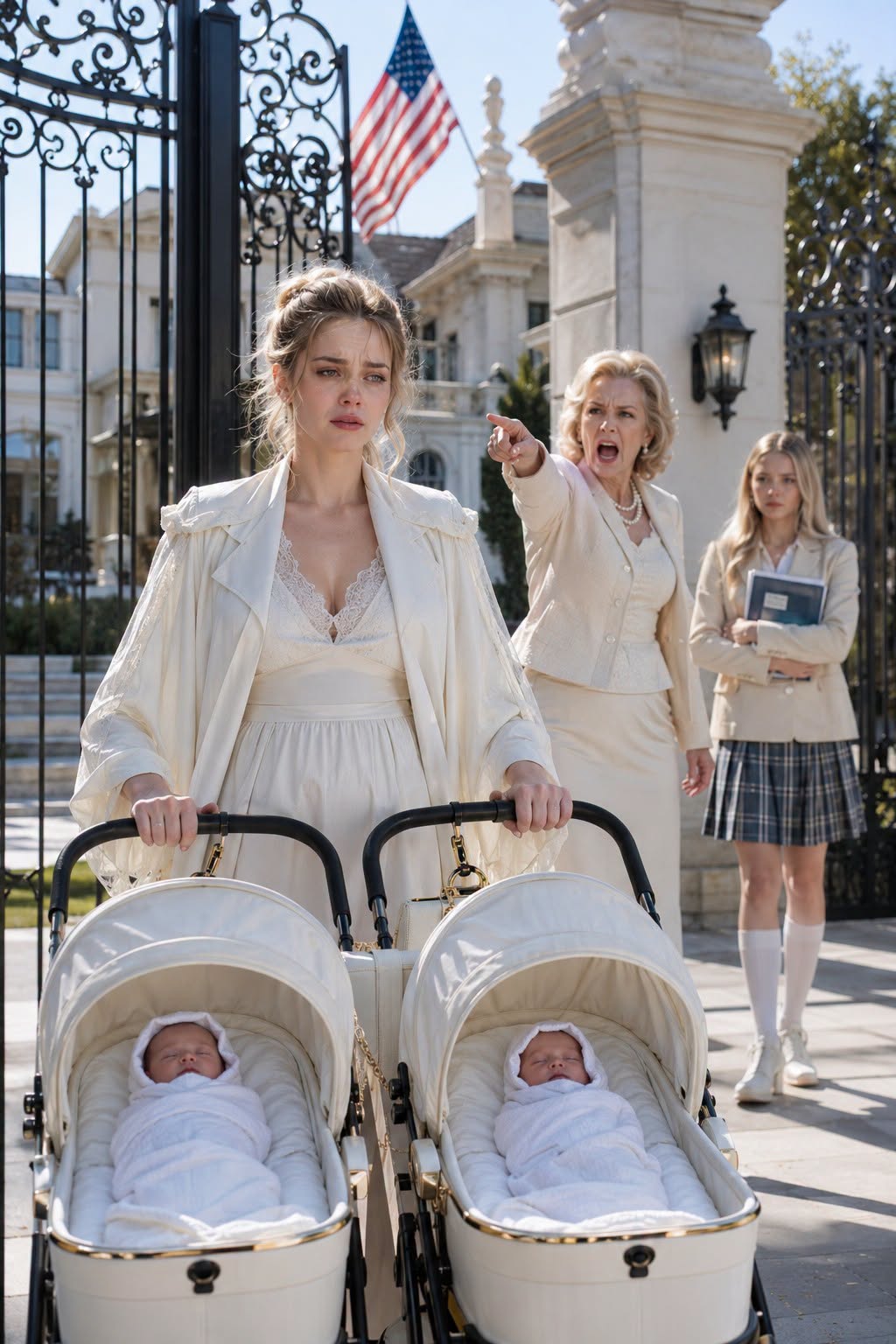
PART 2
Jenna lived in a small third-floor apartment in Wicker Park above a bakery that made cinnamon rolls every morning at six.
It had one bedroom, thin walls, a noisy radiator, and a kitchen table that wobbled if you leaned on it wrong.
It was the safest place I had been in three years.
She spread clean towels over her bed for me, turned the couch into a changing station, and put both babies in a borrowed double bassinet near the window.
Then she stood with her hands on her hips and cried again.
“I want to go back there and slap every person in that condo,” she said.
“Get in line.”
“You just had major surgery.”
“I know.
My body keeps reminding me.”
I tried to laugh, but it came out broken.
Jenna brought me chicken soup from the bakery owner downstairs, a woman named Mrs. Alvarez who took one look at my twins and sent up broth, bread, and enough ginger tea to drown a family.
I cried into the bowl.
Not because of the food.
Because someone I barely knew had shown more tenderness than the people who called themselves my family.
By noon, Jenna had called Grace Marshall, a divorce attorney she knew from a nonprofit clinic.
Grace arrived in a navy suit, carrying a laptop, a legal pad, and the calm expression of a woman who had seen too many women realize too late that love doesn’t protect bank accounTS.
She looked at the twins first.
“Five days old?” she asked softly.
I nodded.
Grace’s jaw tightened, but her voice stayed professional.
“Then we’ll do this here.
You stay lying down.”
I handed her my blue folder.
She went through every document slowly.
The down payment contribution from my late father’s savings.
The monthly mortgage transfers from my salary as a hospital billing manager.
Receipts for appliances, nursery furniture, insurance, repairs.
“Claire,” Grace said after nearly an hour, “you have a strong claim.
Even if the deed is under Ethan’s name, the condo was acquired during the marriage, and your contribution is documented.”
Relief hit me so hard I almost closed my eyes.
Then Grace frowned.
Jenna noticed first.
“What?”
Grace turned her laptop toward me.
“There’s a lien.”
“A what?”
“A debt claim against the condo.” She scrolled.
“Actually, more than one.
Ethan used the property as collateral for a private loan.”
My incision seemed to burn from the inside.
“How much?” I asked.
Grace hesitated.
“How much, Grace?”
“Initially, sixty-eight thousand dollars.”
Jenna cursed under her breath.
I stared at the screen.
“Initially?”
Grace clicked again.
“There appears to be a secondary private contract.
I need more records to confirm, but the total exposure may be closer to one hundred and forty thousand.”
The room tilted.
I had been nursing, bleeding, vomiting through pregnancy, saving coupons on diapers, telling myself Ethan was tired because he was building our future.
Meanwhile, he had been digging a hole beneath that future and covering it with flowers.
“Did I sign anything?” I asked.
Grace went still.
“What?” Jenna said.
Grace enlarged a scanned page.
“There is a spousal consent form attached.”
My signature stared back at me.
Except I had never signed it.
My name looked almost right.
The C was too sharp.
The line under my last name was wrong.
Ethan knew that.
He had seen me sign birthday cards, mortgage papers, hospital forms.
“He forged it,” I whispered.
Jenna’s hand covered her mouth.
I called Ethan before I could talk myself out of it.
He answered on the fourth ring.
“Claire,” he said quickly.
“Are the boys okay?”
“You used our condo as collateral.”
Silence.
“You forged my signature.”
His breathing changed.
“Claire—”
“How much do you owe?”
He didn’t answer.
I looked at my sleeping sons.
Henry had one fist tucked under his chin.
Hayes made tiny sucking motions in his sleep.
They had no idea their father had risked the roof over their heads before they had even opened their eyes fully.
“How much?” I repeated.
Ethan exhaled like a man stepping off a ledge.
“About one hundred and thirty-seven thousand.”
Jenna closed her eyes.
I didn’t cry.
Maybe there was a limit to how much a body could leak in one week.
“What was it for?” I asked.
“A development deal,” he said.
“Land outside Joliet.
A friend said it would double in six monThS. I borrowed to get in.
Then it fell apart.
I borrowed again to cover interest.
Then—”
“Then you lied.”
“I was trying to fix it before you found out.”
“No,” I said.
“You were trying to protect yourself from consequences.”
He had no answer.
That evening, Ethan came to Jenna’s apartment.
Rain had soaked his shirt.
He looked smaller than the man I married, like guilt had eaten the structure out of him.
Grace was still there.
Jenna stood by the door like a guard dog in yoga panTS.
Ethan looked at me on the couch, wrapped in a blanket, one baby at each side.
“I’m sorry,” he said.
“Don’t start with sorry,” I said.
“Start with documenTS.”
He swallowed.
“My mother doesn’t know everything.”
“Does she know anything?”
He looked down.
That was answer enough.
Grace asked for loan contracts, bank statements, names of lenders, payment schedules.
Ethan gave pieces.
Not all.
Men who lie for a long time forget that truth has edges; it never comes out smooth.
Then Grace said, “Who is Nadia?”
Ethan froze.
A new kind of cold entered the room.
I looked at him.
“Who is Nadia?”
“Nobody.”
Jenna laughed once.
“That is never the answer.”
Grace slid a printed bank statement across the table.
“Seven transfers.
Twelve thousand dollars total.”
My heartbeat turned ugly.
Ethan rubbed both hands over his face.
“She handled paperwork.
She’s an intermediary.”
“For loans?” I asked.
“Yes.”
“For something else?”
His eyes flashed with panic.
“No.
Claire, no.
I swear.”
I wanted to believe him.
That was the cruel part.
The heart doesn’t stop wanting the person it loved just because the truth turns monstrous.
Later that night, an unknown number called my phone.
“Claire Whitaker?” a woman asked.
“Yes.”
“My name is Nadia Cross.
Please don’t hang up.”
I sat up despite the pain.
Jenna moved closer.
“I’m not Ethan’s lover,” Nadia said quickly.
“I processed some private loan documenTS. I know it was wrong.
But you need to understand something.
Ethan doesn’t hold the final contract.”
“Who does?”
She lowered her voice.
“A man named Victor Harland.”
The name meant nothing to me.
But when I later said it in front of Evelyn, she turned white as paper.
PART 3
The next morning, my fever started.
At first, I blamed the stress.
Then chills rolled down my back so violently my teeth clicked.
My breasts felt hard and hot.
Hayes refused to latch, screamed for three minutes, then went limp with exhaustion against my chest.
His skin looked yellow in the weak morning light.
Jenna, who had worked as an ER nurse before becoming a school nurse, took one look at him and grabbed the diaper bag.
“Hospital.
Now.”
“I can’t go back out.”
“You can and you will.”
“I can barely stand.”
“Then lean on me.”
At Northwestern Memorial, the waiting room smelled like disinfectant, coffee, and fear.
Other women sat with husbands holding diaper bags, mothers adjusting baby blankets, fathers rocking car seats with red-eyed tenderness.
I looked away.
The doctor confirmed what Jenna suspected.
Hayes had elevated bilirubin and needed phototherapy.
I had blocked ducts and a low fever edging toward mastitis.
“You need rest,” the doctor said, reading my chart.
“Real rest.
Physical and emotional.”
I almost laughed.
Ethan arrived around nine with wet hair and a face full of panic.
“Where are they?” he asked.
“Hayes is under the lighTS. Henry is sleeping.”
He reached for my shoulder.
I stepped back.
His hand stopped midair.
“Wash your hands before you touch either of them,” I said.
He nodded without arguing and went to the sink.
Jenna leaned toward me.
“Good.”
Minutes later, Evelyn stormed into the hallway carrying a tote bag and outrage.
Madison trailed behind her, pale and silent.
“What happened?” Evelyn demanded.
“Why did no one call me first?”
“Because no one had time to manage your feelings,” Jenna said.
Evelyn ignored her.
“Claire, this is exactly why you should have stayed with family instead of running to some tiny apartment.”
I stared at her.
“I was with family.
You threw me out.”
Her mouth tightened.
“Don’t twist things.”
Before I could answer, two men in dark suits appeared at the end of the hallway.
They were not loud.
They did not threaten.
That made them worse.
One carried a leather briefcase.
The other held a folder with Ethan’s name printed on the tab.
Ethan saw them and went gray.
“Mr. Bell,” the taller one said, “we represent the entity currently holding your private debt.
We need your answer regarding repayment by five p.m.”
Evelyn blinked.
“What debt?”
The man glanced at her.
“This is not the place.”
“No,” I said.
“This is exactly the place.
Because this debt came into the hospital with my sick newborn.”
People turned to look.
Ethan’s face crumpled with shame.
Evelyn grabbed his arm.
“What are they talking about?”
He said nothing.
The representative continued, “If no payment plan is confirmed, proceedings will begin on the Gold Coast property.”
Evelyn’s eyes snapped to me, as if I had personally invited debt collectors to the NICU hallway for revenge.
“You did this,” she hissed.
I was feverish, stitched together, and holding one baby while the other lay under blue light.
Still, my voice came out steady.
“No, Evelyn.
Your son did this.
I’m just done being the last person to know.”
The men left after repeating the deadline.
Ethan sank into a plastic chair and covered his face.
Evelyn stood frozen, her old certainty cracking.
When Hayes was released later that afternoon, Evelyn’s mood changed as quickly as a curtain drop.
She leaned over Henry’s stroller, eyes softening.
“He looks exactly like Ethan did,” she whispered.
“That forehead.
Those little hands.
Bell blood.”
I pulled the stroller back.
“The doctor said limited touching.”
Her expression soured.
“I’m their grandmother.”
“I’m their mother.”
The words hung between us.
Evelyn sat beside me, suddenly gentle in a way that made my stomach tighten.
“Claire, listen.
You’re weak.
Ethan is drowning in debt.
You’re living in Jenna’s apartment with two infanTS. Let the boys stay with me for a while.”
I turned slowly.
“What?”
She reached for my hand.
I moved it away.
“I have experience,” she said.
“I raised children.
You can recover, find work again, think clearly.
The boys need stability.”
Jenna stepped forward.
“Stability? Yesterday their crying was ruining Madison’s future.
Today they’re family treasures?”
Evelyn’s face flushed.
“You’re not family.”
“Thank God,” Jenna said.
Ethan lifted his head.
“Mom, stop.”
But Evelyn was looking only at me.
“If you keep dragging them from place to place, people will question whether you’re thinking of them or yourself.”
That did it.
I stood, pain ripping through my abdomen.
I grabbed the stroller handle so hard my knuckles whitened.
“Listen carefully,” I said.
“I may be broke.
I may be sleeping on my friend’s couch.
I may cry in the shower because my body hurts so badly I can’t breathe.
But these boys are not trophies, not heirs, not bargaining chips, and not little Bell princes for you to claim when convenient.”
Evelyn recoiled.
I leaned closer.
“You wanted them gone when they cried.
You wanted them back when debt collectors showed up.
That is not love.
That is ownership.”
Madison began to cry silently behind her.
Evelyn’s voice trembled.
“You want to cut them off from their father’s family?”
“No.
If this family learns how to love them without using them, they can know you.
But nobody takes my sons from me.
Not you.
Not Ethan.
Not anyone.”
The hallway went quiet.
For the first time since I had met her, Evelyn Bell had no speech ready.
As Jenna wheeled the stroller toward the exit, Madison whispered, “Claire.”
I turned.
She looked at me like a child watching a bridge burn and realizing she was standing on it.
“I’m sorry,” she said.
I nodded once.
But apology, like milk, cannot feed a child if it comes too late and in drops.
PART 4
Two days later, I took Hayes back for a bilirubin check alone.
Jenna had been called into work.
She packed my bag as if preparing me for war: diapers, formula, wipes, blankets, pain pills, water, extra onesies, insurance card, phone charger.
“Call me for anything,” she said.
“Anything includes if you feel sad and want to scream.”
“I always feel sad and want to scream.”
“Then text me hourly.”
At the hospital, Hayes’s numbers were better.
Henry slept through the appointment like a retired judge.
I sat in the waiting area afterward, trying to convince myself I could handle the ride back, when I saw Madison standing near the vending machines.
She wore jeans, a white sweatshirt, and a backpack.
In her hands was a plastic container.
“I brought soup,” she said.
I blinked.
“Shouldn’t you be at SAT prep?”
“I skipped.”
“Madison—”
“I know.” Her eyes filled.
“I know everyone acts like the SAT is a national emergency.
But I couldn’t sit there solving reading passages while thinking about you leaving with the babies.”
She sat beside me, careful not to touch the stroller without permission.
“I didn’t throw you out,” she said.
“But I didn’t stop it.
I let Mom use me as the excuse.”
“You’re seventeen.”
“I’m old enough to know when something is wrong.”
The honesty hurt because it was clean.
“I don’t blame you like I blame the adults,” I said.
“But silence still leaves marks.
Remember that.
Sometimes one sentence can change what someone survives.”
She nodded, tears sliding down her cheeks.
I opened the soup.
It smelled like chicken, celery, and home.
I ate three spoonfuls before Evelyn’s voice cut across the room.
“Madison Bell.”
Madison froze.
Evelyn marched toward us with Ethan behind her.
“You missed prep for this?”
Madison stood.
“I came to see Claire and my nephews.”
“You have an exam that could determine your college future.”
“My college future shouldn’t depend on a postpartum woman being thrown out of her home.”
Evelyn looked as if Madison had slapped her.
“Don’t speak to me like that.”
“No, Mom,” Madison said, trembling but firm.
“Don’t use me like that.
You keep saying the family sacrifices for me.
I never asked you to sacrifice Claire.
I never asked you to treat babies like enemies because they cried.”
Ethan stared at his sister.
Evelyn’s mouth opened, but no words came.
Then her phone rang.
She glanced at the screen and frowned.
“Aunt Carol?”
She answered.
The voice on the other end was loud enough for us to hear.
“Evelyn, there are men at the lake house asking about property lines.
They said it changed owners.
What is going on?”
Evelyn went white.
Madison turned slowly.
“What lake house?”
Evelyn ended the call too fast.
“Mom,” Madison said, voice shaking.
“What lake house?”
Ethan closed his eyes.
That told me everything.
Another secret.
Madison looked from her mother to her brother.
“Dad’s lake house?”
The lake house in Michigan had belonged to Ethan and Madison’s late father.
I had heard about it for years: the old dock, the maple tree, the kitchen table he built by hand.
Evelyn always promised Madison they would spend a summer there after exams.
Evelyn sat down like her legs had failed.
“I sold it,” she whispered.
Madison stepped back.
“When?”
“Eight months ago.”
Madison’s face collapsed.
“You told me we’d go after graduation.”
“I didn’t want to distract you.”
“Distract me?” Madison’s voice broke.
“That was Dad’s house.”
Ethan spoke quietly.
“Mom sold it to help cover my debt.”
The words dropped like stones.
Madison looked at him with such pain that even I felt it.
“You let Mom sell Dad’s house because of your loans?”
“I thought I could fix it.”
“You keep saying that!” she cried.
“You thought hiding it would protect us? You sold memories and called it protection.”
Evelyn began sobbing.
“I was trying to keep this family from falling apart.”
“No,” I said softly.
“You were hiding the fact that it already had.”
 Woman Stops Being Her Boyfriend’s Emergency Contact After He Secretly Replaces Her With Family
Evelyn looked at me, but this time there was no venom left.
My phone buzzed.
Grace.
I answered.
“Claire,” she said, “I found something else.
The condo wasn’t just collateral on Ethan’s bank loan.
It was tied to a private assignment contract.
If sold, a third party claims priority payment.”
I closed my eyes.
“Who?”
Grace paused.
“Victor Harland.”
Evelyn made a sound.
A gasp.
A wound.
Madison turned to her.
“Mom? Who is Victor Harland?”
Evelyn clutched her purse to her chest.
“Nobody,” she whispered.
But nobody does not make a woman look thirty years older in three seconds.
Nobody does not make a family’s oldest lie rise from the floor.
PART 5
Grace arranged the meeting at her office the next afternoon.
I almost refused to go.
My body still hurt, and my sons needed quiet.
But Grace said, “This man holds documents that affect your home, your money, and your children’s security.
You should hear him directly.”
So Jenna watched the twins while I went.
Ethan was already in the waiting room, hollow-eyed.
Evelyn sat beside him, hands folded so tightly her knuckles shone.
Madison had come too, despite Evelyn’s protesTS.
“I’m eighteen in three months,” Madison said.
“Stop telling me truth has an age requirement.”
At four o’clock, Victor Harland entered.
He was around sixty, tall but thinner than he should have been, with silver hair and a gray suit that looked expensive without trying.
He did not look like a thug.
He looked like a man who had lived through the fire and learned not to flinch at smoke.
His eyes found Evelyn first.
She stopped breathing.
“Hello, Evie,” he said.
Evie.
The name changed the room.
Ethan stood.
“Why are you holding my debt?”
Victor looked at him for a long moment.
His face softened in a way I didn’t understand.
“Because your private lender was going to ruin you,” he said.
“I bought the contract before they could.”
Ethan laughed bitterly.
“Out of kindness?”
“No,” Victor said.
“Out of responsibility.”
Evelyn covered her mouth.
Madison whispered, “Mom?”
Grace sat at her desk.
“Mr. Harland, please explain the debt documents first.”
Victor opened a brown envelope.
He explained that Ethan’s riskiest debt had been transferred from a predatory lender into his legal control.
The men at the hospital were attorneys, not collectors.
He had no intention of evicting a postpartum mother or newborns.
He had, however, frozen movement on the condo because Ethan and Evelyn had both been hiding facts that could harm me and the babies.
Then he turned to me.
“Mrs. Bell—Claire—I owe you an apology for the pressure this caused.
You were never meant to be cornered.”
I stared at him.
“Intentions don’t erase impact.”
“No,” he said.
“They don’t.”
I respected him a little for not arguing.
Ethan leaned forward.
“Why do you care about my family?”
Victor looked at Evelyn.
“Because I should have been allowed to care a long time ago.”
Evelyn began crying silently.
Victor pulled another document from the envelope, but he did not open it.
“Evelyn, tell them.
I won’t do it for you unless you force me.”
Ethan turned toward his mother.
“Tell us what?”
Evelyn shook her head.
Madison stood.
“Mom, please.”
For years, Evelyn Bell had ruled every room she entered.
She knew where everyone should sit, speak, study, work, and suffer.
But now she looked small inside her tailored coat.
“Ethan,” she said, barely audible, “your father—your legal father—was a good man.”
Ethan frowned.
“What?”
“He loved you.
He raised you.
He knew from the beginning.”
“Knew what?”
Evelyn’s face crumpled.
“That you weren’t his biological son.”
The room froze.
Ethan stepped back as if shoved.
“No.”
“I was pregnant when I married him,” Evelyn sobbed.
“Victor and I were young.
My parents hated him.
They said he had no future, no family name, no money.
I was scared.
Then your father—Richard—agreed to marry me anyway.
He said no child should be punished for adults being cowards.”
Madison sat down hard.
Ethan looked at Victor.
Victor’s eyes were wet.
“You’re saying he’s my father?”
Evelyn nodded.
Ethan’s laugh was terrible.
Empty.
“So my whole life was a document with a forged signature too.”
I closed my eyes.
There it was.
The inheritance nobody talks about: not money, not property, but silence.
A mother hid a father.
A son hid debt.
A wife paid the interest.
Newborns almost lost their home before they had one.
Victor placed the DNA report on the table.
“I found out two years ago,” he said.
“I saw you at a construction fundraiser.
You looked like me at thirty.
I investigated.
I’m not proud of how.
But I needed to know.”
Ethan’s jaw tightened.
“So you bought my debt to force the truth out?”
“In part,” Victor admitted.
“And to stop you from destroying your wife and sons while repeating the same cowardice that created this lie.”
Ethan lunged halfway up from his chair.
“You don’t know anything about me.”
Victor’s voice sharpened.
“I know you let your wife leave five days after surgery because confronting your mother made you uncomfortable.”
Ethan went still.
Victor continued, “I know you forged Claire’s signature.
I know you risked your sons’ home.
I know fear can explain many sins, but it excuses none.”
I looked down at my hands.
No one in Ethan’s family had said it that plainly.
No one had named what happened without dressing it up as stress, business trouble, family sacrifice, or temporary misunderstanding.
Evelyn wept into a tissue.
“I ruined everything.”
“No,” I said.
Everyone looked at me.
“You started a lie.
Ethan continued it.
There’s a difference.
And both of you are responsible for your parTS.”
Victor nodded once.
Then he coughed.
It was deep, painful, and left him pale.
A woman I recognized from photos Grace had shown me stepped into the office.
Nadia Cross.
She looked anxious, holding a folder against her chest.
“Mr. Harland,” she said softly, “you should tell them.”
Victor’s expression changed.
Ethan frowned.
“Tell us what now?”
Victor folded the DNA report, slid it toward Ethan, and said, “I have terminal liver cancer.”
Evelyn made a broken sound.
Madison began crying again.
Ethan stared at the man he had just learned was his father and might soon lose.
Rage and grief fought across his face until both collapsed into shock.
Victor looked at him.
“I did not come back to take a name from a dead man who raised you better than I ever could have.
I came because time is collecting from me.
And before I go, I refuse to watch another generation pay interest on our silence.”
For the first time since I left the condo, Ethan cried.
Not because he had been caught.
Because he understood.
PART 6
Three days later, Victor asked to meet the twins.
I almost said no.
Jenna watched me stand in the kitchen, holding the phone, Henry asleep against my shoulder.
“You don’t owe that family anything,” she said.
“I know.”
“But?”
“But he’s dying.
And he protected the debt from worse people.”
“He also manipulated the whole truth out of hiding.”
“Yes.”
“Complicated men are exhausting.”
I smiled faintly.
“All men are exhausting.
Some just come with paperwork.”
Victor was staying at a private oncology center near Streeterville.
Ethan met us in the lobby.
He reached toward Hayes, then stopped himself.
“I used sanitizer,” he said quickly, holding up his hands.
I nodded.
“You can carry him.”
The gratitude in his eyes almost hurt.
Before, he had assumed.
Now he asked.
That was not redemption, but it was movement.
Victor’s hospital room overlooked Lake Michigan.
He looked thinner than he had at Grace’s office, but when he saw the babies, his whole face changed.
“May I?” he asked.
I placed Henry close enough for him to touch the baby’s tiny hand.
Henry wrapped his fingers around Victor’s index finger.
Victor laughed under his breath.
“Look at that.
Already stronger than all of us.”
Evelyn arrived with Madison.
She stopped at the sink before saying anything.
“May I wash and hold Hayes?” she asked.
I stared at her.
The old Evelyn would have taken him from the stroller and dared me to object.
This woman stood by the sink waiting for permission.
“Yes,” I said.
She washed her hands carefully, dried them, then held Hayes like he was made of spun glass.
Tears filled her eyes.
“I treated their crying like an inconvenience,” she whispered.
“I don’t know how to live with that.”
“You live with it by never doing it again,” I said.
She nodded.
Grace arrived with papers.
Victor had created a trust for Henry and Hayes.
One million dollars, held through investments and two rental properties, restricted for health, education, and basic needs.
Not Ethan.
Not Evelyn.
Not me.
A professional board would oversee it, with annual reporting.
I shook my head immediately.
“No.
That’s too much.”
Victor smiled weakly.
“I expected that.”
“I don’t want my sons turned into a guilt project.”
“They won’t be.
That’s why I structured it this way.” He looked at Ethan.
“Their father cannot touch it for debt.”
Ethan nodded, face burning.
“I understand.”
Victor looked at Evelyn.
“Their grandmother cannot use it to claim authority.”
Evelyn lowered her head.
“I understand.”
Then Victor looked at me.
“And you, Claire, can use it when they need care without begging anyone who once made you feel small.”
That broke something in me.
Not forgiveness.
Not trust.
Just the hard shell I had built around the part of me that had been terrified my sons would suffer because I chose dignity over comfort.
I signed nothing that day without Grace reading it twice.
Victor seemed pleased by that.
“Good,” he said.
“Never trust emotion more than a document.”
Ethan gave a sad little laugh.
“Wish someone had told me that.”
“I am telling you now.”
Over the next month, the legal machinery moved.
Ethan turned over every contract, every loan notice, every bank statement.
Grace filed challenges against the forged spousal consent.
Victor released the predatory pressure on the condo under one condition: the property would be sold legally, transparently, and with my contribution recognized first.
Evelyn did not fight.
The Gold Coast condo sold on a bright August morning.
I went back once before closing.
The nursery was empty.
The curtains I had picked were still there.
Sunlight fell across the hardwood where I had once paced at midnight with a swollen belly, believing I was building a life.
Evelyn stood by the kitchen island, holding a box of dishes.
She looked around the condo as if realizing too late that silence can echo louder than crying babies.
“I wanted this place to prove Ethan had made it,” she said.
“And did it?”
She shook her head.
“No.
It proved we were all pretending.”
At closing, the debt was settled.
My documented share and additional marital equity were transferred into an account under my control.
Separate accounts were opened for the boys.
Ethan signed everything without complaint.
When he handed me the copies, he said, “I won’t ask you to come back.”
“Good,” I said.
His eyes reddened.
“I’m going to earn whatever place you allow me to have.
As their father.
As… whatever you decide I can be.”
“That starts with truth,” I said.
“Tiny truThS. Ugly truThS. Boring truThS. Every day.”
He nodded.
“I know.”
Victor died six weeks later.
His funeral was small, but the line of people who came to speak about him was long.
A taxi driver whose surgery he had paid for.
A teacher whose tuition he had covered.
A single mother whose rent he had quietly handled for three months after a fire.
Ethan stood beside the casket with his hands clasped, listening to strangers describe the father he had barely known.
At the end, he whispered, “Dad.”
Just once.
Evelyn heard it and wept.
I stood at the back with Henry and Hayes asleep in their stroller.
I did not know whether some families are repaired or merely rearranged around the damage.
But I knew this: my sons would not inherit silence from me.
PART 7
A year later, I lived in a modest eighth-floor apartment in Lincoln Park.
It had no lake view, no marble counters, no concierge downstairs who knew everybody’s business.
The paint near the hallway closet was chipped.
The dishwasher made a sound like a lawn mower chewing gravel.
The balcony was barely big enough for two chairs and a pot of basil.
I loved it more than I had ever loved the Gold Coast condo.
Morning sun filled the kitchen.
Henry and Hayes crawled through it like little explorers discovering a new country.
Henry was gentle and observant, the kind of baby who studied a spoon as if it might explain the universe.
Hayes was chaos with dimples.
He could turn a folded laundry basket into a demolition site in under thirty seconds.
Jenna still came over constantly, claiming she was there to help but mostly eating my snacks and letting the twins chew on her hoodie strings.
One afternoon, Hayes pushed a plastic truck straight into her ankle.
“Ow,” she said.
“Your son is a menace.”
“He’s Ethan’s son too,” I said.
“Aim all complaints equally.”
Jenna laughed.
“As long as he doesn’t start taking out secret loans against Fisher-Price toys, we’re good.”
For the first time, I laughed too.
Not the dry laugh from the night I left.
A real one.
Ethan lived ten blocks away in a studio apartment above a dry cleaner.
He worked steadily, paid child support without being chased, sent monthly financial summaries without me asking, and came by four nights a week to help with bedtime.
At first, he was terrible.
He held the babies like glass jars filled with explosives.
He put diapers on backward.
He once warmed a bottle and then forgot which twin it belonged to, as if they had different banking passwords.
“You need labels?” I asked.
He looked ashamed.
I sighed.
“Ethan.
Learn your sons.”
So he did.
He learned Henry liked being rocked side to side, not up and down.
He learned Hayes would fall asleep only if someone hummed off-key near his left ear.
He learned pediatrician appointments, diaper sizes, nap schedules, rash creams, insurance forms, and the sacred terror of trimming baby fingernails.
He never once asked me to forgive him.
That mattered.
Evelyn changed too, though slowly, painfully, like an old door learning new hinges.
She called before visiting.
She asked before holding the boys.
She brought food and left if I looked tired.
Sometimes she stood in my kitchen, watching the twins play, and tears would gather in her eyes.
One day Henry bumped his head and started crying.
Evelyn took one step forward, then stopped.
“May I pick him up?”
I nodded.
She held him close, rocking him with trembling arms.
“I used to think love gave me rights,” she said.
“Now I understand love gives me responsibilities.”
I poured her tea.
It was not forgiveness, exactly.
It was a boundary with a chair beside it.
Madison passed her SATs and chose a literature program at the University of Wisconsin, not the elite school Evelyn had dreamed about.
The old Evelyn would have called it settling.
The new Evelyn cried at the acceptance letter and said, “Are you happy?”
Madison said, “Yes.”
Evelyn hugged her and answered, “Then I’ll learn to be happy too.”
Madison spent many weekends at my apartment.
She was still terrible at changing diapers but excellent at reading picture books with dramatic voices.
Hayes adored her.
Henry stared at her like she was a visiting professor.
Sometimes Madison apologized again for that night.
I always told her the same thing.
“Live differently.
That’s the apology that lasTS.”
Victor’s trust operated exactly as planned.
Grace sent annual reports, every dollar accounted for.
A portion of the investment income supported pediatric oncology care, per Victor’s final wish.
When I signed the first donation form, I thought of him in that hospital bed, telling me love without limits was a sentence.
He was right.
Love needed walls.
Doors.
Windows that opened.
Locks that worked.
On New Year’s Eve, Ethan came by after putting the twins to sleep.
Snow tapped softly against the balcony door.
He placed a folder on my kitchen table.
“What’s that?” I asked.
“Divorce papers,” he said.
I stared at him.
He swallowed.
“Signed on my side.
No pressure.
No performance.
If you want to end the marriage legally, I won’t fight you.
I won’t use the boys.
I won’t ask for another chance because I’m tired of asking you to carry my regret.”
For a long time, I said nothing.
The folder sat between us like a quiet animal.
A year earlier, I would have grabbed it and signed just to prove I could.
Maybe I should have.
Some wounds never fully close when the person who caused them is still nearby, breathing, trying, failing, trying again.
But I had learned not to make decisions from panic.
“I’m not signing tonight,” I said.
Hope flashed across his face.
I raised one hand.
“That is not a promise.”
He nodded quickly.
“I know.”
“It means I will decide when I’m ready.
Not when your guilt is ready.
Not when your mother is ready.
Not when anyone thinks enough time has passed.”
“I understand.”
I looked at the man across from me.
He was not the husband who had stayed silent at the bedroom door.
He was not yet the man I could trust with my whole life either.
He was somewhere in the hard middle, where consequences do their slow work.
“One lie,” I said.
“One hidden bill.
One secret meeting.
One little ‘I didn’t want you to worry.’ And I’m gone.
No shouting.
No second trial.
Gone.”
His eyes filled.
“Yes,” he said.
“That’s fair.”
“No,” I said.
“It’s not fair.
It’s what’s left.”
He accepted that too.
At midnight, fireworks bloomed over the city.
Henry woke crying first, then Hayes joined him because twins apparently believe all emergencies should be shared.
Ethan and I went to them at the same time.
For a second, we collided in the hallway and froze.
Then Henry wailed louder.
“Truth number one,” I said.
“Your son smells terrible.”
Ethan blinked, then laughed softly.
“I’ll handle it.”
“Truth number two,” I said, handing him a diaper.
“You’re holding it backward.”
He looked down.
“Right.”
I watched him kneel by the changing mat, clumsy but present.
In the living room, snow fell beyond the balcony glass.
In the kitchen, the unsigned divorce folder waited on the table.
In the nursery, my sons cried under a roof that belonged to no lie.
People like to say storms pass.
They don’t always.
Sometimes they tear the old house down so completely that you stop searching for what survived and start choosing what to rebuild.
I did not get my old life back.
I built a truer one.
And that was better.
THE END