
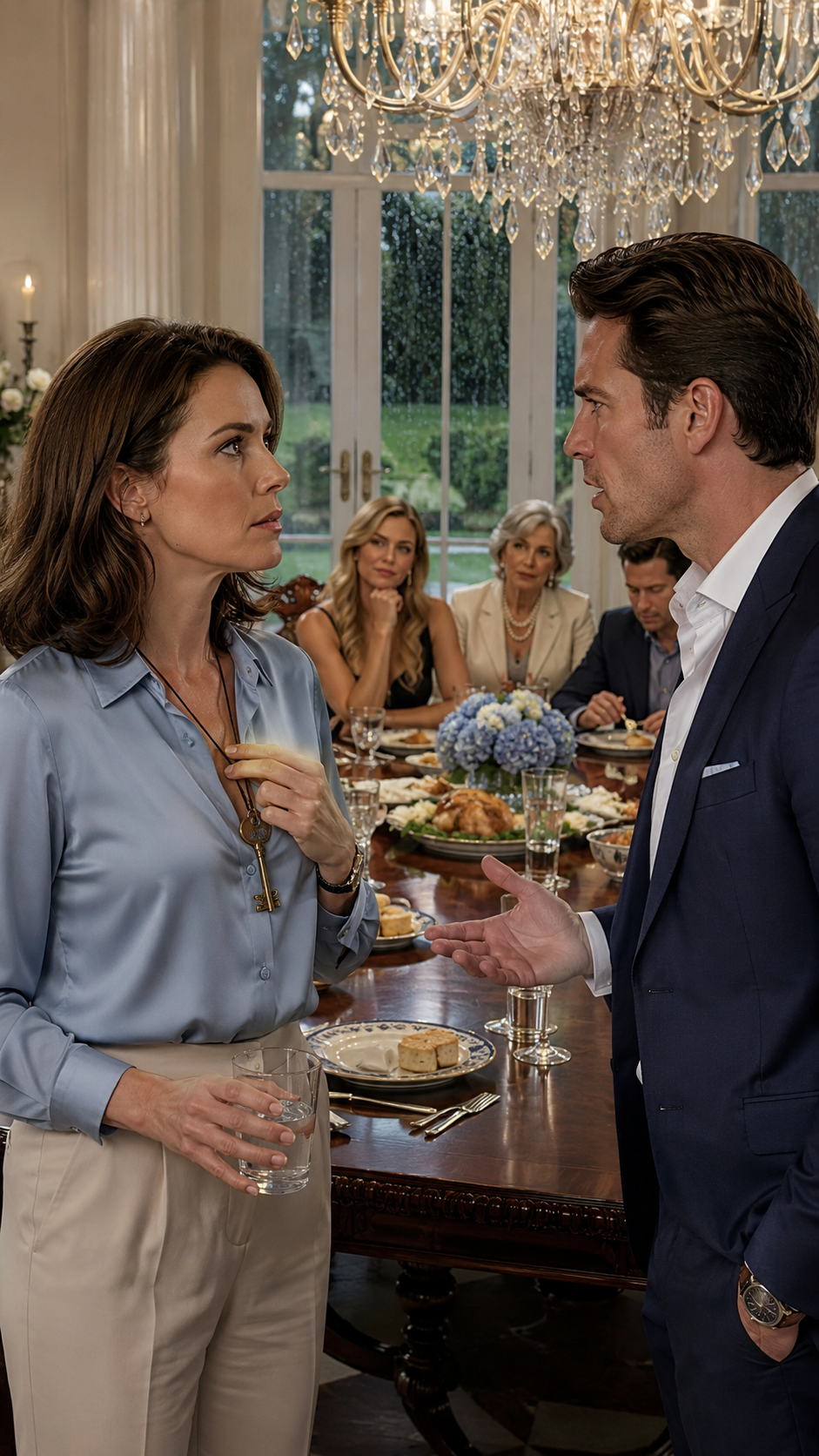
He gave her my chair.
His mother called her the real woman of the family.
So I walked across my own lawn and let them finish dinner in a house they had never owned.
Brooke Alvarez was wearing my grandmother’s funeral dress when my husband brought her into the dining room.
That was the first thing I noticed.
Not his hand on the small of her back.
Not the way she smiled before she crossed the threshold, already certain the room would bend around her.
Not the way my mother-in-law, Lorraine Callaway, straightened in her chair like a judge seeing the witness she had been waiting for.
The dress.
Black silk.
Draped neckline.
Delicate cap sleeves.
A hem I had shortened by hand four years earlier because I needed something modest enough to wear while burying Pearl Elliston, the woman who had raised me, taught me to read deeds before love letters, and pressed a brass key into my palm when I was seventeen.
Brooke wore it badly.
Too tight across the shoulders.
Too loose at the waist.
The alteration along the hem pulled unevenly because she was two inches taller than me and had not known where to look before taking what was mine.
I stood between the kitchen and the dining room with a serving dish in both hands while the roast chicken steamed beneath the chandelier light.
The house smelled like rosemary, butter, polished wood, rain-soaked magnolias, and cornbread cooling in a cast-iron pan.
The long table had been set since four o’clock.
Linen napkins folded into triangles.
Silver placed properly.
Hydrangeas in the center vase, blue and white because those were Grandma Pearl’s colors.
I had cooked everything alone that morning while Desmond played golf and Lorraine called three cousins to complain about how quiet I had become.
The estate sat behind wrought-iron gates on Magnolia Drive, north of the city, with a lawn so green people slowed when they drove past it.
White columns.
Tall windows.
A long curving driveway lined with trees my grandmother had once told me were “pretty enough to make fools sentimental.”
Desmond believed the house was his.
That belief had always been useful.
Until it became insulting.
He walked in with Brooke on his arm as if the front door had opened for him by birthright rather than biometric access I had authorized under a trust he had never bothered to read about.
He was thirty-nine, broad-shouldered, handsome in the athletic, entitled way of men who had been praised for posture before character.
His hair was cut perfectly.
His watch caught the Sunday light.
His smile had the expensive ease of someone standing inside borrowed certainty.
Brooke was twenty-six.
Beautiful, yes.
Sharp in the way a knife is sharp when someone else is holding it.
She had the confidence of a woman who had mistaken proximity to power for power itself.
Gold bracelets on one wrist.
My dress on her body.
Desmond’s hand at her waist.
She looked around my dining room and did not see history, labor, signatures, trust structures, property taxes, and quiet mercy.
She saw a throne.
Then she sat in my chair.
The chair at the head of the table.
The one facing the window that overlooked the garden I had designed after Grandma Pearl died.
The one I sat in every Sunday because I had built that room as a place where family, whatever version of it I still had, might learn to feel less hungry.
Brooke pulled it out, crossed her legs, and rested her chin on her hand.
Theo, Desmond’s younger brother, was already seated.
He saw everything.
He saw Brooke in my chair.
He saw me holding the dish.
He saw the dress.
Theo had a gift common to weak men who depend on stronger ones: he could locate advantage faster than conscience.
He looked away, reached for the bread basket, took a piece of cornbread I had baked at dawn, and bit into it.
No one moved.
Then Lorraine entered.
Small, silver-haired, sharp-faced, wearing a cream blazer and the pearl necklace Desmond had told me he bought for her one Christmas.
He had not.
The receipt had come from my account.
Lorraine walked into the room, saw Brooke at the head of the table, and pressed both hands together with deep satisfaction.
“Now,” she said, looking directly at me, “that is what a real woman of this family looks like.”
The sentence did not float.
It landed.
A blade laid carefully across a white tablecloth.
Brooke lowered her lashes with practiced modesty.
Theo chewed.
Desmond exhaled through his nose as if his mother had said what needed saying and now everyone could stop pretending.
I set the serving dish on the table.
Slowly.
Carefully.
The porcelain touched wood with a small sound that should not have been louder than Lorraine’s cruelty.
But somehow was.
Desmond crossed the room toward me.
He lowered his voice, though not enough.
Men like Desmond often mistake quiet for privacy.
They forget a dining room full of people is still a room full of witnesses.
“I’ve been meaning to talk to you about the guest house,” he said.
“It’s all set up now.
Comfortable out there.
You’ll be fine.”
I looked at him.
The man I married eight years earlier in a courthouse ceremony his mother refused to attend.
The man who once held my hand in an elevator and told me I made him feel steadier.
The man who had been drowning in debt when he met me and never knew because I did not want him to feel small beside me.
“You want me to sleep in the guest house,” I said.
Not a question.
A fact placed on the table beside the chicken.
Desmond’s mouth tightened.
“It’s not a big deal, Margot.
Brooke needs the space.
We need the space.
You understand.”
We.
That tiny word.
It carried a whole betrayal inside it.
I looked past him.
Brooke in my chair, wearing my dress.
Theo eating my cornbread.
Lorraine unfolding her napkin with ceremonial pleasure.
Cousins looking at their plates because cowardice often dresses itself as discomfort.
Then I nodded once.
Just once.
I picked up the glass of water from my place setting, the place where I would not be sitting that evening, and walked out of the dining room.
No one stopped me.
No one said my name.
Brooke laughed at something Theo murmured.
Lorraine began passing plates.
Desmond pulled out his chair, reached for the roast chicken, and started serving himself.
Dinner began without the woman who had prepared every dish.
I walked through the kitchen, opened the side door, and stepped onto the damp grass.
The late Sunday light was gold after rain.
The lawn smelled clean, expensive, impossible.
My shoes sank slightly into the soft earth as I crossed toward the small white guest house at the far end of the property.
I was not crying.
That disappointed them, I think.
People who perform cruelty often expect tears as applause.
I held the glass of water in one hand.
With the other, I pressed my fingers against the fabric of my blouse, finding the brass key on the worn leather cord beneath it.
Small.
Warm.
Old.
It had rested against my collarbone every day for twenty-two years.
I squeezed it once.
Something in me settled into a calm so deep it almost felt like mercy.
Because Desmond Callaway had made one fatal mistake.
He thought sending me to the guest house meant moving me out of power.
He did not know I owned the guest house.
The lawn.
The main house.
The cars in the garage.
The company with his name on the letterhead.
The property beneath Lorraine’s roof.
The land behind the iron gates.
The brokerage accounTS.
The development projecTS.
The hotel holdings.
The infrastructure contracts across fourteen states.
Forty-one billion dollars in assets, layered through trusts, subsidiaries, and operating entities so dense a team of fifty attorneys would need years to find the front door.
Every document bearing one name.
Mine.
Margot Elliston.
Not Callaway.
Never Callaway.
The guest house door opened with a quiet click.
I stepped inside, set the water glass on the small desk by the window, and stood in the dim room while laughter drifted faintly across the lawn from my own dining room.
I did not turn on the lighTS.
Not yet.
Some moments deserve darkness, not because you are lost inside it, but because you need to see exactly where the light will go when you finally allow it in.
To understand what happened next, you have to understand the key.
Grandma Pearl gave it to me on a porch in rural Virginia the night before I left for college.
The air smelled like pine needles, red clay, and the hot metal of a long summer day cooling at last.
I was seventeen, barefoot, serious, and terrified of wanting too much from a world that had never been gentle with the women who raised me.
Pearl Elliston was seventy-four then, retired from teaching, widowed at forty-one, and more dangerous with a pencil than most men were with lawyers.
She kept her money in ledgers so clean they looked almost holy.
She bought land when people told her she had no business doing so.
She saved when people said she had nothing to save.
She survived by never confusing loudness with authority.
“The most dangerous person in any room,” she told me that evening, sorting coins into a tin jar, “is the one nobody thinks is watching.”
I was too young to understand fully, but old enough to know I had been given something worth keeping.
A year before that, I had watched our neighbor, Mrs. Langford, lose her house after signing papers she had not read.
She trusted a man in a suit because he smiled gently and used words like “temporary,” “routine,” and “standard.” By the time she learned what the documents said, every floor beneath her life had moved.
I remember her sitting on Pearl’s porch afterward, hands folded around a cup of tea she never drank.
“They made me feel stupid for asking questions,” Mrs. Langford whispered.
Pearl’s face had gone still.
“Then ask twice next time,” she said.
“And keep asking until stupid becomes expensive for them.”
That day, I made myself a private vow.
I would never sign anything I had not measured.
I would never let my name rest on a document I did not understand.
I would never give another person the power to pull a floor out from under me.
When I left for college on a full scholarship, Pearl called me to the porch.
She took the brass key from her pocket.
It was old, smooth, and warm from her hand.
She pressed it into my palm, then closed my fingers over it.
“This key does not open anything yet,” she said.
“But everything you build will need a key someday.
Keep it close.”
“What will it open?”
Pearl smiled toward the trees.
“Everything, baby.
If you do it right.”
I put it around my neck that night.
I wore it through law school.
Through real estate finance classes where men interrupted me and then repeated my ideas louder.
Through the first deal I closed from a studio apartment with a secondhand laptop and a desk made from a hollow door balanced on filing cabineTS.
Through Elliston Ventures’ first land purchase.
Then its first hotel acquisition.
Then commercial developments, infrastructure partnerships, rail-adjacent industrial parks, hospitals, affordable housing projects, clean energy corridors, and quietly profitable pieces of cities most people only noticed after someone else put a ribbon in front of them.
I built by layers.
That was Pearl’s way.
Do not announce the foundation while people are still admiring wallpaper.
By thirty-six, I controlled assets across fourteen states.
By thirty-eight, financial reporters had begun chasing the initials E.V.
through public filings and failing.
They wrote about the Aldrich Consortium, Meridian South Holdings, Bellweather Land Trust, Callaway Capital Partners, and a dozen other entities without understanding they were looking at rooms inside the same house.
Mine.
Then I met Desmond.
I wish I could say I saw through him immediately.
I did not.
He was charming when charm still looked like warmth to me.
He laughed easily.
He asked questions.
He looked at me at a charity event in Atlanta as if I were not an anonymous nonprofit director in a navy dress, but the only person in the room who had surprised him.
I wanted to be seen without being appraised.
That want made me careless.
Not legally.
Never legally.
Emotionally.
I hid the empire because I wanted one part of my life untouched by valuation.
I told him I worked with a literacy foundation.
That was true.
I funded it anonymously and took a modest public salary because I liked building programs where children learned to read before the world taught them paperwork could be used against them.
Desmond admired my “simplicity.”
That was the word he used.
At first, it sounded tender.
“You’re not like the women in my world,” he said once, kissing the inside of my wrist.
“You don’t need all the performance.”
I thought he meant I was enough.
Later, I understood he meant I was useful because I made him feel taller.
We married in a courthouse.
Lorraine refused to attend because she said a Callaway man deserved a wedding with legacy.
Desmond apologized for her.
I forgave what should have warned me.
The first year was easy enough to mistake for happy.
The second year, Desmond’s investments began failing.
He did not tell me.
But unpaid notices leave trails.
So do anxious men who pretend confidence while opening bourbon at noon.
He wanted to buy the Magnolia Drive estate and believed the bank had approved his mortgage.
It had not.
He was overleveraged and one bad call away from public embarrassment.
I intervened silently.
An Elliston subsidiary purchased the property in cash for $6.8 million.
Another proxy company created a lease-to-own arrangement that sent Desmond monthly statements resembling mortgage confirmations.
He never questioned the favorable rate.
Never read the fine print.
Never asked why the bank’s name did not match any institution he recognized.
Desmond Callaway had never loved fine print.
He loved signatures.
Especially his own.
The Range Rover came next.
Then the Mercedes.
Both registered under Elliston Fleet Management.
Callaway Capital Partners, the company he introduced at every networking event as his firm, operated under revocable license from Elliston Ventures.
His name appeared on letterhead because I allowed it.
His office suite existed because I paid for it.
His deals were curated, approved, structured, and quietly protected by my legal team.
I did not do it to mock him.
That is important.
I did it because I loved him in a foolish, earnest way that believed if I built scaffolding around his self-worth, he might grow into the structure.
Maybe the appearance of discipline would become discipline.
Maybe the title would teach him responsibility.
Maybe being treated like a man of substance would make him want to become one.
It did not.
By year five, he believed the scaffolding was proof he had built the building.
By year seven, Lorraine believed it too.
By year eight, Brooke Alvarez moved through my home wearing my clothes and calling me “sweetie” in a voice that sounded like sugar stirred into poison.
She did not arrive all at once.
Affairs rarely do.
First she was Desmond’s “communications consultant.” Then she was present on calls.
Then she attended dinners.
Then her perfume lingered in the hallway after she left.
Desmond said I was imagining things.
Lorraine said jealousy was unattractive.
Theo said, “Brooke’s just easier to be around, Margot.
She doesn’t make everything feel so serious.”
I documented everything.
Not because I needed proof of the affair.
Because money had begun moving strangely.
Brooke’s personal account received $87,000 over six weeks from Callaway Capital operating funds.
Theo signed three attempted transfers totaling $4.7 million using authorization codes that had expired fourteen months earlier.
Desmond initiated a collateral request against assets he had no authority to pledge.
Lorraine’s property taxes continued being paid by an Elliston entity, a fact she seemed to believe was evidence of her son’s generosity rather than mine.
Each night in the guest house, after the main house went dark, I opened my encrypted laptop and read Warren Aldrich’s briefing.
Warren was sixty-one, Harvard Law, white-haired, and the only man I knew who could make a sentence like “preliminary injunction drafted” sound like a lullaby.
He had been my chief counsel for nine years, though publicly he chaired the Aldrich Consortium, one of the most respected development groups in the South.
His 11 p.m.
briefings were precise.
Magnolia Drive primary residence: purchased 2019 by Elliston Holdings Trust IV.
Current assessed value: $11.2 million.
No name other than Margot Elliston appears on deed or trust documenTS.
Vehicles: Range Rover and Mercedes registered under Elliston Fleet Management LLC.
Repossession authorization drafted and pre-signed.
Awaiting execution.
Callaway Capital Partners: revocation documents prepared.
Employee reassignment plan complete.
Unauthorized transfers: $4.7 million attempted by Desmond and Theodore Callaway.
Invalid authorization codes.
Reversal filings completed.
Brooke Alvarez transfers: $87,000 in unauthorized corporate funds.
Documentation preserved.
Lorraine Callaway residence: 412 Dunmore Lane.
Purchased by Elliston Ventures subsidiary in 2017.
Taxes paid by Elliston twelve consecutive years.
Listing authorization prepared.
Awaiting execution.
I read every line.
Made notes in my leather notebook.
Closed the laptop.
Pressed the brass key against my skin.
“Not yet,” I whispered.
Then one Friday evening, Desmond gave me the sentence that ended my patience.
He was hosting business associates, city officials, and a developer from Charlotte at the main house.
I was not invited.
Brooke wore emerald and arranged candles on every surface, imitating my taste with the hollow accuracy of a person who copies a recipe without understanding why salt matters.
I sat on the guest house porch with a book I was not reading.
Warm light poured from the main house across the lawn.
I could hear low music, clinking glasses, men laughing too loudly near money.
Around nine, Desmond stepped onto the back patio to take a call.
He leaned against the railing, fifteen feet from where I sat in the dark.
He did not see me.
His voice carried cleanly across the yard.
“Yeah, she’s still out there in the guest house.
Look, she’s got nothing, man.
She never had anything.”
A pause.
Then he laughed.
“Everything you see—this house, the cars, the company—I built all of that.
I made that woman.
She was nothing before me, and she’ll be nothing after.”
I sat very still.
The night air smelled like rain, cut grass, and the roast smoke from the dinner I had not cooked this time.
Desmond continued.
“Honestly, she should be thanking me.
I gave her the best years of her life.
All she gave me was that sad little brass key around her neck like it means something.”
He laughed again.
Then went inside.
One tear formed at the corner of my right eye.
I pressed the heel of my hand beneath it for three seconds.
When I lowered my hand, the tear was gone.
I walked inside the guest house, opened the bottom dresser drawer, moved aside a folded scarf and Grandma Pearl’s worn leather Bible, and removed the sealed folder beneath them.
DocumenTS.
Deeds.
Holding company registrations.
Trust structures.
Vehicle titles.
Licensing agreemenTS.
Portfolio statemenTS.
Screenshots of messages.
Transfer logs.
Security stills of Brooke throwing away Pearl’s blanket, my ceramic bowls, and boxes of books with my pencil notes still inside them.
I looked at the folder for a long time.
Then I called Warren.
“It’s time.”
He did not ask if I was sure.
He knew better.
“I’ll have everything ready by Saturday,” he said.
“The consortium gala.
Full guest list.
Every name that matters.”
“Good.”
There was a pause.
Then his voice softened by half an inch.
“Margot?”
“Yes.”
“It has been an honor watching you wait.”
I closed the folder.
For the first time in weeks, the guest house felt less like exile than a staging room.
That was the night I stopped grieving and started finishing.
The gala was held the next evening at a glass-and-steel event center in downtown Atlanta that occupied an entire city block.
Every light in the building was on.
Every significant name in Southern real estate appeared on the guest list: developers, city council members, state legislators, investors, fund managers, bankers, contractors, nonprofit directors, attorneys, and the sort of men who did not attend parties unless power was somewhere near the bar.
Desmond arrived in a navy suit.
Rented.
He did not know I knew.
The cufflinks belonged to Theo.
The confidence was entirely his own and entirely unearned.
Brooke came on his arm in a gold dress that caught the light every time she moved.
She loved reflective surfaces.
I had noticed that.
Mirrors, cameras, polished elevator doors.
Anything that gave her back proof she existed near something expensive.
Desmond worked the room with a broad smile and the phrase “Callaway Capital Partners” on his lips before the second sentence of every conversation.
He looked, to anyone not paying attention, like exactly what he believed himself to be.
At 9:15, the double doors opened.
The first thing people noticed was not silence.
The room did not go silent immediately.
Rooms like that are too disciplined for theatrics.
What happened instead was subtler: the air reorganized itself.
Conversations slowed.
Heads turned by instinct before curiosity.
Warren Aldrich stopped mid-sentence across the room.
Three developers near the bar straightened.
A councilwoman who had met me only once, under another corporate veil, narrowed her eyes.
I walked in wearing a floor-length burgundy gown, the color of authority made fabric.
My hair was natural and full.
No diamonds except Pearl’s small studs.
No ornament at my throat except the brass key, polished for the first time in years and resting visibly against my collarbone.
No longer hidden under a blouse.
No longer private.
A period at the end of a very patient sentence.

Warren crossed the room directly to me.
He took both my hands.
“Ms.
Elliston,” he said clearly, loud enough for the surrounding circle to hear, “welcome.
Everything is ready for your announcement.”
Heads turned.
Desmond was thirty feet away shaking hands with a city council member.
He heard the name.
His grip loosened.
His smile remained, but it stopped reaching his eyes.
Brooke tightened her fingers on his arm.
She felt the shift.
She did not yet understand it.
Warren escorted me to the podium.
I stepped behind it without gripping the sides.
You only need to hold on when something beneath you is unstable.
The room settled quickly.
These were people who knew how to read a moment.
I did not thank anyone for inviting me.
I did not begin with a joke.
“My name is Margot Elliston,” I said.
“I am the sole founder and owner of Elliston Ventures.”
The name moved across the room like weather reaching windows.
Recognition.
Then recalculation.
Then hunger.
“Over the past seventeen years, Elliston Ventures has developed or acquired assets across fourteen states with a current portfolio value of approximately forty-one billion dollars.
Many of you in this room have done business with us without knowing my name.”
I paused.
“That was intentional.
Tonight, I would like that to change.”
Four hundred people.
Not one glass lifted.
Not one phone checked.
Not one whisper continued.
“I would like to begin by clarifying a few specific matters.”
I did not look at Desmond.
Not yet.
“The estate on Magnolia Drive, the one with the white columns and the guest house at the far end of the lawn, was purchased by an Elliston subsidiary in 2019 for $6.8 million.
It has never carried any name but mine on any deed, trust, or recorded document.”
A sound moved through the room.
Not quite a gasp.
Something more controlled and more damaging.
“The black Range Rover and silver Mercedes currently parked in that driveway are registered under Elliston Fleet Management LLC.
They will be collected Monday morning.”
Brooke’s fingers fell from Desmond’s arm.
“The company known as Callaway Capital Partners operates as a licensed subsidiary of Elliston Ventures.
The individual whose name appears on its letterhead holds no ownership stake, no equity position, and no legal authority over any asseTS. The operating license has been revoked as of this evening.”
Now Desmond looked at Warren.
Warren looked back with the calm patience of a man who had spent years waiting to hand someone the invoice for arrogance.
I continued.
“Over the past three weeks, documents were signed attempting to transfer $4.7 million from Elliston subsidiary accounTS. Those documents were executed using authorization codes that expired fourteen months ago.
They are legally null.
My attorneys have reversed every transaction and filed appropriate protections.”
Theo, somewhere near the back, touched his jacket pocket as his phone began vibrating over and over.
I looked at Desmond then.
Just once.
“Before I continue, I would like this room to hear something.”
I took my phone from my clutch and tapped the screen.
Desmond’s voice filled the ballroom.
“She’s got nothing, man.
She never had anything.
I made that woman.
She was nothing before me, and she’ll be nothing after.”
Twelve seconds.
That was all I played.
Twelve seconds containing a man’s entire understanding of the woman he had shared a house, a bed, a name, and a life with.
Then Lorraine’s voice came next from a speakerphone call Warren had preserved legally through counsel.
“She has nothing left.
That girl never had anything to begin with.
My son carried her for eight years, and this is what he geTS.”
Seven seconds.
Then Brooke and Theo on my kitchen security system.
Theo: “Sign them fast before she figures out something is happening.”
Brooke: “She won’t figure out anything.
She doesn’t even understand how money works.”
The recordings ended.
The room did not move.
I looked out at them.
I was not angry.
Anger would have required me to still want those people to understand me.
What I felt was quieter.
Cleaner.
“The woman they described,” I said, “the one with nothing, the one made by someone else, the one who does not understand how money works, is the woman whose capital funded this event center, whose investments employ more than four thousand people in this city, and whose name sits behind half the major development permits issued in this metro area in the last decade.”
I let the sentence settle.
“I did not come here tonight to humiliate anyone.
I came to correct a record and introduce myself properly for the first time.”
My hand touched the brass key.
“My grandmother gave me this key when I was seventeen years old.
She told me it did not open anything yet.
She told me to keep it close.”
I looked directly at Desmond.
“And she told me, ‘Don’t ever let them see it coming.’”
One breath.
Two.
“They did not see it coming.”
Then I stepped away from the podium.
Warren handed me a glass of water.
I took it.
Turned my back on the room.
Did not turn around again.
Behind me, four hundred people began to breathe.
Desmond stood in the center of the most important real estate room in Atlanta and felt the floor of the identity he had performed for eight years begin to separate from anything solid beneath it.
Brooke’s champagne glass froze halfway to her mouth.
Her eyes were wide, not with guilt, but with the specific terror of a woman realizing she had placed her entire bet on a man who did not own the table.
She turned to Desmond.
“You told me she was nothing.”
Her voice carried.
“You told me you built all of this.
I left my apartment for you.
I moved into her house.
I wore her clothes.”
Desmond’s mouth opened.
Nothing came out.
“You told me she was nobody,” Brooke said.
The room watched.
She looked him up and down.
“You ruined my life, and you don’t even own the suit you’re standing in.”
She set the champagne glass on the nearest table and walked toward the exit.
The gold dress caught the light one last time before the doors closed behind her.
No one followed.
No one called her name.
That was the cleanest exit she would ever get from me.
Theo pushed through the crowd toward Desmond, phone in hand, face pale.
“Des, what is happening?”
Desmond stared past him.
At me.
At Warren.
At the room now turned away from him and toward the actual source of power.
Lorraine, watching the livestream from home, called Desmond eight times.
He did not answer.
Someone near the bar laughed once.
Not loudly.
Enough.
The collapse took seventy-two hours.
Monday morning, at eight, two flatbed tow trucks rolled through the Magnolia Drive gates with immaculate paperwork.
The Range Rover went first.
The Mercedes followed.
A neighbor saw.
Then another.
By noon, fourteen people had mentioned it to other people.
Desmond stood in the driveway wearing yesterday’s pants and a face that had not slept.
“You cannot take my cars,” he told the driver.
The driver, who had no interest in becoming part of rich people’s Greek tragedy, handed him a copy of the title documenTS.
“They’re not your cars, sir.”
The sentence was polite.
Devastating.
That afternoon, Callaway Capital Partners received a courier envelope.
Formal notice of subsidiary license revocation.
All operating accounts suspended.
All employees reassigned to Elliston Direct Management.
Desmond’s name removed from letterhead, website, office directory, and email signature before midnight.
Tuesday morning, the Magnolia Drive property manager arrived with an eviction notice.
I had granted a thirty-day courtesy period, more than the law required, given that Desmond’s name appeared nowhere on any document connected to the property.
He read the notice four times at the kitchen counter Brooke had tried to redecorate.
The backsplash she chose gleamed behind him.
A house he had never owned prepared to survive his absence.
Tuesday evening, Lorraine received a certified letter at 412 Dunmore Lane, informing her that the property she believed secured by her son was held by an Elliston subsidiary and would be listed for sale within ninety days.
She called Desmond.
Voicemail.
Theo.
“I can’t talk right now,” he said, then hung up.
Lorraine sat in a living room where she had hosted family dinners for twelve years and stared at the walls.
She thought, I later heard, of the Sunday table.
Of Brooke in my chair.
Of her own voice declaring what a real woman of the family looked like.
For the first time in her adult life, Lorraine Callaway felt small.
Not socially embarrassed.
Small.
Structurally.
The way you feel when the floor shows you it never belonged to you.
Theo’s development deal collapsed by Friday.
He had been pitching a Midtown mixed-use project for two years.
He never asked who funded the investment vehicle behind the commitment.
The lead capital source was an Elliston portfolio account.
When I reorganized the account, the commitment withdrew.
A brief letter.
Direction changed.
No explanation.
Theo called three times.
No one answered.
Brooke tried to reach me once through a mutual contact.
My assistant, Celeste, who had worked for me five years and possessed the coldest email tone in three states, replied with three words.
Unavailable permanently.
Brooke left Atlanta before the month ended.
The $87,000 in unauthorized transfers became part of the civil recovery.
She returned most of it after her attorney explained what “conversion of corporate assets” meant when the actual owner had no interest in being merciful twice.
Desmond ended up in a rented apartment in a neighborhood he used to drive through with the windows up.
His applications stalled.
His references had been my contacTS.
His accomplishments had been my deals.
His reputation had been my architecture.
Without the scaffolding, there was nothing to stand on.
He called once.
I did not answer.
He sent one message.
I did not reply.
Months later, through Warren, he requested a meeting.
Warren asked if I wanted to consider it.
“No,” I said.
“Any message?”
I thought about it.
“Tell him to read the documenTS.”
Warren’s mouth curved.
“I will enjoy that more than is professionally appropriate.”
The divorce was simple because the marriage had been complicated in all the ways money can make simple.
Desmond received what the prenup allowed: personal belongings, a limited settlement from accounts clearly designated marital, and no claim to Elliston assets, Magnolia Drive, Callaway Capital, or the properties he had mistaken for proof of his own success.
He contested once.
Then his attorney read the trust documenTS.
They did not contest again.
But consequences are not only legal.
They are atmospheric.
People stopped saying “Callaway” with weight.
Invitations disappeared.
Lunches became “busy.” Men who had once laughed too loudly at his jokes in private clubs suddenly needed to take calls when he entered.
The same city that had admired his confidence began studying the emptiness beneath it.
Desmond had not merely lost wealth.
He had lost the borrowed lighting that made people believe he possessed it.
I moved back into Magnolia Drive two weeks after he left.
Not because I needed the house.
Because I refused to let exile be the last memory I had there.
The first morning, I walked room by room with Celeste, Warren, and a restoration consultant named Lydia Voss, a woman with gray hair, steel glasses, and no patience for sentimental cowardice.
Brooke’s gold-framed prints came down.
My courthouse photograph went back up, but not in the bedroom.
I did not need the marriage restored to the wall.
I placed it in an archival box labeled Completed History.
Grandma Pearl’s blanket, recovered from the curb by Alice, the housekeeper who had worked part-time on the property and quietly ignored Brooke’s instructions to “get rid of old things,” was cleaned by a textile specialist and folded across the foot of my bed.
My ceramic bowls returned to the kitchen shelves.
The books with my pencil notes took three weeks to recover because some had already gone to a charity shop.
Celeste tracked them down with a level of discipline usually reserved for hostile takeovers.
When she placed the last stack on my desk, she said, “No book left behind.”
I smiled for the first time in days.
Alice received a full-time position, benefits, and a raise.
She cried in my kitchen and apologized for not telling me sooner about Brooke throwing things away.
I told her the truth.
“You saved what you could.
That counTS.”
The master bedroom was repainted soft blue.
Not the blue Brooke chose for online inspiration photos.
The blue of Pearl’s hydrangeas.
The black silk dress went to a preservation box.
I did not wear it again.
I did not throw it away either.
Some objects deserve to become evidence without remaining weapons.
The dining chair at the head of the table stayed empty for two monThS.
Then one Sunday, I hosted dinner.
Not for the Callaways.
For the people who had actually stood with me.
Warren.
Celeste.
Alice.
Lydia.
Janelle, the cousin who had once found me in a grocery store parking lot and gently told me people were saying I had nothing left.
Janelle arrived nervous, holding a peach pie.
“I did not know,” she said in the foyer.
“I know.”
“I should have asked different questions.”
“Yes.”
She swallowed.
“Can I ask them now?”
I looked at her.
Then stepped back.
“Yes.”
That dinner smelled like roast chicken, butter, thyme, and something healing that did not require a speech.
We ate at the long table under the chandelier.
I sat at the head chair because leaving it empty had begun to feel like another way of letting Brooke remain in it.
Before dessert, Alice asked, “Is it all right if I say something?”
Everyone went quiet.
She smoothed her napkin in her lap.
“I worked in houses like this for thirty years,” she said.
“I have seen rich people be cruel because they could afford to be.
I have seen wives disappear inside rooms they decorated.
I have seen staff pretend not to hear things because we needed jobs more than opinions.”
Her eyes met mine.
“I want to say it was an honor watching a woman come back through her own front door.”
No one clapped.
It was not that kind of moment.
But Warren lifted his glass.
“To front doors.”
We drank to that.
Six months later, I drove nine hours to rural Virginia.
Alone.
No driver.
No calls.
No music after the state line.
Just county roads, pine trees, red clay, and the kind of quiet that cities imitate badly in expensive spas.
Grandma Pearl’s property had been empty since she died.
Taxes paid.
Deed clean.
Grass maintained.
Porch restored by a contractor I trusted while I was still sleeping in the guest house, because I had never stopped building simply because other people were trying to tear things down.
I parked at the end of the dirt road and stepped out.
The air smelled like earth after rain.
The sky was huge in the way skies can only be where buildings have not learned to interrupt.
The porch had been painted the same pale gray I remembered from childhood.
A new rocking chair sat where Pearl’s old one had finally given up after decades of holding women who needed somewhere to think.
I sat.
Closed my eyes.
For one moment, I was twelve again.
Bare feet.
Serious eyes.
Pearl beside me, sorting coins into a tin jar, teaching me that quiet could be a strategy and dignity could be a locked room no one else had the key to.
Footsteps came across the yard.
My sister’s daughter, Maya, ran up the porch steps.
Twelve years old, all legs and curiosity, with the same watchful eyes I had carried at her age.
She stopped in front of me, slightly breathless, gaze fixed on my neckline.
“Aunt Margot,” she said, “what is that key for?”
I looked down.
The brass key rested warm against my collarbone.
For years it had felt like a promise.
Then like armor.
Then like proof.
Now, finally, it felt like gratitude.
“Everything,” I said.
“Everything I ever needed.”
Maya’s eyes widened.
I reached into my pocket and took out a second key.
Smaller.
New brass, still bright, strung on a leather cord identical to mine.
I had it made three weeks earlier and carried it since, waiting.
I placed it in her open palm.
“This one does not open anything yet,” I said.
“But one day it will.
When it does, remember what your great-grandmother told me.”
Maya looked down at the key with solemn importance.
“What did she say?”
I smiled.
Fully.
Unguarded.
“Don’t ever let them see it coming.”
Evening came in warm and slow.
Pine shadows stretched across the red clay.
Somewhere in Atlanta, Desmond was learning what it meant to stand on ground that had never been his.
Somewhere else, Lorraine was packing dishes from a house she had mistaken for security.
Somewhere beyond them, Brooke was discovering that stolen silk does not become yours because you wear it long enough.
And on a porch in Virginia, where my grandmother once taught me that the person nobody watches may be the one keeping every record, I rocked in a chair I had chosen myself and felt the full, unhurried weight of being right all along.
I had not raised my voice.
Not once.
I had not begged for a seat at a table I purchased with my own money and set with my own hands.
I had not chased them through grocery stores, called cousins, or stood on the lawn demanding someone finally understand my worth.
I gave none of them the pleasure of watching me come apart.
Pearl taught me better.
Dignity is not permission granted by a room.
It is something you protect from the inside.
Real power does not need to announce itself at dinner.
It builds.
It waiTS.
It structures and protects and compounds in silence behind walls the careless never think to look for.
And when it finally speaks, not with rage, not with pleading, not with the performance people expect from someone they have wronged, but simply by standing up in a room full of people and saying its own name clearly, there is nothing left to argue with.
Nothing at all.