
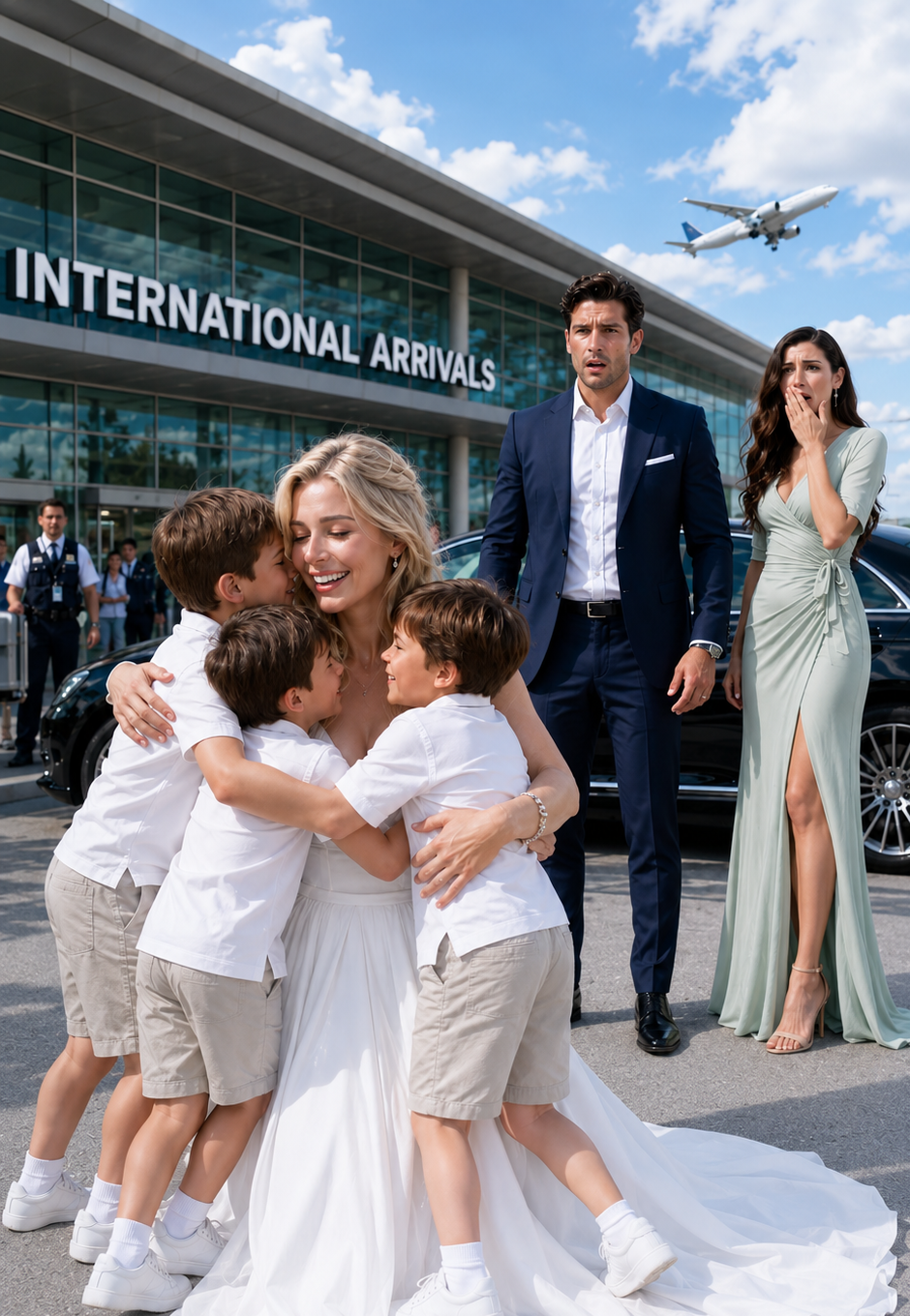
Blake Harrington stared at the three boys as though the ground had disappeared beneath his feet.
For a moment, he did not look like the billionaire whose face had appeared on magazine covers, or the man who could silence a boardroom with one lifted eyebrow.
He looked like someone who had opened a door he had spent five years pretending did not exist, only to find everything he had lost waiting on the other side.
The boys clung to me, still chattering over one another.
“Mom, Noah spilled juice in the car,” one said.
“I did not,” the youngest protested.
“Eli bumped my elbow.”
“Because Theo took my dinosaur.”
“I didn’t take it.
I borrowed it.”
Their voices should have made me smile.
On any other day, they would have.
But all I could hear was Blake’s breathing, uneven and shallow, as his eyes moved from one small face to another.
Eli, the oldest by two minutes, stood closest to me.
He had always been the cautious one, thoughtful and observant, with a habit of studying people before he trusted them.
Theo was already half-hidden behind my coat, curious but careful.
Noah, the youngest, stared openly at Blake with the fearless confusion of a child who had never learned to be intimidated.
Then Noah tilted his head.
“Mom,” he whispered, not quietly enough, “why is that man looking at us like that?”
My heart tightened.
Blake heard him.
His face changed, pain flickering across it so quickly I almost missed it.
I placed a steady hand on Noah’s shoulder.
“Because he’s someone I used to know.”
“From work?” Eli asked.
My mouth went dry.
Before I could answer, Blake stepped forward.
Only one step, but it felt like the closing of a distance that had taken years to build.
“Emma,” he said again, my name rough in his throat.
“Are they…”
I held up one hand.
Not here.
Not like this.
The curb outside O’Hare was crowded with drivers holding signs, passengers dragging suitcases, horns sounding somewhere down the line of cars.
The world kept moving around us, indifferent to the fact that my past and my children had just collided in the middle of an airport pickup lane.
Blake seemed to understand.
He stopped, his jaw tight, his eyes never leaving the boys.
My driver, Simon, came around from the Bentley and took my suitcase without a word.
He had worked for my father’s company for years and had mastered the rare talent of seeing everything while appearing to see nothing.
“Ma’am,” he said softly, “should I take the boys to the car?”
“Yes, thank you.”
Theo looked up immediately.
“Are you coming?”
“In just a minute.”
Eli’s small hand tightened around mine.
“Mom?”
There was worry in his voice, and that hurt more than anything.
My children had grown up in a house full of warmth, books, scraped knees, bedtime stories, and pancake Saturdays.
I had worked hard to make sure they never felt the absence of the man who had walked away before knowing they existed.
I knelt in front of them, forcing my voice to remain calm.
“Go with Simon.
Buckle in.
I’ll be right there.”
Noah looked again at Blake.
“Is he sad?”
Blake closed his eyes for half a second.
“Yes,” I said before I could stop myself.
“I think he is.”
The boys followed Simon to the car.
Eli glanced back twice.
Theo held Noah’s hand.
Their small bodies disappeared into the Bentley, and the driver shut the door gently behind them.
Only then did I turn back to Blake.
His face had lost every trace of the cold arrogance he had worn on the plane.
“How old are they?” he asked.
I knew what he was really asking.
“Four.”
He swallowed hard.
“Almost five?”
“Yes.”
The single word landed between us like a verdict.
Blake looked toward the Bentley again.
Through the tinted window, the faint outline of Noah’s hand pressed briefly against the glass before disappearing.
“You were pregnant,” he said.
It was not a question.
I folded my arms across my chest, though not from the cold.
“Yes.”
“When?”
I gave a humorless little laugh, because if I didn’t laugh, I was afraid something inside me would break open in a way I could not control.
“When you decided I was guilty before I could finish a sentence.”
His expression twisted.
“Emma—”
“No.” My voice was quiet, but it stopped him.
“You don’t get to say my name like that.
Not yet.”
He took that in as though it wounded him, but he nodded.
“I didn’t know.”
“I know you didn’t.”
“Why didn’t you tell me?”
The question was so simple.
Too simple for the years behind it.
“I tried.”
He stared at me.
I looked past him, toward the line of cars, toward the gray Chicago sky, toward anything that might help me stay composed.
“The night after you served me divorce papers, I called you nine times.
Your assistant said you were unavailable.
I went to your office.
Security wouldn’t let me up.
I sent an email.”
“I never got an email.”
“I figured that out eventually.”
His brows drew together.
“What does that mean?”
“It means there are a lot of things you never got, Blake.
And there are a lot of things I never got either.
Like the chance to speak.”
A muscle moved in his jaw.
“I thought…”
“You thought the worst of me.
Yes.
That much was clear.”
The airport doors slid open behind us, releasing another wave of travelers and cold air.
Someone bumped my shoulder and apologized.
I barely heard them.
Blake lowered his voice.
“The messages.
Emma, I saw them.”
“I know what you saw.”
“They said he missed you.”
“They were from my brother.”
His face went still.
The words hung there, impossible and plain.
“My brother,” I repeated.
“My half brother, Daniel.
The one I found out about three months before everything fell apart.
The one my mother had given up for adoption before she met my father.
The one who contacted me privately because he was sick and wanted to know if I would take a genetic test.”
Blake looked as though I had struck him.
“No,” he whispered.
“Yes.”
His eyes searched mine, desperate now, almost childlike.
“You never had a brother.”
“I didn’t know I had one.”
“The messages said—”
“They said he missed me because we were trying to build a relationship in secret until I knew how to tell my parenTS. They said he loved me because he was my family.
They said he needed to see me because he had just been diagnosed with a heart condition and was scared.”
I had not spoken Daniel’s name to Blake in five years.
Saying it now reopened a grief that had never fully closed.
Blake’s voice faltered.
“Where is he?”
I looked at him then, and the answer must have been in my face before I said it.
“He died three weeks after the divorce was finalized.”
Blake stepped back as if the words had physically pushed him.
For the first time, I saw him understand that the story he had carried for five years was not simply wrong.
It was ruinously wrong.
“I didn’t know,” he said again, but this time the words sounded useless even to him.
“No,” I said.
“You didn’t.”
The Bentley door opened slightly, and Eli leaned out.
“Mom? Noah’s crying because Theo said the clouds look like mashed potatoes.”
I turned quickly, grateful for the interruption and crushed by it at the same time.
“I’m coming.”
Blake’s gaze moved to Eli, and something raw crossed his face.
“Emma,” he said, “please.
Let me speak to you.”
I wanted to say no.
Every protective instinct in me demanded it.
I had built a life after Blake.
Not a glamorous one, though from the outside it might have seemed that way.
After the divorce, I had gone back to my mother’s family in Chicago.
My father’s health had been declining, and the company needed someone who understood both science and leadership.
I worked while pregnant.
I grieved Daniel in silence.
I gave birth to three boys two weeks early during a thunderstorm that knocked out power on half the block.
I learned how to hold one baby while feeding another and rocking a third with my foot.
Blake had not been there for any of it.
He had not watched Eli sleep with one fist curled beside his cheek.
He had not learned that Theo laughed before he cried.
He had not seen Noah take his first steps across my mother’s kitchen, arms stretched toward a dog who was too old to move out of the way.
He had missed everything.
And now he stood before me with heartbreak in his eyes, asking for minutes after losing years.
I looked at the Bentley.
Then I looked back at him.
“I’m staying at the Whitmore House tonight,” I said.
“My family’s place in Lincoln Park.
Come tomorrow at ten.
Alone.”
Hope flashed across his face so fast it hurt to see.
“I’ll be there.”
“This is not a reunion,” I warned.
“It is not forgiveness.
It is not permission to step into their lives and start making claims.”
His face tightened, but he accepted it.
“I understand.”
“No, Blake,” I said quietly.
“You don’t.
But you will.”
I got into the Bentley without looking back.
As we pulled away, Noah crawled into my lap despite his booster seat protests from Simon, wrapped his arms around my neck, and whispered, “Was that man a friend?”
I pressed a kiss to his hair.
“A long time ago.”
Theo leaned against my side.
“He looked like Eli when Eli broke the blue bowl.”
“I did not break it,” Eli said.
“It slipped.”
Noah frowned.
“Are we going to see him again?”
The question filled the car.
I could lie to investors, to reporters, to strangers at charity dinners.
I had learned how to smile through exhaustion and grief.
But I could not lie to my sons.
“Yes,” I said carefully.
“Maybe.”
“Why?”
I looked out the window, watching the city blur past in streaks of stone, glass, and winter light.
“Because sometimes grown-ups have unfinished conversations.”
Eli did not speak for a long moment.
Then he asked, “Is he our father?”
The silence that followed was so complete I heard Simon’s hands shift on the steering wheel.
Theo’s mouth fell open.
Noah looked from Eli to me.
I turned to my oldest son.
Of the three, Eli had always seen too much.
“What makes you ask that?”
He shrugged, but his eyes stayed serious.
“He has our face.”
Something inside me trembled.
I reached for his hand.
“Yes,” I said softly.
“He is.”
Theo blinked.
“But I thought we didn’t have one.”
“You have always had one,” I said.
“He just didn’t know about you.”
Noah’s lower lip pushed forward.
“Why not?”
The answer was a room full of broken trust, a phone full of misunderstood messages, doors that wouldn’t open, and pride dressed up as pain.
But they were four.
So I said, “Because sometimes adults make very big mistakes.”
Eli looked out the window.
“Did he make one?”
“Yes.”
“Did you?”
I closed my eyes briefly.
Children had a way of reaching the truth without knowing where they had touched.
“Yes,” I said.
“I made one too.”
“What was yours?” Theo asked.
I smoothed his hair back.
“I thought protecting you meant never talking about him.”
Noah curled closer.
“Are you mad?”
I breathed in the familiar scent of his shampoo and the faint trace of crackers from the car ride.
“I don’t know what I am yet.”
That night, after the boys were asleep in the nursery they still insisted on sharing whenever we stayed at my mother’s house, I sat alone in the library with a cup of tea growing cold beside me.
Whitmore House had belonged to my mother’s family for nearly a century.
It was not as sleek as the penthouse Blake and I had once shared.
It creaked in the winter.
The windows rattled when the wind came off the lake.
The wallpaper in the upstairs hall was older than some countries’ governmenTS. But it had held me together when everything else fell apart.
My mother, Celeste Whitmore, entered without knocking.
She was elegant in a way I had never learned to be, silver-haired and straight-backed, with a silk robe tied at her waist and concern written plainly across her face.
“Simon told me,” she said.
“Of course he did.”
“He was worried.”
“Simon worries if the boys wear mismatched socks.”
“He said Blake saw them.”
I stared into my tea.
“Yes.”
My mother sat across from me.
“And?”
“And he knows.”
She folded her hands in her lap.
“How much?”
“Enough to show up here tomorrow.”
Her mouth tightened.
“You don’t approve.”
“I didn’t say that.”
“You didn’t have to.”
For a while, neither of us spoke.
My mother had never forgiven Blake.
Not for the divorce, not for the way it had been handled, and certainly not for the months after, when I moved through this house like a ghost in maternity clothes, refusing to cry during the day because I feared I might never stop.
“He hurt you,” she said finally.
“Yes.”
“He abandoned you when you were carrying his children.”
“He didn’t know.”
“Because he chose not to know.”
I looked up.
There it was.
The same thought I had repeated to myself for years.
My mother’s expression softened.
“Emma, I am not telling you to keep him away.
Those boys deserve the truth, and so do you.
But do not confuse his shock for change.”
“I won’t.”
“Blake Harrington is used to wanting something and getting it.”
“He won’t get them that way.”
“No,” she agreed.
“He won’t.
Because they are not an acquisition.
They are children.”
Her words stayed with me long after she left.
Upstairs, I checked on the boys before bed.
Eli was asleep on his back, one arm thrown over his head.
Theo had kicked off his blanket.
Noah had somehow managed to turn sideways, his feet resting against Theo’s shoulder.
I tucked them in carefully.
For years, I had told myself that Blake’s absence had made things simpler.
No custody argumenTS. No tense holidays.
No father who resented their mother and carried that bitterness into every room.
But standing there, watching them sleep, I wondered if I had also denied them something they might one day need.
Not a perfect father.
No such person existed.
But the chance to know where they came from.
At ten the next morning, Blake arrived exactly on time.
I watched from the front window as his black car stopped at the curb.
He stepped out wearing a charcoal overcoat, no security, no assistant, no entourage.
For Blake, that was practically naked.
He stood at the gate for several seconds before pressing the bell.
My mother appeared beside me.
“He looks terrible,” she observed.
“He deserves to.”
“Emma.”
“I know.”
The door opened before I reached it.
Mrs. Alvarez, our housekeeper, gave Blake the kind of polite smile reserved for people one disliked but had been raised too well to insult.
“Mr. Harrington,” she said.
“Please come in.”
Blake stepped into the foyer and looked around.
His eyes landed on the framed photos lining the console table.
The boys at the beach.
The boys covered in flour.
The boys on their first day of preschool, wearing tiny backpacks and expressions of great importance.
He moved toward the pictures as though pulled by gravity.
I let him look.
His hand lifted, hovering over a silver frame that held a photo of me in the hospital bed after their birth, exhausted and smiling, three newborns bundled against my chest.
He did not touch it.
“You were alone,” he said.
“No.
My mother was there.
My father was there.
Mrs. Alvarez was there.
A nurse named Carla threatened to throw my father out because he cried louder than the babies.”
A faint, pained smile moved across his face.
Then it vanished.
“But I wasn’t.”
“No.”
He turned toward me.
“Were they early?”
“Two weeks.”
“Were you all right?”
“Eventually.”
“Were they?”
“Yes.”
He closed his eyes.
I did not comfort him.
That was not my role anymore.
We went into the library.
I had chosen it because it was the least sentimental room in the house, though even there, memories pressed in from every wall.
Blake remained standing until I sat.
Then he lowered himself into the chair opposite me like a man preparing for judgment.
For once, I let the silence stretch.
He was the first to break.
“I need to know what happened.”
“You know most of it now.”
“I know the beginning and the end.
Not the middle.”
“The middle was me trying to reach you while your entire world was arranged to keep me out.”
His brows furrowed.
“I never told anyone to keep you out.”
“You didn’t have to.
You were angry.
Everyone around you knew what that meant.”
“I would have listened if I knew you were pregnant.”
I studied him.
Would he have?
The Blake I had loved would have.
The Blake who had brought me coffee at midnight in the lab, who had listened to me explain algae biofuel systems with the fascination of a man hearing music, who had once flown home early from Singapore because I had the flu and he didn’t want me to wake up alone—that man would have listened.
But the Blake who stood in our penthouse holding my phone with betrayal burning in his eyes?
I did not know.
“You didn’t listen when I wasn’t pregnant,” I said.
“That mattered too.”
He flinched.
“You’re right.”
The admission surprised me.
Blake Harrington did not say those words easily.
In our marriage, apologies had usually arrived disguised as gifTS. A necklace on my pillow.
A weekend in Aspen.
A rare book I had once mentioned wanting.
Beautiful offerings, but not always the words I needed.
He leaned forward, elbows on his knees.
“I have replayed that night more times than I can count,” he said.
“At first, I replayed it to justify myself.
I told myself I had seen what I had seen.
I told myself no one reacted that way unless they were hiding something.”
“I was hiding something.”
His eyes lifted.
“Daniel,” I said.
“I was hiding Daniel because he asked me to.
He was afraid my parents would reject him.
He was afraid your people would leak it to the press.
And I was afraid of hurting my mother.”
Blake frowned.
“Why would it hurt Celeste?”
I looked toward the closed door, making sure my mother was not nearby.
“She didn’t know about him.”
“I thought you said—”
“My mother was eighteen when she had him.
Her parents sent her away, arranged the adoption, and told her to come home and never speak of it again.
My father knew.
No one else did.
Not even me.”
Blake’s expression shifted from confusion to understanding.
“Daniel found you?”
“Through a DNA registry.
He sent a message.
At first I thought it was a scam.
Then he sent a photo of himself at twenty, and I saw my mother’s eyes.”
My throat tightened.
“He was kind.
Funny.
Nervous.
He worked as a music teacher in Vermont.
He had a daughter named Lily.
He wanted medical history at first, nothing more.
Then we started talking.”
Blake’s face sharpened slightly.
“Lily?”
“She was six then.
She’s eleven now.”
“Where is she?”
“With her mother.
We’re close.
She visits sometimes.”
He processed that, and I saw the question form before he asked it.
“The messages I saw,” he said slowly.
“Some were about meeting at a hotel.”
“Because Daniel came to New York for cardiac testing.
He couldn’t afford the specialist, so I arranged it under a private account.
The hotel was near the hospital.”
Blake covered his mouth with one hand.
“I thought…”
“Yes,” I said.
“I know exactly what you thought.”
A long silence followed.
Outside the library windows, snow had begun to fall, soft and thin, vanishing as soon as it touched the stone patio.
“I was poisoned by suspicion,” Blake said.
The phrasing was so unexpected that I looked at him more closely.
He gave a bitter little smile.
“That sounds dramatic.”
“It sounds accurate.”
“There was more going on than I told you.”
I stiffened.
“What does that mean?”
He reached into his coat and pulled out a folded envelope, worn at the edges.
“I received these two weeks before I found the messages.”
He slid it across the table.
I did not touch it immediately.
“What is it?”
“Photographs.”
A cold sensation moved through me.
I opened the envelope.
Inside were six printed images.
Grainy.
Distant.
Taken from across a street.
Me walking into a hotel.
Me leaving a café.
Me standing beside a man whose face was turned partially away.
Daniel.
The last photo showed Daniel hugging me outside the hospital.
His hand rested on the back of my head, my face pressed to his shoulder.
To someone who did not know the truth, it might have looked intimate.
To me, it looked like a dying man holding the sister he had just found.
My eyes burned.
Blake’s voice was low.
“They came without a return address.
Just a note.”
I found it behind the photos.
One sentence.
Ask your wife where she goes when she says she is saving the world.
The paper shook slightly in my hand.
I looked up at him.
“You never showed me this.”
“No.”
“Why?”
“Because I was ashamed that I’d hired someone to follow you after.”
I went still.
“You did what?”
His face tightened.
“For three days.
I called it confirmation.
It was cowardice.”
I stood so abruptly the chair scraped against the floor.
“You had me followed?”
“Yes.”
“And even then you didn’t ask me?”
“I thought the photographs were enough.”
A humorless sound escaped me.
“Of course you did.”
He rose too, but kept distance between us.
“I’m not defending it.
I’m telling you because you deserve the truth.”
“The truth would have been useful five years ago.”
“I know.”
“No, Blake.
You don’t know.” My voice trembled now, but I did not care.
“You don’t know what it was like to lose my marriage, my brother, and the future I thought my children would have all in the same month.
You don’t know what it was like to sit in a doctor’s office alone and hear three heartbeats and realize the first person I wanted to tell had already decided I was unworthy of being believed.”
His eyes filled, but he did not look away.
“I am sorry,” he said.
The words were quiet.
No grand gesture.
No excuse.
No performance.
Just three words, stripped bare.
They did not fix anything.
But they entered the room differently than I expected.
Before I could answer, small footsteps thundered down the hallway.
The library door burst open, and Noah appeared in dinosaur pajamas even though it was nearly noon.
“Mom! Theo says billionaires have secret tunnels.
Do we have secret tunnels?”
Behind him, Theo shouted, “I said maybe!”
Eli appeared last, fully dressed, hair combed, expression wary.
All three boys froze when they saw Blake.
The air changed.
Blake seemed to forget how to breathe.
Noah pointed.
“It’s the sad airport man.”
“Noah,” I said gently.
Blake crouched slowly, bringing himself closer to their height but not reaching for them.
“Hello,” he said.
His voice was careful.
“My name is Blake.”
“We know,” Eli said.
Blake looked at him.
Eli’s chin lifted.
“Mom told us.”
Theo stepped half behind Eli.
“Are you really our father?”
There it was.
The question no adult in the room was prepared to hear, asked with the plain directness only a child could manage.
Blake’s gaze flicked to me.
I gave the smallest nod.
He turned back to them, and for the first time since I had known him, Blake Harrington looked completely humbled.
“Yes,” he said.
“I am.”
Noah’s brow wrinkled.
“Where were you?”
The question struck harder than accusation.
Blake’s mouth opened, then closed.
He looked at me again, not for rescue but for permission to be honest.
“You can answer,” I said.
He swallowed.
“I didn’t know about you.”
“Why?” Eli asked.
“Because I made a mistake with your mom.
A very serious one.”
Theo’s eyes widened.
“Did you break a bowl too?”
Despite everything, a laugh escaped me.
Blake glanced at me, and for one impossible second, something familiar passed between us.
“No,” he said to Theo.
“It was worse than a bowl.”
Noah studied him.
“Did you say sorry?”
“I did.
But saying sorry doesn’t make everything better right away.”
Eli nodded slowly, as if this aligned with his understanding of justice.
“No,” he said.
“You have to show it.”
Blake looked at him with something like wonder.
“Yes,” he said.
“Exactly.”
The boys did not run into his arms.
They did not call him Dad.
Life was not one of those stories where blood erased absence in a single scene.
But Noah walked closer and touched the sleeve of Blake’s coat.
“It’s soft,” he announced.
Theo followed, braver now.
“Do you have a plane?”
Blake blinked.
“Sometimes I use one.”
“Can it go to the moon?”
“No.”
“Then it’s not that impressive.”
Blake laughed then, a quiet, broken sound that seemed to surprise him.
Eli remained near me.
I rested a hand on his shoulder.
“You don’t have to talk to him before you’re ready,” I whispered.
“I know,” Eli whispered back.
But he watched Blake answer Noah’s questions about cars, planes, and whether billionaires were allowed to eat cereal for dinner.
He watched with guarded curiosity, the kind that could become trust one day if handled gently.
That afternoon did not heal us.
But it began something none of us had expected.
Over the next week, Blake came every morning at ten and left before lunch.
At my request, he brought no gifTS. No toys, no expensive gadgets, no grand distractions.
The first day, he arrived with a children’s book.
The second, he brought a small wooden puzzle he said he had made himself, badly, in a workshop program his company sponsored.
Theo loved it because one of the corners was crooked.
Noah loved it because Blake let him pretend it was a spaceship.
Eli said nothing, but I later found him turning the pieces over, examining how they fit.
Blake learned slowly.
He learned that Noah hated carrots unless they were in soup.
He learned that Theo asked questions when he was nervous.
He learned that Eli preferred to be told the truth even when the truth was uncomfortable.
And I learned things too.
I learned that Blake had not remarried.
That he had stepped down from daily operations at Harrington Energy six months earlier after what the press called exhaustion and what he called “the bill coming due.” That his father had died the previous year and left him with more money, more silence, and fewer excuses.
One evening, after the boys had fallen asleep during a movie, I found Blake standing in the hallway outside their room.
He was looking at the three little beds visible through the half-open door.
“You should go,” I said softly.
“I know.”
But he did not move.
“They talk in their sleep,” he said.
“Theo mostly.
Noah hums.
Eli pretends he doesn’t but does.”
His mouth curved faintly.
Then he looked at me.
“Thank you for letting me know them.”
“I’m letting them know you,” I corrected.
“There’s a difference.”
He nodded.
“There is.”
I expected him to leave it there.
Instead, he said, “I found out who sent the photographs.”
Every muscle in my body tightened.
“When?”
“This morning.”
“And you waited until now to tell me?”
“I didn’t want to say it in front of the boys.”
I closed their bedroom door gently and motioned for him to follow me downstairs.
In the library, the same room where so many truths had already surfaced, Blake took out a folder.
“My investigator traced the original prints through a private security contractor.
The payment came from a shell account.”
“Whose?”
His expression darkened with confusion more than anger.
“At first, I thought it was someone from my company.
A rival.
Maybe someone trying to destabilize me before the merger vote that year.”
“And?”
“It wasn’t.”
He opened the folder and slid a single page toward me.
My eyes moved over the bank transfer details, the account numbers, the corporate names I did not recognize.
Then I saw one name I did.
My hand went cold.
“No,” I whispered.
Blake’s voice was careful.
“Emma—”
“No.”
But the letters remained on the page, black ink against white paper.
Whitmore Holdings.
My family’s company.
For a moment, I could not speak.
“That’s impossible,” I said.
“I thought so too.”
“My father was chairman then.
He would never—”
“I’m not saying he did.”
“My mother?”
“I don’t know.”
I stood, heart pounding.
“No.
My mother helped me survive that year.
She held my hand in the hospital.
She rocked those babies when I was too exhausted to stand.”
“I know.”
“You don’t know anything about her.”
“You’re right,” he said.
“But someone connected to your family paid for those photographs to be taken and sent to me.”
The room seemed to tilt.
Memories rearranged themselves in small, terrible ways.
My father asking too casually where I had been after one of my meetings with Daniel.
My mother insisting I wait before telling Blake about my half brother because “men like Blake do not handle uncertainty well.”
A company lawyer who had appeared at the house after the divorce with papers I had never requested.
No.
No, grief made patterns where none existed.
Suspicion had already destroyed enough.
“We need proof,” I said.
Blake nodded.
“There’s more.”
He reached into the folder again and removed a copy of an email.
It was dated five years ago.
The day after I had tried to tell Blake I was pregnant.
The sender’s address belonged to a man named Martin Vale, the Whitmore family’s longtime legal adviser.
The recipient line made my breath catch.
Blake Harrington’s private office.
I read the message once.
Then again.
Mr. Harrington, as discussed, Mrs. Harrington has chosen not to contest the divorce and requests no further contact.
For the well-being of all involved, any personal communication should be routed through counsel.
Beneath it was a scanned attachment.
A document bearing my electronic signature.
A document stating I wanted Blake to stop contacting me.
I gripped the edge of the desk.
“I never signed this.”
Blake’s face went pale.
“I never saw this email,” he said.
“But my office did.”
“Who handled it?”
“My executive assistant at the time.
Clara.”
The name landed heavily.
Clara Bennett.
Efficient, loyal, fiercely protective of Blake’s schedule and privacy.
She had disliked me from the beginning, though always with a smile polished enough to pass for courtesy.
“She told me you refused my calls,” I said slowly.
Blake stared at me.
“And she told me,” he said, “that you had instructed your lawyers never to put me through.”
The room went silent.
Outside, the wind moved against the old windows.
Five years of pain shifted beneath my feet, not disappearing, not easing, but changing shape.
This was no longer only about Blake’s pride or my silence.
Someone else had stood between us.
Maybe more than one someone.
Before either of us could speak, the library door opened.
My mother stood there, one hand resting on the brass knob.
Her face was unreadable.
“I wondered when you would find that,” she said.
I could not move.
Blake turned slowly toward her.
My voice came out barely above a whisper.
“Mom?”
She looked at the folder on the desk, then at me, and for the first time in my life, my mother looked older than her years.
“I did what I thought was necessary,” she said.
The words struck me harder than any denial could have.
Blake’s hands curled at his sides.
“Necessary?”
My mother ignored him.
Her eyes stayed on me.
“You were pregnant, grieving, and married to a man who had already shown he would believe strangers before believing his wife.”
“That wasn’t your choice to make,” I said.
“No,” she admitted.
“It wasn’t.”
“Then why?”
Her lips parted, but before she could answer, a small voice came from the hallway behind her.
“Grandma?”
Eli stood there in his pajamas, clutching the wooden puzzle Blake had brought him.
His eyes moved from my face to Blake’s, then to my mother’s.
“What did you do?” he asked.
No one answered.
Then the grandfather clock in the hall began to strike nine, each note falling into the silence like a door closing.
My mother looked at Eli, and her composure finally cracked.
“I was trying to keep a promise,” she whispered.
I stared at her.
“What promise?”
She reached into the pocket of her cardigan and withdrew a folded envelope, yellowed at the edges, sealed with tape that had long ago lost its shine.
On the front, in handwriting I had not seen in five years, was my name.
Emma.
My mother held it out with trembling fingers.
“This was from Daniel,” she said.
“He asked me not to give it to you unless Blake came back.”
My breath stopped.
Blake looked at the envelope as if it might contain the one truth neither of us had ever imagined.
And when I finally took it, I felt something inside the paper.
Not just a letter.
A photograph.
 She Walks Away From Family Drama To Focus On School And Personal Growth, Leaving Her Dad Behind
A key.
And a tiny hospital bracelet with the name Harrington printed across it.
PART 3
For several seconds, no one in the library moved.
The old grandfather clock in the hallway continued its slow, steady chime, each note sinking into the silence like a stone dropped into deep water.
Snow tapped softly against the windows.
Somewhere upstairs, the pipes groaned in the walls of Whitmore House, an ordinary sound in an ordinary night.
But nothing felt ordinary anymore.
I stood with Daniel’s envelope in my hands.
It was lighter than it should have been for something that had the power to change five years of grief, anger, and unanswered questions.
The paper was worn at the edges, as if it had been held too many times by hands that were afraid to open it.
My name was written across the front in Daniel’s familiar handwriting.
Emma.
Just my name.
No explanation.
No warning.
No apology.
Across from me, Blake looked as though he had forgotten how to breathe.
His eyes were fixed not on the envelope, but on the small hospital bracelet I could feel inside it, the one my fingers had already recognized before my mind could understand.
Harrington.
Why would Daniel have a hospital bracelet with Blake’s name on it?
My mother stood by the library door, her face pale, her lips pressed together in a line that trembled despite her effort to stay composed.
For my entire life, Celeste Whitmore had been a woman who knew how to control a room.
She could settle boardroom disputes with a glance, soothe frightened children with one hand on their hair, and host a dinner for fifty people while carrying private heartbreak like a secret stitched beneath her skin.
But tonight, she looked like someone who had run out of places to hide.
Eli stood in the hallway behind her in his pajamas, clutching the crooked wooden puzzle Blake had brought him earlier that week.
His small brows were drawn together.
He understood far more than any four-year-old should have, not the details perhaps, but the feeling in the room.
Something important had happened.
Something frightening.
Something grown-ups had tried too hard to bury.
“What promise?” I asked again.
My mother’s eyes flicked to Eli.
“Not in front of him.”
That gentle sentence snapped something inside me.
“You don’t get to decide that anymore.”
She flinched.
I regretted the sharpness the moment I saw Eli’s shoulders tense, but I did not take the words back.
Too many decisions had been made for me.
Too many truths had been wrapped in silence and called protection.
Blake stepped forward slowly, careful not to startle Eli.
“Buddy,” he said softly, then hesitated, as if unsure whether he had earned the right to use such a word.
“This is a grown-up conversation.
Not because you did anything wrong.
Because sometimes grown-ups make things more complicated than they need to be.”
Eli looked at him with solemn eyes.
“Did Grandma make a mistake too?”
My mother closed her eyes.
Blake did not answer right away.
He glanced at me, and for once, there was no arrogance in his face, no instinct to take control.
Only a quiet question.
I nodded.
“Yes,” Blake said gently.
“I think she did.”
Eli hugged the puzzle to his chest.
“Then she has to show sorry.
Like you.”
Something passed across Blake’s face—pain, wonder, and a fragile kind of hope.
“Yes,” he said.
“Exactly like me.”
I crossed the room and crouched in front of my son.
“Eli, I need to talk to Grandma and Blake for a little while.
Will you go upstairs and check on Theo and Noah?”
“They’re asleep.”
“Then make sure they stay asleep.”
His mouth twitched.
“Noah snores.”
“I know.”
He looked past me at my mother.
“Are you going to leave?”
My mother inhaled shakily.
“No, sweetheart,” she whispered.
“I’m not going to leave.”
“Promise?”
“I promise.”
Eli considered this, then held the puzzle out toward Blake.
“You can have this back until tomorrow.”
Blake took it as though Eli had placed something priceless in his hands.
“Thank you.”
“It’s not a present,” Eli clarified.
“It’s just so Noah doesn’t chew it.”
Blake’s mouth softened.
“Understood.”
Eli turned and padded back upstairs.
We listened until his footsteps faded above us.
Then the room changed again.
I rose slowly, still holding Daniel’s envelope.
“Start talking,” I said to my mother.
She moved to the nearest chair and sat down, not gracefully this time, but heavily.
Her hands folded together in her lap.
She stared at them as if the truth might be written across her palms.
“I never meant for it to go this far.”
Blake gave a bitter, quiet laugh.
“That seems to be a common theme.”
My mother looked at him then, and for the first time that night, some of her old fire returned.
“You don’t get to stand in my house and pretend you were a helpless victim, Blake Harrington.”
“I’m not pretending anything.”
“You saw photographs and assumed the worst.
You refused to hear her.
You let strangers and staff and pride decide the fate of your marriage.”
“I know.”
His answer was so simple that it seemed to take the force out of her anger.
He set Eli’s puzzle carefully on the desk.
“I know exactly what I did,” he said.
“And I will spend the rest of my life wishing I had done differently.
But tonight we are not only talking about my mistakes.”
My mother looked away.
“No,” she said.
“We’re not.”
I sat opposite her.
The envelope rested in my lap, unopened.
“You forged my signature.”
My mother’s face crumpled for half a second.
“I authorized Martin to send that document.
I did not call it forgery in my mind then, but yes.
That is what it was.”
The honesty stunned me more than a denial would have.
“Why?”
“Because Daniel begged me to keep you safe.”
The name landed gently and painfully between us.
Daniel.
My brother for such a brief time and yet somehow forever.
Blake’s voice softened.
“Safe from what?”
My mother did not answer him.
She looked at me instead.
“When Daniel found you, he found me first.”
I stared at her.
“What?”
“He contacted me through an intermediary.
He wanted medical history.
He did not know whether I would speak to him.
I almost didn’t.”
Her voice broke slightly on the last words.
For years, I had known my mother carried regret about Daniel.
She never spoke of it directly.
She had told me the facts in careful pieces after he died: her pregnancy at eighteen, her parents’ decision, the adoption papers, the silence that followed.
But I had never heard her speak as a mother who had lost not an idea, not a secret, but a child.
“I was a coward,” she said.
“At first.
I told myself he had a life, a family, a mother who had raised him.
I told myself opening that door would only hurt everyone.”
“What changed?”
“He sent a photograph of Lily.”
Daniel’s daughter.
I could picture her instantly: bright brown eyes, serious face, curls that never stayed tied back.
She had been six when I met her, and even then she had asked questions like an old soul.
“She looked like you at that age,” my mother whispered.
“Same stubborn chin.
Same suspicious eyes when adults avoided the truth.”
Despite everything, a faint ache of a smile tugged at my mouth and vanished.
“So you spoke to him.”
“Yes.”
“And you didn’t tell me?”
“He asked me not to.
Not until he was ready.
Then he changed his mind.
He said you had a right to know him.
That he didn’t want to die as a stranger to his sister.”
My throat closed.
I looked down at the envelope in my lap.
Blake’s gaze dropped too.
“The hospital bracelet,” he said carefully.
“Why does it have my name?”
My mother’s expression shifted.
There it was—the part she feared most.
“When Daniel became ill, he began investigating his adoption,” she said.
“At first, he only wanted medical answers.
But he uncovered things that none of us expected.”
“What things?” I asked.
“He learned that his adoption file had been altered.”
I gripped the envelope tighter.
“Altered how?”
“The name of his biological father had been removed from the original intake record.”
Blake frowned.
“I don’t understand.
What does that have to do with me?”
My mother looked at him for a long moment.
“It may have nothing to do with you directly.”
“That’s not an answer.”
“No,” she said quietly.
“It isn’t.”
Blake’s face tightened, but he waited.
My mother exhaled.
“Before Daniel died, he believed someone connected to the Harrington family had helped conceal the identity of his father.”
The room seemed to contract.
Blake stared at her.
“My family?”
“Yes.”
“That’s impossible.”
I looked at him then, and the strange thing was, I believed he meant it.
Blake’s shock was not defensive performance.
It was genuine bewilderment.
“My father was ruthless in business,” he said, “but he would have been in his thirties when Daniel was born.
My mother was already married to him.
I would have heard something.”
“Families like ours are very skilled at not hearing things,” my mother said.
Blake went still.
The words found their mark.
I thought of the photographs.
The forged document.
Clara Bennett.
Martin Vale.
My mother.
My father.
Blake’s office.
A marriage broken apart not by one misunderstanding, but by a chain of silences, each person certain they knew best.
I pressed a hand against my stomach, not because I was in pain, but because old memory lived there.
The weight of carrying three babies alone.
The fear.
The stubbornness.
The love that saved me when love had also broken me.
“What promise did Daniel make you keep?” I asked.
My mother’s eyes filled.
“He was afraid that if Blake learned you were pregnant before the truth came out, the Harrington family would take control.”
Blake’s expression hardened.
“I would never have taken her children.”
“You might not have,” my mother said.
“But I did not know that then.
Daniel did not know that.
And your father had already sent someone to ask questions.”
Blake’s face drained.
“My father?”
My mother nodded once.
“Daniel told me a man came to see him in Vermont.
He claimed to represent a private medical charity, but Daniel recognized the Harrington name on a document in his folder.
After that, he was frightened.”
Blake’s voice lowered.
“Why didn’t he tell Emma?”
“Because Emma was pregnant and didn’t know it yet.
Because her marriage was cracking.
Because Daniel’s health was failing.
Because every adult in this story thought we could spare someone pain by carrying the truth alone.”
The words settled over us.
For the first time, my anger toward her shifted.
It did not vanish.
It simply made room for something else.
Grief.
My mother had made a terrible choice.
But she had not made it coldly.
She had been afraid.
We all had.
I slid my finger under the flap of Daniel’s envelope.
“Emma,” my mother said softly.
I paused.
“He wanted you to read it only when Blake came back.”
“Then I suppose he knew something we didn’t.”
The envelope opened with a dry whisper.
Inside were three things.
A folded letter.
A small photograph.
And the hospital bracelet.
The bracelet was faded, its plastic slightly yellowed with age.
The printed label read:
HARRINGTON MEDICAL CENTER
INFANT MALE
DATE: MAY 14
No first name.
No mother’s name.
Only the hospital name and a partial identification number.
Blake leaned closer.
“That was my grandfather’s hospital,” he said slowly.
“It closed more than twenty years ago.”
My mother nodded.
“It was where Daniel was born.”
I looked at her sharply.
“You told me he was born at St.
Agnes.”
“That was what my parents told everyone.”
I felt the floor shift beneath another buried lie.
“You were eighteen,” I whispered.
“You were scared.
They took you there?”
“Yes.”
“And the Harringtons were involved?”
“I don’t know how deeply.”
Blake sat down as if his legs had given way.
“My grandfather owned hospitals, clinics, charities.
Half the city’s private medical system had his name on it back then.”
His eyes moved to the bracelet.
“But why would Daniel keep this?”
“Because it wasn’t in his official adoption records,” my mother said.
“He found it in a box after his adoptive mother died.
She had kept it hidden with a note that said, ‘This is the only real thing they let me take.’”
A chill passed through me.
I unfolded the letter.
Daniel’s handwriting filled the page, uneven in places, stronger in others.
I could almost see him at a kitchen table in Vermont, one hand curled around a pen, Lily’s drawings taped to the refrigerator behind him, trying to decide how much truth to leave for the sister he had barely found.
I began to read aloud.
“Dear Emma,
If you are reading this, it means Blake came back into your life somehow.
I know you might be angry that I asked your mother to keep this from you.
You have every right to be.
I’m angry too, more often than I admit.
But I need you to understand something.
When I started looking for where I came from, I thought I was searching for names.
A mother.
A father.
Maybe a town.
Maybe a mistake everyone regretted.
I found you, and for a little while, that was enough.
Then I found something else.
There are records that don’t match.
Dates that were changed.
A nurse who remembered my birth but refused to talk after one phone call.
A man who came to Vermont and told me some doors were closed for a reason.
Emma, I don’t know exactly what happened when I was born.
I don’t know why the Harrington name appears where it shouldn’t.
I don’t know whether Blake knows anything.
My heart tells me he doesn’t.
But families with power leave fingerprints even when they wipe away names.”
I stopped.
My hands were trembling.
Blake was motionless.
My mother covered her mouth, tears slipping silently down her face.
I forced myself to continue.
“I asked your mother to protect you because I saw how quickly Blake believed the wrong story.
Maybe that was unfair to him.
Maybe fear made me judge him too harshly.
But I had very little time left, and I needed to know my sister and her children would be safe if the past came looking for them.
Yes, children.
I knew before you told me.
You were glowing in that exhausted, furious way pregnant women in movies always glow, except you mostly looked like you wanted to throw up on expensive shoes.
I suspected it before you did.
I wish I could have teased you about it years later.
I wish I had years.
If Blake ever comes back, and if he comes back with humility instead of pride, give him the truth.
Not forgiveness automatically.
Truth.
And ask him one question.
Ask him why his family paid a woman named Clara Bennett before she ever became his assistant.
Love,
Daniel.”
The final line blurred.
I lowered the letter slowly.
The room fell into silence.
Blake’s face had gone ashen.
“Clara?” he whispered.
I looked at him.
“Your assistant?”
He nodded, but his eyes were distant now, searching some internal archive of memory.
“She started working for me six months before our divorce,” he said.
“My father recommended her.”
My mother closed her eyes.
Blake stood abruptly and moved toward the window, one hand braced against the frame.
“My father told me she was efficient.
Discreet.
From a good family.
He said I needed someone loyal during the merger.”
He turned back slowly.
“She wasn’t loyal to me.”
No one said anything.
“She was loyal to him.”
The words landed with a quiet finality.
I looked down at the photograph Daniel had included.
It was small, creased at one corner, taken decades earlier.
My mother looked impossibly young in it, sitting on the steps of a garden I did not recognize.
Beside her stood a young man in a linen shirt, dark-haired, smiling at her with a warmth that made the photograph feel almost private.
I turned it over.
On the back, in faded blue ink, someone had written:
C.W.
and A.H.
— Summer before everything changed.
C.W.
Celeste Whitmore.
A.H.
My pulse quickened.
“Mom,” I said slowly, “who is A.H.?”
My mother looked at the photograph.
Every bit of color left her face.
Blake crossed the room and looked over my shoulder.
The moment he saw the young man, his expression changed.
Recognition.
Not complete, but enough.
“That’s not my father,” he said.
My mother whispered, “No.”
Blake’s eyes narrowed.
“Then who is he?”
My mother stared at the young man in the photograph as if the years had collapsed and she was eighteen again, standing at the edge of a life she had never been allowed to choose.
“Arthur Harrington,” she said.
Blake went completely still.
“My uncle?”
I turned to him.
“You have an uncle?”
“I had an uncle,” Blake said slowly.
“My father’s younger brother.
He died before I was born.
At least that’s what I was told.”
My mother shook her head.
“No,” she said, barely audible.
“He didn’t die before you were born.”
Blake looked at her sharply.
“What does that mean?”
But before she could answer, a soft cry sounded from upstairs.
Noah.
The sound broke through the room like a thread pulling us back to the present.
I wiped my face quickly and moved toward the door, but Blake stepped forward.
“Can I?”
I stopped.
Every instinct in me rose at once.
For years, I had been the one who answered every cry, every fever, every nightmare.
I had built motherhood out of exhaustion and fierce devotion.
Letting Blake walk upstairs toward one of my sons felt like handing him something fragile before I knew whether his hands had learned gentleness.
But then I remembered Eli’s words.
You have to show it.
Blake was looking at me, not demanding, not assuming.
Asking.
I nodded once.
Together, we went upstairs.
Noah was sitting up in bed, cheeks flushed from sleep, curls stuck to his forehead.
Theo snored beside him.
Eli was awake too, of course, watching from his pillow with quiet alertness.
“Mom,” Noah whimpered.
“I’m here.”
He reached for me, then noticed Blake in the doorway.
His small face crumpled with confusion.
“Is the sad man leaving?”
Blake froze.
I sat on the edge of the bed and gathered Noah into my arms.
“Not right now.”
Noah rubbed his eyes.
“I had a dream.”
“What happened?”
“The airport got big and you couldn’t find us.”
My heart squeezed.
Blake came closer slowly and crouched beside the bed.
“That sounds scary,” he said.
Noah sniffed.
“You were there too.”
Blake’s throat moved.
“Was I?”
“You were looking everywhere, but you didn’t know our names.”
The room went utterly still.
Children’s dreams had a way of turning truth into pictures.
Blake lowered his head for a moment.
When he looked up, his eyes were wet.
“I know your name now,” he said softly.
“Noah.”
Noah studied him.
“And Theo,” Blake continued, glancing at the sleeping boy curled under a blanket printed with stars.
“And Eli.”
Eli did not pretend to be asleep.
Blake looked at all three of them.
“I know I missed a lot,” he said.
“I can’t fix that by saying the right words.
But I would like to learn, if you’ll let me.”
Noah yawned.
“Can you learn pancakes?”
A sound escaped me, half laugh, half sob.
Blake nodded solemnly.
“I can try.”
“Mom makes dinosaur pancakes.”
“That may take advanced training.”
Noah leaned against me, satisfied by this answer.
“Okay.”
Eli’s voice came from the other bed.
“You can come Saturday.”
Blake looked over at him.
“For pancakes,” Eli added.
“Not forever.”
Blake absorbed that like a blessing.
“Saturday,” he said.
“Not forever.”
It was the smallest beginning.
And somehow, it felt enormous.
Later, after Noah fell asleep again and Theo mumbled something about moon planes, Blake and I stood in the upstairs hallway beneath the soft glow of the night-light.
From downstairs, I could hear my mother moving quietly in the library.
She had not run.
That mattered.
She had stayed.
Blake held Daniel’s letter in one hand.
He had not asked to keep it, but I had let him read it again.
“I don’t know what my father did,” he said.
“I believe you.”
He looked at me, startled.
The truth was, I did believe that part.
Blake had failed me in ways that still hurt.
He had been proud, wounded, reckless with suspicion.
But the shock in his face tonight had been too deep to fake.
“I don’t know if I can forgive you,” I said.
“I know.”
“But I don’t want the boys to inherit our silence.”
His eyes softened.
“Neither do I.”
“We tell them the truth in pieces.
Age-appropriate pieces.
No lies.”
“No lies,” he agreed.
“And no legal maneuvers.
No surprise filings.
No using money to accelerate trust.”
He shook his head.
“I won’t.”
“If you want time with them, you earn it by showing up when you say you will.
You learn their routines.
You listen when they say no.
You don’t buy your way around discomfort.”
“I understand.”
I studied him.
“Do you?”
“I’m starting to.”
That was the most honest answer he could have given.
For the first time in five years, the space between us did not feel like a battlefield.
It felt like a bridge under construction, fragile and unfinished, with missing boards and warning signs everywhere.
But still a bridge.
Downstairs, my mother stood when we entered the library again.
Her eyes went to my face.
“Is Noah all right?”
“Yes.”
She nodded, relief flickering across her features.
I held up Daniel’s photograph.
“You were going to tell me about Arthur Harrington.”
My mother sank back into her chair.
Blake remained standing.
For a long moment, she looked past us, into a past only she could see.
“I met Arthur the summer I turned eighteen,” she said.
“My parents rented a house near Lake Geneva.
The Harringtons owned the property next door.
Arthur was nothing like his brother.”
“George,” Blake said.
His father.
My mother nodded.
“George was already ambitious.
Polished.
Certain he deserved whatever room he entered.
Arthur was quieter.
Funny in a way that surprised you.
He wanted to be an architect, not a Harrington executive.
He sketched old churches and train stations and once told me buildings were just memories people could walk inside.”
Her voice softened so much that I barely recognized it.
“You loved him,” I said.
She looked at me then.
“Yes.”
One word.
A lifetime inside it.
“And Daniel was his son?”
My mother closed her eyes.
“I believed so.”
Blake’s hand tightened around the back of a chair.
“Believed?”
“My parents never allowed me to see the birth certificate.
They told me the child was placed with a good family.
They told me Arthur had gone abroad.
Then, months later, they said he had died in an accident.”
Blake’s face was grim.
“That’s the story my family told too.
That he died overseas.”
“Did he?” I asked.
No one answered.
My mother looked at Blake.
“Years later, at a charity event, I saw George Harrington.
I asked him where Arthur was buried.
He smiled at me and said some grief was better left without a grave.”
A chill ran through me.
“That sounds like him,” Blake said quietly.
“I was married by then,” my mother continued.
“Your grandfather was kind.
He knew about Daniel.
He never judged me for it.
But he also warned me not to reopen old doors.
He said families with old money often built their houses over locked rooms.”
I thought of Whitmore House.
Its creaking floors, hidden closets, family portraits, polished lies.
Maybe all old houses were built over locked rooms.
“And Clara Bennett?” I asked.
My mother shook her head.
“I don’t know.
Daniel found her name shortly before he died.
He said she had been paid by a Harrington trust years before she appeared in Blake’s office.
He thought she was watching both of you.”
Blake’s expression hardened with purpose.
“I can find her.”
“Will she talk?” I asked.
“She disappeared after I stepped down from daily operations.
I thought she left for another position.”
He looked at the documents spread across the desk.
“Now I think she was removed.”
The word made the room feel colder.
I did not like it.
I did not like any of this.
The past had already taken too much from us.
Now it was reaching into the fragile beginning we had made and asking for more.
My mother reached for my hand.
I almost pulled away.
Then I saw that her fingers were trembling.
“I was wrong,” she said.
“Not because I wanted to protect you.
I will never apologize for loving you.
But I was wrong to take away your choice.”
My eyes burned.
“I needed you,” I whispered.
“Back then.
I needed my mother, not another person managing my life from behind a closed door.”
Her face crumpled.
“I know.”
“I trusted you with my broken heart.”
“I know.”
“And you hid pieces of it from me.”
A tear slipped down her cheek.
“Yes.”
The anger in me did not vanish, but it changed again.
It became something heavier, sadder, less sharp.
My mother had not been a villain in my story.
Blake had not been only a villain either.
They had been people—flawed, frightened, shaped by families that taught them control was safer than truth.
And I had been shaped by my own hurt.
Maybe healing did not begin when everyone became innocent.
Maybe it began when everyone stopped pretending they were.
I let my mother hold my hand.
Not forgiveness.
Not yet.
But contact.
She bowed her head over our joined fingers and wept silently.
Blake turned away, giving us privacy, but I saw him wipe his face with one hand.
By Saturday morning, the house smelled like butter, maple syrup, and cautious hope.
The boys woke before sunrise, which they did whenever something important was happening.
Theo insisted on wearing a bow tie over his pajamas because “first pancake meetings require style.” Noah wore one rain boot and one slipper until Mrs. Alvarez bribed him with blueberries.
Eli sat at the kitchen table, arranging napkins with the seriousness of a judge preparing a courtroom.
“He’s late,” Eli announced at 7:59.
“He said eight,” I replied.
“That’s what I said.”
At exactly eight, the doorbell rang.
Eli’s eyes widened, but he pretended not to be impressed.
Blake arrived in jeans and a sweater, holding nothing but a paper bag.
I raised an eyebrow.
“No gifts,” I reminded him.
“Flour,” he said, lifting the bag.
“You said pancakes require participation.”
Noah peeked inside.
“That’s boring.”
“It is,” Blake agreed.
“But apparently important.”
Theo looked him up and down.
“Where is your billionaire suit?”
“At home.”
“Do billionaires have homes or lairs?”
“Mostly homes.”
“Disappointing.”
Blake smiled.
The morning unfolded in small, imperfect steps.
Blake cracked eggs too hard and got shell in the bowl.
Noah declared him “a beginner.” Theo tried to stir and dusted half the counter with flour.
Eli watched Blake closely, then silently handed him a towel when batter dripped onto his sleeve.
“Thank you,” Blake said.
Eli nodded once.
Progress.
When the first dinosaur pancake came out looking more like a tired lizard, Theo laughed so hard he slid off his chair.
Noah insisted on eating the head.
Eli quietly asked Blake if he wanted to try again.
Blake did.
The second dinosaur had three legs.
The third was almost recognizable.
By the fourth, the boys were cheering as if he had completed a miracle.
I stood near the stove, coffee warm between my hands, watching Blake kneel beside Noah to help him pour syrup.
His movements were careful.
He asked before touching.
He listened when Eli corrected him on which cup belonged to which brother.
He did not try to become central.
He simply stayed present.
My mother entered halfway through breakfast and paused in the doorway.
The boys greeted her with sticky enthusiasm.
Blake stood, his expression guarded but respectful.
“Mrs. Whitmore,” he said.
“Blake.”
The air tightened.
Then Noah held up his pancake.
“Grandma, he made a weird dinosaur.”
My mother looked at the plate.
“So he did.”
“It’s a stegosaurus,” Blake said.
Eli glanced at it.
“It’s not.”
For the first time in days, my mother laughed.
A real laugh.
Small, surprised, but real.
The sound loosened something in the kitchen.
Not enough to heal everything, but enough to let morning light in.
After breakfast, the boys dragged Blake into the sitting room to inspect their train set.
My mother and I stayed behind, clearing plates side by side.
For a while, we worked in silence.
Then she said, “Your father knew more than I did.”
I froze with a plate in my hand.
“What?”
She kept her eyes on the sink.
“About Arthur.
About the adoption.
About why my parents were afraid.”
“Dad?”
My father had died two years earlier.
In my memory, he was gentle, patient, absent-minded with keys, tender with the boys.
He had held all three of them in the hospital and cried without shame.
The idea that he had carried another secret felt like losing a piece of him all over again.
“He loved you,” my mother said quickly, seeing my face.
“And me.
Whatever he knew, he thought silence was mercy.”
“I am beginning to hate that word.”
“So am I.”
She dried her hands and looked toward the sitting room, where Theo was explaining train routes in a voice loud enough for most of Chicago to hear.
“Before he died, your father moved several boxes from his office into the attic.
He told me they were old tax records.
But last night I remembered something.”
“What?”
“He said, ‘If Emma ever starts asking about Lake Geneva, don’t stop her.’”
A prickle went across my skin.
“Lake Geneva,” I repeated.
“The summer you met Arthur.”
She nodded.
I set the plate down carefully.
“Where are the boxes?”
“In the attic.”
We did not call Blake right away.
I do not know why.
Perhaps because I wanted one discovery that belonged to my mother and me before the Harrington name entered the room again.
Perhaps because after years of being managed by other people’s choices, I needed to choose the next door myself.
We climbed the narrow attic stairs after lunch, while the boys watched a movie with Mrs. Alvarez and Blake took a work call in the study.
The attic smelled of cedar, dust, and winter.
Light filtered through a small round window, catching on covered furniture and stacks of labeled boxes.
My mother led me to the far corner, where three gray storage containers sat beneath an old quilt.
My father’s handwriting marked each lid.
W Records.
I knelt and opened the first box.
Tax documenTS.
Old property files.
Insurance forms.
Nothing unusual.
The second box held more of the same.
By the third, my knees ached and dust clung to my sweater.
I was beginning to think grief had tricked my mother into making meaning where there was none.
Then I found a blue folder tucked beneath a stack of old architectural drawings.
The tab read:
L.G.
— PRIVATE
My mother sat back on her heels.
I opened it.
Inside were photographs, letters, and a copy of a newspaper clipping dated nearly thirty years earlier.
LOCAL HEIR ARTHUR HARRINGTON DIES IN OVERSEAS ACCIDENT
No body recovered, the article said.
Presumed dead.
I looked at my mother.
Her face had gone white.
Beneath the clipping was a handwritten note from my father.
Celeste must never see this unless Arthur returns.
My heart began to pound.
Arthur returns?
I pulled out the next page.
It was not a letter.
It was a bank statement from an account in Switzerland, opened under the name A.
Hale.
A.
Hale.
A.H.
Attached to it was a recent transaction record dated only six months before my father’s death.
My hands went numb.
“Mom,” I whispered.
She could not speak.
At the bottom of the folder was one final photograph.
A man standing on a dock beside a lake, older now, hair silver at the temples, face turned slightly toward the camera.
I had never met him.
But I knew his eyes.
Daniel’s eyes.
My mother made a sound like the air had been knocked from her chest.
Footsteps sounded on the attic stairs.
Blake appeared at the top, breathless.
“Emma, Clara Bennett just returned one of my calls.”
I turned slowly, the photograph still in my hand.
Blake stopped when he saw my face.
“What happened?”
I held up the picture.
“My father thought Arthur Harrington might still be alive.”
Blake went still.
Then his phone buzzed in his hand.
He looked down at the screen.
A message had arrived from an unknown number.
He read it once, and all the color drained from his face.
“What is it?” I asked.
He lifted his eyes to mine.
“It’s from Clara.”
His voice was barely audible.
“She says Arthur Harrington isn’t just alive.”
My mother gripped the edge of a storage box to steady herself.
Blake turned the phone so I could see the message.
Arthur has been protecting the boys since the day they were born.