
PART 2
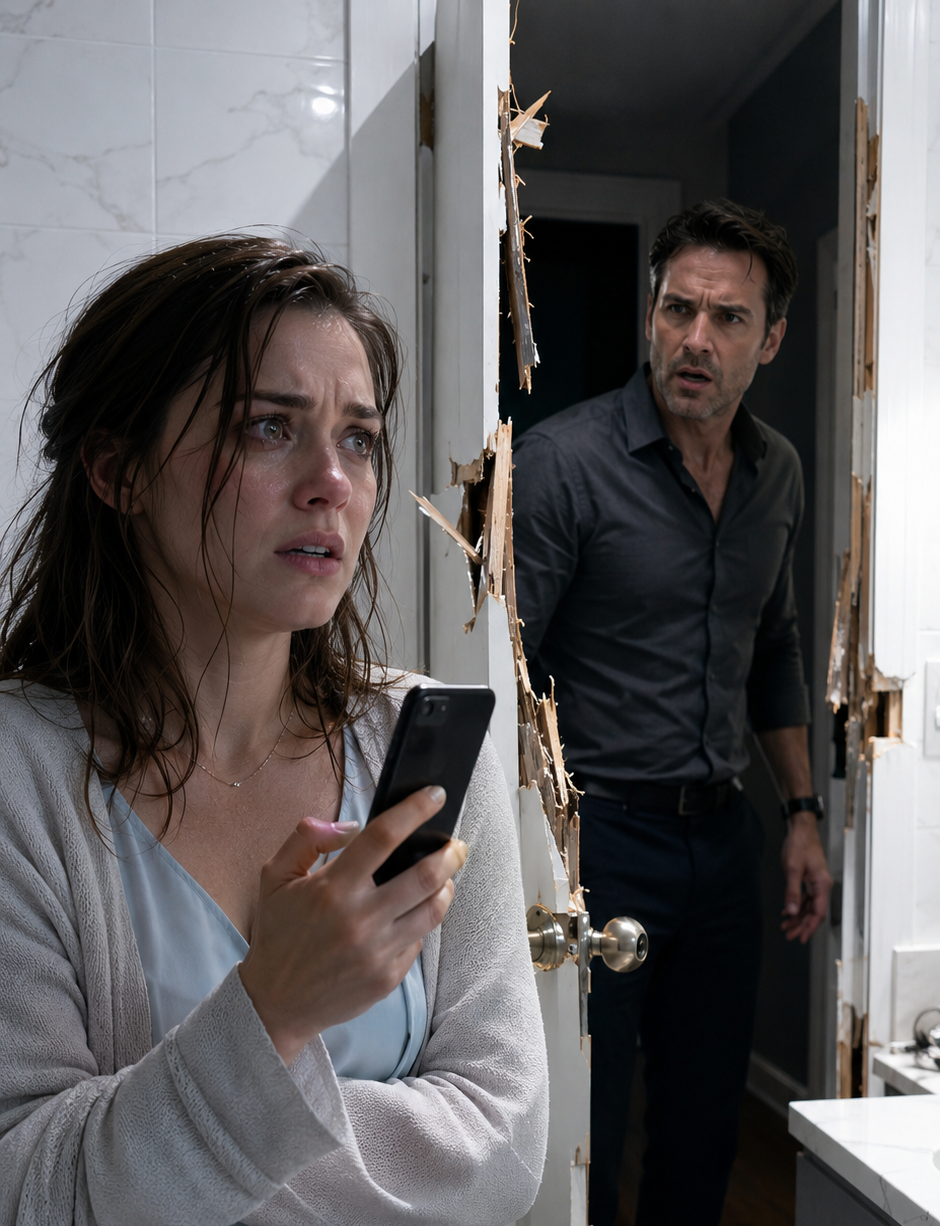
The bathroom door flew inward with a crack that seemed to split the whole apartment in two.
For one suspended second, Lena did not scream.
She only stared at the splintered wood, at the broken lock hanging from one screw, at the shadow filling the doorway.
Her husband stood there breathing hard, his shirt wrinkled, his eyes glassy with drink and disbelief.
The phone was still pressed to her ear.
“Eight minutes?” he said, his mouth twisting when he saw it.
“Who did you call, Lena?”
She tried to pull the phone closer to her chest, but pain tore through her so sharply that her vision went white.
“Give me the phone.”
His voice lowered.
That had always frightened her more than shouting.
Shouting meant anger.
Quiet meant decision.
On the other end of the call, Vincent Moretti spoke only once.
“Lena,” he said, calm as winter, “put the phone on speaker.”
Her thumb shook as she tapped the screen.
Her husband took one step into the bathroom.
Then Vincent’s voice filled the tiny room.
“Daniel Harper.”
Daniel froze.
It was not fear at first.
It was confusion.
Then recognition arrived slowly, draining color from his face as though someone had opened a hidden valve beneath his skin.
Lena blinked through her tears.
Daniel had always seemed invincible inside these walls.
He controlled the money, the locks, the neighbors’ impressions, the story everyone else believed.
Yet the sound of his own name spoken by a stranger had stopped him in place.
“Who is this?” Daniel asked, but the arrogance had thinned.
“You know who it is.”
Lena heard movement behind Vincent, a car door closing, the murmur of another man asking something too low for her to understand.
Daniel swallowed.
“This is a private matter.”
“No,” Vincent replied.
“It became mine when she asked for help.”
Something passed across Daniel’s face then, something Lena had never seen there before.
Not regret.
Not shame.
Calculation.
He looked from the phone to Lena, then to the broken bathroom door, as if suddenly noticing the evidence scattered around him.
He straightened and forced a laugh.
“She’s being dramatic,” he said.
“She slipped.
She gets emotional.”
Lena stared at him.
Even now, even with her arm bent unnaturally and blood drying along her wrist, he could build a lie without pausing.
Vincent did not raise his voice.
“Step away from her.”
Daniel’s jaw tightened.
“You don’t give orders in my home.”
“No,” Vincent said.
“But the police arriving behind me will ask why your wife is locked in a bathroom with a broken arm.”
The words struck the room differently.
Police.
Lena’s heartbeat stuttered.
She had imagined many endings to this night in the long seconds after making the call.
She had imagined Vincent arriving like the rumor people made him out to be, all shadows and punishment.
She had imagined Daniel becoming even more dangerous.
She had imagined not making it at all.
She had not imagined police.
Daniel’s eyes darted toward the hallway.
Vincent continued, “The ambulance is two minutes out.
Officers are closer.
You can stand still and keep your hands where they can see them, or you can explain why you ran.”
Daniel’s face twisted with resentment.
For a moment, Lena thought he might lunge anyway.
Then the faint wail of sirens drifted up from the street.
It was distant, but real.
Daniel heard it too.
The apartment seemed to hold its breath.
He backed out of the bathroom doorway slowly, palms raised in mock surrender, but his eyes never left Lena.
They held a promise that made her stomach turn cold.
“You’ll regret this,” he mouthed.
She closed her eyes.
Vincent’s voice came through the phone again, softer this time.
“Lena, stay with me.”
“I’m here,” she whispered.
“You did well.”
No one had said that to her in years.
The sirens grew louder.
Doors opened somewhere down the hall.
A neighbor’s startled voice floated through the apartment, followed by heavy footsteps and someone calling Daniel’s name.
Lena could not follow everything after that.
Pain had become a tide pulling her away from the room.
She remembered blue uniforms.
She remembered an officer kneeling beside her, careful and kind, asking if she could tell him her name.
She remembered Daniel protesting from the living room, his voice polished now, almost offended.
She remembered someone placing a blanket over her shoulders.
Then she remembered Vincent.
Not as a rumor.
Not as a name printed in gold on a black card.
As a man standing in the ruined doorway of her bathroom, wearing a dark coat dusted with rain, his expression unreadable except for his eyes.
They were not cold when they found her.
They were tired.
And beneath that, unmistakably relieved.
“You came,” she said, though she was not sure if she spoke aloud.
Vincent crouched far enough away that no one could accuse him of interfering, close enough that she could see the faint scar along his jaw.
“You called,” he answered.
That was the last thing she remembered before the paramedics lifted her onto the stretcher.
When Lena woke, the world smelled like antiseptic and rain.
For a few confused seconds, she did not know where she was.
The ceiling above her was white.
A machine beeped steadily somewhere near her shoulder.
Her broken arm was wrapped and supported, heavy with a dull ache that felt distant compared with the earlier fire.
Then memory returned.
Daniel.
The bathroom.
The call.
Her body went rigid.
A nurse appeared at once, gentle hands adjusting the blanket.
“You’re safe, Lena.
You’re at St.
Catherine’s.
Surgery went well.”
“Surgery?”
“Your arm needed to be set properly.
You also had two bruised ribs and a mild concussion.
You’re going to heal, but you need rest.”
Lena tried to sit up.
The room tilted.
“Daniel?”
The nurse’s expression became careful.
“He’s in custody.”
Lena let the words sink in.
In custody.
Not at work, charming a supervisor.
Not in the living room, waiting for her silence.
Not beside her hospital bed, explaining what she was allowed to say.
In custody.
Her eyes filled before she could stop them.
The nurse squeezed her good hand.
“There’s someone outside who’s been waiting.
He said he won’t come in unless you ask.”
Lena knew before the nurse said his name.
Outside the narrow window, morning had colored the city in gray and silver.
Rain tapped softly against the glass, blurring the tops of buildings.
Everything looked ordinary, which somehow made it harder to believe her life had changed overnight.
“Vincent?” she asked.
The nurse nodded.
Lena hesitated.
Calling him had been desperation.
Letting him into this room felt like a decision.
For years, every choice had been trained out of her.
What to wear.
How much to spend.
Who to speak to.
Whether a smile lasted too long or not long enough.
Now a nurse was waiting for her answer, and the simple power of it unsettled her.
“Yes,” Lena said finally.
“He can come in.”
Vincent entered without drama.
He carried no flowers, no grand gesture.
Only a paper cup of coffee in one hand and a folded coat over his arm, as if he had been standing in a hallway for hours pretending he had somewhere else to go.
In daylight, he looked different.
Not less intimidating, exactly, but more human.
There were shadows beneath his eyes.
His dark hair was damp from the rain.
His suit jacket was gone, leaving him in a white shirt with the sleeves rolled to his forearms.
He stopped near the foot of the bed.
“How are you feeling?”
Lena almost laughed, but it came out as a breath.
“Like someone dropped a building on me.”
A faint smile touched his mouth and vanished.
“That sounds accurate.”
Silence settled between them, awkward at first, then strangely steady.
“Why did you call the police?” she asked.
His eyes lifted to hers.
“Because that is what should have happened.”
She looked away.
“I thought…”
“I know what you thought.”
Of course he did.
Everyone knew what people said about Vincent Moretti.
Some of it was whispered in fear, some with fascination, some by people who enjoyed turning other people into legends because legends were simpler than human beings.
“You gave me that card,” Lena said.
“I never understood why.”
Vincent looked toward the rain-streaked window.
“You reminded me of someone.”
“Who?”
He was quiet long enough that she wondered if he would answer.
“My sister.”
Lena turned back to him.
His face had changed.
Not dramatically, not enough for someone passing in the hallway to notice, but she saw the small tightening around his eyes.
“She worked nights too,” he said.
“A bakery in Queens.
She smiled at everyone, even when she was exhausted.
She thought kindness was something you gave away before anyone had the chance to earn it.”
Lena did not speak.
“She married a man who needed the world to think he was respectable,” Vincent continued.
“At home, he needed her afraid.
By the time she asked for help, she thought no one would believe her.”
The beeping machine seemed suddenly too loud.
“What happened to her?”
Vincent’s gaze lowered to the coffee cup in his hand.
“She survived.
But she left New York and never came back.”
It was not the answer Lena expected.
There was no dramatic tragedy, no dark confession.
Only survival.
Distance.
A life altered so completely that returning to the place of hurt was impossible.
“I’m sorry,” Lena said.
“So am I.”
The door opened before either of them could say more, and a woman in a navy blazer stepped inside carrying a folder.
She introduced herself as Mara Ellis, a victim advocate assigned through the hospital.
Her voice was warm but practical, the kind of voice that did not rush pain but did not let it drown the room either.
She explained options.
A protective order.
Emergency housing.
StatemenTS.
Photographs of injuries.
Legal support.
Each phrase felt enormous.
Lena listened, fingers gripping the blanket, while Vincent stepped back toward the wall as if removing himself from the conversation.
He did not speak for her.
He did not decide for her.
He simply stayed.
That, more than anything, made Lena trust him a little.
When Mara asked whether Lena had somewhere safe to go after discharge, Lena opened her mouth and closed it again.
Their apartment was not safe.
Her coworkers were kind, but none knew the truth.
Daniel had made sure her friendships remained shallow, harmless, easy to dismiss.
Her parents were gone.
Her aunt in Pennsylvania had not heard from her in two years, because Daniel disliked the woman and Lena had eventually stopped calling to avoid argumenTS.
“I don’t know,” Lena admitted.
Mara nodded as if this answer was common and not shameful.
“That’s okay.
We’ll build from there.”
Vincent spoke then, his voice measured.
“There’s a guest apartment in a building I own.
Private entrance.
Security.
She can stay there as long as she needs.”
Mara looked at Lena, not Vincent.
“Would that feel safe to you?”
Lena appreciated that more than she could say.
She studied Vincent.
“No conditions?”
His eyebrows drew together.
“None.”
“No favors I’ll owe?”
“None.”
“No one telling me what to do?”
A pause.
Then Vincent said, “Only doctors.
They tend to insist.”
Despite everything, Lena smiled.
It hurt her ribs, but she smiled.
Two days later, she left the hospital wearing borrowed clothes and a sling that made every movement slow and awkward.
Mara walked her through paperwork.
A detective took her statement.
The process was exhausting, but no one laughed.
No one asked what she had done to provoke him.
No one suggested she return home and calm things down.
Daniel had been released with strict conditions pending the next hearing, but he was barred from contacting her.
The detective told her there would be consequences if he tried.
Lena wanted to believe that.
Belief, she was learning, did not arrive all at once.
It came in pieces.
The guest apartment was on the fourth floor of a brick building near Riverside Park.
It was smaller than the apartment she had shared with Daniel, but sunlight entered through tall windows, and the front door had three locks she controlled herself.
On the kitchen table sat groceries, a vase of white daisies, and a note from Mara with appointments and phone numbers.
Vincent’s driver, an older man named Sal, carried her bag inside and placed the keys on the counter.
“Mr. Moretti said I’m to give these to you and leave,” Sal said.
“He also said to tell you the locks were changed this morning and no one else has copies except building security.”
Lena picked up the keys.
They were ordinary brass keys, warm from Sal’s palm.
They felt like something sacred.
“Thank you,” she said.
Sal nodded, then hesitated at the door.
“There’s soup in the fridge.
My wife made it.
She said hospital food makes people sad.”
Lena’s throat tightened.
“Please thank her.”
When he left, the apartment became quiet.
For the first time in five years, quiet did not mean danger waiting to reveal itself.
Lena walked from room to room, touching nothing at first.
The bedroom had a quilt folded across the foot of the bed.
The bathroom mirror was spotless.
The living room held a worn blue sofa and a bookshelf with three novels, a city guide, and an empty ceramic bowl shaped like a lemon.
She laughed softly at the bowl.
Then she sat on the floor and cried until her ribs ached.
Not because she wanted to go back.
Because she finally could not.
Recovery turned out to be less like freedom and more like learning a language she had once known as a child.
The first week, Lena jumped every time someone knocked.
She kept the lights on at night.
She checked her phone obsessively even though Daniel’s name never appeared.
Sometimes she woke convinced she had heard the bathroom door cracking again.
Mara called daily at first, then every other day.
She helped Lena contact the diner.
Lena expected impatience from her manager, a brisk woman named Gloria who could balance six plates on one arm and remember every regular’s order.
Instead, Gloria said, “You should have told me.”
Lena closed her eyes.
“I didn’t know how.”
“Well,” Gloria replied, voice thick, “now you do.
You call me.
Any hour.
I mean it.”
The diner staff sent cards.
One cook drew a cartoon pancake flexing its arms and wrote, Heal up, boss.
Lena taped it to the refrigerator and found herself looking at it whenever the apartment felt too empty.
Vincent visited only twice in those first two weeks.
The first time, he brought documents from Mara that had accidentally been sent to his office.
He stood in the hallway until Lena invited him in.
He noticed the cartoon pancake and nodded solemnly, as if greeting a respected colleague.
“The pancake looks strong,” he said.
“It has better arms than I do right now.”
“That is a temporary advantage.”
The second time, he came because Lena called him.
She had not planned to.
But the number remained in her phone, and one night after a nightmare, she found herself staring at it.
She did not want rescue.
She did not want protection.
She wanted to ask the question that had been growing since the hospital.
When Vincent answered, he did not sound surprised.
“Is something wrong?”
“No,” she said quickly.
“I mean, yes.
But not tonight.
Not like before.”
“Tell me.”
She sat beside the window, watching rain turn the streetlights blurry.
“Why were you already close that night?”
Silence.
It was brief, but Lena felt it.
“What do you mean?” he asked.
“You said eight minutes.
The hospital was across town from your office.
The diner is downtown.
My apartment wasn’t near either.
But you were there in eight minutes.”
Vincent exhaled slowly.
“Lena—”
“Please don’t lie to me.”
The words came out stronger than she expected.
On the other end, something shifted.
Not annoyance.
Respect, perhaps.
“I wasn’t at my office,” he said.
“Where were you?”
“Outside your building.”
Her hand tightened around the phone.
The apartment seemed to shrink around her.
“Why?”
“I had someone watching Daniel.”
Lena stood too fast and gasped when her ribs protested.
“You what?”
“Not you,” he said.
“Daniel.”
“That doesn’t make it better.”
“I know.”
The honesty disarmed her for half a second, but only half.
“You had no right.”
“I know that too.”
“Then why?”
Vincent did not answer immediately.
In the silence, Lena heard the faint hum of traffic beyond the glass.
“Because his name came across my desk three weeks before you called,” Vincent said.
That stopped her.
“How?”
“He borrowed money from the wrong people.
Not from me.
Someone worse.
Someone careless.
He used your name on paperwork connected to the debt.”
Lena sank back onto the sofa.
“My name?”
“Yes.”
“I never signed anything.”
“I believe you.”
Her mouth went dry.
Daniel had always controlled their mail.
He said bills confused her.
He said paperwork was his responsibility because he was the practical one.
She had accepted this at first because it seemed easier, then because questioning him made life harder.
“What kind of paperwork?”
“I don’t have all of it yet.”
“Vincent.”
“I’m finding out.”
Lena closed her eyes.
Anger rose slowly, not hot and explosive, but steady and clean.
“He broke my arm,” she said.
“He emptied my savings.
He told everyone I was fragile and forgetful.
And now you’re telling me he may have put my name on a debt?”
“Yes.”
The word was quiet.
For a moment, Lena could not speak.
Then she said, “I need to know everything.”
“You will.”
“No.
I need to know without being handled.”
Another pause.
“All right,” Vincent said.
“Tomorrow.
I’ll bring what I have.”
He arrived the next afternoon with Mara, which made Lena trust the meeting more than she wanted to admit.
They sat at the kitchen table with tea growing cold between them while Vincent laid out copies of documenTS.
Lena stared at her own signature on a loan agreement she had never seen.
It was close enough to hurt.
Not perfect.
Daniel had missed the way her L curved at the bottom, the way she sometimes pressed too hard on the final letter of her last name.
But anyone glancing quickly might believe it.
The amount made her dizzy.
Mara placed a steady hand near Lena’s cup.
“Forged signatures can be challenged.”
Lena nodded, though the numbers blurred.
Vincent slid another paper forward.
“There’s more.”
She looked at him.
“Daniel didn’t act alone.”
The room chilled.
“Who helped him?”
“I don’t know yet.”
Mara frowned.
“But you suspect someone?”
Vincent’s expression hardened—not with anger, but concentration.
“The notary stamp is real.”
Lena stared at the seal.
“So someone verified me when I wasn’t there?”
“Yes.”
“Who?”
Vincent tapped the name beneath the stamp.
Elaine Porter.
Lena read it once.
Twice.
Then all the air left her lungs.
Mara noticed.
“You know her?”
Lena nodded slowly.
Elaine Porter was not a stranger from some dim office Daniel visited in secret.
Elaine volunteered twice a week at the community center where Lena sometimes picked up donated winter coats for the diner’s holiday drive.
She was friendly in the polished way some people were friendly from a distance, all neat scarves and sympathetic smiles.
And she had known Daniel.
Not well, Lena had thought.
Just enough to wave when he picked her up once outside the center.
Just enough for him to charm her, as he charmed everyone.
“She told me I was lucky,” Lena whispered.
Vincent’s eyes sharpened.
“When?”
“Last winter.
Daniel came to get me after a coat drive.
Elaine watched him open the car door for me.
She said I was lucky to have a husband who cared so much.”
The memory landed differently now.
Elaine’s smile.
Daniel’s hand at Lena’s back.
The pressure of his fingers warning her not to say the wrong thing.
Mara wrote something down.
“Would she have had access to your identification?” Vincent asked.
Lena thought hard.
“Maybe.
The center made copies for volunteers once.
Background forms.
Emergency contacTS. I filled everything out there.”
“Daniel knew that?”
“He picked me up that day.”
Vincent leaned back, his face unreadable.
For the first time since the bathroom, Lena felt something larger than Daniel taking shape around her.
Not a monster.
Not a conspiracy from a movie.
Something quieter and more believable, which made it worse.
A favor.
A forged stamp.
A woman who preferred a charming man’s story to an injured woman’s silence.
“What do I do?” Lena asked.
Mara answered first.
“We document.
We report the forgery.
We build a record.”
Vincent nodded.
“And you do not speak to Elaine alone.”
Lena almost bristled at the instruction, then heard the concern beneath it.
“I won’t,” she said.
But that night, after Mara left and Vincent’s car disappeared from the curb, Lena sat at the kitchen table staring at Elaine Porter’s name until the letters stopped looking real.
She should have been frightened.
She was frightened.
But beneath that, something else had begun.
For years, Lena had believed survival meant becoming smaller.
Taking up less space.
Asking fewer questions.
Wanting less.
Now the opposite seemed true.
Survival meant looking directly at what had been done.
It meant naming papers, people, signatures, lies.
The next morning, she called Gloria at the diner.
“I’m not ready to come back,” Lena said.
“I didn’t ask you to.”
“I know.
But I need something.”
“What?”
Lena looked at the folder on her table.
“Do you remember Elaine Porter from the holiday coat drive?”
Gloria made a thoughtful sound.
“Fancy scarves? Talks like she’s being interviewed?”
“That’s her.”
“Sure.
Why?”
“Did Daniel ever come into the diner with her?”
Silence.
Lena sat straighter.
“Gloria?”
“I thought you knew.”
Her stomach tightened.
“Knew what?”
“He came in once, maybe two months ago.
Afternoon shift.
I wasn’t working the counter, but I saw him in the back booth with a woman.
I thought it was work.
He had papers spread out.”
“What did she look like?”
“Blond.
Neat.
Green coat.”
Elaine.
Lena closed her eyes.
“Did he see you?” Gloria asked.
“No,” Lena whispered.
“I didn’t see him.”
Because two months ago, Daniel had insisted she take extra shifts to cover bills he claimed she had caused by being careless with money.
While she worked until her feet throbbed, he had sat in her diner with Elaine and papers bearing Lena’s name.
“Lena,” Gloria said, gentler now, “there’s something else.”
Lena gripped the phone.
“What?”
“He wasn’t just with her.
There was a man too.
Older.
Gray hair.
Expensive coat.
I remember because he didn’t eat anything.
Just watched the door.”
Lena wrote it down with shaking fingers.
“Would the security cameras still have it?”
“Maybe.
The owner hates deleting anything.
I’ll ask.”
“Don’t tell him why,” Lena said quickly.
“I won’t.”
After they hung up, Lena called Mara, then Vincent.
By evening, the quiet guest apartment had become a small command center of careful facTS. Dates.
Names.
ReceipTS. A possible video.
Nothing dramatic enough to solve everything, but enough to prove Daniel’s betrayal had rooTS.
At seven, Vincent arrived with dinner he claimed Sal’s wife had insisted on sending.
Lena opened the door wearing a cardigan over her sling, her hair tied messily at the nape of her neck.
For the first time, she did not feel embarrassed to be seen tired.
“You look different,” Vincent said.
She arched an eyebrow.
“That’s a dangerous thing to say to a woman recovering from surgery.”
“I meant stronger.”
She let him in.
“That’s also dangerous, but acceptable.”
Over soup and bread, they talked about the diner, about Vincent’s sister’s bakery, about Mara’s calm ability to make terrifying paperwork sound manageable.
Lena learned that Vincent hated olives, read old history books, and had once wanted to become an architect before family obligations pulled him elsewhere.
He learned that Lena used to paint small watercolor cityscapes, that she loved lemon desserts, and that she could identify most customers by the sound of their footsteps before they reached the counter.
For nearly an hour, Daniel’s name did not enter the room.
When it did, Lena was the one who spoke it.
“I’m afraid he’ll talk his way out.”
Vincent set down his spoon.
“He might convince some people.
Not everyone.”
“He convinced me once.”
“That doesn’t mean you were foolish.”
She looked at him sharply, expecting pity.
There was none.
“It means he studied what you needed and pretended to be it,” Vincent said.
“People like Daniel don’t begin with cruelty.
They begin with attention.”
The truth of it made her eyes sting.
“He brought me soup when I had the flu,” she said.
“On our third date.
I thought no one had ever taken care of me like that.”
“Maybe that moment was real for you.”
“But not for him.”
Vincent was quiet.
“Maybe parts of him wanted to be that man.
Wanting is not the same as choosing.”
Lena looked down at her bandaged arm.
No one had ever explained Daniel in a way that did not make her feel responsible for misunderstanding him.
Later, after Vincent left, Lena slept five hours without waking.
The next day, Gloria called.
“We found the footage.”
Lena’s pulse quickened.
“Can you send it?”
“I already sent it to Mara.
Honey, you need to prepare yourself.”
“For what?”
Gloria hesitated.
“The older man in the expensive coat.
I’ve seen him before.”
“Where?”
“On the news.”
Within the hour, Mara confirmed it.
The man in the diner footage was Arthur Bell, a private financial consultant whose clients included several city officials, developers, and charities.
He was respectable in the way Daniel had always tried to be respectable, polished by expensive lighting and better connections.
Elaine Porter had notarized the forged loan.
Arthur Bell had sat at the table.
Daniel had brought the papers.
And Lena’s name had become the bridge between them.
That evening, Vincent called to tell her not to open the door for anyone unexpected.
“Already planning not to,” Lena said.
“I’m serious.”
“So am I.”
There was a pause.
“Good.”
She almost smiled.
“You sound surprised.”
“No.
Just pleased.”
After they hung up, Lena made tea and sat by the window.
The city below moved in ordinary patterns: taxis hissing over wet pavement, umbrellas bobbing like dark flowers, strangers heading home with groceries and briefcases and private worries of their own.
For the first time, Lena wondered what her life might look like after all this.
Not immediately.
Not magically.
But eventually.
A room with sunlight.
A job she chose.
A phone that did not make her flinch.
Maybe paint on her fingers again.
Maybe friends who knew the truth and stayed.
The thought was fragile, but it was hers.
At 9:14 p.m., someone slipped an envelope under her door.
Lena did not move at first.
The envelope came to rest on the hardwood with a soft whisper.
No knock followed.
No footsteps lingered.
Her heart began to pound.
She called building security, then Vincent.
While she waited, she stood across the room staring at the envelope as if it might breathe.
Security arrived first, a broad-shouldered woman named Denise who checked the hallway and found no one.
Vincent arrived six minutes later, rain on his coat and worry held tightly behind his eyes.
 Ex-Husband Tries To Get Back At Her After Their Divorce, But Her Brother Has A Hilarious Payback
“You didn’t touch it?” he asked.
“No.”
“Good.”
Denise put on gloves and lifted the envelope.
There was no address, only Lena’s first name written in blue ink.
Not Daniel’s handwriting.
Not Elaine’s.
Something about it made the back of Lena’s neck prickle.
Inside was a single photograph.
Denise held it under the light.
Lena stepped closer, then stopped.
It was an old picture, slightly faded, taken outside a summer street fair.
A little girl of about seven stood holding a paper cup of lemonade, squinting in the sun.
Beside her was a woman Lena recognized with a force that nearly knocked her backward.
Her mother.
Younger than Lena remembered, laughing at something beyond the frame.
On the other side of the little girl stood a teenage boy in a black T-shirt, thin and serious, with dark eyes that looked too familiar.
Lena slowly turned toward Vincent.
He had gone completely still.
On the back of the photograph, someone had written seven words.
Ask Vincent what happened to your mother.
Lena’s voice came out barely above a whisper.
“Vincent… why are you in this picture?”
He looked from the photograph to her, and for the first time since she had known him, the most feared man in New York looked afraid to answer.
Part 3
The bathroom door burst inward with a sound like the whole apartment had split in two.
Splinters skittered across the tile.
The doorknob struck the wall and bounced once before rolling near the sink.
Cold hallway light spilled over me, bright and cruel, and for one frozen second, I could only stare at the broken frame while my husband filled the doorway.
Daniel was breathing hard.
His shirt was wrinkled, his hair damp with sweat, and one hand still gripped the side of the shattered door as if he had conquered something.
His eyes dropped to the phone clutched against my ear.
Then he smiled.
“Who did you call, Lena?”
I pressed myself harder against the bathtub, my broken arm cradled against my stomach.
The pain was no longer sharp.
It had become a great white noise inside my body, drowning out everything except the phone still warm against my cheek.
Vincent’s voice came through, low and steady.
“Put him on.”
Daniel heard it.
His smile faltered.
For the first time that night, uncertainty crossed his face.
I swallowed.
“He wants to talk to you.”
Daniel laughed too loudly, the kind of laugh a person uses when they are trying to prove they are not afraid.
He stepped into the bathroom and reached for the phone.
I flinched before I could stop myself.
He saw it.
Something flickered in his expression, almost like satisfaction, and then he snatched the phone from my trembling hand.
“Who is this?” Daniel snapped.
I could not hear Vincent’s answer clearly, but I saw the effect of it.
Daniel’s shoulders stiffened.
His face changed so quickly it might have been a trick of the light.
The anger remained, but something else slipped beneath it.
Recognition.
Alarm.
The kind of fear men like Daniel pretended belonged only to other people.
“No,” Daniel said, forcing another laugh.
“No, that’s not funny.”
Vincent spoke again.
Daniel’s eyes moved toward me, then toward the apartment door.
Outside, somewhere far below on the street, tires hissed against wet pavement.
The city continued as if nothing were happening in our little fifth-floor apartment, as if a woman were not sitting on a bathroom floor with her life balanced between one phone call and eight impossible minutes.
Daniel lowered his voice.
“You don’t know anything about this.”
Vincent answered.
This time, Daniel said nothing.
He handed the phone back to me as though it had burned him.
I pressed it to my ear with my good hand.
“Lena,” Vincent said.
“Are you still with me?”
“Yes.”
“Good.
Listen carefully.
Move as far from him as you can.
Do not argue.
Do not explain.
Help is at your door in less than a minute.”
Less than a minute.
The words entered me like oxygen.
Daniel backed into the hallway, staring at the front door now.
“You think you’re clever?” he said, but his voice had lost its weight.
“You have no idea what you’ve done.”
I did not answer.
For years, answering had been my habit.
Explaining.
Apologizing.
Softening.
Tonight, silence felt like a door I had finally learned to lock.
A heavy knock struck the apartment door.
Daniel froze.
Another knock followed, deeper than the first.
“Daniel Reed,” a man called from the hall, calm and clear.
“Open the door.”
Daniel looked at me, then at the broken bathroom door, then toward the entryway.
His mouth opened, but no words came.
The knock came again.
“Open it,” the man said.
“Now.”
Daniel moved as if pulled by strings.
I heard the chain slide, the deadbolt turn, and then the apartment filled with unfamiliar voices.
Not shouting.
That surprised me most.
I had imagined chaos.
Loud threaTS. Some terrible scene that would make the neighbors peek through their doors and whisper for monThS. Instead, the men who entered spoke in measured tones, the way paramedics speak around a dangerous staircase or firefighters around smoke.
“Step away from her.”
“I didn’t—”
“Hands where we can see them.”
“I said step away.”
There was a rustle, a chair scraping, Daniel protesting in a voice that sounded smaller with every word.
Then the hallway cleared.
A man appeared in the bathroom doorway.
He was not Vincent.
He was younger, broad-shouldered, with a dark coat dripping rainwater onto the tile.
His expression softened the moment he saw me.
He crouched, keeping both hands visible.
“My name is Luca,” he said.
“Mr. Moretti sent me.
You’re safe right now.”
Safe.
I wanted to believe him so badly that tears blurred the edges of his face.
“My arm,” I whispered.
“I know.
An ambulance is downstairs.
We’re going to move slowly.”
“I can’t stand.”
“You don’t have to.”
He stepped aside, and two paramedics entered with a folding stretcher and a medical bag.
A woman with kind eyes knelt beside me.
“Hi, Lena.
I’m Mara.
I’m going to help you breathe through this, okay?”
I nodded, then immediately regretted the movement as pain rippled through me.
Mara touched my shoulder gently.
“Eyes on me.
In through your nose.
Out slowly.
That’s it.”
Behind her, I heard Daniel.
“This is my apartment.
She’s my wife.
You can’t just come in here.”
Then Vincent’s voice answered from somewhere near the front door.
“I can when she asks for help.”
Everything inside me went still.
He had come.
Not sent help.
Not made a call from some distant office.
He was there.
The most feared man in New York stood in the apartment where I had once believed no one would ever hear me.
I turned my head as much as I could.
Vincent Moretti stepped into view.
He wore a black overcoat dampened by rain, his silver-streaked hair combed back, his face as composed as it had been that night in the diner.
But his eyes were different now.
They were not the cold eyes the newspapers described.
They were focused, watchful, and quietly furious in a way that did not need to announce itself.
He looked at me, and the anger left his face just enough for something gentler to appear.
“Lena,” he said.
I tried to speak, but all that came out was a broken breath.
He did not come closer until Mara glanced at him and nodded.
Then Vincent knelt outside the shattered doorway.
“You did the right thing,” he said.
Those six words undid me.
I cried then.
Not gracefully.
Not quietly.
I cried like someone who had been holding a heavy door closed for years and finally felt someone stronger take hold of the other side.
Vincent did not tell me to stop.
He did not tell me I was safe forever or that everything was fine.
He simply stayed there while Mara and the other paramedic secured my arm and prepared to carry me out.
As they lifted me, Daniel tried once more.
“Lena,” he said, his voice suddenly soft.
“Tell them this got out of hand.
Tell them we were arguing.
You know how you get when you’re upset.”
I turned my face toward him.
He stood near the kitchen with Luca beside him and another man by the door.
His hands were visible.
His confidence was not.
He looked almost ordinary now, and that frightened me in a different way.
How many times had I mistaken ordinary for harmless?
For years, I would have said what he wanted.
For years, I would have saved him from consequences just to survive the next hour.
But Vincent’s words still rested inside me.
You did the right thing.
“No,” I said.
It was barely a whisper, but everyone heard it.
Daniel stared as though the word had come from a stranger.
Maybe it had.
Maybe the Lena who always apologized had been left behind on that bathroom floor.
Mara squeezed my good hand.
“That’s enough for now.
Let’s get you downstairs.”
As they carried me through the apartment, I saw pieces of my life in flashes.
A mug I had glued back together because Daniel hated waste.
A framed wedding photo turned slightly crooked from the impact of the door.
The little jar of tip money hidden behind the flour canister, which I had once believed might someday buy me a bus ticket out of the city.
Vincent noticed where my gaze lingered.
Without asking, he said to Luca, “Her purse, coat, and anything personal from the bedroom.
Carefully.”
Daniel began to object, then looked at Vincent and thought better of it.
At the doorway, I looked back one last time.
The bathroom door hung broken.
The hallway light flickered.
Daniel stood beneath it, smaller than the shadow he had cast over my life.
Then the paramedics carried me into the hall.
Neighbors had opened their doors.
Mrs. Alvarez from 5B covered her mouth when she saw me.
Mr. Patel from upstairs lowered his eyes, shame coloring his face.
They had heard things.
I knew they had.
Everyone had.
But tonight, no one pretended not to see.
Outside, rain washed the sidewalk into shining black glass.
Red and white ambulance lights glowed against the buildings.
Vincent walked beside the stretcher, one hand in the pocket of his coat, the other holding my phone.
“You don’t have to come,” I whispered.
He looked down at me.
“Yes,” he said.
“I do.”
At the hospital, everything became bright.
Bright lighTS. White sheeTS. Silver rails.
Voices asking questions gently but firmly.
A doctor examined my arm.
Nurses cleaned the cuts on my hand and temple.
Someone from social services arrived with a folder, a soft cardigan, and eyes trained not to show shock.
I expected Vincent to disappear once I was inside.
Men like him did not sit in emergency rooms under fluorescent lights with vending machines humming nearby.
But when they moved me into a curtained bay, he was there.
Not too close.
Never in the way.
He sat in a plastic chair outside the curtain with Luca standing near the wall, both of them speaking quietly to hospital security and then to two police officers who arrived just before midnight.
I could hear enough to understand.
No threaTS. No favors.
No strange influence.
Just facTS.
“She called for help.”
“We arrived after the door was forced open.”
“The paramedics can confirm her condition.”
“The neighbor on the fifth floor witnessed him resisting assistance.”
Vincent Moretti, the man everyone feared, was careful with the law when my life depended on it.
That confused me more than anything.
After the doctor set my arm and gave me medicine for the pain, the world softened at the edges.
Mara had left, but the woman from social services remained.
Her name was Claire.
She sat beside my bed and spoke in a voice that never hurried.
“Do you have somewhere safe to go tonight?”
I looked toward the curtain.
I had no family in New York.
My mother lived in Ohio and believed my marriage was strained but manageable because that was the story I had given her.
My younger brother had not spoken to me in two years after Daniel convinced me he was a bad influence.
My friends from the diner knew pieces of the truth, but none of them had a spare room where Daniel would not think to look.
“I don’t know,” I said.
Claire nodded as if that answer made sense.
“That’s okay.
We have options.”
The curtain moved slightly.
Vincent stood outside, not entering until Claire looked at me and asked, “Is it alright if he comes in?”
I should have said no.
Not because I was afraid of him exactly, but because everyone knew his name.
Everyone knew the stories.
A safer life could not possibly begin with a man like Vincent Moretti sitting beside a hospital bed.
And yet he had come when I called.
“Yes,” I said.
Vincent stepped inside.
He had removed his overcoat.
His white shirt sleeves were buttoned neatly at the wrisTS. Without the coat, he looked less like a headline and more like a tired man who had spent too many years in rooms where trust was expensive.
Claire studied him.
“Mr. Moretti, we’re discussing safe placement.”
“I have a guesthouse in Queens,” he said.
“Private entrance.
Staffed.
No one will bother her.”
Claire’s expression tightened.
I understood her concern before she voiced it.
“Lena needs independence, not another person controlling her access to the world.”
Vincent accepted that without offense.
“Then make the arrangements you think best.
I will cover the cost anonymously if she permits it.
She owes me nothing.”
I stared at him.
Nothing.
No one had said that to me in years without eventually naming a price.
Claire looked at me.
“How do you feel about that?”
I looked at Vincent.
“Why?”
He seemed to know exactly what I was asking.
Why give me the card?
Why answer?
Why come?
Why care?
His eyes moved briefly to the bandage on my arm.
“Because someone once called for help in my house,” he said quietly, “and no one came in time.”
The room changed.
Claire softened but did not interrupt.
Vincent looked away, toward the narrow hospital window where rain traced silver lines down the glass.
“My sister,” he said.
“Her name was Rosa.”
I had never heard his voice sound like that.
Not weak.
Not broken.
Just open in a place that looked painful.
“She was eighteen.
She hid things from us because she thought our family had enough trouble.
By the time I understood, it was too late to undo what silence had allowed.”
I forgot my own pain for a moment.
“The card,” I whispered.
“I give very few of those.” He looked back at me.
“Only when I recognize a look.”
“What look?”
“The look of someone measuring every word before they speak.”
Tears burned again, but this time they came quietly.
Claire closed her folder halfway.
“Lena, there’s a protected residence affiliated with the hospital.
It is small, confidential, and staffed by people trained for this.
You can stay there tonight.
Tomorrow, we can discuss longer-term plans.”
I looked at Vincent.
He nodded once.
“That is a good choice.”
I almost laughed from exhaustion.
“You approve?”
For the first time, something like a smile touched his mouth.
“I am learning not to give orders in hospital rooms.”
Claire smiled too.
That tiny moment of warmth felt impossible after everything that had happened, and because it felt impossible, I held on to it.
Near dawn, after the police took my statement and the hospital completed its paperwork, Claire arranged transport to the protected residence.
Vincent waited in the hallway while I signed forms with my good hand.
Before I left, he handed me my purse.
“Luca found this behind the flour,” he said.
Inside was my little jar of tip money, wrapped in a clean dish towel.
I stared at it.
“He would have thrown it away.”
“I assumed it mattered.”
“It was supposed to be my escape fund.”
“Then keep it,” Vincent said.
“Not because you need it now.
Because it proves you were already trying.”
I clutched the purse against me.
At the residence, I slept for fourteen hours.
When I woke, sunlight filtered through pale curtains.
My arm rested in a sling.
My ribs ached when I breathed too deeply.
A small vase of yellow flowers sat on the windowsill, and beside it was a note from Claire.
You are safe here today.
One step at a time.
Today.
Not forever.
Not magically healed.
Just today.
Somehow, that was enough.
The next few days moved slowly, but they moved.
I called my mother.
At first, I tried to sound normal.
It was a habit stronger than pain.
“Hi, Mom.”
“Lena? Honey, what’s wrong?”
Two words from her, and the wall inside me crumbled.
I told her enough.
Not everything.
Not at once.
But enough for her to understand that her daughter had been living inside a story she had carefully edited for everyone else.
My mother cried.
Then she got quiet in the way mothers do when love turns into action.
“I’m coming.”
“Mom, you don’t have to—”
“I am not asking permission.”
For the first time in years, being overruled felt like being loved.
My brother, Aaron, called an hour later.
His voice cracked when he said my name.
“I should have pushed harder,” he said.
“No,” I whispered.
“I should have answered your calls.”
“We can argue about blame later.
Right now, I just want my sister back.”
I pressed the phone against my cheek and closed my eyes.
“I want that too.”
On the third day, Vincent visited.
Claire asked me first, and I said yes.
He arrived without his usual entourage, though I noticed a black car parked across the street and suspected Luca was inside.
Vincent brought no flowers, no dramatic gifts, nothing that made the visit feel like a claim.
Only a paper bag from the downtown diner.
“I thought hospital food might have followed you here,” he said.
Inside were two blueberry muffins and a cup of tea prepared exactly the way I drank it during overnight shifTS.
I looked at him.
“You remembered?”
“I remember details.”
“That sounds useful in your line of work.”
“Sometimes it is a curse.”
We sat in the small common room by the window.
Outside, children walked past with backpacks, and a woman pushed a stroller through morning light.
Ordinary life.
I had never realized how beautiful ordinary could look from the other side of danger.
“Daniel was released pending the hearing,” Vincent said carefully.
My hand tightened around the tea.
“He knows not to come near you.
The order is in place.
Claire has the details.”
I nodded, though my stomach had gone cold.
Vincent leaned forward slightly.
“Lena, look at me.”
I did.
“He can still frighten you.
That does not mean he still owns your life.”
I breathed in slowly.
“He always made things sound so reasonable afterward,” I said.
“Like I had misunderstood.
Like I was too sensitive.”
“My father did that,” Vincent said.
The admission surprised me.
“To you?”
“To everyone.
He could make a person apologize for a wound he caused.”
I studied him then.
The careful suit.
The controlled posture.
The heavy name.
Beneath all of it, I suddenly saw a boy who had learned silence in a house where power spoke first.
“Is that why people fear you?” I asked.
“Because of my father?”
“Because you learned from him.”
Vincent did not answer immediately.
A lesser man would have been offended.
A more dishonest one would have laughed it off.
“I learned many things from him,” he said.
“Some I kept too long.”
“And now?”
His eyes moved to the window.
“Now I am trying to decide what kind of man remains if I stop being the one everyone expecTS.”
The question stayed with me long after he left.
A week later, my mother arrived with a suitcase, a winter coat, and enough determination to reorganize the entire city.
She hugged me carefully, mindful of my arm, then held my face in both hands.
“My baby,” she whispered.
I wanted to tell her I was thirty-two, not a baby, but I let her hold me because she needed it, and maybe I did too.
Aaron came the next morning.
He was taller than I remembered, with a beard that made him look older and eyes that were still the same soft brown as when we built blanket forts as children.
He brought a ridiculous stuffed giraffe because, he said, hospital-adjacent recovery required at least one useless animal.
I laughed so hard my ribs protested.
It hurt.
It was worth it.
With my family beside me, practical things became possible.
Claire connected me with a legal advocate.
My mother helped request leave from the diner.
Aaron changed passwords, closed old accounts, and sat with me while I blocked numbers I had been afraid to block before.
Every small action felt like lifting a brick from a wall.
Then, on Friday afternoon, a package arrived at the residence.
No return address.
My name written in block letters.
Claire’s face tightened when she saw it.
“We don’t open unexpected packages alone.”
A security officer took it to a safe room.
My mother gripped my good hand while we waited.
Aaron paced.
I told myself it was probably nothing.
A mistake.
A form from the court.
Something ordinary.
It was not ordinary.
Inside was a small wooden recipe box.
I knew it immediately.
It had belonged to Rosa, the woman who owned the diner before she passed away and left it to her nephew.
Rosa had taught me how to carry three plates up one arm, how to smile without giving pieces of myself away, and how to make lemon pie when grief had stolen everyone’s appetite.
I had not known Vincent’s sister was also named Rosa.
Inside the recipe box were cards written in the diner Rosa’s looping handwriting.
Blueberry pancakes.
Tomato soup.
Lemon pie.
And beneath them, a photograph.
My breath stopped.
It showed a much younger Vincent standing outside the diner beside Rosa, his arm around her shoulders.
They were smiling.
Between them stood a woman with tired eyes and a familiar tilt to her chin.
My mother.
“Mom?” I whispered.
Her face had gone white.
Aaron stopped pacing.
“What is it?”
My mother reached for the photo with trembling fingers but did not touch it.
“I haven’t seen this in years,” she said.
“You knew him?”
She closed her eyes.
“I knew Rosa.”
“Vincent’s sister?”
“No.” Her voice shook.
“Not his sister.
The woman who helped me leave your father when you were little.”
The room seemed to tilt.
“My father?” I said.
“You told me Dad died after the divorce.”
“He did, years later.” She sank into a chair.
“But before that, he was dangerous in ways I didn’t know how to name.
Rosa gave me work.
Money.
A place to hide for two nighTS. She saved us.”
Us.
The word landed slowly.
Aaron stared at her.
“We were there?”
“You were babies.
Lena had a fever.
Aaron wouldn’t stop crying unless Vincent held him.”
I looked down at the photograph again.
Vincent’s smile was younger, unguarded.
My mother looked exhausted but alive.
And tucked in the corner of the frame, almost hidden behind Rosa’s skirt, was a little girl with a round face and dark curls.
Me.
I sat back, unable to speak.
Vincent had not helped a random waitress.
He had recognized me.
That evening, he came after Claire called him.
For the first time since I had known him, Vincent looked uncertain when he entered the common room.
My mother stood when she saw him.
“Vincent,” she said softly.
“Marianne.”
The name in his voice held memory.
My mother crossed the room and embraced him.
He went still at first, then gently returned it, his eyes closing for one brief second.
“You saved my daughter,” she whispered.
Vincent looked at me over her shoulder.
“Once,” he said quietly, “your family saved what was left of mine.”
After my mother stepped back, I lifted the photograph.
“You knew who I was.”
“I suspected the first night you served me coffee,” he said.
“You had Marianne’s eyes.”
“Why didn’t you tell me?”
“Because you looked like someone who had spent years being watched.
I did not want to become another person demanding a place in your life.”
The answer was so careful, so sad, that my anger lost its sharpest edge.
“But you gave me the card.”
“Yes.”
“Because of my mother?”
“Because of you.”
I looked down at the photo again.
In it, I was holding Vincent’s hand.
A memory stirred at the very edge of my mind: a diner booth, rain against glass, a man in a dark jacket folding a paper bird from a napkin while my mother cried in the kitchen.
“You made me an origami bird,” I whispered.
Vincent’s face changed.
“You remember?”
“Not until now.”
He sat across from me slowly, as if the memory had weight.
“You called it a snow bird,” he said.
“Even though it was raining.”
I laughed softly, and tears came with it.
For the first time, Vincent Moretti was not a myth, not a feared name, not a dangerous favor.
He was a piece of my childhood returned at the exact moment I needed to remember that I had been loved before I ever learned to be afraid.
The room grew quiet around us.
Then Claire entered holding an envelope.
“This was tucked under the bottom lining of the recipe box,” she said.
“We missed it at first.”
She handed it to my mother, whose name was written across the front in Rosa’s handwriting.
My mother opened it carefully.
Inside was one letter and a faded key taped to a card.
As she read, her hand began to tremble.
“Mom?” I asked.
She looked at Vincent first.
Then at me.
“Rosa says she kept something for me,” my mother whispered.
“DocumenTS. Photographs.
Proof of what happened back then.”
Vincent leaned forward.
“Where?”
My mother turned the card around.
The key was labeled with an address.
Not a storage unit.
Not the diner.
An apartment number in the same building where Daniel and I had lived for five years.
Aaron whispered, “That can’t be a coincidence.”
Before anyone could answer, my phone buzzed from the table.
A message from an unknown number lit the screen.
I know about the key.
Don’t open that door.
Vincent read it over my shoulder, and the warmth drained from his face.
My mother gripped the old photograph like it might vanish.
And for the first time since I had escaped Daniel, I understood that the story had not begun with my marriage at all.
It had been waiting for me long before I ever walked into that diner.