
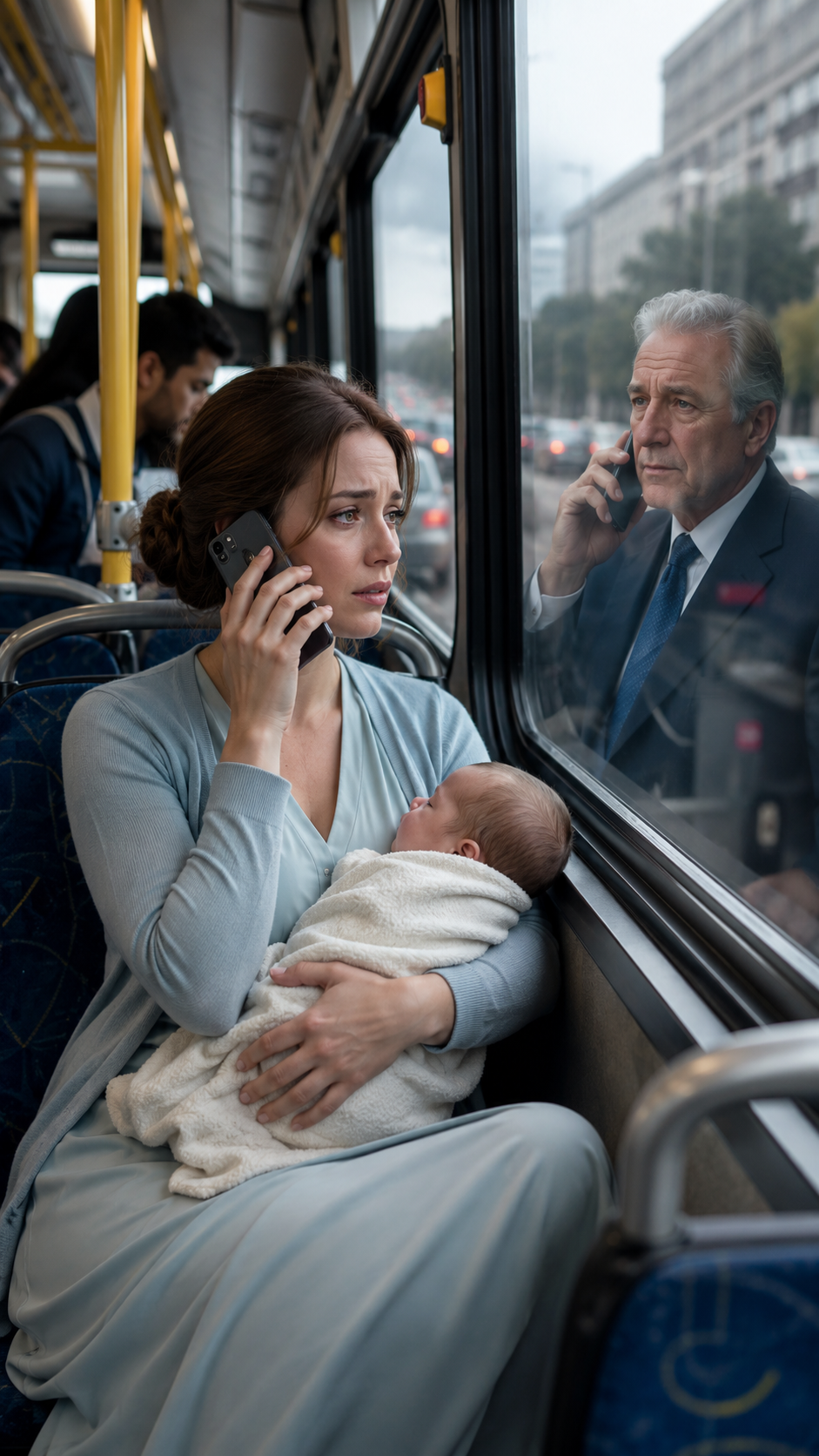
Fifty Dollars for the Bus — The Call That Ended a Marriage
Five days after they cut me open to bring my son into the world, my husband pressed a folded fifty-dollar bill into my palm like he was tipping a valet.
“This should cover the bus fare,” Dominic said.
I looked at the money.
Then I looked at him.
Somewhere in the space between those two looks, thirteen years of marriage quietly finished dying.
Part One — The Bus Stop
A nurse settled Leo into my arms while Dominic slung the diaper bag over his shoulder like it was the heaviest thing he’d carry all day.
My abdomen throbbed with every breath, the incision still an angry red line beneath the gauze, and even the hospital’s automatic doors sliding open felt like it happened a beat too fast for my body to keep up with.
“Let’s go home,” I whispered, more to Leo than to Dominic.
That’s when the fifty appeared, crumpled, warm from his pocket.
“The bus?” I said.
“I need the SUV.”
Our SUV — my father’s wedding gift to us, black and glossy and worth more than most people’s first house — sat thirty feet away in the pickup lane, keys already jingling in Dominic’s other hand.
“I just had major surgery,” I said.
“I can barely stand up straight.”
“My sister was walking laps around the block two days after she gave birth.
You’ll be fine.”
I want to tell you that was the moment I understood him completely, but the truth is uglier — I’d understood him for a while.
I’d just kept choosing not to look at it directly, the way you don’t look at the sun.
“What about our son?” I asked.
“Babies ride buses every day, Audrey.” He checked his watch, the Cartier one my father had given him for our fifth anniversary, back when Dominic still called Charles Brooks sir and meant it.
“Hurry up.
My parents are waiting.”
“For what?”
“Mom wants lunch.
They flew in this morning.
I made reservations.”
I stood there in the loading zone of Mercy General, five days postpartum, holding our newborn son, and asked the only question that mattered.
“You’d rather take your family to a restaurant than drive your wife and newborn home from the hospital?”
“There you are!”
Victoria — my mother-in-law — emerged through the sliding doors in oversized sunglasses, clutching a handbag that cost more than my hospital bill.
Arthur trailed behind her, already scrolling his phone, and Natalie brought up the rear, laughing at something on her screen like they were headed to a spa day instead of picking up their newest grandchild.
Natalie glanced at Leo for exactly one second.
“So that’s him.”
Then she went back to her phone.
Nobody asked how I felt.
Nobody asked if the baby needed anything — a bottle, a blanket, five minutes of rest.
Victoria sighed, theatrical and put-upon, the way she sighed at waiters and weather.
“We’re going to lose the reservation.”
Dominic tossed the diaper bag into the trunk, opened the passenger door for his mother with a courtliness he hadn’t shown me in years, and folded himself behind the wheel.
“There’s leftover rice in the fridge,” he called through the window, already backing out.
“Heat it up when you get home.”
Then, almost as an afterthought: “And don’t keep calling me.
I’ll be busy.”
They pulled away.
For one long second I let myself want to cry — a real, whole-body want, the kind that used to end in tears when I was younger and softer.
Instead I pressed my lips to the top of Leo’s head, breathed in that new-baby smell that undoes something in every mother, and walked toward the bus stop like my stitches weren’t screaming with every step.
The bus driver took one look at my face — gray, sweating, holding a baby like he was the only solid thing in the world — and lowered the ramp without a word.
I found a seat near the front.
The city slid by outside the window, indifferent and gray, and I let myself remember the man I thought I’d married.
Dominic hadn’t always been like this.
Eleven years ago he was a junior engineer who bought me flowers from the grocery store because that’s what he could afford, who stayed up with me until three in the morning arguing about whether The Godfather Part II was better than the original, who cried — actually cried — the day we got married in the small courthouse ceremony neither of our families attended in full force.
Then the investors came.
Then the company took off.
Then his mother started calling twice a day with opinions about how a CEO’s wife should dress, should talk, should know her place, and Dominic — who once would have hung up on anyone who spoke to me that way — started laughing along instead.
None of them knew the truth about who I was.
I’d never told Dominic who my father really was, because eleven years ago I’d wanted someone to love me, not the nine zeros behind my last name.
Dominic believed my father owned a mid-size construction company, comfortable but unremarkable.
He had no idea Charles Brooks was the founder and chairman of Brooks Global Infrastructure, the company whose silent backing was the entire reason half of Dominic’s investors had trusted a twenty-nine-year-old with no track record.
He didn’t know that when his board did their due diligence three years ago, it was my father’s name buried in an obscure holding company that made them comfortable enough to write the first big check.
Dominic thought he’d built his empire from nothing.
He had never once asked why nothing had been so generous to him.
The bus stopped at a red light.
In the lane beside us, our SUV idled — Dominic laughing at something his mother said, Natalie in the back seat filming herself for whatever platform she was performing for that week.
Not one of them glanced toward the bus.
Not one of them wondered if I’d made it home.
Not one of them wondered if their newest family member was crying, or hungry, or cold.
Something in my chest, which had been cracking slowly for three years, finished breaking.
I wasn’t heartbroken anymore.
I was finished.
I pulled out my phone and called the one number I hadn’t dialed in eleven years without Dominic standing beside me, coaching me on what to say, softening every hard edge of my own family for his comfort.
It rang once.
“Audrey?” My father’s voice, sharper than I remembered, immediately alert.
Hearing it broke something else open in me — the last of the tears I’d been holding since the recovery room.
“Dad.
I need you.”
His voice changed instantly, the warmth dropping away into something clean and focused.
“What happened?”
“Dominic put me and Leo on a city bus five days after my C-section so he could take his family to lunch.”
Silence.
I looked down at Leo, asleep against my chest, oblivious to the fact that his existence had just triggered something neither his father nor his grandmother would see coming.
“I’m leaving him,” I said.
“I’m never going back.”
More silence — the kind I remembered from childhood, the kind that meant my father was doing math in his head, math that always ended with someone losing more than they thought they had to lose.
“Tell me where you are,” he said, frighteningly calm.
I gave him the cross streeTS. Another pause.
Then, in the background, I heard voices — quick, clipped instructions to someone — and the rapid clatter of a keyboard.
“Dad?”
“Stay on the bus, Audrey.
My driver is three minutes out.
He’s coming for you and my grandson.”
“What are you doing?”
He didn’t answer right away.
When he finally spoke, his voice held a chill I hadn’t heard since he fired a longtime business partner for skimming from a pension fund — not angry, just absolutely, permanently done.
“I’m making sure Dominic understands exactly whose money built the life he just threw away.”
The line went dead.
Across the intersection, I watched Dominic’s phone light up in the cupholder.
He glanced down, smiled, answered.
Three seconds later, the smile disappeared completely.
The light turned green.
Our bus pulled forward.
His SUV didn’t move for a long moment, and in the side mirror I watched him twist around in his seat, scanning the street, scanning the bus stop we’d already left behind — looking, for the first time in longer than I could remember, for me.
Part Two — What Fifty Dollars Buys
The black town car found us four blocks later.
The driver, a quiet man named Samuel who’d worked for my father since before I was born, didn’t ask questions.
He simply took the diaper bag, helped me into the back seat with the careful economy of someone who’d once driven my mother home from her own hospital stays, and pulled into traffic like we had all the time in the world, even though we both knew we didn’t.
“Your father’s on his way to the penthouse,” Samuel said.
“He asked me to tell you it’s ready.
Nursery included.”
“He built a nursery?”
“He’s been building a nursery for six months, Miss Audrey.” Samuel met my eyes in the rearview mirror, something gentle in them.
“He just didn’t tell you, because he was hoping he wouldn’t need it.”
I put my hand over my mouth and didn’t cry, because I’d already used up my quota for the day, and because Leo stirred at the sound and I didn’t want his first hour of freedom to smell like his mother’s grief.
My father’s penthouse occupied the top two floors of a building he owned outright, which was, I’d come to learn over the years, simply how Charles Brooks did things — not flashy, but absolute.
He met us at the private elevator himself, no assistant, no fanfare, just a sixty-eight-year-old man in a cardigan who looked, for one unguarded second, exactly like the father who’d taught me to ride a bike in an empty parking lot because he didn’t trust anyone else to catch me if I fell.
He took Leo from my arms like he’d done it a hundred times, even though this was the first.
“Hello, small person,” he said softly, and something in his face rearranged itself entirely.
Then he looked at me — my hospital pallor, the wince I couldn’t hide when I lowered myself onto the couch — and his jaw tightened in a way I recognized from every negotiation I’d ever watched him walk away from unbeaten.
“Tell me everything,” he said.
“From the beginning.
Not just today.”
So I did.
I told him about the years of Victoria’s comments disguised as concern, the way Dominic had started introducing me at company events as my wife instead of by name, the birthday he’d missed for a shareholder dinner, the ultrasound appointment he’d skipped for a golf outing with investors, the slow, patient erosion of a person into a background detail in her own marriage.
I told him things I’d never told anyone, because admitting them out loud had always felt like admitting I’d chosen wrong, and choosing wrong felt like failing the one parent who’d never failed me.
My father listened without interrupting once.
When I finished, he was quiet for a long moment, turning something over — not just in his mind, I realized, but on his phone, where a string of messages had been accumulating the entire time I talked.
“Audrey,” he said finally, “I need to tell you something, and I need you to hear all of it before you react.”
Something cold moved through me.
“What.”
“Dominic has known who I am for three years.”
The room tilted slightly.
“That’s not possible.
I never told him.”
“You didn’t have to.” My father set his phone face-down on the table between us, deliberate, like he was setting down a weapon he no longer needed.
“Three years ago, during his Series C, his lead investor got cold feet about the size of the round.
Dominic’s CFO went digging into the cap table structure and found the holding company.
It took him one afternoon to connect it to me.”
“Then why—” My voice cracked.
“Why didn’t he ever say anything?”
“Because the moment he understood who your father was, he understood something else, too — that if he told you he knew, you’d wonder if he’d ever loved you for anything beyond that.
So he decided to keep quiet, take the advantage, and let you keep believing the marriage was clean.” My father’s voice, when he continued, had the particular gentleness he reserved for the worst news.
“He’s spent three years building his empire on my name without ever once thanking me for it, or treating you like the reason he had access to it at all.”
I sat with that for a long moment.
It should have felt like the final betrayal, the one that made all the others make sense.
Instead, strangely, it felt like relief — like discovering the fog I’d been walking through for years actually had an edge, a place where it ended and clarity began.
“How long have you known?” I asked.
“Eighteen monThS.” He held my gaze, unflinching.
“I should have told you sooner.
I told myself I was protecting you.
The truth is I was hoping he’d become a better man before I had to.”
“He didn’t.”
“No,” my father agreed quietly.
“He didn’t.”
That night, after Leo finally settled into the crib my father had built with his own hands — an old habit from when I was small, one I hadn’t known he’d kept up — I sat at the window of the penthouse and watched the city lights blur through unshed tears.
My phone had thirty-one missed calls from Dominic.
I didn’t listen to a single voicemail.
I didn’t need to.
I already knew what panic sounded like on a man who’d just realized the floor under his empire had a trapdoor, and I didn’t have the energy to hear it dressed up as an apology.
The next morning, my father’s lawyer — a sharp, unhurried woman named Priya Chandrasekaran who’d handled Brooks Global’s most sensitive matters for over a decade — arrived with a folder an inch thick.
“Before we discuss anything else,” Priya said, laying the folder on the table, “I need you to look at this.”
Inside was a letter, dated eight months earlier, on Brooks Global letterhead.
It authorized a direct capital transfer from a Brooks Global subsidiary into Dominic’s company — the kind of formal backing that, if real, would have meant my father had personally vouched for Dominic’s business well beyond the quiet holding-company arrangement he’d actually agreed to.
“I never signed this,” my father said, his voice flat with a fury I’d rarely heard from him.
“I never authorized it.
The signature is forged.”
I stared at the page, at my father’s signature — close, almost right, wrong in the small ways that only someone who’d watched him sign a thousand documents would ever notice.
 She Walks Away From Family Drama To Focus On School And Personal Growth, Leaving Her Dad Behind
“Why would Dominic forge a letter from you?” I asked, though some cold part of me had already started assembling the answer.
“Because eight months ago,” Priya said, “his real numbers stopped supporting his valuation.
His board was asking questions he couldn’t answer honestly.
So he manufactured a reason for them to keep believing in him — Brooks Global’s name, without Brooks Global’s actual money or actual knowledge.”
The room went very quiet.
“He built an entire year of investor confidence on a lie with my father’s signature on it,” I said slowly, understanding arriving in pieces, each one heavier than the last.
“Yes,” Priya said.
“That’s fraud.”
“That’s fraud,” she confirmed.
“Serious enough that if this letter surfaces publicly with my confirmation that it’s forged, it doesn’t just end your marriage, Audrey.
It ends his company.
Possibly his freedom.”
I thought about the man who’d once cried at our courthouse wedding.
I thought about the man who’d handed me fifty dollars for a bus while his mother waited in the SUV he’d bought with money he’d stolen, in every meaningful sense, from a father-in-law he’d never once thanked.
I thought about Leo, five days old, who deserved a mother who chose herself, and a father who would have to learn — the hard way, since he clearly couldn’t learn any other way — what it cost to treat people as disposable.
“I want to see him,” I said.
“Before anything else happens.
I want to look him in the eye and let him explain himself, knowing everything I know now.”
My father studied me for a long moment, weighing, I think, whether this was strength or softness.
Whatever he saw settled something in him.
“All right,” he said.
“But you don’t go to him.
He comes to you.
On our ground, on our terms, with Priya in the room.”
Part Three — What He Knew
Dominic arrived at the penthouse two days later looking like a man who hadn’t slept, his tailored suit slightly wrong on him for the first time since I’d known him successful, like it belonged to someone he wasn’t quite managing to be anymore.
“Audrey.” He said my name like an apology and a plea in the same breath.
“Thank god.
I’ve been calling—”
“Sit down, Dominic.”
He sat.
Priya sat across from him with the folder closed on the table, not yet revealed, and my father stood by the window with his arms crossed, saying nothing, letting me run this the way I chose to run it.
“I know you’ve known who my father is for three years,” I said.
Whatever color remained in Dominic’s face left it entirely.
“Audrey, I can explain—”
“I know about the forged letter.”
The silence that followed was the loudest thing I’d ever heard.
“It wasn’t supposed to—” He stopped, started again, the practiced smoothness of every board meeting he’d ever charmed his way through failing him for once.
“The board needed reassurance.
I panicked.
I was going to make it right before anyone—”
“Before anyone what? Before anyone noticed you forged my father’s signature to keep your investors from realizing your company is worth less than they think it is?” My voice didn’t shake, and I was almost surprised by that — the surgical calm I’d inherited, apparently, from a man who could end careers without raising his voice.
“You didn’t panic once, Dominic.
You panicked for eight monThS. Quietly.
While you let your mother insult me at every dinner.
While you skipped an ultrasound for golf.
While you handed your wife fifty dollars for a bus five days after major surgery so you wouldn’t be late for lunch.”
“That’s not — I wasn’t thinking about the letter when I did that.
That was just—” He faltered.
“Just what? Just who you actually are, when nobody important is watching?”
He had no answer for that, because there wasn’t one that didn’t confirm what I’d said.
“Here is what’s true, and I need you to actually hear it,” I said.
“I never told you who my father was because I wanted to be loved for myself.
You found out anyway, and instead of telling me, you used it — for three years — without ever once treating me like an equal partner in the marriage that gave you access to it.
You built a company on a foundation I didn’t even know I’d laid, and then, the one time in eleven years I actually needed you — physically, literally could not walk without pain — you chose your mother’s lunch reservation over me.”
Dominic’s eyes were wet now, and some old part of me, the part that had loved him honestly once, wanted to reach for him.
I didn’t move.
“I’m not asking you to forgive me right now,” he said, quiet.
“I know I don’t deserve that.
But Audrey — the company, everything I’ve built — if this letter gets out, it’s not just me who loses everything.
It’s every employee who’s never done anything wrong.
People who trusted me.
Good people who need their jobs.”
And there it was — the one thing he said that I couldn’t entirely dismiss, the sentence that made the room uncomfortable in exactly the way a true thing does.
He wasn’t wrong that innocent people stood to lose their livelihoods for a crime none of them had committed.
It didn’t excuse him.
It didn’t make me owe him anything.
But it was the first honest thing he’d said since walking in, and it cost me something to hear it and not simply feel satisfied.
My father spoke for the first time since Dominic arrived.
“That’s a real consideration, and I respect that you raised it instead of only defending yourself.” His voice was even, businesslike, the voice he used when he was about to make an offer that would define the rest of someone’s life.
“Here is what happens now.
You will step down as CEO, effective immediately, citing personal reasons.
You will not contest the divorce, and you will not contest full custody arrangements that prioritize Leo’s wellbeing over your convenience.
In exchange, Brooks Global will quietly restructure its position in your company to stabilize it for your employees’ sake — not for yours.
The forged letter stays in this room, unless you ever give me a reason to use it.”
Dominic looked at me, not my father, when he answered.
“And Leo?”
“You’ll have a relationship with your son,” I said.
“A real one, built the slow way — the way you never bothered to build one with me.
Supervised, structured, and entirely dependent on whether you can become someone worth him knowing.
That’s not punishment, Dominic.
That’s just what you’ll have to earn now, the way everyone else already had to earn everything from you.”
He nodded, slowly, and for the first time in years I saw something in his face that looked less like performance and more like actual reckoning.
“Okay,” he said.
“Okay.
I’ll sign whatever you need me to sign.”
He didn’t ask if there was a version of this where we tried again.
He already knew there wasn’t.
That, more than anything else, told me he finally understood exactly what he’d lost — and that understanding, for the first time in a long while, felt like enough.
Part Three and a Half — Victoria’s Version of Sorry
The call from Victoria came four days after the meeting at my father’s penthouse, at nine in the morning, while Leo was mid-feeding and I had exactly no patience left for anyone who wasn’t him.
“Audrey.” My mother-in-law’s voice had none of its usual imperial polish.
It sounded, for the first time in eleven years, uncertain.
“I understand there have been… developmenTS.”
“That’s one word for it.”
“Dominic tells me you’re divorcing him.”
“Dominic tells you correctly.”
A pause, filled with the particular static of someone rehearsing a sentence they’d rather not say.
“I want you to know,” Victoria continued, “that whatever happened between the two of you, I never intended for things to feel the way they clearly felt to you.
I only ever wanted what was best for my son.”
“You wanted what was easiest for your son,” I said.
“There’s a difference.
Easiest was a wife who didn’t argue, didn’t inconvenience him, and disappeared quietly into the background of his life so you could keep pretending he built all of this on his own talent and nothing else.
You’ve spent eleven years making sure I understood I wasn’t good enough for him.
You never once wondered whether he was good enough for me.”
“That’s not fair.”
“It’s exactly fair.
You watched your son leave his wife on a curb five days after surgery and your first instinct wasn’t concern — it was irritation that lunch might be delayed.
I don’t need you to apologize for eleven years of insults, Victoria.
I need you to understand that the version of Dominic you’re grieving right now — successful, admired, untouchable — was never real.
He built it on borrowed foundations he never told me about and never thanked anyone for, and the moment those foundations were tested, he chose to protect his image instead of his family.
That’s not a tragedy that happened to him.
That’s who he decided to be, one small cruelty at a time, with your applause the entire way.”
Victoria didn’t respond to that.
The silence stretched long enough that I almost thought the call had dropped, until I heard something that might have been the start of actual tears — the first honest sound I’d ever heard from her in over a decade of dinners, criticisms, and carefully aimed insults disguised as advice.
“I’d still like to know my grandson,” she said finally, quieter now.
“Then you’ll have the chance to earn that, the same way Dominic will have to earn his place in Leo’s life.
Slowly.
Consistently.
Without expecting credit for showing up exactly once.” I softened my voice, not for her sake, but because I found I didn’t actually want to be cruel — I only wanted to be honest, which was a different thing entirely, and a harder one.
“I’m not trying to punish anyone, Victoria.
I’m trying to build a life where my son isn’t raised to think love is something you’re owed just because of who you married into.
That starts with me.
It can include you, if you’re willing to actually change instead of just apologizing for getting caught.”
She was quiet for another moment.
“I don’t know if I know how to do that.”
“Neither did I, six months ago,” I said.
“You learn by doing it badly first, and then a little less badly, and then eventually you’re just doing it.
Start small.
Send a card.
Don’t mention my clothes, my background, or the bus.”
Something that might have been a laugh, wet and surprised, came through the line.
“All right,” Victoria said.
“All right, Audrey.
I’ll try.”
It wasn’t forgiveness.
I wasn’t ready to offer that yet, and I wasn’t sure I owed it to her on any particular schedule.
But it was, for the first time, an honest conversation between two women who’d spent over a decade performing politeness at each other across a dinner table neither of them had ever wanted to sit at.
That felt, if not like healing exactly, at least like the first true brick in whatever got built next.
Part Three and Three-Quarters — What the Watch Remembered
Priya finalized the settlement on a gray Tuesday in October, in a conference room with a view of the harbor, the kind of room where I imagined a hundred other marriages had ended in exactly this quiet, businesslike way — not with shouting, but with signatures, initials, and the soft click of a pen being set down.
Dominic signed everything without argument.
His company survived, restructured and diminished but alive, employing the people who’d never done anything to deserve losing their jobs over his mistakes.
He’d stepped down permanently, taken a smaller advisory role that kept him financially afloat without ever again holding the reins of anything larger than himself.
It was, my father said, the most merciful outcome available, and I believed him, mostly because I trusted my father to know exactly how unmerciful the alternative could have been.
At the end of the meeting, as we were gathering our things, Dominic reached into his jacket pocket and set something on the table between us — small, silver, catching the gray afternoon light.
The Cartier watch.
My father’s fifth-anniversary gift.
“I don’t think I’ve earned the right to keep wearing this,” he said quietly.
“Not until I actually become someone who deserves what it represenTS.”
I looked at it for a long moment — this small, expensive object that had once meant nothing more sinister than a happy occasion, a marriage still young enough to believe in itself.
I thought about telling him to keep it.
I thought about the version of myself that would have insisted on graciousness even here, even now, because graciousness had always been easier than confrontation.
Instead, I left it on the table.
“That’s between you and yourself,” I said.
“Not me anymore.”
I picked up Leo’s diaper bag, nodded once to Priya, and walked out of the room without looking back — not out of anger, not anymore, but because I finally understood that some doors don’t need slamming.
They just need to be closed, quietly and completely, by someone who’s already decided not to walk back through them.
Part Four — The Life I Chose
The divorce took four months to finalize — fast, by the standards of settlements that size, because neither of us wanted to drag it out in public, and because Priya was, in her own words, “not in the business of losing.” Dominic’s resignation from his company was announced as a personal decision to “focus on family,” which was true in the narrowest, most face-saving sense of the phrase.
His mother called me exactly once during that period, ostensibly to discuss visitation, actually to inform me that I’d “always been ungrateful for everything Dominic gave me.” I let Priya handle that call.
It felt, honestly, like the first fully restful decision I’d made in years.
I moved into a modest three-bedroom apartment eleven blocks from my father’s building — close enough that Samuel could get there in ten minutes if I ever needed him, far enough that it was unmistakably mine.
I hung the same crooked watercolor of a lighthouse that had sat in a closet, unwrapped, for three years because Dominic thought it “clashed with the aesthetic.” I put it directly across from the couch where I nursed Leo at two in the morning, so it would be the first thing either of us saw when the world felt too big and dark to manage alone.
Six months after the bus stop, I stood in my new kitchen making rice — not leftover, not reheated for someone else’s convenience, but fresh, made because I wanted it, in a pot my mother had given me before she passed, the one thing from my childhood home that had survived every move since.
Leo sat in his high chair, gumming a spoon, entirely unbothered by how close his existence had come to unraveling everything, and entirely unaware of how much his mother had rebuilt in the months since.
My father visited most Sundays.
He never once said I told you so, though he’d have been within his rights to.
Instead he built things — a rocking chair, a set of wooden blocks, a small step stool so that someday soon Leo could reach the counter and help me cook, badly and joyfully, the way children do.
“You did the hard part,” he told me one Sunday, watching Leo sleep in my arms after a walk in the park.
“Recognizing it.
A lot of people never get there.
They just keep heating up the rice.”
I thought about that sentence for a long time afterward — about the years I’d spent making myself smaller to fit into a marriage that had stopped fitting me the moment success changed the man inside it.
About the fifty-dollar bill, which I still had, folded into a small frame on my dresser, not as a wound I kept picking at, but as a marker: this is the exact moment I stopped waiting to be chosen and started choosing myself.
Dominic and I speak occasionally now, brief and businesslike, mostly about Leo — a supervised visit here, a pediatrician appointment there.
He’s quieter than he used to be.
Whether that quiet is real growth or just the absence of an audience worth performing for, I honestly don’t know yet.
Maybe I never will.
That’s not my job to determine anymore.
What I know is this: I am not the woman who stood outside a hospital holding her newborn while her husband drove away laughing with his family.
I am the woman who got on the bus anyway, who made the call that changed everything, who chose — deliberately, expensively, at real cost — a life that is not perfect, but is finally, completely mine.
On Leo’s first birthday, I threw a small party in the apartment — nothing extravagant, just my father, Samuel (who Leo had taken to calling “Sam-Sam” with the fierce, uncomplicated love only a toddler can produce), and, tentatively, Victoria, who arrived twenty minutes early carrying a wooden train set and an apology she’d clearly practiced in the car.
“I looked up what he likes,” she said, a little stiffly, holding out the gift like an offering she wasn’t sure would be accepted.
“Samuel told me trains.
I hope that’s — I hope that’s all right.”
“It’s all right,” I said, and meant it, and was a little surprised to find that I did.
She sat on the floor with Leo for twenty minutes, running the wooden train along a track she’d clearly practiced assembling beforehand, and didn’t once mention my clothes, my apartment, or the fact that it was considerably smaller than the house I used to live in.
It wasn’t everything.
It was, undeniably, something — the second brick, laid carefully, on top of the first.
Dominic came for an hour that afternoon, supervised, exactly as we’d agreed.
He knelt on the floor and let Leo pull books off the shelf one by one, reading none of them, just laughing at the chaos with an ease I hadn’t seen in him in years — not the practiced ease of a man performing for an audience, but something quieter, more effortful, like a muscle he was only just beginning to rebuild.
Before he left, he paused at the door.
“Thank you for letting me be here,” he said.
“He’s your son,” I said.
“That was never in question.
Only whether you’d actually show up for it.”
“I’m trying.”
“I know,” I said, and I did know, though trying and arriving were still, in my experience, two very different destinations.
“Keep trying.
That’s all anyone’s asking.”
He nodded and left, and I closed the door behind him without ceremony, the way you close a door on an ordinary Tuesday — not a door slammed in anger, not a door held open in hope, just a door doing exactly what doors are for.
Later that evening, after everyone had gone and Leo was finally, blessedly asleep, I found myself standing at the kitchen counter, unpacking the last of the party’s leftovers.
My hand brushed against the small framed fifty-dollar bill on the shelf above the stove, and for once, I didn’t look away from it.
I thought about the five small things I’d carried with me out of that marriage, the ones that had meant nothing at the time and everything now: the crooked lighthouse watercolor, finally hung where I could see it every day.
The pot my mother left me, simmering rice for two instead of leftovers reheated for one.
The fifty-dollar bill, framed not as a wound but as a marker.
The Cartier watch, left behind on a conference table, a debt Dominic still owed to no one but himself.
And the sound of my father’s voice on the phone that day at the bus stop — stay on the bus, Audrey — which I heard now, a year later, not as the sound of rescue, but as the sound of someone finally, fully believing I deserved to be caught.
I thought about the woman who’d once been so afraid of being loved for her name instead of herself that she’d hidden the truth from her own husband for over a decade — and how that fear, in the end, had protected nothing.
Dominic had found the truth anyway.
He’d simply chosen to use it instead of honor it, and that choice, more than any inheritance or any forged letter, was the real measure of the man he’d turned out to be.
I was not that frightened woman anymore.
I was someone who had been handed fifty dollars and a bus ticket, and had turned it, deliberately, into a whole new life — not a fairy tale, not a revenge fantasy with a bow on top, but something realer and harder-won than either: a small apartment with crooked art on the walls, a son who was loved without condition, a father who showed up every Sunday with wood shavings on his sleeves, and a version of herself who no longer needed anyone’s permission to matter.
Some nights, when Leo is finally asleep and the apartment is quiet, I stand at the window and look out at the city the way I did that first night at my father’s penthouse — except now the tears that come aren’t grief.
They’re something closer to relief, and something even closer to pride.
The rice on the stove tonight is only for the two of us.
It’s enough.
It has always, in the end, been enough — I simply needed to stop waiting for someone else to notice.