
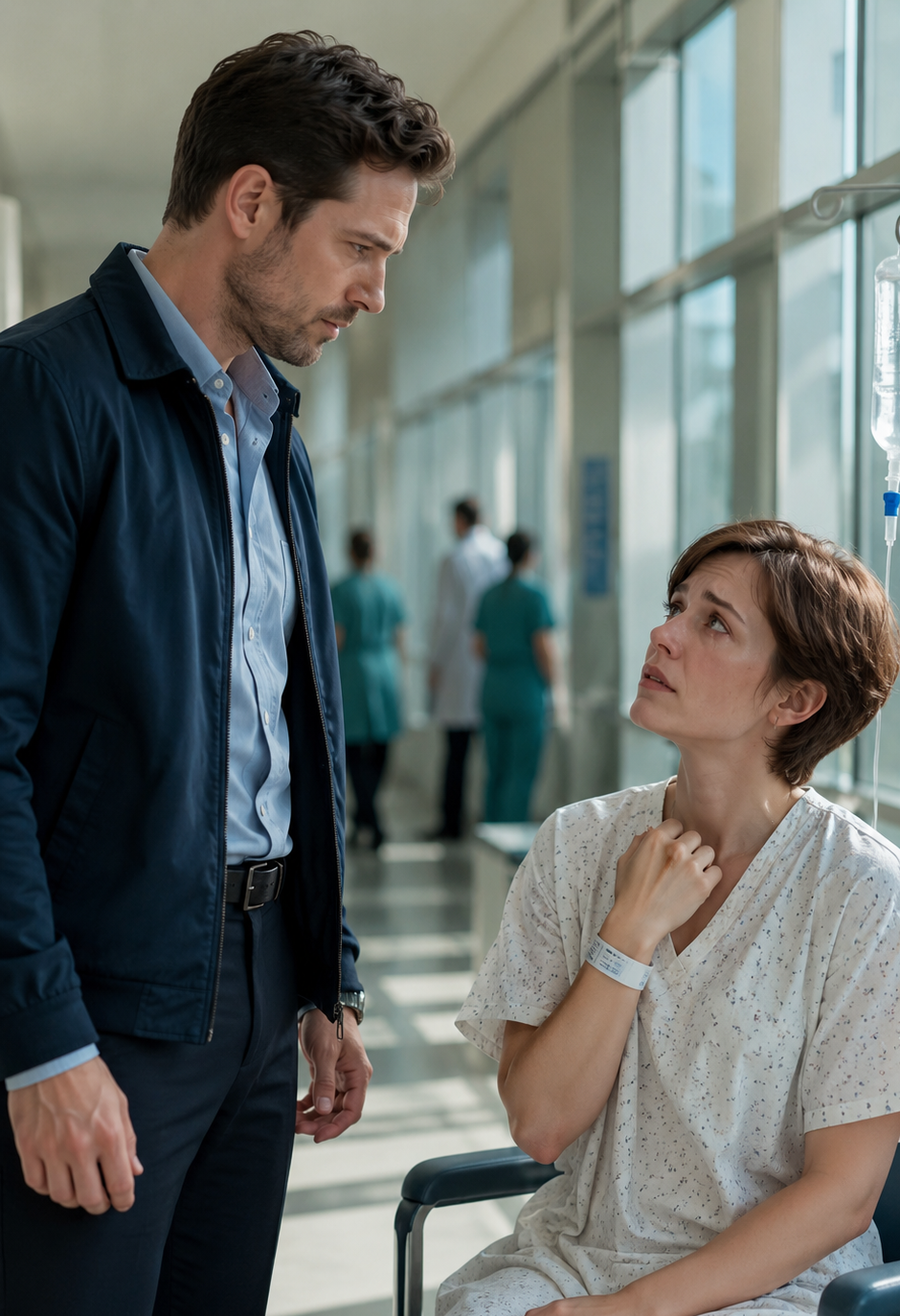
“Mr. Hale,” the doctor said, his voice lowering as if the hallway itself had become too fragile for ordinary volume.
“Are you willing to be tested as a donor?”
The words struck me strangely, not like a question, but like a door opening onto a room I had been avoiding for years.
“A donor?” I repeated.
Sophie looked away first.
The doctor glanced at her, then back at me.
“Sophie’s condition has progressed faster than we hoped.
Medication has helped, but not enough.
At this stage, the best chance is a transplant.
We began donor matching quietly because she refused to involve anyone unless it became absolutely necessary.”
I turned to her.
“You refused to involve anyone?”
Her lips pressed together.
She looked exhausted, impossibly small beneath the fluorescent hospital lights, but there was still a stubbornness in her face that I knew too well.
It was the same stubbornness that had once made her argue with me for three hours about painting the kitchen yellow because, according to her, “gray walls make people forget how to laugh.”
“You would have come running,” she said softly.
“Of course I would have.”
“That was exactly what I was afraid of.”
Something inside me cracked.
For the past year, I had told myself our marriage had died slowly, naturally, like a fire with no wood left to burn.
I told myself grief had changed us both beyond repair.
I told myself Sophie had stopped reaching for me, and I had stopped knowing how to reach back.
But the truth was standing in front of me wearing a hospital bracelet.
She had been fighting alone.
Not because she didn’t love me.
Because she did.
The doctor cleared his throat gently.
“We can do the initial blood work today.
If you are a potential match, further evaluation would follow.
But I need to be clear.
This is not simple.
There are risks, and no one should feel pressured.”
I almost laughed, though there was no humor in me.
Pressure?
I had abandoned my wife to lonely appointments, lonely nights, lonely fear.
I had signed divorce papers while she carried a secret that should have belonged to both of us.
And now the universe had the nerve to ask whether I felt pressured.
“I’ll do it,” I said.
Sophie’s head snapped toward me.
“Ethan, no.”
“Yes.”
“You haven’t even asked what it means.”
“I don’t care what it means.”
“You should.”
“I should have cared sooner.”
Her eyes filled, but she blinked fast, refusing to let the tears fall.
The doctor looked between us and nodded once.
“I’ll have the nurse arrange it.”
When he left, the silence returned, but this time it was different.
Not empty.
Not cold.
It was crowded with all the things we had buried.
Sophie leaned back against the chair, closing her eyes.
“You always do this,” she murmured.
“Do what?”
“Charge into danger when you think someone needs saving.”
“I’m not trying to be heroic.”
“No,” she said, opening her eyes again.
“You’re trying to punish yourself.”
The accuracy of it made me look away.
She knew me.
Even after everything, she knew me.
I sat beside her, close enough that our shoulders nearly touched, but not close enough to pretend I still had the right.
“I’m sorry,” I said.
She shook her head slowly.
“Don’t do that.”
“Do what?”
“Say it like one apology can hold all of it.”
I swallowed hard.
“Then I’ll say it as many times as it takes.”
Her hand rested on the arm of the chair.
Pale fingers.
Thin wrist.
Bracelet with her name printed in black letters.
SOPHIE HALE.
She had kept my name.
The realization punched the air from my chest.
“You never changed it,” I whispered.
Her eyes followed mine to the bracelet.
For the first time since I arrived, something like embarrassment crossed her face.
“I meant to.”
“But you didn’t.”
“No.”
“Why?”
She looked down at her hands.
“Because on the days when I was scared, it helped to see it.”
I closed my eyes.
In my memory, Sophie was laughing barefoot in our first apartment, dancing with a paintbrush in her hand.
Sophie asleep beside me during a storm, one palm resting against my chest as if checking that I was still there.
Sophie in a white dress, promising forever in a voice that trembled with happiness.
And then Sophie in a silent kitchen after the second miscarriage, staring at a cup of tea that had gone cold, while I stood three feet away and had no idea how to cross the distance.
“I thought you blamed me,” I said.
“For what?”
“For losing them.”
Her face crumpled.
“Ethan.”
“I know it sounds cruel.”
“It sounds like grief,” she whispered.
I looked at her then, really looked.
The woman I had loved, lost, and misunderstood.
“Did you blame me?”
“No.” Her voice was immediate.
“Never.”
My breath shook.
“I blamed myself,” she admitted.
I wanted to argue, to tell her she shouldn’t have, but how could I? I had done the same thing in secret.
We had both been drowning in the same ocean, only we had turned our backs and called it distance.
A nurse arrived with paperwork and led me to a small room with a blue chair and a tray of sealed needles.
The blood draw took less than five minutes.
It felt insultingly simple for something that might decide the course of a life.
When I returned, Sophie was asleep.
Her head tilted against the wall, her dark hair loose around her face.
Without the effort of conversation, she looked younger.
Or maybe I was seeing the girl from ten years ago, the one who spilled coffee on my contract during our first meeting and then accused me of leaving it “recklessly within splash range.”
I pulled a blanket from the end of her bed and draped it over her.
Her fingers moved in sleep, catching the edge of my sleeve.
I froze.
“Don’t go,” she whispered, barely awake.
“I’m here.”
Her grip relaxed, but she didn’t let go.
So I sat beside her until the hallway lights dimmed and visiting hours ended.
The nurses stopped asking me to leave after Sophie’s doctor quietly spoke to them.
I signed more forms.
Answered questions.
Waited.
Waiting, I discovered, was its own kind of punishment.
By morning, the first results came back.
The doctor found me near the vending machines, holding a cup of coffee I hadn’t tasted.
“You’re a possible match,” he said.
The cup nearly slipped from my hand.
“Possible?”
“A strong one.
We need more testing, but this is promising.”
I turned toward Sophie’s room.
Through the glass, I could see her sitting up now, a book open on her lap, though she wasn’t reading.
Sunlight touched the side of her face.
“She doesn’t want me to do it,” I said.
“I know.”
“Can she refuse?”
“She can refuse treatment,” he said carefully.
“But she can’t refuse your right to be evaluated.
The decision, if you qualify, will be yours.”
Mine.
That word had followed me for years.
My career.
My grief.
My pride.
My escape.
Now it stood before me changed into responsibility.
When I told Sophie, she became so still that I heard the monitor beside her bed before I heard her voice.
“No.”
“Sophie—”
“No, Ethan.”
“You don’t even know what I’m going to say.”
“I know exactly what you’re going to say.”
“Then let me say it.”
Her eyes flashed.
“You think this fixes everything.”
“I don’t.”
“You think saving my life earns you forgiveness.”
“No.”
“You think this means we can go back.”
The words hurt because part of me had imagined it.
A foolish, impossible image: Sophie coming home, my key turning in the lock, yellow kitchen walls, morning light, two people choosing each other again.
But love did not work like rewinding a clock.
“I don’t think we can go back,” I said.
“I think we can stop pretending the past didn’t happen.”
Her anger faltered.
“I failed you,” I continued.
“You failed me too, maybe, by not letting me in.
But I walked away when I should have stayed.
I let pain make me selfish.
I let silence become easier than love.”
Her eyes shone.
“I’m not offering this to buy my way back into your life,” I said.
“I’m offering it because you are still Sophie.
Because whether we are married or divorced or strangers after this, the world is better with you in it.”
She turned her face toward the window.
For a while, neither of us spoke.
Then she whispered, “I was so angry when you left.”
“I know.”
“No, you don’t.” Her voice cracked.
“I packed your shirts into boxes and told myself I hated you.
Then I sat on the floor and held one of them until morning because it still smelled like you.”
My chest tightened painfully.
“I signed the papers,” she said, “because I thought maybe if I let you go, at least one of us would survive what we became.”
I moved closer, but stopped at the edge of the bed.
“Sophie.”
She wiped her cheek quickly.
“And then I got sick.
Really sick.
And I wanted to call you.
Every night.
I would open your contact and just stare at your name.”
“Why didn’t you?”
“Because I heard your voice in my head.” She looked at me.
“Not cruel.
Just tired.
I was afraid you’d answer like I was another burden.”
The shame of that was almost unbearable because I couldn’t honestly say she was wrong.
There had been a time when I might have answered that way.
Not because I didn’t love her, but because I had forgotten how to love without fear attached.
“I’m here now,” I said.
Her smile was sad.
“Now is a very fragile word.”
Over the next several days, I learned the language of hospitals.
Numbers.
Ranges.
Compatibility markers.
Consent forms.
Risks explained in careful voices.
Hope delivered cautiously, like glass.
I also learned Sophie had built an entire life around hiding pain.
Her neighbor brought a small bag of clothes and cried when she saw me.
Her best friend Mara arrived with soup, glared at me for ten full seconds, then hugged me so hard my ribs hurt.
“She told me not to call you,” Mara said over my shoulder.
“I wanted to break into your office and drag you here.”
“You should have.”
“I know.”
Sophie groaned from the bed.
“Please don’t form an alliance.”
“Too late,” Mara and I said together.
For one second, Sophie laughed.
It was soft and brief, but it changed the room.
I chased that sound for days.
I brought her tea the way she liked it, with too much honey.
I read aloud when her hands trembled too much to hold a book.
I learned which nurses made her feel calm and which doctor’s footsteps made her anxious.
At night, when she slept, I sat in the chair beside her and watched the city lights blink beyond the window.
Sometimes she woke and found me there.
“You can go home,” she said once.
“I know.”
“You have work.”
“I have sick leave.”
“You hate being idle.”
“I’m not idle.
I’m annoying you.”
She almost smiled.
“Professionally.”
The final donor results arrived on a Friday afternoon while rain streaked the windows.
The doctor entered with two other specialisTS.
Sophie reached for my hand before she remembered herself.
I took it anyway.
The doctor looked at me.
“You’re a match.”
For a moment, the room disappeared.
Sophie’s hand tightened around mine.
“A very strong match,” he continued.
“Better than we expected.”
I exhaled for what felt like the first time in a year.
But the doctor wasn’t smiling.
“What?” I asked.
He glanced at Sophie.
She closed her eyes.
“What?” I repeated.
“There is something else we discovered during the evaluation,” he said.
“It doesn’t affect your ability to donate, but it does require a conversation.”
Sophie’s face had gone pale.
“Sophie?” I said.
She pulled her hand from mine.
The doctor hesitated, then placed a sealed envelope on the table beside the bed.
“These records were forwarded from St.
Catherine’s Fertility Clinic after we requested her full medical history.
We needed complete background because of her prior pregnancies.”
My skin went cold.
St.
Catherine’s.
That name belonged to the last hopeful chapter of our marriage.
The clinic with soft music in the waiting room.
The place where Sophie had squeezed my hand and smiled bravely while pretending not to be afraid.
The place we stopped talking about after loss became easier to name than hope.
“What records?” I asked.
Sophie’s voice was barely audible.
“Ethan, I was going to tell you.”
The room narrowed around her.
“Tell me what?”
The doctor excused himself with professional mercy, leaving the envelope behind like a live wire.
Rain tapped the window.
Sophie stared at the envelope.
“I couldn’t carry another pregnancy,” she said.
“Not after the diagnosis.
Not safely.
But before we lost everything, before we signed the papers, there was one more chance.”
My heart began to pound.
“What chance?”
“At St.
Catherine’s,” she whispered.
“After the second miscarriage, they preserved embryos for us.
We made the decision together, remember?”
I remembered.
A blur of forms and grief and desperate hope.
Sophie’s hand in mine.
A doctor explaining possibilities.
Me nodding because I would have agreed to anything that kept hope alive for one more day.
“Most didn’t survive,” Sophie said.
“But one did.”
I couldn’t move.
“One embryo,” she continued.
“One.”
I stared at the envelope.
“What happened to it?”
She looked at me then, and the guilt in her eyes frightened me more than any diagnosis.
“When you left, I thought everything was over.
Then I found out I was sick.
The doctors said treatment might destroy any future chance.
I was grieving.
I was terrified.
And I knew you were gone.”
“Sophie.”
“I didn’t transfer it,” she said quickly.
“I swear I didn’t make that decision without you.
But I also couldn’t let it be discarded.”
My thoughts tangled.
“Then what did you do?”
She reached toward the envelope with a shaking hand but couldn’t pick it up.
“There was a storage issue at the clinic,” she said.
“A legal review.
Missing consent updates.
I received letters, calls, forms.
I didn’t answer some of them because I was in treatment and because every time I saw that clinic’s name, I fell apart.”
The room seemed to tilt.
“Last month,” she whispered, “someone from the clinic contacted me again.
They said there had been an administrative error.
Our file was flagged.
Our embryo had been transferred out of storage years ago.”
I felt the blood leave my face.
“What does that mean?”
“I don’t know.”
“That’s not an answer.”
“I know.”
“Sophie, what does that mean?”
She flinched at the sharpness in my voice, and I hated myself for it, but fear was already tearing through me.
She finally lifted the envelope and held it out.
“I couldn’t open it.”
For a few seconds, I only stared at the white paper.
My name was printed beneath hers.
ETHAN HALE.
Husband.
Emergency contact.
Potential donor.
Father?
My fingers felt numb as I took it.
The seal broke too loudly in the quiet room.
Inside was a letter, several copied forms, and a recent notice stamped with St.
Catherine’s blue emblem.
I read the first page once.
Then again.
The words refused to settle into meaning.
Unauthorized release.
Third-party transfer.
Ongoing investigation.
Possible live birth.
My knees weakened.
At the bottom of the page was a handwritten note from a legal coordinator.
Mr. and Mrs. Hale, we urgently request your presence regarding a child believed to be biologically related to both parties.
A child.
Not a memory.
Not a dream.
Not a grave silence between us.
A child.
I looked at Sophie.
She was crying silently now, one hand pressed against her mouth.
“I didn’t know,” she said.
“Ethan, I swear to you, I didn’t know.”
I believed her.
That was the terrible part.
I believed every word, and still the world had cracked open beneath us.
Before either of us could speak again, my phone vibrated in my pocket.
Unknown number.
I almost ignored it, but the screen lit again, insistent, as if whoever stood on the other end of the line had been waiting for the exact moment my life fell apart.
I answered slowly.
“Hello?”
A woman’s voice spoke through static and rain.
“Mr. Hale?”
“Yes.”
“My name is Rebecca Lane.
I’m calling from St.
Catherine’s legal office.
I’m sorry to contact you this way, but we’ve been trying to reach you both.”
My eyes locked on Sophie’s.
The woman inhaled shakily.
“There’s been a development.
The child has been located.”
The room went completely still.
Then, from somewhere behind Rebecca’s voice, faint and distant, I heard a small child ask, “Is that my daddy?”
…If you want to know what happened next, please type “YES” and like for more.
PART 3
The Question That Shattered What Was Left of My Heart
The doctor’s question hung in the hallway before he even said it, heavy enough to change the shape of my entire life.
Sophie stared at him as if she already knew what was coming.
I didn’t.
I only knew that the woman I had once promised to love through sickness and health was sitting in front of me in a hospital gown, pale beneath the fluorescent lights, looking like she had been carrying the weight of a storm alone for monThS.
Dr. Kwon glanced at Sophie, then back at me.
“Mr. Carter,” he said gently, “Sophie’s condition has progressed faster than we hoped.
She needs a stem cell transplant.”
The words sounded distant at first, like something spoken underwater.
“A transplant?” I repeated.
Sophie closed her eyes.
The doctor nodded.
“We’ve been searching for a compatible donor.
Her family members were tested, but none were suitable.
The registry hasn’t produced a strong match yet either.”
I turned to Sophie.
“Your family knows?”
Her mouth tightened.
“My aunt knows.
That’s all.”
“Your aunt lives in Arizona.”
“She came once.”
Once.
The word cut through me.
Once, while I had been living eight miles away.
Dr. Kwon continued, his voice careful.
“During Sophie’s previous fertility testing, some compatibility markers were recorded.
They’re not enough for us to proceed, but they suggest you might be a better match than we’d normally expect.”
I stared at him.
He looked me directly in the eyes.
“We need to ask if you’re willing to be tested tonight.”
For one terrifying second, I couldn’t speak.
The hospital hallway faded—the nurses, the passing carts, the low beeping from nearby rooms, the smell of antiseptic and rain-soaked coaTS. All I could see was Sophie on our wedding day, standing under a canopy of white flowers, laughing because the wind kept pulling loose strands of hair across her face.
I had said, “I’ll always be here.”
And then I hadn’t been.
“Yes,” I said immediately.
Sophie’s eyes flew open.
“Ethan, no.”
I turned toward her.
“No?”
“You don’t understand what you’re agreeing to.”
“I understand enough.”
“You don’t.” Her voice cracked.
“This isn’t a signature on a form.
This isn’t you helping me move a box or fixing something because you feel guilty.”
“Sophie—”
“No.” She gripped the armrest, her knuckles whitening.
“I won’t let you do this because you think you owe me.”
The doctor stepped back, giving us space, but I barely noticed.
I crouched in front of her chair.
For the first time in two months, I was close enough to see the tiny scar near her eyebrow from when she had tripped on our honeymoon, close enough to remember that she hated cold coffee, that she hummed when she was nervous, that she used to fall asleep with one hand tucked beneath her cheek.
“I do owe you,” I said quietly.
“But that’s not why I’m saying yes.”
Her chin trembled.
“I walked away because I thought leaving would hurt less than staying and failing you every day,” I said.
“But I failed you anyway.”
She looked down.
“Don’t make this into a confession.”
“It already is.”
A nurse passed by, slowing for only a moment, then continued down the hall.
Somewhere nearby, someone laughed softly.
The sound felt impossible.
Sophie shook her head.
“You have your life now.”
“No,” I said.
“I have an apartment with unpacked boxes, takeout containers, and a television I don’t even watch.
That’s not a life.”
Her eyes filled with tears, but she blinked them away before they could fall.
Dr. Kwon cleared his throat softly.
“Testing doesn’t commit you to donation yet.
It only tells us whether it’s possible.”
I stood slowly, my decision already made.
“Test me.”
Sophie whispered my name like it hurt.
A nurse named Angela led me to a small room nearby.
She tied a band around my arm and drew blood while I sat staring at the wall, trying not to fall apart.
“You’re doing a good thing,” she said.
The words should have comforted me.
They didn’t.
Because I hadn’t been good when it mattered.
When I returned to the hallway, Sophie was no longer in the chair.
For one horrible moment, panic seized me.
“Where is she?”
Dr. Kwon turned from the nurses’ station.
“She became weak.
We moved her back to her room.”
I followed him through the double doors into a quieter wing.
Her room was dim, lit by a small lamp near the bed.
Sophie lay beneath a thin blanket, her face turned toward the window.
Rain streaked the glass, blurring the city lights beyond it.
“She needs rest,” Dr. Kwon said.
I nodded.
He started to leave, then paused.
“Mr. Carter?”
“Yes?”
“She kept your number on every form.
Even after the divorce.”
I looked at Sophie.
She didn’t turn around, but I saw her fingers tighten around the blanket.
“Why?” I asked softly after the doctor left.
For a long time, she said nothing.
Then, barely above a whisper, she answered, “Because even when I stopped expecting you to come, I still didn’t know who else to call.”
That sentence broke something inside me that had been cracking for years.
I pulled the chair closer to her bed and sat down.
“I’m here now,” I said.
She let out a faint, bitter laugh.
“That’s what scares me.”
Before I could answer, the door creaked open.
A little girl stood in the doorway wearing yellow slippers and a robe covered in moons and stars.
She had a paper crown tilted sideways on her head and a stuffed rabbit tucked beneath one arm.
“Sophie?” the girl whispered.
Sophie’s face changed instantly.
The pain softened.
Her eyes warmed.
“Mia,” she said.
“What are you doing out of bed?”
The little girl stepped inside with the guilty confidence of someone who had escaped supervision before.
“I heard you came back.”
A nurse appeared behind her, breathless.
“Mia Bennett, you promised me you were only going to the water fountain.”
Mia ignored her and looked at me.
“Who are you?”
I opened my mouth, but no answer came easily.
Sophie saved me.
“This is Ethan.”
Mia’s eyes widened.
“The Ethan?”
I looked at Sophie.
Her cheeks flushed faintly.
Mia came closer, studying me with alarming seriousness.
“You’re taller than I thought.”
Despite everything, Sophie almost smiled.
“And you’re smaller than your reputation,” I said.
Mia considered that, then nodded as if accepting a diplomatic treaty.
“She tells stories about you,” Mia said.
My breath caught.
“She does?”
“Not boring ones,” Mia said quickly.
“Ones where a prince gets lost in a kingdom made of fog.”
Sophie looked away.
“And the queen?” I asked, my voice unsteady.
Mia’s expression turned solemn.
“She waits for him until she forgets how to wait.”
No one spoke.
Even the nurse’s face softened.
Then Mia reached into the pocket of her robe and pulled out a silver moon sticker.
She placed it carefully on Sophie’s blanket.
“For luck,” she said.
Sophie touched the sticker with trembling fingers.
“Thank you, sweetheart.”
The nurse guided Mia back toward the door, but the little girl turned before leaving.
“Ethan?”
“Yes?”
“If you’re the prince, don’t get lost again.”
Then she disappeared into the hallway.
I stood motionless.
Sophie closed her eyes.
“I told her fairy tales,” she whispered.
“During treatment.
It helped her sleep.”
“And in those stories, I got lost?”
“You did.”
“Did I ever find my way back?”
Sophie opened her eyes and looked at me.
“I hadn’t written that part yet.”
The rain tapped softly against the window.
I reached for her hand, then stopped, afraid she would pull away.
To my surprise, she moved first.
Her fingers slid into mine, cold and light.
It wasn’t forgiveness.
It wasn’t a promise.
But it was something.
And for that moment, something was enough.
PART 4
A Perfect Match for a Love That Was Almost Lost Forever
The hospital became my whole world before sunrise.
Its hallways replaced streeTS. Its vending machines replaced meals.
Its waiting rooms replaced sleep.
I learned the rhythm of nurses’ footsteps, the difference between urgent voices and ordinary ones, the hollow silence that fell over a ward at three in the morning.
By dawn, I had forgotten I was supposed to visit my best friend after surgery.
Daniel remembered me first.
My phone buzzed while I sat in the family lounge with a paper cup of coffee cooling untouched in my hands.
Where are you? Daniel texted.
Did you get lost in the world’s saddest building?
I typed back with stiff fingers.
I found Sophie.
Three dots appeared.
Then disappeared.
Then appeared again.
What happened?
I stared at the screen, but there was no simple way to explain that I had found my ex-wife fading in a hospital hallway, that she had been sick before I left her, that a doctor had just drawn my blood to see whether I could help save her life.
Finally, I wrote:
She’s very sick.
I’m staying.
Daniel’s reply came almost instantly.
Then stay.
I lowered the phone and pressed my palms against my eyes.
For years, I had believed love was proven in grand declarations.
Wedding vows.
Anniversary speeches.
Promises made under soft lighTS.
But that morning, love looked like a plastic chair outside a hospital room and a man finally refusing to leave.
At eight, Sophie woke to find me still beside her bed.
“You stayed,” she said, surprised.
“I said I would.”
“You also said that before.”
I deserved that.
The words landed between us, sharp but honest.
“I know,” I said.
She turned her face toward the window.
The city beyond it was gray and wet, wrapped in the kind of morning that made everything look unfinished.
“You should go home and sleep,” she said.
“I’m not tired.”
“You look terrible.”
“So do you.”
She gave me a weak glare.
For one second, I saw my wife again—not the fragile patient, not the woman I had hurt, but Sophie, who used to steal fries from my plate and insist she wasn’t hungry.
The moment passed quickly, but I held onto it.
Around noon, a woman stormed into the room carrying a tote bag and enough anger to fill the entire floor.
“Absolutely not,” she said the moment she saw me.
Sophie winced.
“Lena—”
“No.” Lena dropped the bag onto a chair and pointed at me.
“You don’t get to sit here looking tragic after disappearing for monThS.”
I stood.
“You’re right.”
That stopped her for half a second.
She narrowed her eyes.
“Don’t agree with me.
It ruins my momentum.”
Sophie let out the smallest laugh, then covered her mouth as if the sound had escaped by accident.
Lena’s expression softened when she looked at her.
“I brought the sweater you like.
And real tea because this place serves hot disappointment in cups.”
Then she turned back to me.
“You.
Hallway.”
Sophie sighed.
“Lena.”
“It’s fine,” I said.
Outside the room, Lena crossed her arms.
She had known Sophie since college and had tolerated me for most of our marriage.
Now tolerance was gone.
“She drove herself to appointments after treatments that left her barely able to stand,” Lena said.
“Did you know that?”
I shook my head.
“She cried in my car once because she wanted to call you and didn’t think she had the right anymore.
Did you know that?”
I swallowed.
“No.”
“She kept defending you.
That was the worst part.
I would call you every name in the book, and she’d say, ‘He’s grieving too.’ As if grief gave you permission to vanish.”
“It didn’t.”
“No, it didn’t.”
I looked through the small window in Sophie’s door.
She was adjusting the blanket with slow, careful movemenTS.
“I can’t undo it,” I said.
Lena studied me for a long moment.
“No,” she said.
“You can’t.”
Her voice lowered.
“But you can stop making her feel like she has to apologize for needing someone.”
That sentence stayed with me all afternoon.
Later, Dr. Kwon came in with two other specialisTS. Sophie sat upright, hands folded in her lap.
I stood near the window, afraid to breathe too loudly.
The doctor held a folder against his chest.
“The preliminary compatibility results are back.”
Sophie’s eyes flicked toward me.
My heart pounded.
Dr. Kwon looked almost stunned.
“Ethan is a remarkably strong match.”
The room went very still.
“How strong?” Sophie asked.
“Strong enough that we’d like to move quickly with further evaluation.
If everything else is clear, he may be our best donor option.”
Sophie’s face went white.
I felt something rush through me—not relief exactly, but purpose.
For months I had been useless, drowning in regret.
Now there was something concrete in front of me.
Something I could give.
“Then we do it,” I said.
Sophie shook her head.
“No.”
Dr. Kwon spoke gently.
“Sophie—”
“No.” Her voice grew stronger.
“I need to speak with Ethan alone.”
The doctors exchanged glances, then left.
The door clicked shut.
Sophie turned on me with more fire than I had seen in years.
“You don’t get to decide that in five seconds.”
“I already did.”
“That’s exactly the problem!” Her eyes shone.
“You walk in here after two months, see me sick, and suddenly you’re ready to risk yourself because guilt is eating you alive.”
“This is not only guilt.”
“Then what is it?”
I stepped closer to the bed.
“It’s love.”
She flinched as if the word had physically touched her.
“No,” she whispered.
“Yes.”
“You divorced me.”
“I know.”
“You left.”
“I know.”
“You made me believe that needing you was too much.”
My voice broke.
“I know.”
Tears slipped down her face then, silent and devastating.
“I was so scared,” she said.
“And I missed you so much that I hated myself for it.”
I sat on the edge of the bed, not touching her yet.
“I thought I was setting you free,” I said.
“You set yourself free from watching me fall apart.”
There it was.
The truth.
Not cruel.
Not exaggerated.
Just true.
I bowed my head.
“You’re right.”
For a long time, neither of us spoke.
Then I felt her fingers brush mine.
“I don’t want to survive because you destroy yourself trying to pay a debt,” she said.
I looked at her.
“I’m not trying to pay a debt.
I’m trying to choose you.”
Her lips trembled.
“I needed you to choose me before.”
“I know.”
“That version of me is gone, Ethan.”
“Then let me know this version.”
She looked at me as if she wanted desperately to believe that, but belief had become dangerous.
“I’m not the same woman you married,” she said.
“I’m not the same man who left.”
A tear dropped onto the blanket between us.
Sophie wiped her face quickly, embarrassed by her own emotion.
“You always did know how to say things that sounded beautiful.”
“Then don’t trust the words,” I said.
“Watch what I do.”
The second round of tests took the rest of the day.
They checked my health, my history, my blood, my heart.
I signed forms.
I answered questions.
I sat in rooms that smelled like latex gloves and lemon cleaner.
Through it all, I kept thinking of Sophie alone in waiting rooms, alone under fluorescent lights, alone when she received news no one should have to hear by herself.
That evening, when I returned to her room, she was asleep.
Lena sat beside her, knitting something pale blue.
“She won’t admit it,” Lena whispered, “but she sleeps better when you’re here.”
I looked at Sophie’s face, softer in sleep, younger somehow.
“I don’t deserve that.”
Lena’s needles clicked quietly.
“Probably not.”
Then she sighed.
“But love has never been fair about who deserves what.”
I sat in the chair on the other side of the bed.
After midnight, Sophie stirred.
“Ethan?”
“I’m here.”
Her hand moved across the blanket, searching.
I took it.
Her eyes opened halfway.
“If this works…”
“It will.”
“If it works,” she repeated, “you can’t expect us to go back.”
“I don’t.”
“Promise me.”
“I promise.”
She studied me in the dark.
“What do you expect?”
I thought about our old apartment, the house we never bought, the nursery we painted in our imaginations and never built.
I thought about grief turning us into strangers.
I thought about her hospital bracelet and my name still written on her forms.
“I expect nothing,” I said.
“But I hope for everything.”
Sophie closed her eyes again.
This time, she did not let go of my hand.
PART 5
The Night She Refused to Be Saved
The days before the transplant moved with unbearable speed.
One moment, doctors were explaining schedules and risks.
The next, I was receiving injections to prepare my body for collection, sleeping in broken stretches, and waking with the strange knowledge that something inside me might become the bridge between Sophie and tomorrow.
Sophie hated every second of it.
Not the treatment.
Not the hospital food.
Not even the endless tesTS.
She hated needing me.
I could see it in the way she apologized whenever I adjusted her blanket, the way she thanked me too many times when I brought her tea, the way she turned her face away when exhaustion made her vulnerable.
One afternoon, I found her trying to stand without calling a nurse.
“What are you doing?” I asked, rushing forward.
“Proving I still have legs.”
“You could have fallen.”
“I didn’t.”
“You were about to.”
She gripped the IV pole and glared at me.
“Do not start treating me like glass.”
“I’m not.”
“You are.
Everyone is.”
I stepped back, lifting my hands.
“Okay.
Tell me what you need.”
She looked startled, as if she had expected an argument and found an open door instead.
“I need…” She exhaled slowly.
“I need five minutes where I’m not a tragedy.”
So I sat in the chair and talked about Daniel.
I told her how he had woken up after surgery convinced he had briefly died and met a nurse named Barbara in heaven, only to discover Barbara was very much alive and had been checking his blood pressure.
Sophie laughed.
Really laughed.
The sound was thin from weakness, but it filled the room like sunlight breaking through a storm cloud.
I would have done anything to hear it again.
That evening, Mia visited with permission this time, wearing a mask decorated with tiny moons.
She climbed carefully onto the chair near Sophie’s bed and held up a notebook.
“I finished the story,” she announced.
Sophie raised an eyebrow.
“You finished my story?”
“You were taking too long.”
“Fair.”
Mia opened the notebook and read in a dramatic whisper.
“The prince was lost because he forgot the queen had given him a map.
But the map was in his pocket the whole time, folded next to his heart.”
My throat tightened.
Sophie looked at me.
Mia continued, “When he came back, the queen was mad, because queens are allowed to be mad.
But she also gave him soup, because he looked awful.”
Sophie covered her smile with her hand.
“I like this queen,” I said.
“She’s based on Sophie,” Mia said proudly.
“I suspected.”
Then Mia looked serious.
“But the ending isn’t done.
I don’t know if the queen gets better.”
The room went quiet.
Sophie reached for her hand.
“Sometimes stories don’t tell us the ending until we’re brave enough to keep reading.”
Mia nodded solemnly, though I could tell she didn’t like that answer.
Neither did I.
The night before collection, Sophie and I talked longer than we had in years.
Not about doctors.
Not about divorce papers.
About us.
The real us.
The us buried beneath hospital reports and grief.
“I tried to tell you once,” she said.
I looked up from the cup of ice chips I had been holding for her.
“About being sick?”
She nodded.
“I drove to your office.”
“When?”
“Three days before I signed the papers.”
My stomach twisted.
“I was in the parking lot,” she continued.
“I saw you outside with people from work.
You were laughing.”
I remembered that day vaguely.
A coworker had spilled coffee on his shirt before a client meeting.
Everyone had laughed because it was easier than admitting how exhausted we all were.
“I wasn’t happy,” I said.
“I know that now.” Sophie looked down.
“But at the time, you looked free.
And I thought, if I tell him, he’ll come back out of duty.
He’ll sit beside me and resent me quietly.
I couldn’t survive that.”
I closed my eyes.
“That laugh cost me months with you.”
“No,” she said softly.
“Our silence cost us monThS.”
The words were gentle, but they did not excuse either of us.
I told her things too.
I told her how after the second miscarriage, I used to sit in my car outside our building for twenty minutes because I didn’t know how to walk upstairs and see the same grief in her face that I felt in my chest.
I told her I had mistaken numbness for survival.
I told her I had wanted to be strong for her, but when strength failed, I chose distance because distance looked less shameful than helplessness.
She listened without interrupting.
Then she said, “I thought you stopped loving me.”
I answered immediately.
“I never stopped.”
She looked at me with heartbreaking tiredness.
“Sometimes love that doesn’t show up feels exactly like no love at all.”
I had no defense.
Only regret.
The next morning, they took me for collection.
Sophie insisted on seeing me before I left.
“You can still change your mind,” she said.
“I won’t.”
“Ethan.”
“I know the risks.
I know the process.
I know you’re scared.
But I am not changing my mind.”
She looked furious for half a second.
Then terrified.
Then she whispered, “What if something happens to you?”
I smiled faintly.
“Then Daniel gets my apartment and immediately ruins it with sports memorabilia.”
She didn’t laugh.
I softened.
“Nothing is going to happen to me.”
“You don’t know that.”
“No,” I admitted.
“But I know what happens if fear keeps making all our decisions.”
Her eyes filled.
I bent down and pressed my lips lightly to her forehead.
It was not romantic in the old easy way.
 Husband Gives His Wife A Harsh Critique During A Game, She Cries, But He Thinks She’s Overreacting
It was reverent.
A promise without demanding one back.
The collection took longer than expected.
Doctors and nurses moved calmly around me, but I sensed the quiet tension beneath their professionalism.
My body ached.
My head felt hollow.
I kept focusing on Sophie’s face, Sophie’s hand in mine, Sophie asking whether the lost prince ever found his way back.
When the first collection ended, Dr. Kwon came to see me.
His expression told me before his words did.
“We didn’t collect enough.”
I sat up too quickly.
“What does that mean?”
“It means we may need another round.”
“Do it.”
“You should rest first.”
“Can she wait?”
The doctor hesitated.
That hesitation was answer enough.
“Do it,” I repeated.
The second collection blurred into a long tunnel of white walls and quiet voices.
I remember Angela telling me to breathe slowly.
I remember the cold press of a blanket over my shoulders.
I remember thinking that if Sophie had endured months of fear, I could endure one more day of discomfort.
By evening, they had enough.
When they wheeled me back toward Sophie’s room, I expected to find her sleeping.
Instead, I heard raised voices.
“No,” Sophie was saying.
“I said no.”
Dr. Kwon’s voice was calm.
“Sophie, the transplant window is narrow.”
“I don’t care.”
I pushed myself upright, ignoring the nurse’s protest.
“What’s happening?”
Sophie turned toward me, and her face crumpled.
“You look awful.”
“So do you,” I said, trying to smile.
She shook her head, crying now.
“I can’t do this.”
“Yes, you can.”
“No, Ethan.
You don’t understand.” Her voice broke.
“If this works, I have to live knowing part of you saved me.
If it doesn’t, you’ll have given all that for nothing.
Either way, I can’t breathe under the weight of it.”
I moved closer.
“You once told Mia that stories reveal the ending only if we keep reading,” I said.
“That was for a child.”
“It was for me too.”
She covered her face.
I knelt beside her bed, weak and aching but certain.
“Sophie, listen to me.
I am not asking you to forgive me because of this.
I am not asking you to love me again.
I am not asking for our marriage back.”
She lowered her hands.
“I am asking you to live.”
The room went still.
“Please,” I whispered.
For a long time, she stared at me through tears.
Then she nodded once.
Small.
Terrified.
Enough.
That night, as the transplant began, the room was almost silent.
No thunder.
No dramatic music.
No miracle bright enough to see.
Just a clear bag hanging from a pole, nurses checking lines, Dr. Kwon watching carefully, and Sophie lying beneath a white blanket while something from my body entered hers like a message finally delivered after years lost in the mail.
I stood beside her, holding her hand.
Her eyes were closed, but her fingers moved faintly around mine.
“Ethan?” she whispered.
“I’m here.”
“Don’t disappear when the hard part starTS.”
I leaned closer.
“I won’t.”
And for the first time, I meant it with my whole life.
PART 6
Twenty-One Days Between Goodbye and a Miracle
After the transplant, time stopped behaving like time.
It stretched.
It folded.
It punished.
Doctors counted days with careful optimism.
Day one.
Day two.
Day three.
They watched Sophie’s numbers and spoke in measured tones.
Nurses came and went, adjusting medications, checking vitals, reminding me to eat.
I learned new words I never wanted to know.
Engraftment.
CounTS.
Complications.
Precautions.
Hope became a language spoken in tiny changes.
A stable temperature.
A better morning.
One less alarm.
But fear spoke louder.
On day five, Sophie developed a fever.
On day seven, she was too tired to speak.
On day nine, Mia stood outside the glass window of Sophie’s room holding up a sign covered in moons.
QUEENS DO NOT QUIT.
Sophie was too weak to lift her head, but I read it aloud to her.
Her lips curved faintly.
“That child,” she whispered, “is very bossy.”
“She learned from you.”
Her eyes opened slightly.
“I was never bossy.”
I looked at her.
Even exhausted, she managed to glare.
“Fine,” she murmured.
“Maybe a little.”
On day eleven, Lena found me asleep in a chair with my neck bent at an angle that guaranteed suffering.
“You look like a haunted coat rack,” she said.
“That’s the nicest thing you’ve said to me.”
“Don’t get used to it.”
She placed a sandwich in my lap.
“I’m not hungry.”
“I didn’t ask.”
Sophie slept through most of that afternoon.
Lena sat with me near the window, knitting the same pale blue thing that seemed no closer to completion.
“What is that?” I asked finally.
“A scarf.”
“For who?”
She glanced at Sophie.
“For her.
She’s always cold.”
I nodded.
After a while, Lena said, “She loved you annoyingly much.”
I looked at her.
“She still might,” Lena added.
“Also annoyingly.”
My chest tightened.
“I don’t know if that makes this better or worse.”
“Both,” she said.
On day fourteen, Sophie asked for paper.
Her hands trembled too much to write for long, so I held the notebook steady while she scratched a few words with slow determination.
“What are you writing?” I asked.
“Instructions.”
“For what?”
“In case.”
I hated those two words.
“Sophie—”
“Don’t.” Her voice was fragile but firm.
“Let me control something.”
So I sat beside her while she wrote.
When she finished, she folded the page and handed it to me.
“Not now,” she said.
“Only if I can’t tell you myself.”
I wanted to refuse it.
Instead, I put it in my jacket pocket, where it felt heavier than stone.
That night, she worsened.
The nurses moved quickly.
Dr. Kwon arrived with two others.
I was asked to step back, then step out, then wait.
Waiting was the cruelest thing I had ever done.
I stood in the hallway with my hands pressed against the wall, listening to muffled voices through the door.
Lena arrived with wet hair and mismatched shoes.
Daniel called three times before I answered.
“Tell me what to do,” he said.
“I don’t know.”
“Then breathe.”
“I can’t.”
“Yes, you can.
Put your feet on the floor.”
“They are on the floor.”
“Good.
That’s step one.”
It was ridiculous.
It helped.
Near dawn, Dr. Kwon came out.
“She’s stable,” he said.
Stable did not mean safe.
But it meant still here.
I returned to her room and sat beside her bed.
She slept, pale and still, surrounded by the soft machinery of survival.
For the first time in years, I prayed.
Not beautifully.
Not eloquently.
Just her name, again and again, in the quiet.
Sophie.
Sophie.
Sophie.
On day seventeen, there was still no clear sign the transplant had taken.
Dr. Kwon’s optimism thinned.
Nurses still smiled, but I had learned to read the spaces between words.
Lena stopped making jokes.
Mia’s visits became shorter because her own treatments tired her, but she sent drawings every day.
One showed a queen standing on a hill beneath three moons.
One showed a prince carrying soup.
One showed a house with too many windows and a garden full of blue flowers.
At the bottom, in crooked letters, Mia had written:
FOR WHEN EVERYONE GOES HOME.
I stared at that drawing for a long time.
Home.
Sophie and I had once talked endlessly about home.
Not as a location, but as a future.
A yellow kitchen.
A creaky staircase.
A guest room that would become a nursery.
A porch where she could grow lavender and complain that I watered it wrong.
We had lost that dream slowly, then all at once.
On day nineteen, I unfolded the letter.
I told myself I would only hold it.
Then I read it.
Ethan,
If you are reading this, it means I could not say these things myself.
So let me say them clearly now.
I was angry with you.
I was angry for the nights you stayed away, for the silence, for the way you looked relieved when we stopped trying to talk.
I was angry that I still missed you after you hurt me.
But I also know grief turned both of us into people we did not recognize.
I do not want your life to become a monument to regret.
If I don’t make it, live.
Laugh without feeling guilty.
Buy the house with the porch, even if it is not with me.
Tell Mia the queen got her happy ending somehow.
And know this: I loved you before the pain.
I loved you through the pain.
Some part of me will love you after it too.
Sophie.
The page blurred.
I pressed it to my chest and bent over in the chair, trying to keep silent because she was sleeping and because if I made a sound, I was afraid the whole world would hear me break.
The next morning was day twenty.
No miracle came.
By evening, the sky turned orange over Chicago, and Sophie opened her eyes.
“Did you read it?” she asked.
I froze.
She gave me the faintest smile.
“You’re a terrible actor.”
“I’m sorry.”
“Don’t be.”
I took her hand carefully.
“You said to buy the house.”
“Did I?”
“With the porch.”
Her eyes glistened.
“We never even found it,” she whispered.
“Then we’ll find it.”
She looked at me for a long time.
“You still think I’m coming home?”
The question tore through me.
“Yes,” I said.
“I do.”
She closed her eyes, and one tear slipped down the side of her face.
“Then tell me about it.”
So I did.
I told her about a house we had never seen.
A blue front door.
Lavender along the walkway.
A kitchen with morning light.
A room with shelves for Mia’s stories and Lena’s unfinished scarves and Daniel’s terrible board games.
A porch swing big enough for two people who had almost lost everything and somehow found their way back.
I talked until my voice went hoarse.
Sophie fell asleep while I was describing the garden.
On day twenty-one, Angela woke me.
I sat up too fast.
“What happened?”
She was smiling.
Not a polite hospital smile.
A real one.
“Her counts are rising.”
I stared at her, unable to understand.
Dr. Kwon came in behind her, and his face confirmed it.
“It’s early,” he said, “but this is what we hoped to see.”
I stood slowly.
“The transplant?”
“Appears to be taking.”
The room seemed to tilt.
I looked at Sophie.
She was awake.
Her eyes found mine.
For a second, neither of us moved.
Then she whispered, “The queen?”
I laughed and cried at the same time.
“The queen,” I said, taking her hand, “is extremely stubborn.”
Her fingers closed around mine.
“And the prince?” she asked.
“He’s learning to follow maps.”
For the first time since I found her in the hallway, Sophie smiled without sadness.
It was small.
It was tired.
It was everything.
PART 7
The Girl with the Moon Stickers
Sophie did not walk out of the hospital into a perfect life.
That would have been too easy, and nothing about us had ever been easy.
Recovery was slow.
Some days she could walk down the hallway with her hand lightly resting on my arm.
Other days, getting from the bed to the chair felt like a victory no one else would understand.
There were medications, appointments, precautions, and nights when fear returned without warning.
But Sophie was alive.
That fact changed the color of every morning.
The day she was discharged, Mia insisted on organizing a farewell parade.
It consisted of three nurses, Lena holding balloons, Daniel wearing sunglasses indoors because he claimed hospitals had “bad emotional lighting,” and Mia sitting in a wheelchair decorated with paper moons.
Sophie cried before we even reached the elevator.
“I’m not dying,” Mia announced.
“You can’t cry like that unless someone is dying or getting married.”
Daniel leaned toward me.
“I like this kid.”
Mia pointed at him.
“You look suspicious.”
“I am suspicious,” he said.
“Good instincTS.”
Sophie laughed, then leaned against me as if the laugh had used all her strength.
I brought her to my apartment because her lease had ended during treatment and Lena’s place had too many stairs.
Before she arrived, I cleaned like a man preparing for judgment.
I bought new sheets, stocked the fridge with everything her doctors allowed, and placed lavender in a small vase by the window.
When Sophie stepped inside, she went still.
“You hate lavender,” she said.
“I tolerate it heroically now.”
She looked around at the apartment—the careful blankets, the disinfectant wipes, the stack of books on the table, the tea arranged by flavor.
“You did all this?”
“Lena helped.”
“Lena threatened you?”
“Mostly.”
A smile tugged at her mouth.
Then her eyes filled.
I panicked.
“Is something wrong?”
“No,” she whispered.
“That’s the problem.”
I understood.
Kindness felt dangerous when you had learned not to expect it.
We lived carefully at first.
Not as husband and wife.
Not as strangers.
Something in between.
I slept on the couch.
Sophie took the bedroom.
We spoke gently, sometimes awkwardly, like people rebuilding a bridge while standing on opposite cliffs.
We also fought.
Real fighTS.
Honest ones.
One night, after a long appointment, Sophie snapped at me for reminding her about medication.
I snapped back that I was scared.
She said my fear felt like control.
I said her silence felt like punishment.
We stood in the kitchen, both breathing hard.
In the old days, I would have retreated.
She would have gone quiet.
The distance would have widened.
This time, Sophie gripped the counter and said, “I don’t want to disappear inside your guilt.”
I answered, “I don’t want to love you so carefully that I become useless.”
The anger drained from her face.
We sat on the kitchen floor for almost an hour after that, not touching, just talking.
That became our new beginning.
Not flowers.
Not kisses in the rain.
The kitchen floor.
Therapy helped too.
I had resisted it for years, believing private pain should remain private.
Sophie had believed the same in her own way.
But every Tuesday afternoon, we sat in a quiet office with a therapist named Dr. Patel and learned how to say things before they became walls.
“I felt abandoned,” Sophie said during one session.
“I was ashamed,” I said.
“I needed you.”
“I didn’t know how to be needed without feeling like I was failing.”
“That made me feel like my sadness was too much.”
“It was never too much.
I was too small for it then.”
Dr. Patel listened, asked questions, and somehow helped us untangle years of silence without turning either of us into a villain.
Spring arrived slowly.
Sophie’s hair began to grow back in soft chestnut curls.
She hated the uneven stage.
I loved it but knew better than to say so too often.
Mia continued sending letters from the hospital.
Dear Sophie and Suspicious Ethan,
Today I walked twelve steps.
Nurse Angela cried, but she pretended she had allergies.
I am working on chapter two.
The queen has a dragon now.
The prince is still bad at maps.
Love, Mia.
Sophie taped every letter to the wall near the dining table.
“She misses you,” I said one morning.
“I miss her too.”
“We could visit.”
Sophie’s spoon paused over her oatmeal.
“I don’t know if I can.”
“The hospital?”
She nodded.
“Part of me is still there.”
I reached across the table, palm up.
She looked at my hand for a moment before taking it.
“Then we go only when you’re ready.”
Two weeks later, she was ready.
Mia saw Sophie from the end of the pediatric hallway and shouted so loudly that two nurses turned around.
“THE QUEEN ESCAPED!”
Sophie laughed and opened her arms just in time for Mia to crash into her carefully.
I watched them cling to each other, one woman and one child, both thinner than they should have been, both alive against frightening odds.
Mia looked at me over Sophie’s shoulder.
“You came too.”
“I did.”
“Good,” she said.
“The prince needs supervision.”
We began visiting every Saturday.
Sophie told stories.
I brought snacks approved by nurses.
Daniel came once and was immediately recruited to voice a villainous squirrel.
Lena knitted in the corner and pretended not to enjoy any of it.
For the first time in years, our life widened.
It no longer revolved only around what we had lost.
One Saturday in June, Sophie and I walked through a neighborhood north of the city after visiting Mia.
We had no destination.
Sophie wore a yellow scarf Lena had finally finished, even though the weather was too warm for it.
We turned down a quiet street lined with old trees.
Then Sophie stopped.
I followed her gaze.
There it was.
A small white house with a blue front door, a wide porch, and wild lavender spilling along the walkway.
A FOR SALE sign stood in the yard.
Neither of us spoke.
It looked exactly like the house I had described to her on day twenty.
Impossible, almost.
Sophie walked to the gate and rested her hand on it.
“It’s too much,” she said.
“The price?”
“The coincidence.”
“Maybe.”
She glanced at me.
“Don’t say destiny.”
“I wasn’t going to.”
“You were thinking it.”
“I was thinking… strong coincidence.”
She smiled.
A week later, we toured the house.
It needed work.
The kitchen cabinets stuck.
The stairs creaked loudly.
The upstairs bathroom had wallpaper that looked like a crime against taste.
Sophie loved it immediately.
So did I.
In the smallest bedroom, sunlight fell across the wooden floor in a bright rectangle.
Sophie stood in the doorway, silent.
I knew what she was seeing.
Not the room.
The ghosts of rooms we had imagined before.
A crib.
Tiny socks.
A rocking chair.
Loss moved between us like a familiar shadow.
I said softly, “It doesn’t have to be anything yet.”
She nodded, wiping her cheek quickly.
“I know.”
We put in an offer anyway.
Not because we were healed.
Because we were healing.
The call came three days later.
Our offer had been accepted.
Sophie stared at me after I hung up.
“We bought a house.”
“We bought a house.”
“With a porch.”
“With a terrible bathroom.”
“With lavender.”
“With suspiciously aggressive lavender.”
She laughed, then cried, then laughed again.
I held her carefully.
For the first time, she didn’t stiffen.
That night, as we sat on the floor surrounded by moving boxes, Sophie leaned her head against my shoulder.
“Ethan?”
“Yeah?”
“I don’t want to remarry because we survived.”
My heart paused.
“I know.”
“I don’t want to remarry because it makes a beautiful story.”
“I know.”
She lifted her head and looked at me.
“If we ever do it again, I want it to be because we know how to stay.”
I touched her cheek.
“Then I’ll keep learning.”
She kissed me then.
Softly.
Slowly.
Not erasing the past.
Not promising an easy future.
Just choosing the present.
And for us, that was miracle enough.
Or so I thought.
But the real surprise was still waiting.
PART 8
The House at the End of the Storm
The first storm in our new house arrived before we owned enough furniture to face it with dignity.
Rain hammered the roof.
Wind shook the old windows.
Somewhere inside the walls, the house made a groaning sound like it regretted allowing us to buy it.
Sophie stood in the kitchen wearing one of my sweatshirts, staring at water dripping into a saucepan on the floor.
“Our dream house leaks,” she said.
“Our dream house has character.”
“Our dream house needs a contractor.”
“Our dream house is expressing itself.”
She gave me a look.
“Get a towel.”
“Yes, ma’am.”
We had been in the house for thirteen days.
Thirteen chaotic, beautiful days.
Boxes crowded every room.
The porch swing still sat unassembled in the hallway because I had lost the instructions and refused to admit defeat.
Lena had declared the upstairs wallpaper “emotionally hostile.” Daniel had already claimed the guest room despite not being invited to stay.
Sophie moved slowly, still regaining strength, but every day she seemed more herself.
Not the old Sophie exactly.
A new one.
Braver in some places.
More guarded in others.
Still gentle.
Still stubborn.
Still able to make a house feel warm just by standing inside it.
Her latest test results had been good.
Not perfect.
Good.
Good was enough to let us breathe.
One afternoon in late August, almost a year after I found her in the hospital hallway, Dr. Kwon called us in for a follow-up.
Sophie sat beside me in the exam room, her hand resting loosely in mine.
Dr. Kwon entered with a folder.
I hated folders.
Sophie felt my hand tense and squeezed once.
He sat down, opened the folder, then smiled.
“Still in remission.”
For a second, neither of us reacted.
Then Sophie exhaled like she had been holding her breath for eleven monThS.
I bent forward, pressing my hands over my face.
Still in remission.
Three words.
A universe.
Dr. Kwon continued talking about monitoring and caution and long-term care, but his smile had already told us the part that mattered most.
Sophie was here.
She was staying.
As we left the hospital, Mia appeared near the lobby with Angela pushing her wheelchair.
She wore a purple hat and held a stack of papers against her chest.
“Sophie!” she shouted.
Sophie turned, and her face lit up.
“Mia!”
Mia rolled toward us with great ceremony.
“I have news,” she announced.
“So do we,” Sophie said.
Mia narrowed her eyes.
“Mine first.”
“Of course.”
Mia lifted her chin.
“I am being discharged next month.”
Sophie’s hands flew to her mouth.
“Mia!”
“And,” Mia continued, “my story won a hospital contest.”
I gasped.
“The queen and the terrible prince?”
“He improved,” Mia said generously.
“Thank goodness.”
Angela smiled, though there was something tender and careful behind it.
Sophie noticed too.
“What is it?”
Angela hesitated.
“Mia’s social worker was hoping to speak with you both, actually.”
I felt Sophie’s hand tighten around mine.
A woman named Ms.
Rivera met us in a quiet consultation room.
Mia waited outside with Angela, unaware of the way our world was about to tilt.
Ms.
Rivera had kind eyes and a folder of her own.
Again, I hated folders.
“I know this may feel sudden,” she began.
“But Mia has spoken about both of you often.
Especially Sophie.”
Sophie sat very still.
“Mia has been in foster care during treatment,” Ms.
Rivera continued.
“Her current foster family has cared for her deeply, but they are moving out of state for a family emergency.
Given Mia’s medical history and emotional attachment, we’re trying to avoid placing her with strangers if there is another safe option.”
The room seemed to shrink.
Sophie whispered, “What are you asking?”
Ms.
Rivera looked from her to me.
“Before Sophie became ill, she had submitted an inquiry about becoming a foster parent.”
I turned to Sophie.
Her face had gone pale.
“You did?”
Her eyes filled.
“After the second miscarriage.
I wasn’t trying to replace anything.
I just… I thought maybe love didn’t have to arrive the way we planned.”
My chest ached.
“Why didn’t you tell me?”
She gave a sad, small smile.
“By then, we weren’t telling each other much of anything.”
Ms.
Rivera spoke gently.
“Nothing would happen immediately.
There are evaluations, requirements, legal steps.
Sophie’s health would need consideration.
You would both need to decide whether this is something you can pursue together.”
Together.
The word settled over us like sunlight after a long winter.
Sophie looked at me, terrified.
Not of illness this time.
Of hope.
“We just found our footing,” she said.
“I know.”
“This would change everything.”
“I know.”
“We might not be approved.”
“I know.”
“She might not want—”
The door opened slightly.
Mia’s face appeared in the gap.
“I would want,” she said.
Ms.
Rivera turned.
“Mia, sweetheart, we asked you to wait.”
“I waited a little.”
Angela appeared behind her, mouthing sorry.
Mia rolled herself inside with all the authority of a queen entering court.
“I know adults have to do paperwork,” she said.
“And inspections.
And talk in serious voices.
But I want the blue-door house.”
Sophie started crying.
Mia looked alarmed.
“Not sad crying, right?”
Sophie shook her head, laughing through tears.
“No, sweetheart.”
Mia looked at me.
“Does the house really have lavender?”
“It does.”
“Good.
My rabbit likes fancy smells.”
“You have a rabbit?”
She held up the stuffed one.
“This is Sir Hopsworth.
Please be respectful.”
I nodded solemnly.
“My apologies to Sir Hopsworth.”
Mia studied me.
Then she said, “You can be my suspicious dad maybe.”
The word hit me so hard I forgot how to breathe.
Dad.
Maybe.
Sophie covered her mouth.
I crouched in front of Mia’s wheelchair.
“I would be honored,” I said, my voice rough, “to be suspicious in any official capacity.”
Mia nodded, satisfied.
The process was not instant.
Nothing worth keeping ever seemed to be.
There were interviews.
Home visiTS. Medical clearances.
Training sessions.
Background checks.
Conversations that left us emotionally exhausted.
Nights when Sophie worried her health history would disqualify us.
Nights when I worried I would fail a child the way I had failed my wife.
But we did not run from the fear.
We sat with it.
We spoke it aloud.
We kept going.
That autumn, Mia came to stay with us temporarily.
She arrived with two suitcases, one stuffed rabbit, fourteen notebooks, and strong opinions about soup.
“This room has bad curtains,” she announced upon seeing the small bedroom.
Sophie smiled.
“We can change them.”
“Can they have moons?”
“Absolutely.”
Mia turned to me.
“Can you paint?”
“Poorly.”
“Good.
I’ll supervise.”
The small bedroom that had once held ghosts became purple and silver and full of paper stars.
Sophie painted slowly from a chair while Mia directed us like a tiny general.
I taped moons to the ceiling.
Daniel assembled the bookshelf upside down and blamed the manufacturer.
Lena knitted a blanket so large it looked capable of covering the entire Midwest.
On Mia’s first night, thunder rolled over the house.
She appeared at our bedroom door with Sir Hopsworth tucked under her chin.
“I’m not scared,” she said.
“Of course not,” Sophie replied.
“I’m just checking if you are.”
“I might be a little,” Sophie said.
Mia climbed into the bed between us and patted Sophie’s arm.
“It’s okay.
Queens can be scared.”
Then she looked at me.
“Princes too, I guess.”
I lay there in the dark, listening to rain tap against the windows of the house we almost never found, with Sophie breathing softly on one side and Mia curled safely between us.
Once, I had believed happiness would feel like victory.
Loud.
Certain.
Untouchable.
But real happiness was quieter.
It was a leaking roof repaired before winter.
It was medication alarms and bedtime stories.
It was Sophie’s hand finding mine in the grocery store.
It was Mia shouting, “Family meeting!” whenever she wanted pancakes.
It was choosing to stay after the hard part started.
On Christmas Eve, snow fell over Chicago.
The adoption was not final yet, but Mia had already claimed us with the confidence of someone who understood that love often arrived before paperwork caught up.
We held a small gathering at the house.
Lena brought too many desserTS. Daniel wore a sweater with blinking lighTS. Angela came after her shift, and Dr. Kwon stopped by with flowers, insisting he was only there for ten minutes before staying two hours.
Near midnight, Sophie found me on the porch.
Snow gathered along the railing.
The lavender slept beneath frost.
Warm light spilled from the windows behind us, carrying the sound of Mia laughing at something Daniel had done.
Sophie stood beside me, wrapped in the blue scarf Lena had made.
“I have something for you,” she said.
She handed me a small box.
Inside was a frame.
Behind the glass were two hospital braceleTS.
Hers.
And mine.
Beneath them, Sophie had written in careful script:
The day you found me was not the day our story ended.
It was the day we finally began telling the truth.
I couldn’t speak.
She slipped her hand into mine.
“I don’t want our old marriage back,” she said softly.
I looked at her.
“I want a new one,” she continued.
“One with therapy and leaky ceilings and moon curtains.
One where we talk before silence becomes a wall.
One where we stay.”
My heart thundered.
“Sophie…”
She smiled through tears.
“I’m asking, in case that wasn’t clear.”
I laughed, broken and breathless.
“Yes.”
“You didn’t let me finish.”
“Yes anyway.”
She laughed too, and I pulled her into my arms as snow fell around us.
Inside the house, Mia shouted, “ARE YOU GETTING MARRIED OR FREEZING?”
Sophie leaned her forehead against mine.
“Both, apparently,” she whispered.
We remarried in spring.
Not in a grand hall.
Not beneath perfect flowers.
In our backyard, under strings of lights, with lavender blooming along the fence and Mia standing between us in a silver dress, holding Sir Hopsworth like an honored guest.
When the officiant asked if anyone had the rings, Daniel patted every pocket in theatrical panic until Mia rolled her eyes and produced them from her basket.
“Adults,” she muttered.
Everyone laughed.
Sophie’s hand trembled as I slid the ring onto her finger.
Mine trembled too.
But this time, our vows were not made by people who believed love meant never breaking.
They were made by people who had broken, learned the shape of the cracks, and chosen to hold each other carefully anyway.
That summer, Mia’s adoption became final.
The judge asked her if she understood what adoption meant.
Mia sat up straight and said, “It means they can’t return me for store credit.”
The courtroom burst into laughter.
Then the judge smiled and said, “It means you are a family.”
Mia looked at us then.
Not joking.
Not performing.
Just a little girl who had waited too long for somewhere safe to land.
“Good,” she said.
“Because I already picked them.”
Afterward, we went home to the blue-door house.
Mia ran up the porch steps, Sophie following slowly behind her, laughing as Daniel nearly dropped the cake and Lena yelled at him like the fate of civilization depended on frosting.
I stood at the gate for a moment, watching them.
My family.
Not the one I had imagined years ago.
Not the one grief had stolen.
Something stranger.
Harder won.
More beautiful than anything I could have planned.
Sophie turned back from the doorway.
“Ethan?”
The same voice that had once whispered my name from a hospital bed.
The same eyes that had looked at me across a hallway and shattered my world.
But now she was smiling.
Now she was home.
“You coming?” she asked.
I looked at the lavender, the porch, the open blue door, the child shouting inside, the woman I had lost and found and learned to love better.
“Yes,” I said.
And this time, I did not hesitate.
I walked toward them.
Toward the noise.
Toward the mess.
Toward the life waiting inside.
The lost prince had finally learned to read the map.
And the queen, stubborn and radiant, had not merely survived.
She had built a kingdom.
The End.