
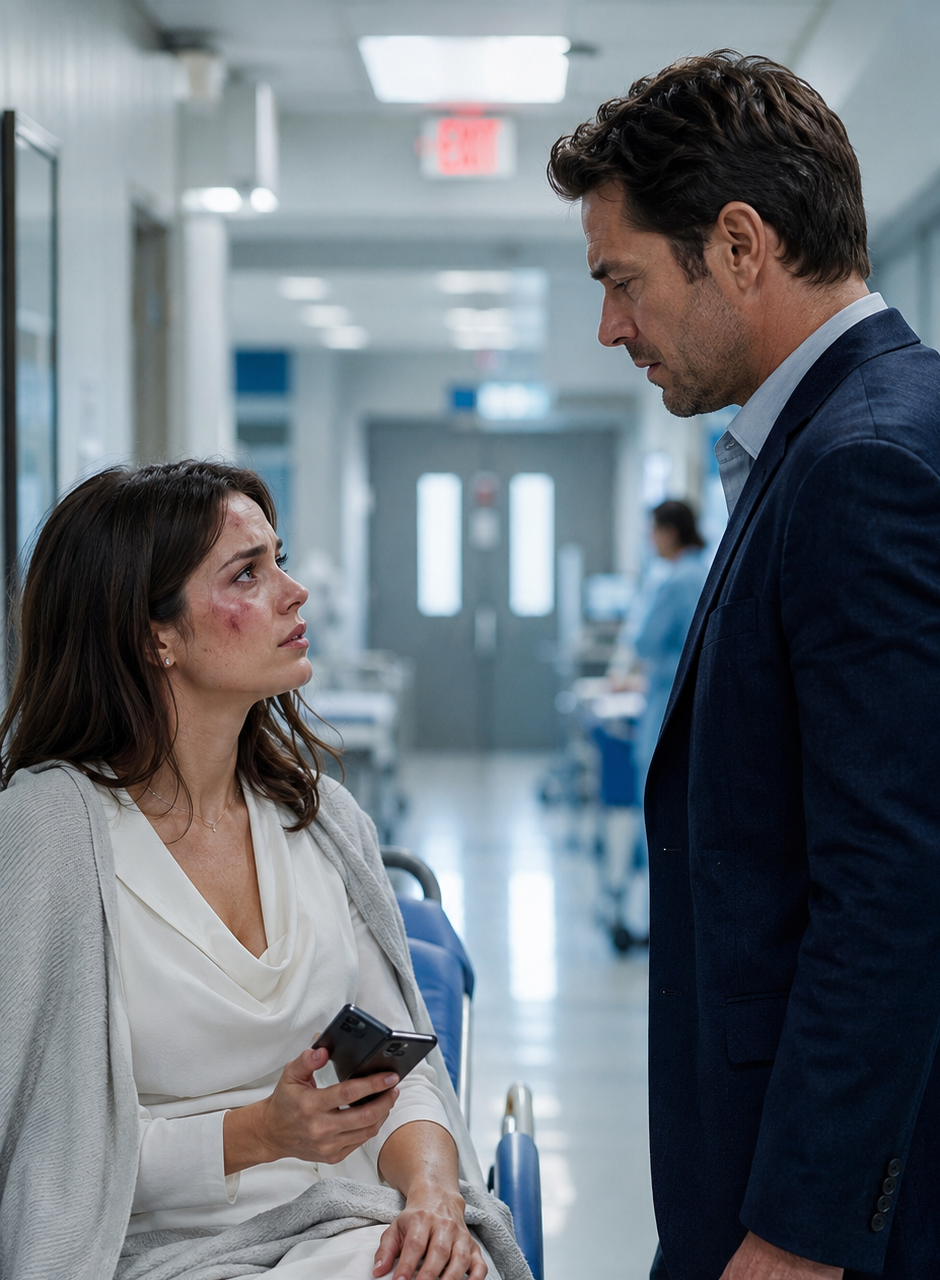
I Believed Love Meant Enduring — Until He Left Me Bleeding for Her
Twelve years I called it marriage.
It turns out I was only ever collateral, waiting to be liquidated.
Rain hammered the overpass like something trying to get in.
Steel groaned somewhere behind me, folding in on itself, and my own blood tasted like pennies and rust in my mouth.
Across the wreckage, Claire was screaming Ethan’s name like he was the only oxygen left on the freeway.
“Ethan.” My voice came out smaller than I wanted.
“I can’t feel my hand.”
He turned.
For one full second, his eyes found mine, and I thought—stupidly, instinctively, the way twelve years of habit thinks before the mind catches up—he’s coming.
Then Claire cried out again, and he was gone, sprinting through the rain toward her, lifting her into the ambulance himself, barking at the paramedics to hurry, to be careful, to please, please save her.
Nobody carried me anywhere.
I crawled toward the flare of red lights on my own, one hand dragging uselessly behind me, and a stranger—a trucker who’d stopped to help—was the one who finally knelt beside me and said, “Stay with me, okay? Stay with me.”
I want to tell you I screamed his name.
I didn’t.
I watched the ambulance doors close around my husband’s back and I went very quiet inside, the way you go quiet right before you understand something you can never unknow.
Hours later, strapped to a gurney with my own blood pooling faintly pink through the bandage on my abdomen, a nurse pressed a clipboard into my one working hand.
Surgical consent.
My signature wobbled like a child’s.
No one was there to hold the other hand steady.
I signed it alone.
But before the anesthesia dragged me under, I did one more thing.
I asked the nurse for my phone.
“Naomi,” I whispered when my attorney picked up.
“Freeze everything connected to Ethan’s name.
All of it.
File the divorce paperwork tonight.
And open the fraud review—the one I asked you to prepare six weeks ago.”
“Elena, you’re being wheeled into surgery—”
“I know exactly what I’m doing,” I said, and for the first time in longer than I could remember, that was true.
I didn’t grow up believing love was supposed to feel good.
I grew up believing love was supposed to be earned, over and over, the way my mother earned my father’s presence at the dinner table by never once asking where he’d been.
She used to say, A good wife makes herself indispensable, not desired.
I was eleven the first time I watched her smile through a lipstick stain that wasn’t hers on his collar, and I filed it away as instruction rather than tragedy.
Be useful.
Be quiet.
Be the last one standing when everyone else has left the room.
That’s how you keep a man.
I met Ethan Cole nine years after I buried that lesson deep enough to mistake it for wisdom.
He was twenty-six then, sharp-jawed and hungry in a way I recognized because I was hungry too, just for different things.
He grew up two trailers down from a country club he could see but never enter, and he used to point at the golf course through the chain-link fence and tell me, One day I’ll own the whole thing, and they’ll have to let me in.
I loved that hunger in him.
I mistook it for ambition.
I didn’t understand yet that hunger like that doesn’t stop once it’s fed—it just finds a new thing to starve for.
He used to bring me to that same fence, early in our marriage, on the anniversary of the day he’d bought the land the country club eventually sold off to developers—a strange, private ritual I mistook for romance instead of recognizing it for what it actually was: a man still narrating his own origin story to an audience, needing someone to keep witnessing the wound so it never fully closed.
I stood at that fence a dozen times over the years, nodding along, telling him how far he’d come, never once asking myself why a man who owned three properties still needed to visit a chain-link fence to feel like enough.
Claire Whitfield was the thing he’d wanted first.
She’d grown up on the right side of that chain-link fence, and when she left him at nineteen for a boy with a boat and a trust fund, something in Ethan didn’t break so much as it calcified.
He married me two years later.
I used to think I was the woman he chose.
It took the crash to understand I was the woman he settled for while he waited for something better to come back around.
Claire came back around eight months before the accident.
Divorced, restless, twice as beautiful and half as kind as I remembered her from the one dinner party where Ethan had introduced us with his hand resting too long on the small of her back.
I told myself I was imagining things.
I told myself that for eight months, the way you tell yourself a lot of things when the alternative is admitting your whole life is a house built on a fault line.
I wasn’t imagining things.
PART 2:
The notebook was my mother’s habit before it was mine—she kept a small leather one in her apron pocket, and I never once saw what she wrote in it.
I started my own the year Ethan’s company, Coldridge Ventures, began “restructuring,” which is a word rich men use instead of admitting they’re bleeding money.
I wrote down deposiTS. I wrote down withdrawals I didn’t authorize.
I wrote down the night he came home smelling like a perfume I didn’t own and told me it was from a client meeting that ran late.
I told myself I was keeping the notebook to understand my own marriage.
I understand now I was keeping evidence.
Three weeks before the crash, I found the notebook wasn’t enough.
I had a friend from college, a security consultant, install two cameras in our garage—the kind disguised as smoke detectors, the kind you only install on a man you’re starting to fear rather than merely doubt.
I told myself it was about the missing funds.
I told myself a great many things that spring.
Three days before the crash, the cameras showed me the truth in full color, timestamped, unambiguous.
Ethan and Claire, hunched over a printed map of my daily driving route, his finger tracing the overpass on Route 9 where the guardrail curved sharp and low.
I watched him kiss her against my own workbench.
I watched him say, low and certain, the way he used to say things to me when we were young and it still meant something: “Just wait until Friday.
Once it’s done, her trust fund finally belongs to us.
All of it.”
Not an accusation.
Not a suspicion.
A recording, clear as a confession, of my husband and his old love planning to end my life on a stretch of highway I drove five days a week to reach my mother’s care facility.
I didn’t go to the police that night.
I want to be honest about why, because honesty is the only thing I have left that’s entirely mine: I didn’t trust that a small-town department would move fast enough or believe a wife’s video over a Coldridge Cole’s reputation.
Ethan’s family had sat on the county council for two generations.
I needed something the law couldn’t quietly misplace.
I needed something public, permanent, and mine.
So I did what my mother never did.
I stopped being useful and started being dangerous.
I called Naomi Reyes, the best attorney in three counties and the only person outside my mother who’d ever told me the truth without flinching.
I didn’t tell her about the cameras yet—only that I needed a financial forensics review of Coldridge Ventures, quietly, and a divorce filing drafted and ready to trigger on my signal.
“What did he do?” Naomi asked, in the flat voice she used when she already suspected the answer would be worse than whatever I said next.
“I don’t know yet,” I lied.
“I just know I need to be ready.”
Friday came four days later than the recording promised.
I have never been more grateful for a man’s poor planning in my life
The overpass.
The rain.
Claire’s screaming.
My husband’s back as he carried another woman away from me.
I’ve told you that part already.
What I haven’t told you is what it felt like, lying on wet asphalt with a hand I couldn’t feel, to understand with total clarity that the marriage I’d spent twelve years earning had never once been mine to lose.
You cannot lose what was never given freely.
Ethan didn’t choose me that night.
He’d never really finished choosing Claire.
I was simply the version of his life he’d settled into while he waited to see if the better one would come back.
There is a strange mercy in absolute clarity.
It doesn’t hurt less.
But it stops you from bargaining with the pain, and bargaining is where people lose years of their lives.
The doctors told me later that the impact had fractured my wrist and two ribs and opened a laceration along my abdomen that had come within inches of something far worse.
I don’t remember most of the surgery.
I remember the phone call to Naomi with a clarity that still surprises me, the way emergencies sometimes carve out one perfectly lucid room in the middle of a collapsing house.
I woke to fluorescent light and the low murmur of machines, and to Naomi sitting in the vinyl chair beside my bed with a sealed evidence box on her lap and an expression I’d never seen on her before—something between fury and relief.
“The financial review came back early,” she said.
“Elena, it’s worse than fraud.”
“Show me later,” I said.
“First tell me—is it filed?”
“Divorce petition, filed this morning.
Every joint account and every account he controls independently that touches Coldridge Ventures is frozen pending the fraud investigation.
He can’t move a dollar without a judge’s signature.” She paused.
“He doesn’t know yet.
He’s been trying to find you for six hours.
Hospital wouldn’t tell him your room.”
I closed my eyes.
Somewhere down the hall, I could already hear him.
“Where’s my wife?” Ethan’s voice, carrying that particular register men use when they’ve never once in their lives been told no and are discovering, in real time, how badly it fits them.
“I need to see my wife.
Now.”
A doctor’s voice answered him, calm and absolutely without warmth.
I would learn later it was Dr. Whitcombe, the surgeon who’d operated on me, a woman in her fifties who had apparently already heard enough about my husband’s conduct from the trauma nurses to have formed a private and permanent opinion.
“Your wife is alive,” she said.
“Awake.
And she’s asked me to relay a message.
The divorce has been filed.
Every account you rely on has been frozen.
And she has no intention of seeing you tonight, or possibly ever again.”
There was a silence I could feel through two walls.
Then Ethan laughed—that short, incredulous bark he used whenever reality failed to defer to him.
“That’s not possible.”
I turned my head toward Naomi.
Through the gap in the curtain, I could just see the edge of the hallway, the shape of my husband’s shoulders as he tried to push past a nurse who did not move.
“Let him keep thinking that,” I said, “for exactly as long as it takes him to walk in here.”
He came in eleven minutes later, once a hospital administrator had confirmed that yes, legally, an awake and competent patient could refuse a visitor, even a spouse, and that continuing to raise his voice in a trauma ward would result in security removing him from the building.
Ethan Cole had never in his adult life been removed from anywhere.
The threat alone seemed to do more to sober him than anything else had.
He stood in the doorway looking, for the first time since I’d known him, genuinely uncertain of his welcome.
Rain had dried into his shirt in dark blotches.
There was a fading lipstick mark—Claire’s, I assumed, though I no longer had the energy to feel much about it—near his collar.
“Elena.” He said my name like an apology and an accusation at once, the way he always had when he wanted me to do the work of forgiving him before he’d finished the sentence.
“You could have died out there.
Do you have any idea what I’ve been through today?”
I looked at him for a long moment.
Twelve years, and I had never once looked at him the way I looked at him then—not with love, not with fear, not even with the particular grief I’d expected.
Just clear, unhurried assessment, the way you’d look at a stranger’s résumé.
“I know exactly what you’ve been through,” I said.
“I have four hours of security footage of what you’ve been through.
Garage, workbench, Tuesday and Thursday of last week.
Should I describe the parts where you discuss my trust fund, or would you rather I just play it for the room?”
The color left his face in a way that told me more than any confession could have.
He didn’t ask what footage.
He didn’t say what are you talking about.
He said, “Elena, whatever you think you saw—”
“I saw you and Claire trace my driving route with a red marker,” I said.
“I saw you say just wait until Friday.
I was on that overpass Friday, Ethan.
So was Claire, apparently, which tells me either your plan went spectacularly wrong, or she got cold feet and drove out there to stop you and got caught in the middle of it instead.
I genuinely don’t know which.
I find I don’t especially care.”
 Husband Gives His Wife A Harsh Critique During A Game, She Cries, But He Thinks She’s Overreacting
“That’s insane,” he said, but his voice had lost its floor.
“You think I tried to—Elena, I love you—”
“You carried another woman into an ambulance and stepped over me to do it,” I said.
“I don’t need you to explain what love means to you anymore.
I understood it perfectly, lying on that road.”
He came a step closer, and for one disorienting moment I saw the boy from behind the chain-link fence, hungry and furious at a world that hadn’t let him in yet, and some old, exhausted part of me almost reached for him out of sheer twelve-year habit.
Then Naomi rose from her chair, silent and immovable, and the moment passed the way a fever breaks.
“You should leave,” Naomi said.
“Before I call the detective who’s currently reviewing the footage Elena mentioned.”
Ethan looked between us—his wife, his wife’s attorney, the closed curtain, the machines quietly charting a heartbeat that no longer had any use for him—and for the first time in his life, I watched him understand that no amount of charm or inherited last name was going to talk his way out of the room.
“This isn’t over,” he said, which is what people say when it very obviously is.
I would like to tell you that filing the divorce and freezing the accounts was the hardest part.
It wasn’t.
The hardest part was the six weeks that followed, learning to live inside a body that no longer trusted the man who’d built half its memories, and inside a house that still smelled like him, and inside a town that had spent a decade admiring us as the golden couple who’d risen out of nothing.
Naomi’s forensic review, once fully unsealed, turned out to be far uglier than a single failed attempt at highway murder.
Coldridge Ventures had been quietly siphoning investor capital for eighteen months—my trust fund among the largest single sources, but not the only one.
Three retired teachers had put their pensions into what Ethan had marketed as a low-risk real estate fund.
It was, in fact, low-risk only for him.
He’d been using new investments to cover old losses, the oldest trick in finance and the one that always, eventually, runs out of new investors.
He needed my trust fund released—needed the marriage’s community assets liquefied—to cover a shortfall auditors were three weeks from discovering on their own.
My death would have solved two problems at once: silence a wife who’d started asking pointed questions about missing statements, and free up capital before the fraud became visible.
Claire, it turned out from the messages Naomi’s investigator recovered, hadn’t known about the money at first.
She’d known only that Ethan wanted his old life back, and she’d wanted hers back too, and between them they’d built a plan neither one, alone, might have had the nerve to finish.
I’ve thought about that a great deal since.
About how two wounded, hungry people can talk each other into monstrous math neither would have done the arithmetic on solo.
There is a particular kind of exhaustion that comes from watching your entire financial life get dismantled in front of strangers, one line item at a time.
Naomi walked me through the forensic report in her office three weeks after the crash, my wrist still in a brace, an untouched cup of coffee going cold between us.
She’d printed everything—she said she didn’t trust me to read numbers this size off a screen without something physical to hold onto while I did it.
“This wire,” she said, tapping a line from fourteen months earlier, “went to an account in Claire’s maiden name.
Forty thousand dollars, labeled a ‘consulting retainer.’ Coldridge Ventures doesn’t have consultanTS. It has Ethan, an office manager, and you, unpaid, doing half his bookkeeping for six years because he told you accountants were expensive and he trusted you more anyway.”
I remembered that conversation.
I remembered feeling flattered by it—I trust you more than a stranger, Elena—the way you feel flattered by scraps when you’ve spent your whole life trained to call scraps a meal.
“How much, total, before Friday?” I asked.
“Two point three million, across eighteen monThS. Your trust fund makes up almost half of what’s left standing.
Once the auditors got close, he needed liquidity fast, and the only account he couldn’t touch without your signature or your death was yours.” She set the last word down gently, the way you’d set down something breakable.
“I need you to understand this wasn’t a crime of passion, Elena.
It was a spreadsheet problem, and you were the fastest solution he could find to it.”
I sat with that for a long moment.
It should have been the most painful sentence anyone said to me that year.
Instead it was almost a relief, because a spreadsheet problem, unlike a marriage, has an answer.
You can audit it.
You can close it out.
You cannot audit a broken heart, but you can absolutely audit a fraud, and for the first time since the crash I understood exactly which one I was actually dealing with.
I started going into Naomi’s office twice a week after that, not because she needed me there, but because I needed to watch the case built in real time, the way you might watch a house reframed after a fire—slow, deliberate, load-bearing beam by load-bearing beam.
It gave the rage somewhere to go besides my own chest.
The detective assigned to the case—Ramirez, unhurried, thorough, the kind of investigator who writes everything down twice—built the criminal side over four monThS. Claire, faced with attempted-murder conspiracy charges and the reality that Ethan’s messages placed the idea and the map both squarely on him, took a plea in exchange for testimony.
I watched her on the witness stand describe, in a flat and finally honest voice, how frightened she’d been in the moments after the crash—not for me, she admitted, but of what she’d just helped set in motion.
It was the closest thing to remorse either of them offered, and it wasn’t for me.
I didn’t need it to be.
I’d stopped needing anything from either of them by then.
Claire found me once, in that stretch of months, in the parking lot of the physical therapy clinic where I was relearning how to close my right hand fully around a pen.
She was thinner than I remembered from the dinner party, her expensive composure worn down to something raw underneath, and for a moment I almost didn’t recognize the girl from the photographs in Ethan’s old yearbook—the golden one, the one who’d left him standing at a chain-link fence with nothing but hunger to keep him company.
“I didn’t know about the money,” she said, before I’d even reached my car.
“I swear to you, Elena, I didn’t know what he needed it for.
I thought—” She stopped herself, and something in her face suggested she’d rehearsed this and lost her place anyway.
“I thought he wanted to scare you off the road.
Force you to stay home, maybe put you in the hospital long enough that he’d have time to fix things quietly before you found the statemenTS. I didn’t know he meant—I didn’t think he meant for you to—”
“Die,” I said, because she couldn’t.
“You didn’t think he meant for me to die.
You just thought a controlled, deniable act of violence against his wife was an acceptable variable in the plan.
I want to make sure I understand the distinction you’re drawing, because from where I was lying on that asphalt, it didn’t feel like much of one.”
She flinched, and for a moment I felt something close to pity move through me, quick and unwelcome.
Not because she deserved it.
Because I recognized, underneath her fear of prison and her fear of Ethan and her fear of what she’d let herself become complicit in, the same starved logic I’d inherited from my own mother’s kitchen: that love, real love, requires you to make yourself useful to a man’s plans even when those plans curdle into something monstrous, because the alternative—being unnecessary to him—felt like the greater death.
“I loved him first,” she said, quieter now, like it was supposed to explain something.
“Before you.
Before any of this.”
“I know,” I said.
“That’s the part I actually believe.
It’s also the part that should have stopped you from getting in that car with him at all.
Loving someone first was never a permission slip, Claire.
It never has been.
I hope, whatever happens to you now, you learn that on a timeline that still leaves you time to use it.”
I didn’t wait for her to answer.
I got in my car with a hand that still couldn’t fully close around the wheel, and I drove home the long way, past the overpass, slow, the way you drive past something you’re teaching yourself not to fear anymore.
There were three moments in those months that I think, if I’m honest, defined who I was going to be on the other side of this.
The first was in that hospital room, choosing to let him walk in and hear the truth from my mouth instead of a lawyer’s letter.
I could have avoided him entirely.
I chose to look at him, because I needed to know I could.
Between the first moment and the second, there was a stretch of weeks I think of now as the quiet leveling—the part of the story that doesn’t make it into the version people tell at dinner parties, because it isn’t dramatic so much as it is grinding.
Naomi and I spent entire afternoons in a records office three towns over, requesting archived wire transfer logs the bank was in no hurry to release.
I learned to read subpoena language.
I learned the particular exhausted patience of waiting on hold with a compliance department for forty minutes only to be transferred to another department that would put me on hold again.
None of it was cinematic.
All of it mattered.
There was one afternoon, in the middle of that grind, when Ramirez called to tell me they’d need me to testify to the authenticity of the garage footage myself—not just submit it, but sit in a room and answer questions about when I’d installed the cameras, why, what I’d suspected, how long I’d waited before acting.
I remember feeling something close to shame at the question, the old inherited instinct that a wife who spies on her husband must have already failed at something.
Naomi caught the look on my face before I’d said a word.
“You didn’t fail him,” she said.
“You survived him.
Those aren’t the same category of thing, and I need you to stop filing them together before you get on that stand.” It was the kind of sentence I turned over for days afterward, turning it the way you turn a stone in your pocket, checking every side of it for the truth.
The second came eleven weeks later, after the fraud charges were public and Coldridge Ventures had collapsed under its own weight, when Ethan showed up at Naomi’s office—not mine, he’d learned that lesson—asking to see me one more time.
Not to threaten.
To apologize, he said, in a voice with none of its old certainty left in it.
He’d lost the company, the house, most of his family’s remaining goodwill, and Claire, who’d taken the plea deal that put the full weight of the conspiracy on him.
He was, for the first time since I’d met him, genuinely without leverage.
I almost went.
Some old, well-trained part of me still believed that a woman who’d been left to bleed alone owed her husband the dignity of one final, gracious conversation.
I sat with that pull for two days before I understood what it actually was: the last gasp of my mother’s lesson, the one that said a good woman is measured by how much she’s willing to endure, right up to and including her own attempted murder.
I didn’t go.
I sent one message instead, through Naomi: I hope you use the years ahead of you to become someone I wouldn’t have needed cameras to survive.
I never heard from him directly again.
I won’t pretend the decision cost me nothing.
That night I sat on the floor of my rented living room, still mostly unfurnished, boxes stacked against walls I hadn’t chosen to paint yet, and I cried in the specific, ugly way you cry not for the man you lost but for the twelve years you spent training yourself to be lost-able.
I thought about my mother’s leather notebook again, and I understood, finally, that she hadn’t kept it to remember what my father did.
She’d kept it to remember what she’d allowed.
There’s a difference, and it took me most of a lifetime to learn to hear it.
The third moment, the hardest one, came at sentencing.
The prosecutor asked if I wanted to give a victim impact statement.
I stood in a courtroom that smelled like recycled air and old carpet, in front of the man I’d built twelve years around, and I had a choice that had nothing to do with him anymore: whether to make my statement about my anger, or about what I’d learned.
Anger would have been easier.
It would have felt, in the moment, like justice.
I talked instead about my mother’s leather notebook, and the lesson I’d carried out of her kitchen without ever examining it—that love is something you earn through your own erasure.
I told the courtroom that the version of me who believed that lesson was the one who would have died quietly on that overpass, grateful even at the end for whatever attention she was given.
I said that the woman standing in front of them now had learned, four hours too late to matter but not too late to be true, that love that requires your disappearance was never love.
It was tuition for a lesson I should have unlearned decades earlier.
Ethan received nine years.
Claire received eighteen months and a mandate to pay restitution to the pensioners whose savings had funded a marriage’s slow-motion collapse.
Neither sentence undid the crash.
Neither one gave me back the twelve years, or the version of myself who’d have kept driving that same route, week after week, grateful just to be married to someone who occasionally looked at her.
I watched Ethan’s face when the judge read the number aloud.
Nine years.
He didn’t look at me.
He looked, instead, at the empty space at the back of the courtroom where his mother should have been sitting and wasn’t—she’d stopped taking his calls three weeks into the investigation, once the pensioners’ names started appearing in the local paper, once the golf-club fence he’d spent his whole childhood staring through finally, definitively, closed against him for good.
I felt, watching that particular absence land on his face, something I hadn’t expected to feel: not triumph, exactly, but a kind of grim, complicated grief for the boy behind the chain-link fence who’d never learned any way to be chosen except by force.
I let myself feel it for the length of one breath.
Then I stood, and I walked out of that courtroom without looking back, because grief for who someone might have been is not the same thing as forgiveness for who they chose to become, and I no longer confuse the two.
I still have the notebook.
It sits in the drawer of a small rented house forty minutes from the one Ethan and I shared, in a town where nobody knows the golden-couple story, where I go by my maiden name again, Elena Marsh, which felt strange in my mouth for exactly one week and then felt like coming home.
The silver bracelet Ethan gave me the year we married—the one I used to touch when I was anxious, an old comfort object more than jewelry—sits in the same drawer as the notebook now.
I didn’t throw it away.
I considered it.
In the end I kept it the way you keep a scar: not because you’re proud of how you got it, but because pretending it isn’t there doesn’t make you whole faster.
The garage light that Ethan always meant to fix and never did—the one that used to leave our driveway in half-shadow every night for three years, a small, ordinary neglect I’d absorbed the way I absorbed everything—I fixed within my first week in the new house, on my own, with a YouTube tutorial and hands that no longer shook.
It is a stupid, small thing to be proud of.
I am proud of it anyway.
It is proof that I can finish what needs finishing without waiting for someone else to notice it’s broken.
My wrist healed crooked, just slightly, a faint angle the orthopedist tells me will never fully correct.
I’ve stopped minding.
It reminds me, every time I sign my name, that I once signed my own consent to surgery with a hand no one was holding, and survived it, and built an entire second life out of the decision I made in the four minutes before the anesthesia took me under.
Naomi and I have dinner every second Thursday now, a habit that started as case updates and became something closer to family.
My mother, in the care facility I still drive to every week—on a different, longer route now, one I chose myself—asked me once, gently, whether I regretted marrying him at all.
“No,” I told her, and meant it.
“I regret believing that being useful was the same thing as being loved.
I don’t regret the twelve years it took me to learn the difference.
I just refuse to spend a thirteenth.”
I started a small consulting firm this spring, helping women untangle joint finances during divorce—the unglamorous, granular work of finding hidden accounts, understanding what you actually own versus what you were only ever allowed to use.
I’m good at it.
It turns out that four months of building a case against your own husband from a hospital bed teaches you more about forensic accounting than most people learn in a career.
My first client cried in my office and told me she felt stupid for not seeing it sooner.
I told her what I’ve had to tell myself more than once this year: you didn’t see it because you were taught not to look.
Looking is a skill.
You’re learning it now.
That’s not stupid.
That’s survival, arriving late but arriving.
I don’t know if I’ll marry again.
I’m not in a hurry to find out.
What I know is that I no longer measure a room by how much of myself I can make disappear into it to keep the peace.
I measure it, now, by whether anyone in it would carry me to the ambulance first.
The overpass on Route 9 has a new guardrail.
I drove past it once, deliberately, six months after the crash, just to prove to myself I could.
I didn’t cry.
I didn’t feel triumphant either.
I felt, mostly, like someone looking at the exact spot where an old life ended and a truer one, however painfully, finally began.
I keep the bracelet in the drawer, not because I’m still that woman, but because I want to remember, on the days it would be easier to forget, exactly how far I climbed out of being her.
Some mornings, usually the ones where the light comes in low and gray and reminds me a little too much of that highway, I still catch myself listening for footsteps that aren’t coming—the old, worn groove of waiting to be noticed, waiting to be chosen, waiting to matter enough to be carried somewhere safe.
I don’t think that groove ever fully closes over.
I think you just learn, eventually, to notice yourself standing in it, and to step out on your own power instead of waiting for someone else’s arms.
My second client this fall was a woman named Priya, forty-four, married nineteen years, who came into my office convinced she had nothing of her own to untangle because her husband had always “handled the money.” I recognized the sentence the moment she said it—I’d said some version of it myself, once, to a stranger at a dinner party, proud of how little I had to worry about.
I didn’t tell her my own story.
I’ve learned that women in that particular kind of fog don’t need someone else’s crash to make sense of; they need someone patient enough to open the actual statements with them, line by line, until the fog burns off on its own.
We sat together for three hours that first session.
By the end of it, she’d found four accounts she hadn’t known existed.
She cried, and then, quietly, she laughed—the particular laugh of someone realizing that the floor she thought she didn’t have was there all along, waiting for her to find it herself.
That’s the work now.
Not vengeance—I closed that account, so to speak, the day the judge read Ethan’s sentence aloud and I walked out without turning around.
Just this: teaching women to open their own statemenTS. Teaching them that being useful and being loved were never supposed to be the same transaction.
Teaching myself, one ordinary Tuesday at a time, that the woman who signed her own surgical consent with a shaking hand and no one beside her was not abandoned.
She was, without knowing it yet, already free.
The garage light stays on now, every night, whether I’m home to see it or not.
Some habits you keep, in the end, not because you’re afraid of the dark anymore, but because you’ve decided, once and for all, that no room you live in is ever going to sit in shadow again just because it was easier not to fix what was broken.