
Change Every PIN — He Never Thought I’d Actually Listen
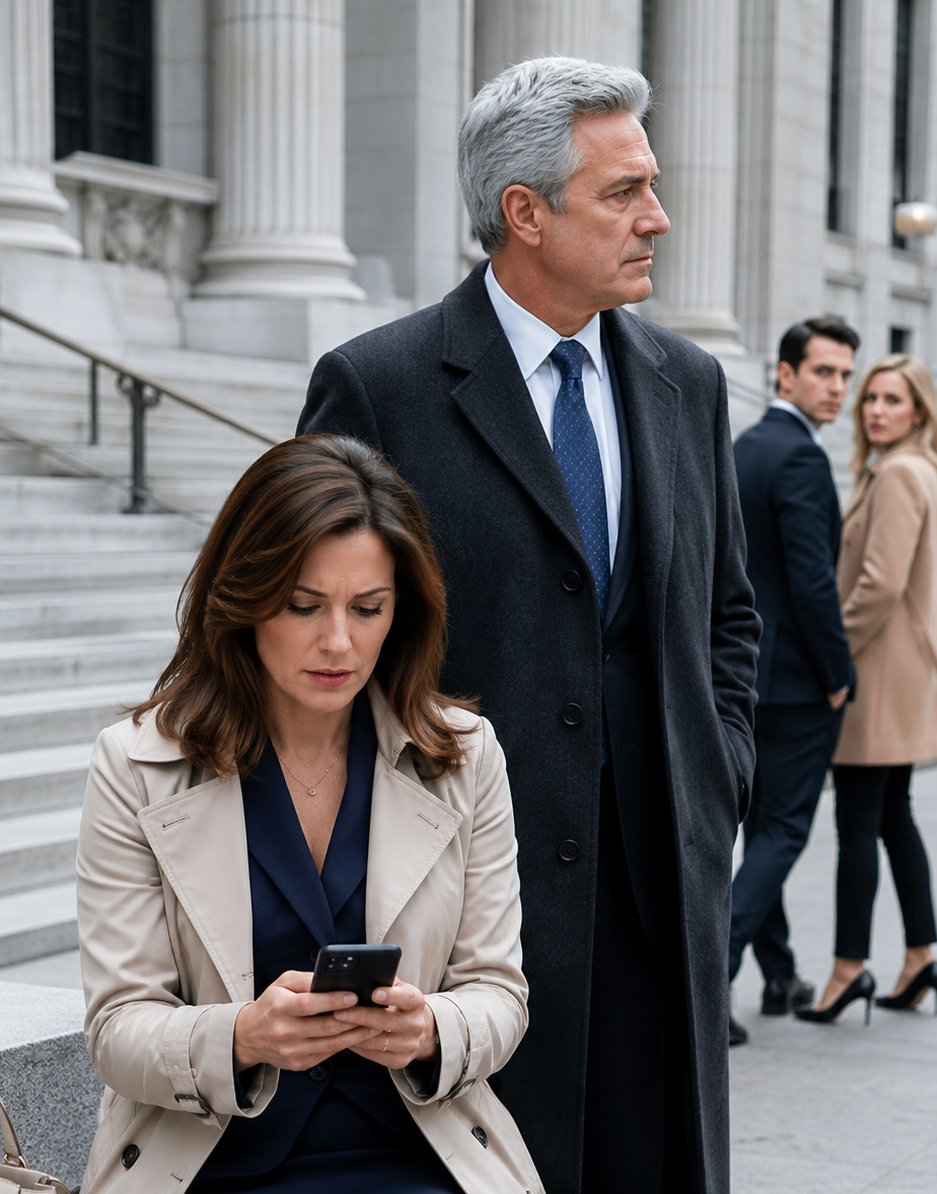
“Emily,” my father said, catching my wrist before I could step through the courthouse doors, “change every PIN.
Right now.
Not tonight.
Now.”
I almost laughed.
My marriage had been declared dead ninety seconds earlier by a judge who hadn’t even looked up from his docket, and my hands were still shaking from the sound of the gavel.
But my father, Richard Hayes, had spent thirty-two years investigating financial fraud for the state of New York, and when he used that voice — flat, certain, already three moves ahead — people listened.
I had learned to listen a long time before I learned to argue.
So I sat down on the cold marble bench outside Courtroom 6B, pulled out my phone, and began changing PINs.
Business checking.
Personal savings.
The emergency line I’d never had to touch.
The travel card.
The corporate card I still, technically, had access to.
Even the old matte-black card tucked behind my driver’s license — the one that had belonged to my mother, that I’d carried since the funeral and never once used.
Ten cards.
Ten new PINs.
My father stood over me the entire time, silent, watching the courthouse doors the way a man watches a door he expects someone to come through with bad intentions.
Daniel walked past us at 4:47, Vanessa Cole hanging off his arm in a cream silk blouse and the particular smile of a woman who has just watched someone else lose.
He slowed just long enough.
“Try not to cry too hard, Em,” he said.
“Some women just don’t know how to keep a man.”
Vanessa laughed like it was the funniest thing she’d heard all week.
I didn’t look up from my phone.
“Some men don’t know how to read a bank statement.”
His jaw moved.
Just once.
Then he was gone, and I went back to typing numbers into my phone with fingers that had finally, finally stopped shaking.
By 8:40 that evening, Daniel and Vanessa were three miles away at Aurum House, a private club on the forty-first floor where the champagne started at four figures a bottle and privacy was the actual product being sold.
Daniel had booked the Sapphire Room under the membership that used to be ours, back when he was still my husband and not just a man with my last name of preference and my company’s dining privileges.
He ordered oysters flown in that morning, a Wagyu tower, two bottles of ’82 Bordeaux, and — because it was apparently Vanessa’s birthday, a fact I would later find almost funny — a jewelry cart wheeled in from the boutique downstairs.
Aurum House kept one on retainer for members who wanted to make expensive mistakes without ever leaving the building.
Vanessa chose a sapphire necklace.
Six hundred and forty thousand dollars, not that anyone in that room was doing math out loud.
Daniel, drunk on wine and something closer to spite, handed over my matte-black card.
The waiter came back three minutes later.
His face had gone the particular gray of a man who has to deliver news to someone used to never hearing no.
“Mr. Whitmore.
I’m sorry.
The payment didn’t go through.”
“Run it again.”
“We did, sir.”
“Then use the backup.” Daniel was already reaching for his wallet, already pulling out the second card, the third.
The waiter’s voice dropped almost to nothing.
“All the linked cards have been restricted, Mr. Whitmore.”
Vanessa’s smile disappeared like it had never been there.
Across town, I sat at my father’s kitchen table, watching my phone light up over and over with fraud alerts I had personally authorized just to see the shape of the man I’d married.
My father poured two mugs of coffee, set one in front of me without asking, and sat down across from me like a man settling in to watch a very long movie he already knew the ending to.
“Now,” he said, “the real divorce begins.”
I didn’t know yet how right he was.
I didn’t know about the forged letter with my company’s seal on it.
I didn’t know Daniel had spent four months trying to open a line of credit using documents with my signature on them — a signature I hadn’t written.
I didn’t know that somewhere in a drawer in my father’s study sat a piece of paper with my dead mother’s name on it, and his, as a witness, to something I had never once been told existed.
All I knew, that night, was that for the first time in six years of marriage, I had done something before Daniel did.
And it had felt like breathing after holding my breath for a very long time.
Part One: What the Marriage Was
People who meet Daniel Whitmore for the first time tend to like him immediately.
He has the kind of face that photographs well from every angle and a laugh that makes strangers lean in, wanting to be part of the joke.
I liked him immediately too, six years ago, at a fundraiser I didn’t want to attend, wearing a dress I’d bought specifically because it made me feel like someone who belonged in rooms like that one.
“You’re the Hayes girl,” he’d said, not a question.
“The one who built the logistics company out of a garage.”
“Out of a spare bedroom, actually.
The garage came later.”
He’d laughed — the real laugh, not the fundraiser laugh — and I’d spent the rest of that night thinking about the sound of it.
What I didn’t understand then, and wouldn’t understand for years, was that Daniel had grown up watching his father lose everything twice.
Not to bad luck — to bad decisions dressed up as confidence, the kind of decisions a man makes when he’s convinced the world owes him back what it already took.
Daniel’s father died believing he’d been cheated out of a life he was entitled to.
Daniel inherited the belief without ever examining it.
He just changed the target.
He didn’t marry me because he loved my success.
He married me because he believed that being close enough to something built and stable would eventually make him feel built and stable too.
It never did.
Six years in, he still woke up some mornings looking at me like I was the reason he felt like a guest in his own life.
My father tried to warn me, in his careful, procedural way, before the wedding.
“He asked about the trust structure of your company twice in one dinner, Emily.
Twice.”
“He’s curious about my work, Dad.
That’s not a crime.”
“I didn’t say it was a crime.
I said it was a pattern.”
I married Daniel anyway.
I loved him — that part was never a lie, not on my end.
What I didn’t understand was that loving someone honestly doesn’t obligate them to love you the same way back, and that a man can smile at you every morning for six years while quietly deciding, somewhere underneath the smiling, that you are a resource he is entitled to and not a person he chose.
I found out about Vanessa the way most people find these things out — not through some dramatic reveal, but through a small, stupid detail.
A restaurant receipt in his jacket pocket, for a dinner on a night he’d told me he was in Boston.
I didn’t confront him that night.
I sat with it for three days, the way my father had taught me to sit with any piece of evidence before acting on it — don’t move on a feeling, Emily, move on a pattern — and by the third day I had found four more receipts, a hotel confirmation, and a joint gym membership under a name that wasn’t mine.
When I finally asked him, Daniel didn’t deny it.
He didn’t even look surprised that I knew.
“I want a divorce,” he said, like he’d been rehearsing it.
“You’ve made this marriage about your company for six years.
I want to actually live.”
“I’ve made this marriage about my company,” I repeated, “because I built it before I met you, and it pays for the apartment you live in.”
He smiled at that.
The old smile, the fundraiser smile.
“See, that’s exactly the problem, Em.
You keep score.”
I didn’t answer him.
I called my divorce attorney the next morning, and I called my father the morning after that, and by the time we sat in Courtroom 6B four months later, I had learned two things about Daniel Whitmore that mattered more than anything else: he never apologized, and he never stopped believing he deserved more than he’d been given.
Vanessa was already pregnant with the idea of a life she thought Daniel could give her — the club memberships, the sapphire counters, the version of him that only existed on his best behavior in expensive rooms.
She had no idea, that night at Aurum House, that she was watching the exact same man make the exact same mistake his father had made twice before him.
She had no idea she was watching the beginning, not the reward.
Part Two: The Letter
The forged letter surfaced nine days after the divorce was finalized.
I found out because Marcus Delgado, who ran compliance for my company and had known me since the spare-bedroom days, called me at 6 a.m.
on a Tuesday with a voice that told me before his words did.
“Emily, someone tried to use your signature to open a corporate line of credit.
Two hundred thousand.
The bank flagged it because the letterhead didn’t match our current template — we updated it in March, and whoever forged this was working off an old file.”
“Which bank?”
“First Meridian.
The branch on 6th.”
I already knew, before Marcus said another word, whose handwriting habits I’d need to compare it against.
Daniel had watched me sign a thousand documents over six years.
He’d have known my signature better than I know it myself, if I’m honest, because I never look at my own name the way another person looking for a weakness would.
My father drove me to First Meridian himself.
He didn’t say much in the car, which was its own kind of statement — Richard Hayes talks more when he’s less worried, not more.
The branch manager showed us the letter.
My company’s old letterhead, my forged signature, a request routed through an account that had been closed for eight months — the same account Daniel and I had shared when we were still married, still speaking to each other in full sentences.
“He used a dead account to try to open a live line of credit,” my father said, almost admiringly, the way a man might admire a magic trick he’s already figured out.
“Sloppy.
He’s improvising.”
“What does that mean?”
“It means he’s not planning ahead anymore.
It means he’s panicking.” My father looked at me.
“Which means he’s out of money already, Emily.
Faster than we thought.”
I felt something in my chest that I didn’t have a clean word for.
Not triumph, not quite pity.
Something closer to recognizing an old photograph of a man I used to think I knew.
We reported the forgery.
First Meridian froze the request, opened an internal fraud file, and — because my father still had friends in every department of every institution in the state, three decades of favors nobody had cashed in yet — the case moved faster than it should have.
Daniel was questioned two weeks later.
He denied everything, of course, blamed a “shared password” from the marriage, implied I’d left the account open on purpose to set him up.
It didn’t hold.
The forensic handwriting analyst was unmoved by implication.
 Sister Buys A Crib For Her Mom’s House, Then Demands Her Brother Sacrifice His Only Private Space
But it was in the middle of that meeting with the fraud investigator that my father said something odd, something that snagged in my memory like a thread pulled loose from a sweater.
“He’s not smart enough to do this alone,” my father said afterward, in the parking lot, staring at nothing.
“Someone’s advising him.”
“Vanessa?”
“Vanessa doesn’t know the difference between a trust and a checking account.
No.” He shook his head slowly.
“Someone who knows exactly what a dead account looks like on paper.
Someone who knows our family’s banking history well enough to reach for it first.”
I didn’t understand what he meant.
Not yet.
It would take another six weeks, a locked drawer in his study, and a document with my mother’s signature on it before I understood exactly what my father had already started to suspect and hadn’t yet found the courage to say out loud.
My father’s face did something complicated.
“That’s the part I need to tell you, and you’re not going to like it.”
Eight years ago, before Daniel and I married, my father had run a background check on him — not invasive, just standard due diligence, the kind he’d have run on anyone dating his only daughter.
In that background check was a detail he’d never mentioned to me: Daniel’s father, before his second bankruptcy, had once worked briefly as a junior associate at the same firm that had helped structure my mother’s original trust — a decade before Daniel and I ever met.
“It’s probably nothing,” my father said.
“It’s probably a coincidence in a city of eight million people.
But Daniel asked about trust structures on your second date, Emily.
Not your fifth.
Your second.
And I’ve spent thirty-two years learning that when a coincidence walks in wearing a suit, you check its pockets before you shake its hand.”
He’d never told me because he’d never found proof of anything beyond the coincidence, and a man who had spent his career punishing people on evidence wasn’t going to accuse his daughter’s boyfriend on a hunch.
He regretted that now, he said.
Not because the hunch would have changed my choice — I would have married Daniel anyway, stubborn the way I’ve always been — but because he thought I’d deserved to make that choice with every piece of information, not just the ones that were comfortable.
“I should have trusted you with the whole picture,” he said.
“I trusted my instinct to protect you instead.
I’m sorry.”
It was the first time in my life I’d heard my father apologize for anything.
I got up from the table and walked to the window, because I needed a moment where he couldn’t watch my face while I decided how to feel.
Outside, the neighbor’s dog was doing slow circles around a maple tree that hadn’t finished dropping its leaves.
I thought about all the dinners with Daniel where he’d steered the conversation, so gently I hadn’t noticed the steering, toward my father’s career, my mother’s estate, the mechanics of how money moved through a family like ours.
I had thought, at the time, that it was interest.
Diligence.
A man doing his homework on the family he was marrying into.
I had never once considered that homework could be reconnaissance.
“Did Mom ever meet him?” I asked, still facing the window.
“Before she died?”
“Twice.
At the engagement party, and once before that, when you brought him to the hospital.” My father’s voice had gone quieter behind me.
“She didn’t say much to me about him directly.
But she asked me, after that second visit, whether I’d run the background check yet.
I told her I had, and it had come back clean.
She said—” He stopped.
“What did she say?”
“She said clean isn’t the same as honest.
She said some men know exactly which papers to keep off the record.” He let out a breath that sounded like it had been held for fourteen years.
“I thought she meant something general.
A mother’s instinct, nothing I could act on.
I didn’t understand until I found this folder last month that she might have meant something specific.”
I turned back around.
“You think she knew about the firm.
About his father.”
“I think your mother noticed things I was too proud to notice, because I’d spent thirty-two years being the expert in the room, and it never occurred to me that the person across the dinner table from our daughter might be the one case I couldn’t see clearly because I loved you too much to look at him the way I looked at everyone else.” He rubbed his eyes with the heel of his hand, an old, tired gesture I’d only ever seen him make at my mother’s funeral.
“I’ve spent this whole year chasing the evidence Daniel left behind.
I think the real evidence was sitting in a folder in my own study the entire time, and I was too afraid of what it meant about my own judgment to open it sooner.”
We sat with that for a long time, the coffee going cold between us, the dog outside finally settling under the maple tree like it had run out of reasons to keep circling.
Part Five: The Choice
The final piece came together three weeks later, not from my father’s decades of experience, but from an email Vanessa forwarded me without comment — a message Daniel had sent his lawyer, cc’d to her by accident in the chaos of his unraveling finances.
In it, Daniel referenced “the Hayes trust structure” by name.
A trust he should never have known existed, because I hadn’t known it existed until a month earlier.
The fraud investigator I’d been working with — a patient, precise woman named Renata Osei — put it together within a week.
Daniel’s father, in his brief time at that firm, had kept copies of client files he wasn’t authorized to keep, a habit he’d apparently passed down along with his resentmenTS. Daniel had gone through his late father’s storage unit two years into our marriage, found paperwork referencing “D.
Hayes trust — do not disclose to beneficiary,” and spent the better part of six years quietly trying to locate and access an account he believed was rightfully connected to me, and therefore, in his mind, rightfully connected to him.
He never mentioned it to me.
Not once, in six years of marriage.
He’d married me at least partially already knowing there was money out there he hadn’t found yet.
Renata offered me two paths forward, and this was the choice my father couldn’t make for me, the choice that would define, more than anything else that year, who I was choosing to become.
Path one: pursue full criminal charges.
Forgery, attempted fraud, unauthorized access — enough evidence, Renata said, to put Daniel away for eighteen months to three years.
It was justice, clean and documented and earned through nine months of his own carelessness.
Path two: pursue a civil settlement and a restraining order, keep the criminal file open but inactive, and let Daniel’s life collapse under the weight of what he’d already done to himself — the club debts, the failed transactions, the reputation now unraveling through a small but tight financial industry that talked to itself.
Renata laid the two folders side by side on her desk, like a woman dealing cards in a game she’d watched a thousand people lose.
“There’s no wrong answer here,” she said.
“Both are within your righTS.”
“What would you do?” I asked her, even though I knew it wasn’t really her question to answer.
She considered it longer than I expected.
“I’ve sat across this desk from a lot of people who chose the criminal path because they wanted the world to officially agree with them that they’d been wronged.
Some of them got that agreement, and it helped.
Some of them got it and found out a guilty verdict doesn’t actually undo anything — it just gives the anger somewhere official to live instead of somewhere private.” She tapped the second folder.
“I’ve also sat across from people who chose this path and spent the next five years wondering if they let someone off too easy.
There’s no version of this where you don’t have to live with the choice.
I can only tell you which one tends to let people sleep better, and it isn’t always the one you’d guess.”
“Which one is that?”
“The one where you stop needing him to suffer in order to feel like you won.”
I thought about that word — won — and how strange it was to hear it in a room with fluorescent lighting and a fraud investigator’s careful, unbothered voice, after a year where winning had come to mean something so different from what I’d have guessed it meant back at the fundraiser, in the dress, listening to a laugh I mistook for a promise.
I thought about my mother, writing a trust fourteen years before she died, trying to protect a daughter she wouldn’t live to see marry the wrong man.
I thought about my father, thirty-two years of chasing people like Daniel through paperwork, learning to distrust his own silence as much as anyone else’s dishonesty.
I thought about Vanessa, and her four-year-old, and the particular exhaustion in her voice when she said I need to know what I’m actually standing in the middle of.
And I thought about Daniel at the fundraiser, six years ago, laughing the real laugh, before either of us had done anything yet to deserve what came after.
I chose the civil path.
Not because I forgave him — I want to be clear about that, because for a long time I thought choosing mercy and choosing forgiveness were the same decision, and they aren’t.
I chose it because I didn’t want the next three years of my life to be organized around Daniel Whitmore’s punishment.
I had already given him six years.
I wasn’t going to give him the shape of the years after, too.
“You’re better than he deserves,” my father said, when I told him.
“I’m not doing it for him,” I said.
“I’m doing it so I stop being the person who has to think about him every day.”
The restraining order went through.
The civil settlement recovered what could be recovered, which was less than the forged attempts but more than nothing.
The criminal file stayed open, a door I could walk back through if he ever came near my accounts, my company, or me again.
Daniel never spoke to me directly again.
The last thing I heard, through Marcus, through the small, gossiping industry we both still moved through, was that he’d taken a job — an actual job, salaried, unglamorous — at a mid-size firm in Hartford, six months after the settlement.
Whether that was growth or just running out of other options, I’ll never know for certain, and I’ve stopped needing to.
Part Six: What Was Left
The sapphire necklace Vanessa never got to buy became, in a strange way, the last small detail of the whole story — Aurum House’s boutique manager mentioned to a mutual acquaintance, months later, that the necklace had finally sold, to a woman celebrating her own divorce settlement, paying in full, in cash, no card required.
I heard that story at a dinner and laughed for the first time in almost a year in a way that didn’t have anything bitter folded into it.
My mother’s trust matured on my thirty-fifth birthday, four months after the settlement closed.
I didn’t touch it right away.
I let it sit, the way she’d apparently always meant for me to build everything first and land on it only if I needed to, and when I finally did use a portion of it, it wasn’t for anything dramatic — I funded a small scholarship at the business school where I’d taken my first accounting class, named for a mother I still sometimes forget isn’t going to call me on a Sunday.
My father and I still have coffee at his kitchen table most weekends.
He still tells me things too late sometimes — old habits built over three decades of deciding what a person can handle — but we’ve gotten better, both of us, at saying the hard things out loud instead of protecting each other from them.
The old matte-black card, my mother’s card, still sits behind my driver’s license.
I use it now, sometimes, for small things — coffee, gas, nothing that needs protecting.
It stopped being a relic the day I understood what she’d actually built it to be: not armor, just a floor, somewhere to land.
I started seeing someone new this spring — carefully, slowly, in the deliberate way my father taught me to move through anything that mattered.
His name is Theo, and on our third date, he asked me a question I’d been half-dreading and half-hoping someone would eventually ask.
“Your dad ran a background check on me, didn’t he.”
“Yes.”
“What’d he find?”
“Nothing,” I said.
“That’s the part that scared me most.
I didn’t know what to do with someone who came back clean.”
Theo laughed — a real laugh, and I’ve learned, finally, the difference between that sound and the other kind, the kind that’s performing for a room instead of speaking to the person across the table.
“Take your time,” he said.
“I’m not going anywhere.
And if I ever do, I hope your father catches me at the door.”
I think about that a lot — the image of my father’s hand on my wrist outside a courthouse, five minutes into the rest of my life, telling me to protect myself before I even had time to grieve what I was losing.
It wasn’t romantic advice.
It wasn’t comforting.
It was just true, delivered at the exact moment I needed it true, by a man who had spent his whole life learning the difference between people who love you and people who are only good at looking like they do.
Sometimes I try to imagine the version of that evening where he said nothing at all — where I walked out of the courthouse still numb, still trusting grief the way he warned me not to, and went home to wait for the fallout instead of getting ahead of it.
I don’t think Daniel would have gotten away with everything in that version either; he was careless enough, eventually, to be caught by someone.
But I think about how much longer it would have taken me to become someone who acted instead of someone who only reacted, and I understand now that the five minutes my father took from my grief that day weren’t cruelty.
They were the first lesson in a longer one: that protecting yourself and mourning what you lost are not the same task, and you don’t have to finish one before you’re allowed to start the other.
The life I have now isn’t the one I planned at twenty-four, standing in a dress I bought to belong in a room I didn’t yet understand.
It’s smaller in some ways, and it’s harder-won in every way that matters.
But it’s mine — audited, verified, and finally, finally, fully mine — and for the first time in a long time, I’m not checking the locks before I go to sleep.
I’m just sleeping.