
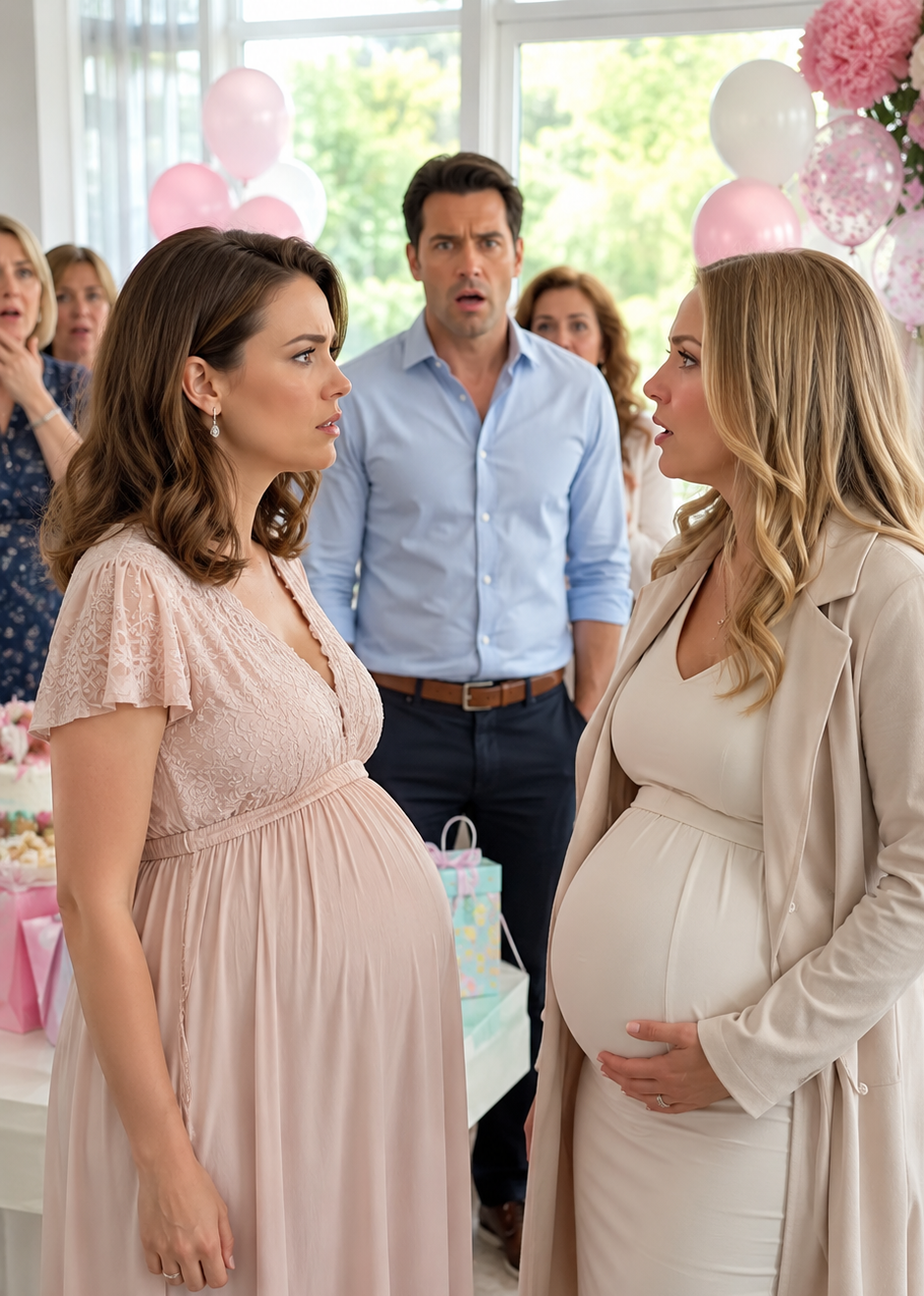
My father’s voice cut through the room like glass.
“Eli,” he shouted.
“Get away from her!”
For one suspended second, nobody moved.
Not Ethan.
Not the woman with her hand buried inside her purse.
Not my mother, who had risen halfway from her chair with one hand pressed to her mouth.
And not me.
Because my father had not shouted Ethan.
He had called my husband Eli.
The name seemed to echo against the walls of our living room, bouncing off the pastel balloons, the paper garlands, the pink-and-white roses, the cake my sister had spent two days decorating with tiny sugared baby shoes.
Eli.
I turned toward Ethan slowly.
His eyes were fixed on my father.
Not confused.
Not insulted.
Not even surprised.
He looked like a man watching a door he had spent years holding shut finally crack open.
“Dad?” I whispered.
My father’s face folded in on itself.
“Ava, honey—”
The woman moved.
It was a small motion, quick and sharp, but Ethan saw it before anyone else did.
He stepped in front of me so fast I felt the air shift between us.
My sister screamed.
My uncle dropped a glass.
The velvet box Ethan had been holding fell from his hand and landed on the carpet with a soft thud.
The stranger pulled something from her purse.
Not a weapon.
A phone.
She held it up, thumb moving across the screen.
“Enough,” Ethan said, his voice low.
The woman’s beautiful, painted mouth trembled, but her eyes stayed hard.
“You were supposed to come quietly.”
“Who sent you?” Ethan asked.
“You know exactly who.”
Outside, the two men who had been standing by the walkway stepped closer to the open door.
They wore dark jackets, not suits, not uniforms—ordinary enough to blend in, wrong enough to make my skin prickle.
My father moved toward the entryway.
“Frank, don’t,” my mother said, grabbing his arm.
But he shook her off with a look I had never seen on his face before.
Not anger.
Not fear.
Something heavier.
Recognition.
The two men paused when they saw him approach.
“Leave,” my father said.
One of them, the taller one, looked past him toward Ethan.
“We only need to speak with him.”
“You won’t speak to anyone in my daughter’s home,” my father replied.
His voice was quiet now, but steadier than it had been a moment before.
“Not today.”
The woman gave a short, humorless laugh.
“That’s sweet.
A grandfather playing guard.”
My father turned his head just enough to look at her.
“Marissa,” he said.
“You have thirty seconds.”
The name changed her.
Not visibly, not dramatically.
But the hand holding the phone lowered a fraction, and for the first time since she had walked into my shower and destroyed the air in the room, she looked uncertain.
My own heart pounded so loudly I could barely hear anything else.
Marissa.
Eli.
Names were falling into my home like stones, and I was standing in the middle of them with one hand resting on my belly, trying to keep breathing for two people.
Ethan reached back without looking and found my hand.
His fingers closed around mine.
The gesture, so familiar, so deeply his, almost undid me.
I wanted to yank away.
I wanted to cling to him.
I wanted him to turn around and tell me, with those steady eyes and that voice I trusted more than anyone’s, that none of this was real.
Instead, he squeezed my hand once.
Apology.
Warning.
Goodbye.
I pulled free.
“Stop,” I said.
My voice was not loud, but something in it cut through the whispers.
Everyone looked at me, and I hated it.
I hated the pity blooming on faces that had been smiling at me minutes before.
I hated the way my mother’s tears had changed from happiness into terror.
I hated that my baby shifted inside me, a soft flutter beneath my ribs, as if reminding me that whatever I did next mattered more than pride.
I looked at the stranger.
“Put the phone away.”
She blinked.
“Now,” I said.
Maybe it was the exhaustion in my voice.
Maybe it was the absurdity of a pregnant woman ordering another pregnant woman around in a room full of pastel balloons.
Maybe it was simply that she had not expected me to find my spine so quickly.
But she slipped the phone back into her purse.
Then I looked at Ethan.
“What is your full legal name?”
His jaw tightened.
Nobody breathed.
Outside, one of the men muttered something I could not hear.
Ethan turned to me slowly.
The man I knew was still there—the same brown eyes, the same small scar above his left eyebrow, the same shoulders that had carried me through grief after grief.
But now there was something behind him I had never been allowed to see.
A room full of locked drawers.
“My name,” he said, “is Ethan Daniel Cross.”
Marissa scoffed.
“That’s not what—”
“But I was born Elijah Daniel Mercer.”
My mother made a broken sound.
My father closed his eyes.
I stared at my husband.
Born.
He had not said formerly.
He had not said used to be.
He had said born.
“What does that mean?” I asked.
Ethan swallowed.
“It means I changed my name before I met you.”
“Before,” I repeated.
“Yes.”
“And you never thought that was something I deserved to know?”
Pain crossed his face.
“I wanted to tell you.”
“That is not an answer.”
“I know.”
Behind us, someone began crying quietly.
I did not turn to see who.
My entire world had narrowed to Ethan’s face and the space between what he said and what he had hidden.
My father spoke before Ethan could.
“Ava, we need to get everyone out of here.”
I turned on him.
“You knew.”
His face went gray.
“Dad,” I said, the word barely holding together.
“You knew?”
My mother looked from him to me.
“Frank?”
He did not answer her.
That was answer enough.
My mother’s hand flew to her chest.
“Frank, what is happening?”
My father looked older than he had that morning.
Older than he had ever looked.
His hair seemed whiter in the soft light, the lines around his mouth deeper.
“Not here,” he said.
A laugh escaped me, brittle and wrong.
“Not here? This is my house.
My husband has another name.
A pregnant stranger walked into my baby shower claiming to be his wife.
There are men outside my door.
And you know her.”
Marissa shifted her weight.
“I’m not staying for a family therapy session.”
“No,” my father said.
“You’re not.”
She lifted her chin, recovering pieces of her confidence.
“You have no idea what you’re interfering with.”
“I know exactly what I’m interfering with.”
The taller man outside stepped through the doorway.
Ethan moved first, but my father held up a hand.
“Don’t,” my father said to him, still watching the man.
“No more secrets in front of Ava.
No more decisions made over her head.”
The man stopped just inside the threshold.
He looked around the room at the stunned guests, the decorations, the half-cut cake, the little pile of presents wrapped in yellow and pink paper.
His expression softened by the smallest degree.
“We don’t want trouble,” he said.
“Then you chose a strange way to introduce yourselves,” my sister snapped.
I had almost forgotten Lily was beside me.
She moved close enough that her arm brushed mine, small and fierce, as if her body alone could hold me upright.
The man’s eyes landed on her, then on my belly, then on Ethan.
“We were told Mr. Mercer would be alone,” he said.
Marissa’s mouth tightened.
Ethan looked at her.
“You brought them here under a lie.”
“I did what I had to do.”
“You don’t even know me.”
“I know enough.”
“No,” he said quietly.
“You know a story someone gave you.”
At that, something in Marissa’s face flickered.
Not guilt.
Not yet.
But doubt.
A thin crack beneath the makeup and performance.
My father opened the front door wider.
“You and your friends can wait outside, or we can call the police and explain why you came to a private home to intimidate a pregnant woman.”
Marissa’s eyes sharpened.
“You wouldn’t.”
My father’s smile was sad.
“You don’t know what I would do for my daughter.”
That silenced her.
The two men exchanged a look.
The taller one stepped back first.
The other followed reluctantly.
Marissa stayed a moment longer, her hand pressed against her belly, her gaze fixed on Ethan.
“You can’t hide forever,” she said.
“I stopped hiding the day I married Ava,” Ethan replied.
The words should have comforted me.
They did not.
Marissa looked at me then.
For the first time, her expression did not seem rehearsed.
There was anger there, yes, but beneath it something rawer.
Fear, maybe.
Desperation.
The kind I had seen in my own mirror after failed treatments, after doctors said words like unlikely and complicated and next time.
“I’m not lying about everything,” she said.
Then she turned and walked out.
The front door closed behind her with a soft click.
The silence she left behind was worse than the chaos.
A room full of people who loved me stood frozen among ribbons and cake crumbs, all of them pretending not to stare while doing nothing else.
My baby shower was over.
My life, as I had understood it, was over too.
I pressed a hand to my lower back as a dull ache moved through me.
Ethan saw it immediately.
“Ava?”
“I’m fine.”
He flinched at the way I said it.
My mother came toward me, wiping at her cheeks.
“Honey, sit down.”
“I said I’m fine.”
Lily touched my arm.
“Ava.”
That broke me more than anything else—not Ethan’s false name, not my father’s silence, not Marissa’s announcement.
My sister’s voice held no demand, no panic, only love.
I let her guide me to the nearest chair.
Someone brought water.
Someone else began quietly ushering guests toward the back patio, then out through the side gate so they would not pass the men on the sidewalk.
I watched it all through a strange distance, as though I were underwater.
Aunt Carol kissed the top of my head and whispered, “Call me later.”
My best friend Nina squeezed my shoulder and said nothing at all, which was exactly why I loved her.
One by one, people left with gift bags and lowered eyes, carrying pieces of my humiliation with them whether they meant to or not.
Soon only my mother, father, Lily, Ethan, and I remained.
The cake sat untouched on the table.
Make a wish, Ava.
I looked at the little plastic baby carriage on top and felt a hysterical laugh rise in my throat.
I swallowed it down.
My mother stood across from my father with her arms folded tightly, looking at him as if he had become a stranger too.
“Frank,” she said.
“Start talking.”
My father rubbed a hand over his face.
Ethan stepped forward.
“This is my fault.
I should be the one to explain.”
“You should,” I said.
“But so should he.”
My father lowered himself onto the sofa.
It made him look smaller, and I hated that I noticed.
“When I first met Ethan,” he began, “he wasn’t Ethan yet.”
I looked at my husband.
“When?”
“Eight years ago,” Ethan said.
A year before he met me.
My father nodded.
“He came into the community legal clinic where I volunteered after retirement.
He was scared, but trying very hard not to show it.
He had documentation, a new address, and a caseworker from a private family services organization.
He needed help filing for a legal name change.”
“Why?” my mother asked, voice trembling.
Ethan looked down at his hands.
I knew those hands.
I knew the way his thumb rubbed across his knuckle when he was anxious.
I had seen those hands assemble cribs, stir soup, hold mine through blood draws, cover his face when yet another test came back negative.
“I grew up in a family that looked respectable from the outside,” he said.
“My father, Victor Mercer, ran a charitable foundation.
He knew judges, donors, police chiefs, pastors.
Everyone thought he was generous.”
My father’s mouth tightened at the name.
Ethan continued.
“At home, generosity had conditions.
Loyalty was everything.
Silence was everything.
If you questioned him, you were ungrateful.
If you wanted a different life, you were betraying the family.”
My anger wavered, and I hated that too.
Because hurt did not erase hurt.
But truth had a sound, and Ethan’s voice had changed into it.
“I left at twenty-six,” he said.
“Not dramatically.
No big scene.
I packed two bags while he was at a dinner, withdrew what little money was mine, and went to a shelter two counties over.
I didn’t want anything from him.
I didn’t want his name, his contacts, his money.
I just wanted to disappear.”
Lily sat on the arm of my chair, her shoulder pressed to mine.
My mother whispered, “Why didn’t you tell Ava?”
Ethan looked at me, and there it was—the question I needed answered more than any other.
“At first,” he said, “because I didn’t know if I’d ever be safe.
Then because I thought if no one knew, Ava couldn’t be pulled into it.
And then…”
His voice thinned.
“Then I loved her.
And every month I didn’t tell her made it harder to tell her the next month.
I convinced myself my old life was dead.
I convinced myself silence was protection.”
I stared at him.
“You decided that for me.”
“Yes.”
“You stood beside me in doctor’s offices and let me tell strangers every intimate detail of my body, my losses, my fears, and you kept this hidden.”
His eyes shone.
“Yes.”
“You let me marry a name.”
“No,” he said quickly, then stopped himself.
His face crumpled.
“No.
That’s not fair for me to say.
I gave you as much of myself as I knew how to give.
But I kept a part back.
And I am sorry, Ava.
More than I can say.”
The apology landed, but it did not heal.
Some wounds did not close because the person who made them sounded sorry.
I turned to my father.
“And you?”
He looked at my mother first, and that made something cold settle in my stomach.
“Frank,” she said, very softly.
“I recognized Ethan the first time Ava brought him home,” he said.
My head snapped up.
“What?”
Ethan looked equally stunned.
“You never told me that.”
“I didn’t recognize your face at first,” Dad said.
“You had a different haircut, different glasses, more weight on you.
But when Ava said your name had been changed, when she mentioned your volunteer work, I suspected.
I checked old notes from the clinic.”
“You checked on him?” I asked.
“I checked because you were my daughter.”
“You investigated the man I loved and then said nothing?”
His eyes filled.
“I found a sealed name change, a clean record, a man who had walked away from something ugly and built a quiet life.
I also found no evidence he had lied to harm you.”
“He lied.”
“Yes.” My father’s voice broke.
“And I made the worst mistake a father can make.
I decided I knew which truth you could survive.”
The room went very still.
My mother sat down slowly, as if her legs could no longer hold her.
“That is not protection,” she said.
“I know.”
“No,” she said, sharper now.
“You don’t know.
You let me welcome him into this family.
You let Ava marry him.
You let us plan a nursery and buy tiny socks and sit in this room today knowing there was a door somewhere that could open.”
“I thought it was locked.”
“And today it opened.”
My father lowered his head.
I had never heard my mother speak to him that way.
They had disagreements, of course, ordinary marital arguments about bills and holidays and whether the thermostat needed to be at seventy or seventy-two.
But this was different.
This was betrayal creating its own weather.
My father looked at me.
“I am so sorry.”
I wanted to forgive him because he was my father, because he had taught me to ride a bike and drove through snowstorms to pick me up from college, because when the first fertility doctor used the word unexplained, he sat with me in the parking lot and let me cry until my voice vanished.
But I was tired of men loving me by making decisions I never agreed to.
“Who is Marissa?” I asked.
Ethan’s brows drew together.
“I don’t know.”
My father inhaled slowly.
“I do.”
We all looked at him.
“She was a child the last time I saw her.
Thirteen, maybe fourteen.
Her mother came to the clinic once.”
“Her mother?” Ethan said.
Dad nodded.
“Serena Vale.”
The name hit Ethan like a hand across the face.
He stood so quickly the coffee table rattled.
“No.”
“You know her?” I asked.
“My father’s assistant,” Ethan said.
“For years.
She ran his schedule, handled donors, cleaned up problems before anyone knew there were problems.”
My father’s eyes stayed on him.
“She came to the clinic with bruises under her sleeves and her daughter sitting beside her.
She wanted advice about leaving her employment contract.
She said Victor had helped her financially after her husband died, but he used the debt to keep her close.
She was terrified.”
“What happened?” Lily asked.
My father’s face tightened.
“She never came back.”
Ethan stared at him.
“I didn’t know.”
“I believe you.”
“Marissa is Serena’s daughter?” I asked.
“Yes,” Dad said.
“Or at least she was introduced that way.”
Ethan walked to the window and looked out through the curtains.
“Those men are still outside.”
Lily joined him, peeking carefully.
“They’re across the street now.
One is on the phone.”
My mother stood.
“We’re calling the police.”
“No,” Ethan and my father said at the same time.
My mother turned on them.
Ethan’s voice softened.
“I’m not saying never.
I’m saying we need to understand what they want first.
If Victor’s name is attached to this, he may have people who can turn a simple complaint into something messy.”
“A simple complaint?” I said.
“A stranger came into our home pretending to be married to you.”
“I know.”
“No,” I said.
“You keep saying that, but I don’t think you do.”
He fell silent.
I stood, slower this time.
The room tilted slightly, then steadied.
“I need air.”
Ethan stepped toward me.
“I’ll come—”
“No.”
The word was not angry.
It was worse than angry.
It was final enough to stop him in place.
Lily rose.
“I’ll go with you.”
I nodded.
We went out through the back door, past the folding tables, past empty cups and plates of cookies shaped like rattles.
The spring air had cooled, and the garden lights Ethan had strung along the fence glowed like little moons.
For seven years, this yard had been a place of waiting.
Waiting for test resulTS.
Waiting for calls from doctors.
Waiting for grief to become manageable.
We had planted lavender after the second failed treatment because I read somewhere that bees loved it, and Ethan said a garden should always have something alive moving through it.
He had built the raised beds himself one Saturday, sunburned and smiling, measuring twice and still cutting one board too short.
Now the lavender shivered in the breeze.
Lily sat beside me on the wooden bench near the fence.
For a while, neither of us spoke.
Then she said, “I want to say something terrible about him.”
“Which one?”
She gave a sad little laugh.
“Fair.”
I pressed both hands over my belly.
The baby moved again, a soft rolling motion.
Lily noticed.
“She okay?”
“I think so.”
“You?”
I stared up at the sky.
It was pale blue fading to silver at the edges, the kind of evening that usually made me feel peaceful.
“I don’t know what I am.”
She nodded, like that made perfect sense.
“I keep trying to decide what hurts most,” I said.
“That Ethan lied.
That Dad knew.
That everyone in there might be in danger because of something I didn’t even know existed.”
“You didn’t cause this.”
“I married into it.”
“You married a person, not a past he buried badly.”
I looked at her.
She shrugged.
“I’m angry.
Don’t mistake that for wisdom.”
Despite everything, I smiled.
Then the back gate creaked.
Both of us turned.
Marissa stood there.
Lily sprang to her feet.
“Absolutely not.”
Marissa lifted both hands slightly.
“I’m not here to start anything.”
“Too late,” Lily said.
I stayed seated, though every nerve in my body had gone alert.
“How did you get back here?” I asked.
“The side gate wasn’t latched.”
“It was.”
She looked away.
That was answer enough.
Lily stepped in front of me.
“Leave.”
Marissa’s eyes flicked to the house.
“I only need two minutes.”
“You had your performance.”
“It wasn’t a performance.”
“You said you were his wife.”
“I was told to.”
The garden seemed to hush around us.
I gripped the edge of the bench.
“By whom?” I asked.
Marissa hesitated.
Then she looked at my stomach, and something in her face changed again.
The sharpness dulled.
She looked suddenly very young.
“My mother,” she said.
Ethan opened the back door before any of us could respond.
He must have seen her through the window.
“Ava,” he said, alarm in his voice.
Marissa backed up a step.
“Don’t come closer.”
He stopped immediately.
My father appeared behind him, then my mother.
Everyone was tired now.
The shock had burned down into something more dangerous: decisions.
Marissa looked at Ethan.
“You really don’t know who I am?”
“No.”
“My mother said you would deny it.”
“I don’t know you,” Ethan repeated.
“But I knew Serena.
I was a teenager when she worked for my father.
She was kind to me.”
Marissa’s mouth twisted.
“Kind.
That’s one word.”
“What did she tell you?” I asked.
“She told me Victor Mercer ruined her life,” Marissa said.
“She told me his son helped him.”
Ethan went still.
“That’s not true,” my father said.
Marissa looked at him with fury.
“You don’t know that.”
“I know enough to question it.”
“You knew my mother for one appointment.”
“And I remember how afraid she was.”
Marissa’s eyes filled suddenly, which seemed to anger her.
She blinked hard and turned her face away.
For the first time, I saw beyond the entrance she had made, beyond the claim and the calculated cruelty.
She was pregnant, yes, but also exhausted.
Her ankles were swollen above expensive shoes.
A strand of hair had fallen from her polished bun.
Her hand trembled where it rested against the curve of her belly.
I knew that trembling.
I knew what it meant to have your body become both shelter and battlefield.
“Is the baby Ethan’s?” I asked quietly.
She looked at me.
The question hung between us, cleaner and sharper than any accusation.
“No,” she said.
Ethan exhaled as if his lungs had been locked for years.
My eyes burned.
“Then why say it?”
“Because my mother said it was the only way to get into the house.” Marissa’s voice was barely above a whisper now.
“She said if I made a scene, he’d panic.
She said if he panicked, he’d admit who he was.
She said I needed to prove he was Elijah Mercer before she would help me.”
“Help you with what?” Lily asked.
Marissa rubbed her belly.
“Leaving.”
That single word changed the shape of everything.
My mother took a step forward, her anger faltering into concern.
“Leaving who?”
Marissa shut her eyes.
“The baby’s father,” she said.
“And my mother.
And all of it.”
No one spoke.
The air smelled of lavender and frosting and rain on the way.
Ethan’s voice, when he spoke, was gentle.
“Why would Serena need proof of who I am?”
“Because she said you had something,” Marissa replied.
“Something Victor gave you before you disappeared.”
Ethan frowned.
“Victor never gave me anything.”
“She said you wouldn’t know what it was.”
My father looked sharply at Ethan.
“Did you take documents when you left?”
“No.
Clothes, cash, my old passport, birth certificate, social security card.
That’s it.”
“Any photographs? Letters?”
Ethan shook his head, then stopped.
I saw the memory arrive in his face.
“What?” I asked.
He looked toward the house.
“There was a box,” he said slowly.
“Not from Victor.
From my mother.”
“Your mother?” I asked.
He rarely spoke of her.
I knew she had died when he was nineteen.
I knew grief had hollowed him out in ways he did not like touched.
That was all.
“When she died, my father gave me a box of her things.
Jewelry, a scarf, some letters.
I couldn’t look at most of it, so I put it away.
When I left, I took it without thinking.”
“Where is it?” my father asked.
“In the attic.”
The house behind us seemed suddenly alive with hidden rooms and buried names.
Marissa looked at Ethan with desperate intensity.
“My mother said Victor has been looking for it for years.”
Ethan’s face tightened.
“Why?”
“She didn’t tell me.
She never tells me the whole truth.”
There it was again.
The sentence every person in that garden could have said.
My mother wrapped her arms around herself.
“We should go inside.”
But nobody moved right away.
Because going inside meant opening the attic.
Opening the box.
Opening whatever had followed Ethan through eight years of borrowed peace and into the nursery we had painted pale yellow because I did not want to know the baby’s gender too early, then cried when the technician accidentally said she.
Finally, I stood.
Ethan stepped toward me, then stopped himself.
It was a small thing, that restraint.
It mattered.
“I want to see it,” I said.
He nodded.
“Okay.”
We entered through the kitchen.
The house felt unfamiliar now, like a stage after the audience had left.
Torn wrapping paper sat near the fireplace.
A banner reading WELCOME BABY fluttered faintly from the air vent.
Marissa lingered near the back door.
Lily pointed at a chair.
“Sit.
You look like you’re about to fall over.”
“I’m fine.”
“That is the official anthem of women who are not fine.
Sit.”
To my surprise, Marissa obeyed.
My mother, because she was still my mother even on the strangest day of our lives, poured her a glass of water.
Marissa accepted it with both hands and stared down as if ashamed.
Ethan pulled the attic stairs down in the hallway.
The groan of the hinges made me jump.
“I’ll get it,” he said.
“No,” I said.
“We all go.”
“Ava, the ladder—”
“I am pregnant, not made of porcelain.”
His mouth closed.
My mother touched my shoulder.
“Let him bring it down, honey.
Please.”
I wanted to argue.
I wanted control over something, anything.
But the ache in my back had returned, and the baby pressed low enough to remind me I was not acting only for myself.
“Fine,” I said.
Ethan climbed into the attic.
The rest of us waited below like villagers beneath a storm cloud.
A minute passed.
Then another.
Dust drifted down in the hallway light.
“Ethan?” I called.
His voice came back strained.
“I found it.”
Something scraped overhead.
He descended carefully, carrying a cedar box about the size of a small suitcase.
I had seen it once before, years ago, on the top shelf of our first apartment closet.
He had told me it held his mother’s things.
I had never asked to open it.
Trust, I now understood, could sometimes look too much like avoidance.
He set the box on the dining room table.
The brass latch had tarnished green at the edges.
For a long moment, he simply rested his hand on the lid.
I stood beside him but not touching.
“Her name was Miriam,” he said.
I knew that.
But hearing him say it now felt different.
Like he was introducing us.
“She used to sing when she cooked,” he continued.
“Badly.
Loudly.
My father hated it, which made her do it more when he wasn’t home.
She smelled like orange peel and soap.
She kept notebooks everywhere.
Grocery lists, poems, recipes, little thoughTS. After she died, Victor said grief made people cling to scraps.
He wanted me to throw most of it away.”
“But you didn’t,” I said.
“No.”
His fingers tightened on the latch.
“I think some part of me knew she left me more than scraps.”
He opened the box.
Inside lay folded scarves, a small velvet pouch, a stack of letters tied with blue ribbon, a silver hairbrush, a pair of reading glasses, and several notebooks with cracked leather covers.
The scent that rose from the box was faint but distinct—cedar, paper, and something citrusy, so delicate it might have been memory rather than smell.
Ethan touched one of the scarves with the backs of his fingers.
For a moment, all the mystery, fear, and betrayal receded, and I saw only a boy who had lost his mother and preserved the last pieces of her because nobody else would.
My anger did not vanish.
But it made room for sorrow.
My father leaned over the box.
“May I?”
Ethan nodded.
He lifted the first notebook carefully and opened it.
Pages of neat handwriting filled the paper.
Recipes.
Household notes.
Fragments of songs.
Nothing that looked like a secret powerful enough to send strangers to my baby shower.
Marissa stood despite Lily’s warning and came closer.
“There has to be something.”
My mother opened the velvet pouch.
Inside was a thin gold bracelet and a locket shaped like an oval.
“It’s beautiful,” she murmured.
Ethan took it.
His face changed.
“She wore this every day.”
“Open it,” I said.
He pressed the tiny clasp.
Inside, where a photograph should have been, was a folded piece of paper cut very small.
Ethan looked at me.
Then he unfolded it.
The paper was old, creased until the fibers had gone soft.
There were only three lines written on it.
Ethan read them aloud.
“Not all debts are money.
Ask Serena about the May ledger.
Trust Frank if he finds you first.”
The room stopped breathing.
My father gripped the back of a chair.
“What?” I whispered.
Ethan turned to him slowly.
“Why would my mother write your name?”
“I don’t know,” my father said.
But his voice betrayed him.
My mother heard it too.
“Frank.”
He backed away from the table, shaking his head.
“I never met Miriam Mercer.”
Marissa stared at the note, her face draining of color.
“The May ledger.”
Ethan looked at her.
“You know what that is?”
“My mother used to say it in her sleep.”
Lily whispered, “What is a ledger?”
“A record,” my father said.
“Usually financial.”
“No,” Marissa said.
“Not this one.”
She reached for the back of a chair, steadying herself.
“My mother said the May ledger wasn’t about money.
She said it was about children.”
The baby kicked so suddenly I gasped.
Ethan reached for me on instinct, then stopped just short of touching my arm.
I stared at the note.
Trust Frank if he finds you first.
My father’s face had gone the color of ash.
“Dad,” I said.
He did not look at me.
“Dad.”
Finally, his eyes lifted.
And in them, I saw the terrible shape of another secret.
“I thought she was dead,” he whispered.
My mother’s lips parted.
“Who?”
He looked not at Ethan.
Not at Marissa.
At me.
“Ava,” he said, his voice breaking on my name, “before your mother and I adopted you, there was a file.
A sealed file.
I was told never to look for the woman who left you.”
The room tilted.
My hand tightened around the edge of the table.
My mother made a sound like a sob caught in her throat.
“What are you saying?” I asked.
My father looked down at the note in Ethan’s hand, then back at me.
“I’m saying,” he whispered, “that Miriam Mercer was the name written on your birth record.”
PART 3 — FINAL PART
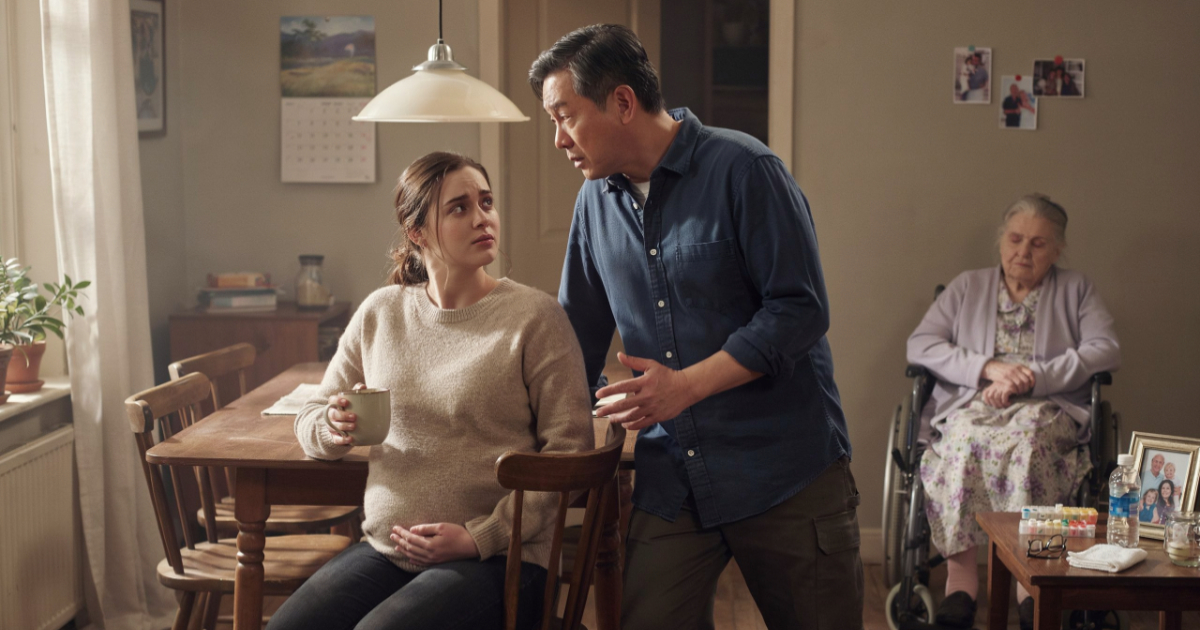 Father Chooses To Keep Supporting His Mother-in-Law, But Refuses To Help His Pregnant Daughter
My father’s voice cut through the room like a bell.
“Daniel, get Ava away from the door!”
Ethan froze.
Not because my father had shouted.
Because he had not shouted Ethan.
He had shouted Daniel.
For one endless second, nobody moved.
The pink balloons bobbed gently above the dessert table.
A ribbon curled off the edge of a gift bag.
Somewhere, a spoon slipped from someone’s hand and clinked against a saucer.
I looked at my husband.
His eyes were fixed on my father, wide with a kind of recognition I had never seen before.
Not fear.
Not guilt.
Recognition.
The stranger’s hand had stopped halfway inside her purse.
Her calm expression cracked, revealing a flash of panic that made everything around me sharpen—the two men outside the front door, my father’s pale face, Ethan’s arm stretched protectively in front of me.
“Dad,” I whispered.
“Why did you call him Daniel?”
My father swallowed, but his eyes never left the woman.
“Because that’s the name I knew him by.”
The room seemed to tilt.
Ethan turned slowly toward me.
His face carried all the dread of a man watching the happiest day of his life split open in front of everyone he loved.
“Ava,” he said quietly, “I can explain.”
The stranger laughed, but this time it sounded thin.
“Oh, now you can explain?” she said.
“That’s convenient.”
My father took one careful step forward.
“Leah,” he said to her, “take your hand out of your purse.”
My mother gasped.
The stranger’s eyes flicked toward him.
“You don’t know me.”
“Yes,” my father said.
“I do.”
And then he said the first thing that made the entire room understand this was bigger than a cheating scandal.
“You were twelve years old when your mother brought you to my office and asked me to help hide you.”
The woman’s face changed.
Not dramatically.
Not like in the movies, where villains crumble all at once.
It was smaller than that.
Her chin trembled.
Her shoulders lowered by half an inch.
Her hand slipped out of the purse.
She was holding an envelope.
No one breathed.
Ethan’s fingers brushed mine, and I realized he was shaking.
“Frank,” he said to my father, voice rough.
“You remember?”
My father looked at him with years of grief in his eyes.
“I never forgot.”
That was the moment the two men outside stepped inside.
One was tall with silver hair and a navy coat.
The other carried a folder against his chest.
Neither looked like a criminal.
They looked tired, official, and uncertain whether they were walking into a family disaster or a legal one.
The silver-haired man raised both hands slightly.
“No one here is in danger,” he said.
“My name is Martin Hale.
I’m an attorney.
This is my associate.”
My sister stepped in front of my mother.
“Then why are you standing outside someone’s baby shower like undertakers?”
Under different circumstances, I might have laughed.
Nobody did.
The attorney looked at me, then Ethan, then at the woman.
“Ms.
Whitaker asked us to accompany her in case Mr. Reed refused to identify himself.”
“Mr. Reed?” I repeated.
Ethan closed his eyes.
The stranger—Leah, apparently—looked down at her envelope.
“I didn’t know there would be a party,” she said, softer now.
“I didn’t know she was pregnant.
I swear I didn’t know.”
My hand moved instinctively over my belly.
The baby shifted beneath my palm, a tiny roll against the chaos.
That small movement steadied me more than anything else could have.
“Everyone stop,” I said.
My voice was not loud, but it cut through the room.
Maybe because I had spent seven years being told to wait, to hope, to endure, to try again.
Maybe because I had learned that panic never gave answers.
Maybe because I could feel my daughter inside me, and for the first time that day, I understood that I was not just a heartbroken woman.
I was a mother.
And a mother had to know the truth.
I looked at Ethan.
“Who is Daniel Reed?”
He took a breath that seemed to hurt.
“I was,” he said.
“A long time ago.”
The sentence landed gently, which somehow made it worse.
My mother reached for my father’s hand.
“Frank, what is going on?”
My father’s eyes shone.
“Maybe we should sit down.”
“No,” I said.
“No more deciding what I can handle.”
Ethan flinched.
I hated that I noticed.
I hated that even then, even with my heart pounding and my mind racing, I still cared whether my words hurt him.
“Tell me,” I said.
Ethan nodded once.
“My birth name was Daniel Reed,” he began.
“I haven’t used it since I was seventeen.
Ethan is my legal name.
I changed it when I aged out of a protection program.”
“A protection program?” my sister said.
The attorney glanced at my father, but did not interrupt.
Ethan’s gaze stayed on me.
“My mother was named Nora Reed.
She worked for a man who was involved in charity fraud—fake adoption grants, stolen donations, forged records.
When she found out, she tried to report him.
Before she could, our house burned down.”
A soft cry escaped someone in the room.
Ethan’s jaw tightened.
“My mother died.
I survived because a neighbor pulled me out.
But the people involved thought she had hidden documents somewhere.
They kept looking for me.
Social services moved me around for years, and a few people helped keep my location private.”
He looked at my father.
“One of them was Frank.”
I turned to my father.
His face was folded with remorse.
“You knew my husband as a child?”
“I knew a boy who had lost everything,” he said.
“I was a young caseworker then.
Your mother and I had just gotten married.
We wanted children, but we were still figuring out rent and bills and how to keep the roof from leaking in the kitchen.”
My mother gave a watery laugh through her tears.
My father continued, “Daniel was quiet.
Polite.
Too polite for a child who had suffered that much.
He never asked for anything.
Not toys.
Not sweeTS. Not even seconds at dinner when he was hungry.”
Ethan looked away.
I had seen that same restraint in him for seven years.
The way he apologized when grief made him quiet.
The way he rarely asked for comfort but always knew how to give it.
The way he could sit beside me through bad news and hold my hand without trying to fix what could not be fixed.
Suddenly, pieces of my husband rearranged into a shape I had never seen.
Not a liar.
A survivor.
“Why didn’t you tell me?” I asked him.
Ethan’s eyes came back to mine.
“I wanted to.
A thousand times.”
“But you didn’t.”
“No.”
“Why?”
His voice broke on the answer.
“Because being Ethan was the first life I ever had that didn’t start with someone else’s tragedy.”
The room went still again, but this silence was different.
Softer.
Heavy with understanding rather than accusation.
“I met you,” he said, “and you looked at me like I was whole.
Not like a file.
Not like a risk.
Not like a boy people had failed to protect.
Just me.
And then one date became two, and two became a life, and suddenly the truth felt like a door I couldn’t open without losing everything on the other side.”
My tears came then, quiet and hot.
“Ethan,” I whispered.
“I know,” he said quickly.
“I know that was wrong.
I know I should have trusted you.
I told myself I was protecting our peace, but maybe I was protecting my own fear.”
He took a step back, giving me space I had not asked for but desperately needed.
Leah covered her mouth.
The attorney cleared his throat gently.
“There is more,” he said.
My father looked at Leah.
“Is this about Nora’s sister?”
Leah nodded.
Ethan’s head snapped toward her.
“My mother had a sister?”
The question was so raw that every person in the room seemed to feel it.
Leah pressed the envelope against her chest.
“Yes,” she said.
“Her name was Maribel.
She was my mother.”
Ethan stared at her.
“No.”
“I didn’t know either,” Leah said quickly.
“Not until last year.
My mother passed away, and I found a box she had hidden in the lining of an old trunk.
Letters.
Photographs.
A birth announcement.
Newspaper clippings about the fire.”
Her eyes filled.
“And your name.”
Ethan looked as if the floor had dropped beneath him.
The attorney stepped forward.
“Maribel Reed spent most of her life trying to locate her nephew, but many records had been sealed for safety reasons.
She was also afraid that digging too publicly would put him at risk if the old associates resurfaced.”
My father nodded slowly, grief deepening the lines around his mouth.
“She called me once,” he said.
“Years ago.
Asked about Daniel.
I couldn’t tell her anything.
The rules were strict.”
Leah looked at my father.
“You told her he was alive.”
My father closed his eyes.
“Yes,” he said.
“I shouldn’t have.
But she was crying so hard.
All I said was that the boy survived and had people watching over him.”
Leah breathed shakily.
“That was enough for her to keep hoping.”
Ethan rubbed both hands over his face.
The velvet box he had given me sat unopened on the coffee table.
The cake remained uncut.
The room that had been filled with laughter now held a truth too large for any of us to carry gracefully.
I turned to Leah.
“Why come here like this?” I asked.
“Why lie about being his wife? Why say you were carrying his child?”
Her expression crumpled.
“I panicked.”
“That wasn’t panic.
That was cruel.”
“I know,” she said, and this time there was no defense in her voice.
“I know.
I’m sorry.”
She lowered herself carefully into the nearest chair, one hand on her belly.
“I’m due in three weeks.
My mother left instructions in her will.
She wanted me to find Daniel Reed and give him what she had saved.
Letters from Nora.
A few belongings.
And… a share of a family trust.”
The attorney nodded.
“Not a large fortune,” he said, “but significant enough that the court required identity verification.”
Leah continued, “We tried contacting you through old addresses.
Nothing worked.
Then we found your current name through a legal filing connected to the name change, but we weren’t sure it was you.
I came to see your face.
I thought if I confronted you, you’d react.”
“You thought accusing my husband in front of my family was a reasonable identification strategy?” my sister demanded.
Leah lowered her eyes.
“No.”
“Good,” my sister said.
“Because it was possibly the worst one available.”
A few nervous laughs fluttered through the room, then faded.
Leah looked at me.
“I was angry,” she admitted.
“My mother spent her whole life wondering about him.
She died with his baby photo under her pillow.
And when we found out he had built this beautiful life, I thought—unfairly—that he had forgotten us.”
Ethan’s voice was barely audible.
“I didn’t know you existed.”
“I know that now.”
The attorney opened his folder and pulled out a small photograph sealed in a plastic sleeve.
He offered it to Ethan.
Ethan hesitated before taking it.
I stepped closer, unable not to look.
The photograph showed a young woman with dark hair and kind eyes holding a little boy in blue pajamas.
The boy could not have been older than five.
His smile was shy, but unmistakable.
Ethan.
No.
Daniel.
My husband made a sound I had never heard from him before.
Not quite a sob.
Not quite a laugh.
Something in between, born from a place deeper than memory.
“She used to sing,” he whispered.
My father’s eyes filled.
“You remember?”
“Only pieces.” Ethan stared at the photograph.
“Her hands smelled like lemon soap.
She used to tap three times on my bedroom door before coming in.”
Leah opened the envelope with trembling fingers.
Inside was a folded piece of yellowed paper.
“My mother found this among Nora’s things,” she said.
“It was addressed to you.”
Ethan did not take it immediately.
Instead, he looked at me.
That small glance undid me.
Even with his past opening like a storm around him, he was asking silently whether I could stand beside him.
I wanted to be angry.
Part of me was.
A real part.
A wounded part.
Trust did not mend instantly just because the reason for the wound was understandable.
But love, real love, is not the absence of hurt.
It is what remains standing when hurt walks into the room.
I nodded.
He took the letter.
His fingers shook so badly that my father gently offered, “Would you like me to read it?”
Ethan shook his head.
“No,” he said.
“I can.”
He unfolded the paper.
The room became so quiet I could hear the hum of the refrigerator from the kitchen.
Ethan began to read.
“My darling Daniel,
If you are reading this, then someone kinder than the world found a way to bring my words back to you.
There are things I need you to know.
First, you were loved before you were born.
Before I held you, before I named you, before I knew whether your hair would curl like mine or your smile would come slowly like your father’s, I loved you.
Second, none of what happened was your fault.
Children sometimes grow up carrying questions that adults were too afraid or too broken to answer.
Put them down, my sweet boy.
They were never yours.
Third, there is a wooden bird in my sister Maribel’s trunk.
Your grandfather carved it when I was little.
I told Maribel to keep it safe until I could give it to you myself.
If I cannot, then let it be proof that you came from people who made beautiful things with their hands, even when life was hard.
And last, wherever you go, whatever name you choose, whoever you become, I hope you build a life full of ordinary miracles.
Toast that burns because you were laughing.
Rain on a roof when you are safe inside.
A hand reaching for yours in the dark.
A child, perhaps, who teaches you that love can begin again.
You are not the fire, Daniel.
You are what survived it.
Love always,
Mom.”
By the time Ethan finished, no one in the room was hiding their tears.
Even my sister, who considered crying in public a design flaw, had both hands pressed over her mouth.
Ethan folded the letter with impossible care.
Then he sat down on the edge of the sofa like his legs no longer trusted him.
I sat beside him.
For a moment, neither of us spoke.
The baby moved again.
Ethan felt it beneath my hand, and his face changed.
The past was still there.
So was the hurt.
So were the unanswered questions.
But so was our daughter.
Our ordinary miracle.
Leah watched us with an expression that looked painfully like regret.
“I’m sorry,” she said again.
“Ava, I’m so sorry.
I thought I was walking into a lie.
I didn’t understand I was stepping into a family.”
I looked at her belly.
“Is your baby okay?”
She blinked, startled by the question.
“Yes,” she said.
“A boy.”
Something softened in me despite everything.
“What’s his name?”
Her hand moved over her stomach.
“I was going to name him Oliver.
After my mother’s favorite book.”
Ethan looked up.
“My mother loved that book too.”
Leah nodded, tears slipping down her cheeks.
“They read it together.”
There it was—the first fragile thread between them.
Not trust.
Not yet.
But something.
My father exhaled, then looked at me with the face of a man who had kept a burden too long.
“Ava, there’s something I need to say.”
I braced myself.
He stepped closer, holding my mother’s hand.
“When you first brought Ethan home, I knew.”
My breath stopped.
Ethan turned sharply.
“You knew?”
“Not right away,” my father said.
“You were grown.
Your name was different.
But there was a scar on your wrist from the fire.
And the way you went still when someone dropped a glass in the kitchen.
I had seen that before.”
I remembered that night.
Our second month dating.
A glass had slipped from my hand and shattered.
Ethan had gone pale, then apologized six times for startling me, though I had been the one who dropped it.
My father’s voice thickened.
“I looked up the public part of the name-change record.
I confirmed enough to know.
But you were an adult.
It was your life.
Your story.
I told myself silence was respect.”
Ethan stood.
“You should have told me.”
My father nodded.
“Yes.”
“You should have told Ava.”
“Yes.”
My mother looked at him, wounded and stunned.
“Frank…”
“I know,” he whispered.
“I know.”
The room watched as my father, the steady man who fixed sinks and remembered birthdays and cried at old songs, let himself be seen as flawed.
“I was afraid,” he said.
“If I told Ava, she would ask questions.
If she asked questions, I might break confidentiality I had sworn to protect.
And if I told Ethan, I might force him to return to a name he had buried to survive.”
His eyes moved to me.
“But fear dressed as protection is still fear.
And today, it hurt the people I love most.”
That sentence settled over me like a hand on my shoulder.
Ethan looked at my father for a long time.
Then he said, “Did she suffer?”
The question came so softly that I almost missed it.
My father’s face broke.
“Nora?”
Ethan nodded.
My father answered with care.
“No.
The report said she lost consciousness from smoke quickly.
But, Daniel… Ethan… she got you out of your room first.
The neighbor found you on the porch wrapped in a quilt.
Your mother went back inside for the box.”
“The documents,” Ethan whispered.
“And your bird,” Leah said.
Ethan turned to her.
She reached into her purse again, slowly this time, and pulled out something wrapped in a faded cloth.
She placed it in his hands.
He unfolded it.
Inside lay a small wooden bird, polished smooth by time.
Its wings were spread as though caught in flight.
One side was darkened near the tail, a faint burn mark etched into the wood.
Ethan held it like it was breathing.
I touched his shoulder.
For seven years, I had watched my husband comfort me through losses we could name.
Now I watched him grieve a loss he had spent most of his life surviving without a name at all.
And strangely, in the middle of that grief, the baby shower began to feel less ruined.
It felt transformed.
The celebration had opened a door none of us knew was there.
Behind it were wounds, yes.
But also letters.
Family.
A carved bird.
A mother’s love reaching across decades to bless a child she never got to watch grow.
The attorney eventually suggested moving the legal matters to another day.
My sister insisted on taking everyone’s contact information “like a normal person instead of a dramatic doorstep ghost.” Leah managed a weak laugh.
The two men stepped outside to wait in their car.
Guests began drifting away after quiet hugs and whispered promises to call.
No one asked for gossip.
No one demanded explanations.
Maybe because every person there had felt the sacredness of what had unfolded.
My mother cut the cake anyway.
Not with ceremony.
Not with candles.
Just gently, as if sweetness might help us find our way back.
She handed Ethan the first slice.
He looked at it, then at me.
“I’m sorry,” he said.
I nodded.
“I know.”
“I should have told you.”
“Yes.”
“I was afraid you would look at me differently.”
“I do,” I said.
His face fell.
I took his hand.
“I see more of you now.”
His eyes filled again.
“But I’m hurt,” I added.
“And you don’t get to skip that part just because your reason makes my heart ache.”
“I won’t,” he said.
“I promise.”
“We rebuild honestly.”
“Yes.”
“No more locked rooms.”
“No more.”
I looked at the small wooden bird on the table between us.
“And tomorrow,” I said, “we talk about Daniel.”
He nodded slowly.
“Tomorrow.”
Then, after a pause, he gave me the velvet box.
“I wanted to give you this before everything happened.”
I opened it.
Inside was not jewelry.
It was a tiny silver locket shaped like a crescent moon.
Inside, engraved in delicate letters, was a name.
Mila Nora Hart.
My throat tightened.
“Nora?”
Ethan swallowed.
“I wasn’t sure whether you’d like it.
I thought maybe as a middle name.
I didn’t know why it came to me so strongly.
I kept hearing it in my dreams.”
Leah covered her mouth.
My father turned away, overcome.
I held the locket in both hands.
All those months we had searched baby name lisTS. All those evenings Ethan had rejected names kindly, patiently, always returning to Nora with a strange tenderness he could not explain.
Now we understood.
Memory had survived where history had vanished.
I pressed the locket against my chest.
“Mila Nora,” I whispered.
Our daughter kicked.
And for the first time all afternoon, everyone laughed.
Not loudly.
Not easily.
But truly.
Three weeks later, Leah called me from the hospital.
I almost did not answer.
Not because I hated her.
I didn’t.
But healing had made me honest enough to admit that forgiveness and closeness were not the same thing.
Leah had wounded me on one of the most vulnerable days of my life.
Her regret mattered.
Her apology mattered.
But trust would need time, patience, and better choices.
Still, when her name lit up my phone, I answered.
“Ava?” she said, breathless.
“I’m sorry to call.
I know I shouldn’t—”
“What happened?”
“It’s Oliver.
He’s fine.
I’m fine.
But the nurse asked about family medical history, and I realized…” Her voice cracked.
“I realized I don’t have anyone to call who shares this blood except Ethan.”
I looked across the nursery, where Ethan was assembling a crib with the solemn focus of a man defusing a bomb.
He saw my face and stood.
“It’s Leah,” I said.
“The baby’s coming.”
Ethan went still.
Then he reached for his coat.
At the hospital, Leah looked smaller than she had in my doorway.
Without the beautiful dress and practiced calm, she was just a frightened woman gripping the bed rail, her hair damp around her face.
When she saw Ethan, she began to cry.
“I’m sorry,” she said immediately.
He moved to her bedside.
“Not now,” he said gently.
“Breathe.”
She laughed through tears.
“You sound like my mother.”
Ethan smiled faintly.
“I wish I knew whether that’s good.”
“It is.”
Oliver Reed Whitaker was born at 2:17 in the morning, furious and pink and perfect.
When the nurse placed him in Leah’s arms, she looked at Ethan.
“Do you want to meet your cousin?”
The word cousin entered the room softly.
Ethan stepped forward.
He touched Oliver’s tiny hand with one finger.
The baby wrapped his entire fist around it.
Something in Ethan’s face opened.
I stood in the doorway, one hand on my own belly, and watched two branches of a broken family tree bend toward each other.
Not fixed.
Not whole.
But growing.
A month later, Mila Nora arrived during a thunderstorm.
Rain struck the hospital windows in silver sheeTS. Ethan held my hand through every wave, every breath, every trembling moment when pain and wonder blurred together.
When our daughter finally cried, the sound filled the room like sunrise.
The nurse placed her on my chest.
She was warm, slippery, furious, alive.
Ethan leaned over us, tears falling freely.
“Hi, Mila,” he whispered.
“We’ve been waiting for you.”
She quieted at his voice.
I looked at him then—my husband, Ethan Hart, once Daniel Reed, a man made of both hidden scars and stubborn tenderness—and I felt the last piece of my fear loosen.
He had not been perfect.
Neither had my father.
Neither had Leah.
But every person in our story had reached, at last, for truth.
And truth, painful as it was, had not destroyed us.
It had made room.
Two days after we brought Mila home, my father came over with a toolbox, though nothing was broken.
He stood awkwardly in the nursery doorway.
“I thought maybe a shelf,” he said.
I knew that tone.
It was my father’s way of asking forgiveness with a hammer in his hand.
Ethan looked at me.
I nodded.
Together, they mounted a small white shelf above the rocking chair.
On it, they placed the wooden bird, Nora’s letter sealed in a frame, and the silver locket.
My father stepped back.
“There,” he said.
Ethan looked at him.
“Thank you, Frank.”
My father’s chin trembled.
“For the shelf?”
“For keeping me alive in the ways you could.”
My father pressed a hand over his eyes.
“I wish I had done more.”
Ethan held Mila against his chest.
She slept with her cheek tucked under his chin, impossibly peaceful.
“You did enough for me to get here,” Ethan said.
My father looked at the baby, then at me.
And finally, after all those years of being the strong one, he wept.
My mother pulled him into her arms.
My sister pretended to inspect the shelf, then cried too.
Leah came by the following week with Oliver and a casserole she admitted she had purchased from a deli and transferred into her own dish.
“I’m trying,” she said.
My sister narrowed her eyes.
“At cooking or honesty?”
Leah smiled nervously.
“Both?”
That was the day we began again.
Not as one perfect family.
Perfect families, I learned, are mostly decorations people hang over complicated lives.
We became something better.
A family that told the truth.
A family that apologized without demanding instant absolution.
A family that left space at the table for old names, new names, and the people still learning how to answer to both.
Months passed.
Mila grew round-cheeked and curious, with Ethan’s serious eyes and my mother’s dramatic sneeze.
Oliver adored her with the baffled devotion of a baby who had no idea why everyone kept putting another baby beside him for photographs.
Leah and Ethan moved carefully around each other at first.
They met for coffee with me nearby.
They exchanged medical history.
Then stories.
Then photographs.
She brought him Maribel’s trunk one Sunday afternoon, and together we opened it in the living room.
Inside were letters tied with ribbon, a cracked music box, a stack of children’s books, and a recipe card for lemon biscuits written in Nora’s hand.
Ethan stared at it for a long time.
“She made these,” he said.
The next day, he baked them.
They burned.
Terribly.
Smoke curled from the oven, the fire alarm shrieked, and Ethan froze for half a second before I grabbed a dish towel and waved it beneath the detector.
Mila began crying.
Then Oliver began crying because Mila was crying.
Leah panicked and spilled flour across the counter.
My sister, who had arrived at exactly the wrong moment, looked around the kitchen and said, “Well, this is emotionally symbolic and also a health hazard.”
Ethan laughed.
At first softly.
Then harder.
Until he had to sit on the floor, laughing and crying while Mila wailed and I opened windows and Leah apologized to the biscuiTS.
Later, we tried again.
The second batch came out golden.
Ethan took one bite, closed his eyes, and whispered, “Lemon soap.”
I did not understand until he smiled.
“My mother’s hands.”
That evening, he wrote down the recipe again on a fresh card.
At the bottom, he added:
For Mila Nora, whose story began before any of us knew.
On Mila’s first birthday, we held another party.
This time, the house glowed with yellow flowers and paper birds.
My mother made punch.
My sister guarded the cake like a security professional.
My father carried Oliver around on his shoulders while Leah followed anxiously with a napkin.
Ethan stood beside me near the window, Mila on his hip.
“Do you ever think about that day?” he asked.
“The baby shower?”
He winced.
“Frequently.”
I looked around the room.
At my father laughing.
At Leah lighting a candle.
At Oliver clapping for no reason.
At the wooden bird on the shelf, its small wings lifted forever toward flight.
“Yes,” I said.
“But not the way I used to.”
“How do you think about it now?”
I leaned my head against his shoulder.
“As the day the door opened.”
He kissed the top of Mila’s head.
“A terrifying door.”
“Yes,” I said.
“But look what came through.”
Mila reached for the locket around my neck and tugged.
Ethan smiled.
“I’m still sorry.”
“I know.”
“Are we okay?”
I looked at him, really looked.
The man who had stood beside me through empty nurseries and negative tesTS.
The boy who had survived a fire and carried a name like a locked room.
The husband who had learned that love did not require hiding the broken places.
The father who sang old songs to our daughter without knowing where he had first heard them.
“We’re honest,” I said.
“That’s better than okay.”
Across the room, Leah lifted a glass.
“To Mila Nora,” she said.
Everyone turned.
Leah’s voice trembled, but she kept going.
“And to Nora Reed, who loved her son so fiercely that her love found him even after all these years.”
Ethan’s hand found mine.
My father raised his glass.
“To ordinary miracles,” he said.
The room echoed it back.
Ordinary miracles.
Burnt toast because we were laughing.
Rain on a roof when we were safe inside.
A hand reaching for ours in the dark.
A child who taught us love could begin again.
Mila leaned forward and planted a sticky kiss on Ethan’s cheek.
The candle flame flickered.
The room filled with applause.
And for once, when I closed my eyes to make a wish, I did not wish for the past to change.
I wished for all of us to keep choosing the truth, even when it trembled in our hands.
Then I opened my eyes, helped my daughter blow out her candle, and watched the whole room brighten.
THE END